
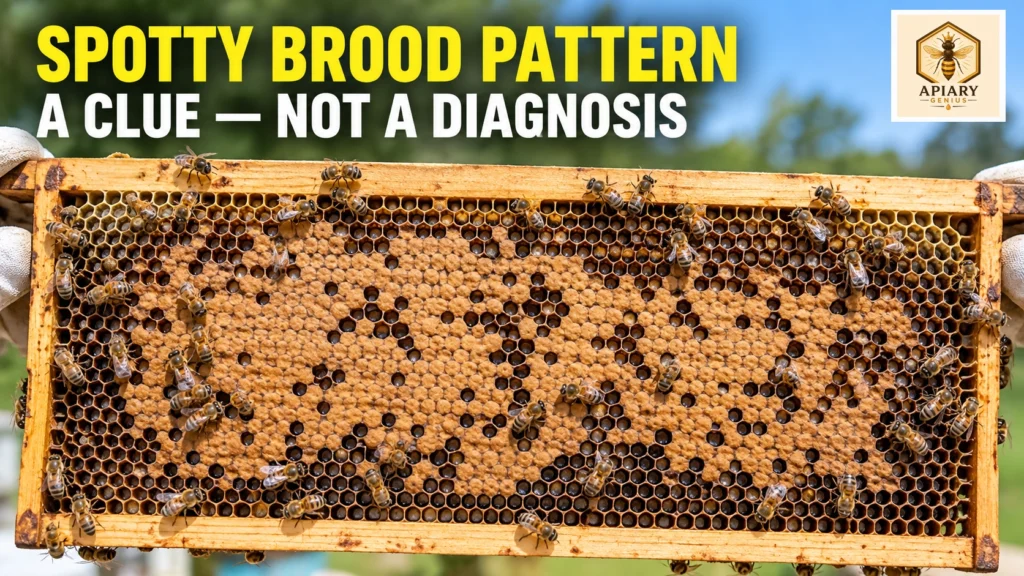
A spotty brood pattern can be unsettling. You pull a brood frame expecting a fairly continuous patch of capped worker brood, but instead you see scattered gaps, open cells, punctured cappings, or an irregular pattern that looks almost shotgun-like.
The important point is that the pattern itself does not tell you the cause.
A spotty brood pattern can be associated with queen performance, brood disease, Varroa and virus pressure, hygienic brood removal, genetics, colony stress, or normal differences in brood age. Some of the cells that appear empty may not be empty at all. They may contain eggs, young larvae, pollen, nectar, or brood that has recently been removed.
The useful question is therefore not simply, “Why is the brood spotty?” It is: What is happening inside and around those gaps?
Quick Answer
A spotty brood pattern is a warning sign to investigate, not a diagnosis. Before blaming the queen or treating for disease, inspect the apparent gaps closely. Determine whether they contain eggs, larvae, food, or truly empty cells. Then evaluate the surrounding brood, cappings, larval appearance, queen status, colony strength, Varroa history, season, and recent colony events.
A poor-looking capped brood pattern can occur for several reasons, and research has shown that brood pattern alone is not a reliable measure of queen quality. Research on brood pattern and queen quality
Spotty brood = clue. Not diagnosis.
Table of Contents
What Is a Spotty Brood Pattern?
A healthy area of worker brood often appears relatively continuous, with many neighboring cells containing brood of similar ages. Healthy capped worker brood generally has fairly uniform cappings, while occasional open cells may contain eggs, larvae, pollen, nectar, or simply be at a different point in the brood cycle. Penn State Extension
A spotty brood pattern occurs when numerous gaps interrupt what would otherwise appear to be a more continuous area of brood.
Beekeepers sometimes call this a shotgun brood pattern because capped cells may appear scattered among open ones.
That description tells you what the frame looks like. It does not tell you why it looks that way.
Brood can disappear at different stages. An egg may never develop normally. A larva may die before capping. A pupa may die beneath a capped cell and later be removed by workers. Alternatively, the cell may never have contained brood during that laying cycle.
That is why inspecting the cells themselves is more useful than judging the overall pattern from arm’s length.
Is a Spotty Brood Pattern Always a Problem?
No.
Some irregularity can occur normally, particularly when brood of different ages is present on the same frame, adults are emerging, the queen is expanding or reducing the brood nest, or cells within the brood area are being used for food storage.
Season also matters. Brood production changes as colony population, forage availability, weather, and reproductive activity change.
One unusual-looking frame should therefore be interpreted in the context of the entire colony.
However, a persistent or widespread poor brood pattern deserves investigation, especially when it appears together with abnormal larvae, suspicious cappings, colony decline, reduced adult population, high mite pressure, or other changes.
The pattern should make you inspect more carefully, not jump to a conclusion.
Look Inside the Empty Cells Before Diagnosing
One of the easiest mistakes is assuming every visible gap is an empty cell where brood failed.
Look closely.
A gap among capped brood may contain a tiny egg at the bottom, a very young larva surrounded by brood food, an older uncapped larva, pollen, nectar, or a cell recently cleaned by workers.
Penn State Extension notes that even within healthy worker brood, uncapped cells may contain eggs, larvae, nectar, or pollen. Penn State Extension
Good lighting is important. Tilt the frame so light reaches the bottom of the cells. Check several parts of the brood nest rather than inspecting only the most obvious patch.
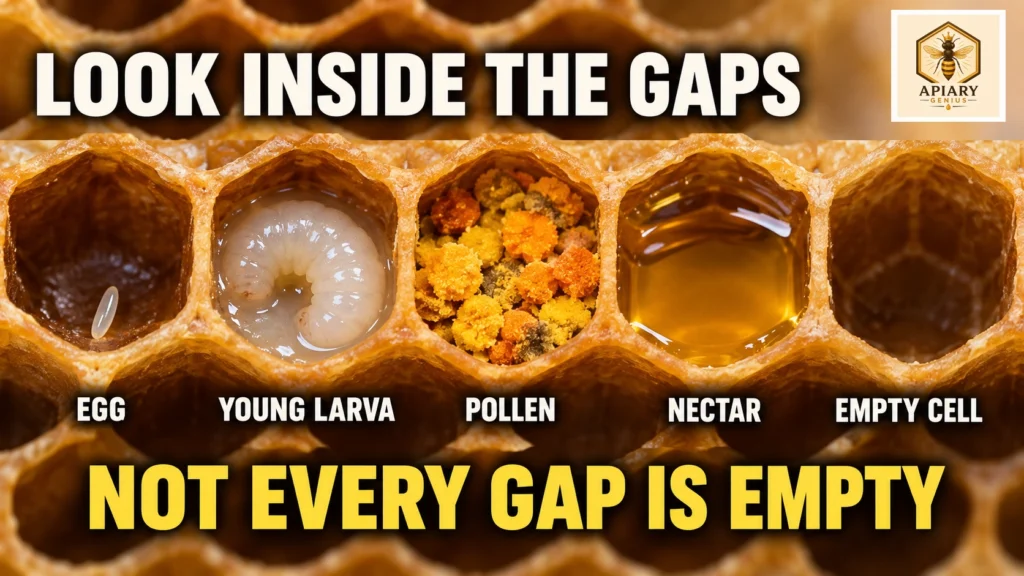
The distinction matters because different observations lead in very different directions.
| What you find in the apparent gap | What to investigate next |
|---|---|
| Egg or very young larva | The cell is part of the current brood cycle and may not represent brood failure |
| Nectar or pollen | Normal food storage may be interrupting the brood area |
| Clean, empty cell | Could reflect laying pattern, emergence, brood removal, or another interruption |
| Partly uncapped cell or damaged pupa | Consider hygienic removal, Varroa pressure, or brood disease |
| Discolored, collapsed, twisted, or otherwise abnormal larva | Investigate disease and colony-health causes |
| Mostly drone brood where worker brood would normally be expected | Investigate queen reproductive status or other laying abnormalities |
| Similar abnormalities across several brood frames | A colony-level problem becomes more concerning |
A beekeeper who looks only at capped versus uncapped cells can miss much of the diagnostic information already visible on the frame.
Could the Queen Be the Problem?
Yes, but not automatically.
A queen that is performing poorly can contribute to an irregular egg pattern, reduced worker brood production, or other reproductive problems. Poor mating, reduced sperm viability, queen age, and other health or colony-level factors can affect reproductive performance.
But the appearance of capped brood also reflects what happens after the queen lays the egg.
Developing brood can die or be removed because of parasites, pathogens, nutrition, environmental stress, genetic factors, or worker hygienic behavior.
That distinction is supported by research examining whether brood pattern can reliably indicate queen quality. Researchers found that queen-quality measurements did not consistently explain poor brood patterns. When queens from poor-pattern colonies were moved into colonies with better brood patterns, their subsequent patterns could improve, showing that colony environment can contribute substantially to the final appearance of capped brood. Study on brood pattern and queen quality
A queen-related explanation becomes more convincing when an irregular pattern persists across the brood nest and across inspections and is accompanied by other evidence of reproductive trouble.
If the colony has genuinely lost its queen or brood production is disappearing altogether, use the signs in How to Tell If a Beehive Is Queenless: Signs, Diagnosis, and What to Do Next rather than using a spotty pattern alone as proof.
Likewise, if you find unusual drone brood, multiple eggs, or other laying abnormalities, the problem may require distinguishing a reproductive queen problem from laying workers. See Laying Worker Bees vs. a Drone-Laying Queen: How to Tell the Difference.
Only after competing causes have been considered should requeening become the management question. If the evidence ultimately points toward queen performance, follow How to Requeen a Beehive: Step-by-Step Guide for Beginners.
Can Varroa and Viruses Cause Spotty Brood?
They can contribute to it, but spotty brood is not a Varroa test.
Varroa destructor reproduces in capped brood and is closely associated with damaging viral infections. As mite and virus pressure increases, developing brood may be damaged or die, and workers may uncap and remove affected brood.
Severely affected colonies can show what is often described as Parasitic Mite Syndrome, or PMS. Reported signs can include a poor or spotty brood pattern, abnormal larvae, uncapped or chewed pupae, deformed-wing symptoms, and a declining adult population. Penn State Extension — Viruses in Honey Bees
Notice that this is a combination of findings.
Seeing scattered empty cells does not establish Varroa as the cause.
Your interpretation should include the colony’s recent mite-monitoring history, whether mites have been managed effectively, whether brood looks abnormal, whether adult bees show virus-compatible signs, and whether the colony is losing strength.
If Varroa pressure is uncertain, investigate it directly rather than treating a brood pattern as a substitute for mite monitoring. See How to Control Varroa Mites: The Complete 2026 Guide for monitoring and management context.
When deformed wings or a broader Varroa-virus picture is present, Deformed Wing Virus in Honey Bees: Symptoms, Varroa Link, and Management explains that relationship in more detail.
When Brood Disease May Be the Cause
Several brood diseases can produce gaps because affected brood dies and workers remove it.
But empty cells alone do not diagnose a brood disease.
Look for disease-specific changes in the larvae, pupae, cappings, and remains.
American Foulbrood
American foulbrood, caused by Paenibacillus larvae, can create an irregular or spotty brood pattern, but suspicion should rise because of the additional brood changes, not because gaps exist.
Compatible findings can include sunken, darkened, or greasy-looking cappings, perforated cappings, brown decomposing brood, and firmly adhering scales in affected cells. Penn State Extension — American Foulbrood
Do not diagnose AFB solely because brood is spotty.
If multiple AFB-compatible signs appear, avoid moving suspect combs or equipment among colonies and promptly seek confirmation through the appropriate state apiary inspection, Extension, or diagnostic resources available in your area.
For the disease-specific guide, see American Foulbrood in Honey Bees: Symptoms, Diagnosis, and Management.
European Foulbrood
European foulbrood is different.
The disease commonly affects larvae before they are capped. Diseased larvae may lose their normal pearly-white appearance and become yellowish or brownish, shrunken, melted-looking, or twisted in their cells. UF/IFAS Extension notes that infected comb can appear spotty because some larvae survive to capping while others die and are removed. UF/IFAS Extension — European Foulbrood
That means the uncapped larvae themselves are particularly important.
If the gaps are surrounded by healthy-looking white larvae, the picture differs from one containing numerous discolored, twisted, or collapsed larvae.
See European Foulbrood in Honey Bees: Symptoms, Diagnosis, and Management when EFB-compatible brood is present.
Chalkbrood
Chalkbrood has a much more distinctive clue than a generic poor brood pattern: mummified larvae.
The fungus Ascosphaera apis can kill developing larvae, which eventually dry into hard, chalk-like mummies. They may be white, grayish, mottled, or dark as the fungus develops.
Workers removing infected brood can leave gaps in the brood pattern, but the presence of characteristic mummies is much more informative than the gaps themselves.
See Chalkbrood in Honey Bees: Symptoms, Causes, and Management if you find chalkbrood-compatible mummies.
Sacbrood
Sacbrood is caused by a virus and affects developing larvae.
Affected brood may be uncapped by workers, leaving an irregular pattern. A characteristic infected larva may appear elongated rather than normally curled and can develop a fluid-filled, sac-like appearance. Penn State Extension — Viruses in Honey Bees
Again, the abnormal larva, not the spotty pattern by itself, is the useful differentiating clue.
See Sacbrood in Honey Bees: Symptoms, Diagnosis, and Management if you find larvae that fit the disease picture.
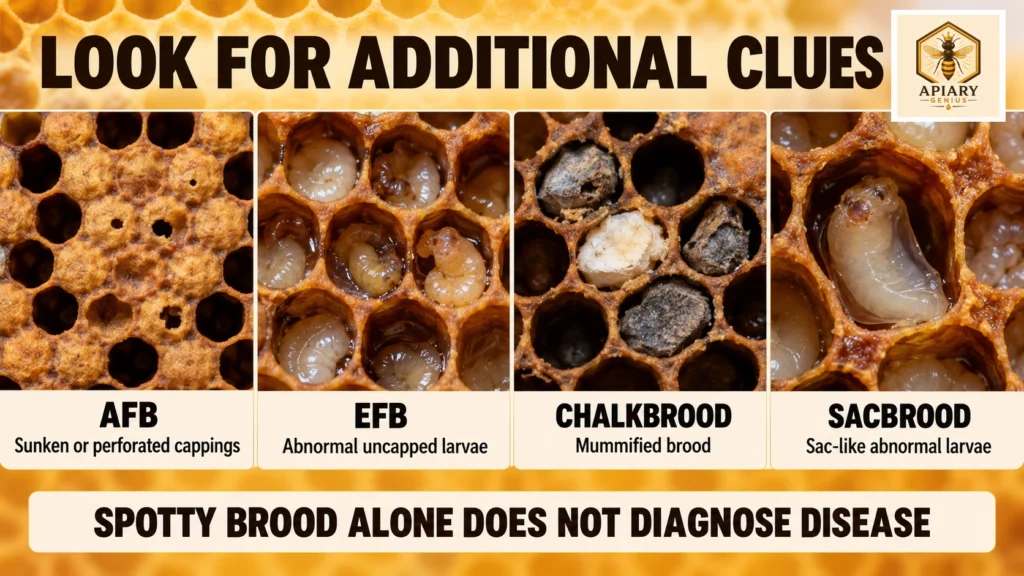
What the Cappings and Larvae Can Tell You
A brood frame contains far more information than the number of empty cells.
Healthy honey bee larvae are typically pearly white, moist or glistening, and curled in a C-shape at the bottom of the cell. Healthy capped worker brood generally forms fairly uniform cappings without widespread abnormal punctures or collapse. Penn State Extension
Now compare that with the questionable area.
Are larvae white and well formed, or yellow, brown, collapsed, twisted, stretched, dried, or mummified?
Are the cappings relatively uniform, or are many sunken, perforated, partly removed, or unusually dark?
Are workers opening isolated cells containing abnormal pupae?
Are adult bees emerging normally?
These observations help separate a simple pattern irregularity from active brood mortality.
Punctured or opened cells also require careful interpretation. Workers deliberately uncap and remove unhealthy brood as part of hygienic behavior. Hygienic colonies can detect and remove sick, damaged, dead, and, in specialized cases, mite-affected brood. Penn State Extension — Hygienic Behavior
That cleaning activity can itself leave visible gaps.
So a less-solid brood pattern is not automatically evidence that worker behavior is failing. In some circumstances, brood removal is part of the colony’s defense.
When Genetics Can Produce a Shotgun Brood Pattern
There is also a genuine genetic explanation for some shotgun-like brood patterns, but it should not be assumed to be the default cause.
Honey bee sex determination depends on the complementary sex determiner, or csd, system.
Normally, fertilized eggs that are suitably heterozygous at this locus develop as females. Under certain matings, a fertilized egg can become homozygous at the sex-determination locus and develop as a diploid male rather than a worker.
Workers detect and remove these diploid-drone larvae early in development. Research into the honey bee complementary sex-determination system describes this mechanism and the removal of diploid males. Cho et al. — Complementary Sex Determination in Honey Bees
Repeated removal can create conspicuous gaps and a shotgun-like appearance, particularly where genetic diversity is restricted or related matings increase the chance of matched sex alleles.
This mechanism is biologically real, but it does not mean that an ordinary colony with a spotty pattern should immediately be diagnosed with a sex-determination problem.
“Shotgun brood pattern” describes an appearance. Genetics is only one possible explanation for that appearance.
What to Check During the Inspection
Work from the cells outward.
First, identify what is actually inside the apparent gaps.
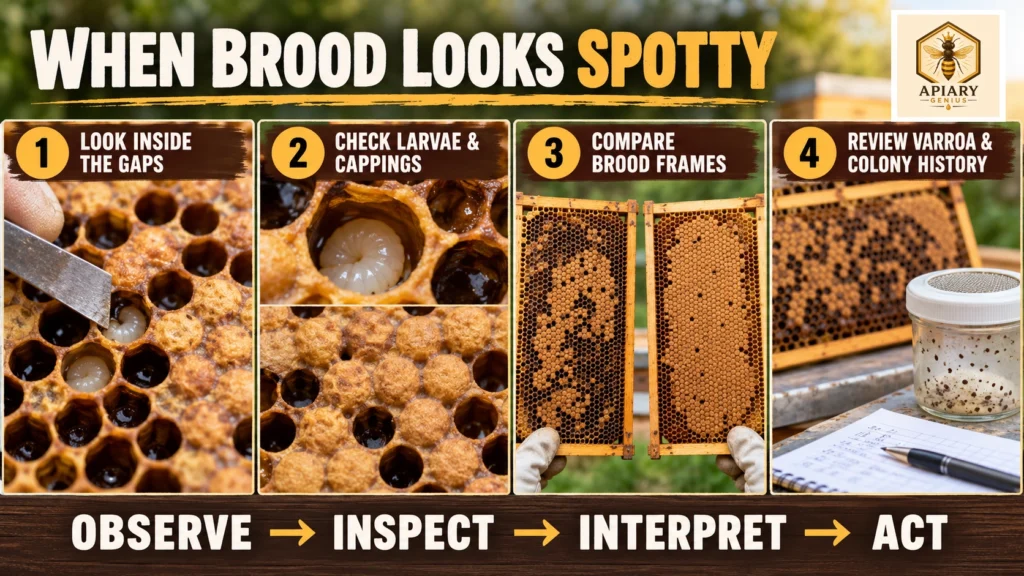
Then check:
- Eggs and young larvae
- Brood stage
- Consistency of brood ages
- Capped worker brood
- Cell cappings
- Larval color, position, and condition
- Drone brood
- Queen presence or other evidence of queen activity
- Colony strength
- Other brood frames
- Recent Varroa monitoring
- Previous mite-management history
- Disease-compatible signs
- Evidence of hygienic brood removal
- Recent swarming, splitting, requeening, or brood interruption
- Seasonal changes
- Recent nutritional or environmental stress
Compare more than one brood frame.
Look for a normal progression of eggs, larvae, capped brood, and emerging adults. Determine whether the irregularity is confined to one area or widespread throughout the brood nest.
Then step back to the colony level.
Is the adult population stable or declining?
Has the pattern persisted across inspections?
Did the colony recently swarm, split, receive a new queen, experience a brood break, or pass through a major seasonal change?
Finally, review Varroa history and disease-compatible signs.
The goal is not to force every clue into one diagnosis. More than one factor can be operating at the same time.
A colony could have a queen-related problem and high mite pressure. Brood disease can occur in a stressed colony. Hygienic workers may be removing brood affected by parasites or pathogens.
That is why a systematic inspection is more reliable than attaching a diagnosis to the first visible symptom.
What Not to Do
Do not immediately replace the queen because one frame looks irregular.
Do not treat randomly for Varroa or brood disease simply because gaps are present.
Do not diagnose American foulbrood or European foulbrood from empty cells alone.
Do not ignore eggs, larvae, pollen, nectar, or other contents inside the apparent gaps.
Do not judge one frame without comparing the rest of the brood nest, colony history, season, and recent inspections.
Do not assume every poor brood pattern has one single cause.
The spotty brood pattern is where the investigation begins, not where it ends.
When to Act Quickly
A spotty brood pattern by itself rarely tells you how urgent the problem is. The additional signs determine urgency.
Prompt investigation is warranted when irregular brood is widespread and worsening, the adult population is declining rapidly, numerous larvae or pupae look abnormal, Varroa pressure is clearly high or uncontrolled, or virus-compatible signs are appearing.
AFB-compatible signs deserve particular attention because American foulbrood is a serious infectious brood disease and management requirements can vary by jurisdiction.
Suspicious cappings, decomposing brood, or other characteristic signs should be investigated promptly rather than managed as an ordinary queen problem. Penn State Extension — American Foulbrood
The same principle applies to any rapidly deteriorating colony: gather evidence quickly, avoid spreading suspect material between hives, and seek experienced or professional diagnostic help when the cause remains uncertain.
FAQ
Is a spotty brood pattern always a sign of a bad queen?
No. Queen performance is one possible cause, but brood pattern also reflects whether developing brood survives after the egg is laid.
Disease, Varroa and viruses, hygienic brood removal, genetics, nutrition, colony conditions, season, and normal brood-stage variation can all affect the appearance of the frame.
Research has specifically shown that poor brood pattern alone is not a reliable indicator of queen quality. Read the study
Can Varroa cause a spotty brood pattern?
Varroa pressure and associated viruses can contribute to irregular brood and brood loss.
Severe mite-virus problems may be accompanied by abnormal larvae, uncapped or damaged pupae, deformed-wing signs, and colony decline.
A spotty pattern alone, however, does not diagnose Varroa. Check the colony’s actual mite-monitoring history and other signs.
What is a shotgun brood pattern?
A shotgun brood pattern describes capped brood interrupted by numerous open or missing cells, creating a scattered appearance.
The term describes the pattern, not a single cause.
Queen problems, brood mortality, disease, mite-related damage, hygienic removal, and specific genetic situations can all potentially produce gaps.
Can hygienic behavior make brood look spotty?
Yes.
Honey bee workers can detect and remove dead, diseased, damaged, or certain mite-affected brood.
That removal leaves empty or partly cleaned cells within otherwise capped brood and can make the pattern appear less solid.
Hygienic behavior is an important colony-level defense rather than automatically a sign of pathology.
How can you tell disease from a poor queen?
Do not use brood pattern alone.
Inspect what is in the gaps, the condition of uncapped larvae, the appearance of cappings, whether brood is being removed, the presence of disease-specific signs, Varroa history, eggs and young larvae, drone brood, colony strength, and how the pattern changes across multiple brood frames and inspections.
A queen problem becomes more plausible when poor reproductive performance persists alongside other queen-related evidence and competing causes have been investigated.
Should I requeen a hive with a spotty brood pattern?
Not from the pattern alone.
First determine whether the apparent gaps truly represent missing brood, examine the rest of the brood nest, evaluate Varroa and disease evidence, and consider colony history and season.
If the evidence eventually points toward persistent queen-performance problems and other important causes have been excluded, requeening may become an appropriate management decision.
Sources
Penn State Extension — Honey Bee Diseases: American Foulbrood
UF/IFAS Extension — Identification and Treatment of European Foulbrood in Honey Bee Colonies
Penn State Extension — Viruses in Honey Bees
Mississippi State University Extension — Managing Varroa Mites in Honey Bee Colonies
Penn State Extension — Varroa Mite Resistance: Testing for Hygienic Behavior