
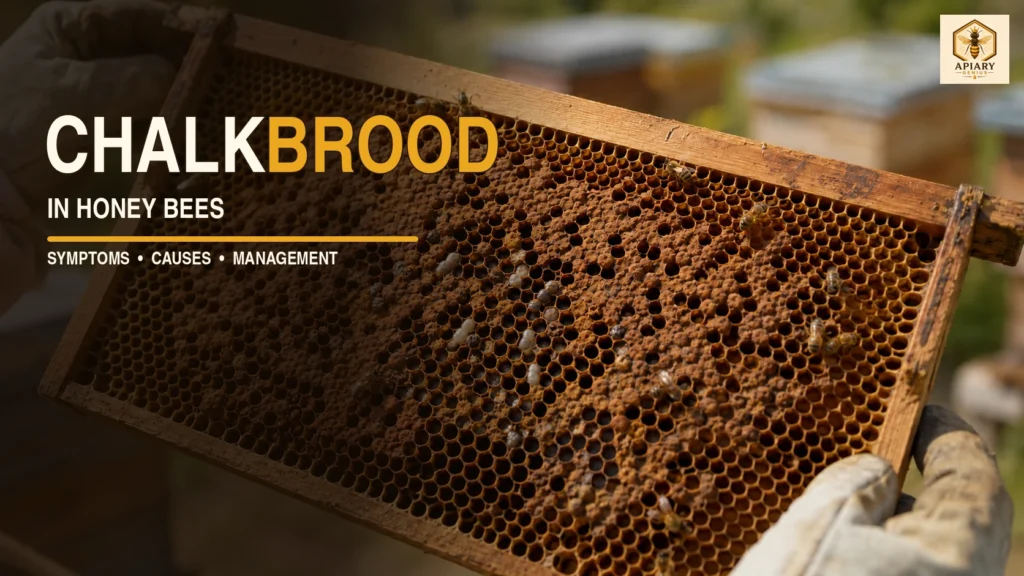
Finding small white, gray, mottled, or black objects in brood cells—or scattered across the bottom board and near the hive entrance—can be alarming. These hard, chalk-like remains may be chalkbrood mummies, one of the most recognizable signs of chalkbrood in honey bees.
Chalkbrood is a fungal brood disease caused by Ascosphaera apis. The fungus is the cause of the disease; cool weather, excess moisture, brood chilling, weak colony populations, nutritional pressure, and other stresses may influence how strongly the disease develops, but they do not create chalkbrood by themselves.
Many colonies experience only a mild or temporary case and recover as conditions improve. More persistent disease, however, can reduce the number of healthy emerging bees, slow colony buildup, and indicate that the colony is struggling to remove affected brood.
The practical response is not to reach immediately for a medication. First identify the suspected mummies, examine the brood pattern and overall colony condition, avoid spreading contaminated material, and correct management problems that may be favoring disease expression. Requeening or replacing heavily affected comb may be appropriate in some cases, but neither step is automatically required for every colony.
Table of Contents
What Is Chalkbrood in Honey Bees?
Chalkbrood is an infectious fungal disease of honey bee brood. It affects developing larvae rather than adult bees. Worker, drone, and queen larvae can be susceptible, although the disease is most often noticed in worker brood because that makes up most of the brood nest.
The disease gets its name from the firm, chalk-like remains produced after an infected larva dies and dries. These remains are commonly called chalkbrood mummies.
According to the USDA Agricultural Research Service’s overview of chalkbrood disease, affected brood may occur in sealed or unsealed cells, and diseased larvae are often found toward the outer areas of the brood nest. Worker bees may uncap affected cells and carry the mummies away, leaving them on the bottom board, at the entrance, or outside the hive.
Chalkbrood usually does not destroy an otherwise healthy colony. That does not mean it should be ignored. A serious or persistent infection can interrupt normal population buildup by killing larvae that would otherwise become adult workers.
Disease severity can vary considerably. One colony may show only a few mummies during a cool spring, while another may develop scattered brood, numerous affected cells, and repeated accumulations of mummies at the entrance.
What Causes Chalkbrood?
Chalkbrood is caused by the fungus Ascosphaera apis. This biological distinction matters because moisture, cold conditions, or colony stress are sometimes incorrectly described as the “cause” of chalkbrood.
Those conditions may favor infection, fungal development, or visible disease, but the pathogen itself is A. apis.
The fungus produces spores that can contaminate brood food, comb, hive debris, and equipment. Larvae may become infected after ingesting spores in food supplied by nurse bees. The spores germinate within the larva, after which fungal growth spreads through its tissues.
Adult bees may carry spores without developing chalkbrood themselves. They can move spores within the colony while feeding larvae, cleaning cells, handling infected material, or contacting contaminated comb.
The presence of spores does not guarantee that a colony will show severe symptoms. Disease expression depends on interactions among the pathogen, larval susceptibility, colony hygiene, genetics, brood-nest conditions, nutrition, worker population, and environmental stress.
This explains why two colonies in the same apiary may respond differently even when both have been exposed to the fungus.
Chalkbrood Symptoms and Warning Signs
The most characteristic symptom is the presence of hard, dry larval mummies. A beekeeper may find them:
- Inside sealed or unsealed brood cells.
- Loosely lodged in cells.
- On the bottom board.
- At the hive entrance.
- On the ground directly in front of the hive.
- Mixed with debris removed by worker bees.
Before the larvae have fully dried, infected brood may appear swollen and covered with white, cotton-like fungal growth. As the process continues, the remains shrink and harden into the familiar chalk-like form.
Other possible warning signs include:
- A spotty or irregular brood pattern.
- Perforated or partly removed cappings where workers are opening affected cells.
- Dead larvae standing more upright or stretched within cells.
- White, gray, mottled, brown-spotted, or nearly black mummies.
- Repeated accumulations of mummies after workers clean the comb.
- Reduced colony buildup when a large amount of brood is affected.
- A rattling sound when loose mummies move inside heavily affected comb.
A scattered brood pattern alone does not diagnose chalkbrood. Poor queen performance, brood chilling, other infectious diseases, pesticide injury, nutritional problems, and worker removal of unhealthy brood can all produce irregular brood.
The mummy itself is the more useful clue. Even then, the beekeeper should examine several cells and consider the entire colony rather than making a diagnosis from one unusual object.
What Do Chalkbrood Mummies Look Like?
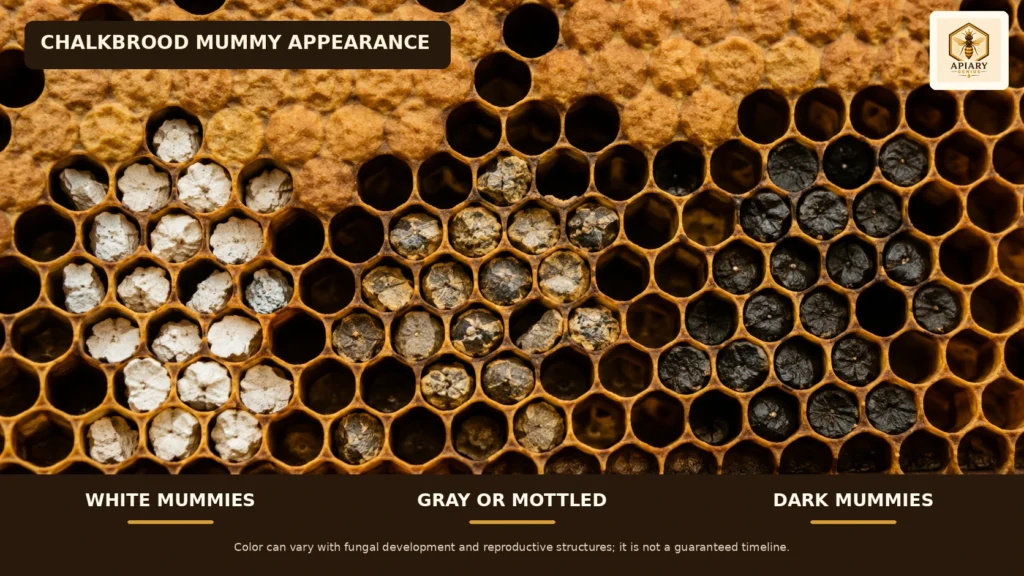
Chalkbrood mummies are dried, hardened remains of infected larvae. They commonly retain the elongated or slightly curved outline of a honey bee larva but feel firm rather than soft or decomposed.
White Mummies
White mummies consist mainly of dried larval remains covered by fungal mycelium. They may look like small pieces of white chalk or compacted cotton. Some have a yellowish or orange area near one end.
A white mummy should not automatically be interpreted as proof of a precisely timed “early stage.” Its appearance indicates fungal growth without the extensive dark reproductive structures visible in darker mummies, but individual mummies and colony conditions can vary.
Gray or Mottled Mummies
Some mummies develop gray, brown, or black speckling. The spots are associated with fungal reproductive structures. Mottling may be especially visible on parts of the mummy rather than covering its entire surface evenly.
Dark or Black Mummies
When compatible fungal mating types are present, reproductive structures can form and produce spores. The resulting mummy may appear dark gray or nearly black.
The University of Florida IFAS chalkbrood recommendations explain that dark coloration indicates the formation of fungal fruiting bodies and active reproduction. The USDA likewise identifies brown-to-black spots as fungal fruiting bodies or spore cysts.
Color should therefore be treated as biological information, not as a rigid clock. White, mottled, and dark mummies may be present in the same colony because larvae were infected under different circumstances or because reproductive development differed among mummies.
Unlike larvae decomposing from bacterial brood disease, fully formed chalkbrood mummies are usually dry, solid, and readily removable from the cell. They do not normally have the soft, melting, rope-like, or rubbery consistency associated with some other brood problems.
How Chalkbrood Develops in the Brood Nest
The disease cycle begins when a susceptible larva is exposed to viable Ascosphaera apis spores, commonly through contaminated brood food. Young larvae are particularly susceptible. The Texas Apiary Inspection Service identifies larvae around three to four days old as an important susceptible stage.
After spores are ingested, they can germinate in the larval digestive tract. Fungal filaments grow through the larva and eventually surround it with white mycelium. The infected larva dies, and the growing fungal mass fills much of the cell.
Visible fungal development is often noticed around or after the cell-capping period. Affected larvae can nevertheless be found in either capped or uncapped cells because workers may open cappings as they detect and remove diseased brood.
The fungal growth and dead larval tissue then dry and harden. If reproductive structures do not develop extensively, the mummy may remain mostly white. If reproductive structures form, it can become gray, mottled, or black and contain large numbers of spores.
The mummy may loosen inside the cell as it shrinks. Hygienic workers can uncap the cell, grasp the mummy, and carry it out of the hive. Colonies that remove affected brood efficiently may suppress visible disease more effectively than colonies that allow mummies to accumulate.
This cycle also explains why old contaminated brood comb can remain relevant. The USDA reports that A. apis spores can remain viable for years, allowing cells previously used for brood rearing to serve as a continuing source of exposure.
What Conditions Make Chalkbrood Worse?
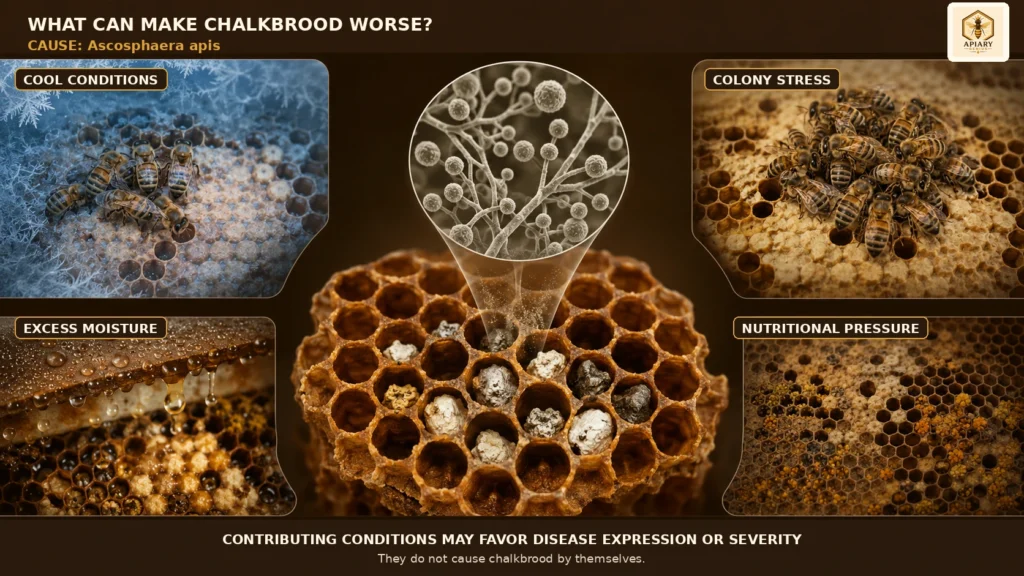
Ascosphaera apis causes chalkbrood. Environmental and colony conditions influence whether exposure remains inconspicuous or develops into obvious disease.
Cool Conditions and Brood Chilling
Chalkbrood is often noticed during spring buildup, when the brood area expands more quickly than the adult bee population can sometimes cover and warm it. Brood near the edge of the cluster may be especially vulnerable to temperature fluctuations.
Brood chilling does not produce the fungus. It may make larvae more susceptible or create conditions that favor fungal development.
Opening a hive for a long inspection during cool or windy weather can unnecessarily expose brood. If you are unsure when conditions are suitable, review the best time to inspect a beehive and keep disease-focused inspections efficient.
Moisture and Humidity
High moisture and inadequate air exchange may favor fungal development. Damp hive locations, water entering the hive, condensation, or equipment that retains excessive moisture can contribute to an unfavorable brood-nest environment.
The goal is not to maximize ventilation without regard to weather or colony strength. Excessive drafts can also interfere with brood temperature regulation. Correct water entry and persistent dampness, then match ventilation and entrance configuration to the climate and colony.
Colony Strength
A colony needs enough adult workers to feed larvae, maintain brood temperature, clean cells, and remove diseased brood. A small worker population caring for a rapidly expanding brood nest may struggle to perform all these tasks.
Weakness can also be a symptom of another problem. Check queen performance, food reserves, mite pressure, and signs of additional diseases rather than assuming every weak chalkbrood colony only needs better ventilation.
Nutrition and Other Stress
Poor or interrupted nutrition can reduce colony resilience, especially while brood production is expanding. If natural forage is inadequate, supplemental feeding may sometimes support colony growth, but it should address a genuine food shortage rather than be presented as a direct fungal treatment. Guidance on selecting and timing supplemental feed is available in the Apiary Genius guide to feeding bees.
Transportation, frequent disturbance, rapid hive expansion, queen problems, parasite pressure, and concurrent disease may also contribute to colony stress. These factors do not replace A. apis as the cause; they can affect the colony’s ability to resist or clear the infection.
How Chalkbrood Spreads Between Colonies
The infective material is associated primarily with fungal spores. These spores can move within and between colonies through several routes.
Inside a colony, nurse bees may transmit spores in brood food. Adult bees can also redistribute spores while cleaning infected cells, contacting mummies, or moving over contaminated comb and hive surfaces.
Between colonies, possible routes include:
- Moving contaminated brood comb or equipment.
- Transferring bees or brood from affected colonies.
- Reusing contaminated hive components without considering disease history.
- Drifting of adult bees between nearby colonies.
- Potentially, robbing activity involving affected colonies.
- Beekeeper tools, gloves, or handling practices that carry contaminated material.
- Introducing an infected colony or nuc into an apiary.
Not every exposure produces visible disease. Nevertheless, avoid transferring brood comb from an actively affected colony into a healthy colony merely to equalize strength. The University of Florida IFAS guidance specifically advises against moving combs from infected colonies to other colonies.
Use sensible apiary hygiene: work healthier colonies before suspect colonies when practical, remove visible mummies from hive debris, and clean hive tools and other reusable equipment after working an affected colony, following locally recommended apiary-hygiene practices. These steps reduce avoidable movement of spores without implying that every exposed item must automatically be destroyed.
How to Diagnose Chalkbrood
A suspected diagnosis begins with close observation.
First, inspect the objects themselves. True chalkbrood mummies are usually:
- Larva-shaped.
- Dry and firm.
- Chalk-like rather than wet or decomposing.
- White, gray, mottled, brown-spotted, or black.
- Present within brood cells or among material removed from the brood nest.
If the remains are soft, ropy, melted, foul-smelling, or tightly attached as scales rather than dry and easily removable, do not assume chalkbrood; another brood disease may be involved.
Next, inspect the brood comb. Note whether affected cells are concentrated near the brood-nest edges, scattered throughout the brood, capped, uncapped, or opened by workers. Check whether the colony is actively removing mummies.
Then assess the whole colony:
- Is the queen present or laying normally?
- Does the colony have enough workers to cover its brood?
- Are food stores adequate?
- Is the hive damp or receiving water?
- Has the weather recently been cool or unstable?
- Is mite pressure being monitored?
- Are there signs of another brood disease?
- Is the condition improving, stable, or becoming more extensive?
The presence of characteristic mummies often provides strong field evidence, but not every pale object or dead larva is chalkbrood. Laboratory methods can identify A. apis through examination of fungal structures, culture, microscopy, or molecular techniques. The peer-reviewed review of standard methods for fungal brood disease research describes methods used to identify and study chalkbrood.
Laboratory confirmation may be useful when:
- Mummies are not clearly formed.
- Several brood abnormalities are present.
- The appearance does not fit a typical case.
- American or European foulbrood cannot be confidently excluded.
- The colony is deteriorating despite management changes.
- A local inspector or veterinarian requests a sample.
When serious or regulated brood disease is possible, contact the appropriate local bee inspector, agricultural authority, diagnostic laboratory, or veterinarian before moving frames or equipment.
Chalkbrood vs. Other Brood Diseases
Chalkbrood has distinctive signs, but abnormal brood should never be diagnosed only by choosing the closest-looking photograph.
| Brood problem | Typical practical clues |
|---|---|
| Chalkbrood | Hard, dry, chalk-like larval mummies; white, gray, mottled, or dark; mummies may occur in cells, on the bottom board, or at the entrance. |
| American foulbrood | Often affects sealed brood; sunken or perforated cappings; brown, decomposed larval or pupal remains may become rope-like and later form tightly adhering scales. |
| European foulbrood | Commonly affects younger, mostly unsealed larvae; larvae may look twisted, displaced, yellowish, brown, melted, or poorly segmented rather than becoming hard chalk-like mummies. |
| Sacbrood | Affected larvae may form a fluid-filled sac and later dry into a curved scale resembling a small canoe or slipper; they are not typically solid fungal mummies. |
| Chilled or neglected brood | Dead brood may occur along brood edges following inadequate coverage or exposure, but the characteristic fungal mummy may be absent. |
The most important difference is consistency. Chalkbrood produces dry, firm mummies. Bacterial brood diseases more often involve discoloration and decomposition before dried remains form.
American foulbrood deserves particular caution because it can be highly consequential and legally regulated. Review the characteristic symptoms and required response in the guide to American foulbrood in honey bees.
European foulbrood can also create patchy brood and dead larvae, but affected larvae usually do not resemble hard pieces of chalk. The complete guide to European foulbrood symptoms, diagnosis, and management explains the differences in greater detail.
Disease regulations vary by country, state, province, and region. If the brood shows suspicious decomposition rather than recognizable dry mummies, stop transferring equipment and obtain local diagnostic guidance.
What to Do If You Find Chalkbrood in Your Hive
Finding a few suspected mummies does not require panic, but it does call for a structured assessment.
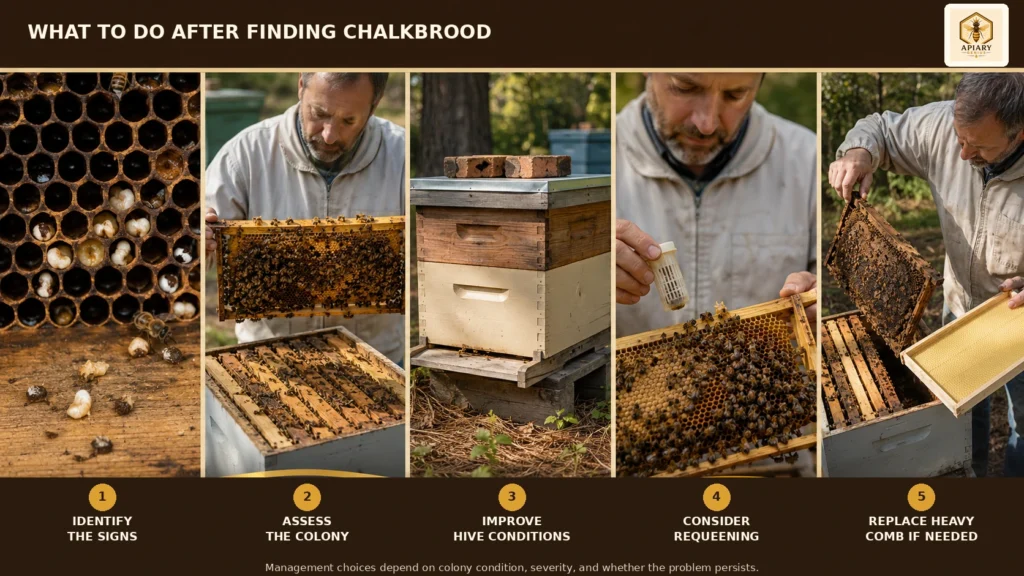
- Confirm what you are seeing. Examine several objects and compare their shape, firmness, color, and location with recognized chalkbrood signs.
- Inspect the brood pattern. Determine whether only a few peripheral cells are involved or whether mummies are widespread across multiple frames.
- Assess colony strength. Check the worker population, brood coverage, queen performance, food stores, and whether the population appears to be increasing or declining.
- Look for contributing conditions. Check for water entry, persistent dampness, a poorly selected hive position, inadequate adult coverage, recent brood chilling, food shortage, or excessive disturbance.
- Check for additional health problems. Chalkbrood can occur while a colony is also dealing with mites, queen failure, nutritional stress, or another disease. Continue appropriate monitoring, including evidence-based Varroa mite control.
- Remove accessible mummies and debris. Clean accumulated mummies from the bottom board and entrance without spreading them around the apiary.
- Avoid transferring suspect comb. Do not use affected brood frames to strengthen another colony.
- Correct practical hive problems. Stop leaks, improve drainage, address persistent dampness, and make management decisions appropriate to the local weather and colony strength.
- Monitor the trend. Record the number and distribution of affected frames, entrance debris, brood pattern, and population. Improvement over subsequent brood cycles is more informative than one isolated inspection.
- Seek help when the picture is unclear or severe. Contact a bee inspector or qualified diagnostic service if another brood disease is possible or the colony continues to decline.
Do not repeatedly dismantle the hive to remove every visible mummy. Excessive inspections can disturb the brood nest and worsen the environmental instability you are trying to correct.
Is There a Treatment for Chalkbrood?
There is no generally recommended or registered chemical medication for chalkbrood in the US guidance reviewed for this article.
The University of Florida IFAS, USDA Agricultural Research Service, Minnesota Department of Agriculture, and Texas Apiary Inspection Service all emphasize the absence of a recommended medication or chemical control and focus instead on colony and apiary management.
This means “chalkbrood treatment” is better understood as a management program:
- Strengthen the colony where practical.
- Correct genuine nutrition shortages.
- Reduce persistent moisture and water entry.
- Avoid brood chilling and unnecessary disturbance.
- Maintain appropriate hive volume for the worker population.
- Remove accumulations of mummies.
- Avoid transferring contaminated comb.
- Consider queen genetics and hygienic behavior.
- Replace heavily affected old brood comb when warranted.
- Monitor for other diseases and parasites.
Do not apply essential oils, household mixtures, unregistered fungicides, medications, supplements, or commercial products merely because they are promoted online as a cure. Laboratory antifungal activity or an unsupported testimonial does not establish that a product is safe, legal, or effective inside a honey-producing colony.
Product registrations and disease-control regulations vary by location. Beekeepers should always consult current local agricultural guidance before applying any substance inside a hive.
Should You Requeen a Colony With Chalkbrood?
Requeening can be useful, but it is not automatically necessary whenever a beekeeper finds chalkbrood.
Colonies differ genetically in their susceptibility and hygienic behavior. Workers from hygienic stock detect, uncap, and remove diseased brood more efficiently, helping reduce the number of mummies and contaminated remains in the brood nest.
Requeening may deserve serious consideration when:
- Chalkbrood remains persistent or repeatedly severe.
- Numerous mummies remain in cells.
- Workers appear slow to remove affected brood.
- The queen’s brood pattern or performance is also poor.
- Nearby colonies under similar conditions remain healthier.
- The current queen comes from stock with repeated disease problems.
- Management corrections have not produced improvement.
A new queen does not remove existing spores immediately. Her value is genetic: her future worker offspring may express stronger hygienic or disease-resistant traits. Improvement therefore depends on colony turnover and should not be expected overnight.
Choose a queen from a reputable source that selects for health, local suitability, and hygienic behavior. If requeening is appropriate, follow a controlled introduction process such as the one described in How to Requeen a Beehive.
A mild, improving spring case in an otherwise strong colony may resolve without replacing a productive queen. Base the decision on severity, persistence, colony performance, and genetics—not on the presence of one or two mummies.
Should You Replace Chalkbrood-Infected Comb?
Comb management should be proportional to the problem.
A colony with a few scattered mummies does not necessarily require the destruction of every brood frame. Workers may remove the affected remains, and the colony may recover after conditions improve.
Comb replacement becomes more relevant when:
- Many cells or frames are affected.
- Mummies repeatedly accumulate in the same old brood comb.
- The problem persists across seasons or returns frequently.
- Comb is very old, dark, damaged, or due for normal replacement.
- The colony has difficulty cleaning heavily affected cells.
Old brood comb can serve as a reservoir because fungal spores may remain viable for years. UF/IFAS recommends routine brood-comb replacement and warns against moving affected comb to other colonies. The Minnesota Department of Agriculture advises removing heavily infected combs.
Replace comb gradually unless immediate action is justified by severity or another disease diagnosis. Removing too much usable brood comb at once can create a different stress by forcing a weak colony to draw large amounts of new wax.
Do not assume that a general cleaning method validated for one bee pathogen will eliminate A. apis spores. Follow local apiary-health guidance for cleaning or disposing of heavily contaminated material, especially if chalkbrood is not the only suspected disease.
How to Prevent Chalkbrood
Complete prevention of exposure may not be realistic because A. apis is widespread and spores can persist. The practical goal is to reduce transmission and maintain colonies capable of suppressing visible disease.
Useful preventive practices include:
- Maintain strong colonies with enough adult bees to cover and care for brood.
- Use queens from healthy, hygienic stock.
- Avoid expanding the brood space faster than the colony can occupy and regulate it.
- Prevent rainwater from entering hive equipment.
- Position hives to avoid persistently damp, poorly drained locations.
- Manage ventilation according to local climate and colony needs.
- Avoid prolonged inspections in cool, wet, or windy conditions.
- Maintain adequate food reserves and respond appropriately to genuine shortages.
- Monitor Varroa and other health pressures instead of treating chalkbrood as an isolated problem.
- Rotate old brood comb as part of routine equipment management.
- Do not transfer actively affected comb into healthy colonies.
- Clean hive tools and reusable equipment after handling suspect material, following locally recommended apiary-hygiene practices.
- Reduce excessive drifting where practical through hive arrangement and orientation.
- Inspect new colonies, nucs, and transferred brood before integrating them into the apiary.
- Keep inspection records so recurring seasonal patterns can be recognized.
Good prevention does not mean attempting to keep a hive artificially warm or dry at all costs. Honey bee colonies regulate their own brood environment. The beekeeper’s role is to avoid management and equipment problems that overwhelm that ability.
Can Chalkbrood Come Back?
Yes. A colony that appears to recover can show symptoms again.
Recurrence may happen because viable spores remain in brood comb or hive material, because infected material is reintroduced, or because environmental and colony conditions again favor disease expression. A colony may look healthy during warm, favorable weather and show mummies during a later period of cool weather, rapid brood expansion, reduced adult population, nutritional pressure, or queen decline.
Recurrence does not automatically mean the earlier management failed. It should prompt the beekeeper to compare the new episode with previous records:
- Is it occurring during the same season?
- Are the same frames repeatedly affected?
- Has the colony population declined?
- Is the queen aging or performing poorly?
- Has the hive become damp?
- Has old brood comb remained in place?
- Are mite levels or other health pressures increasing?
- Does this colony show more disease than neighboring colonies?
Repeated disease despite improved conditions makes genetics, hygienic behavior, old contaminated comb, or an unresolved colony-health problem more important considerations.
Common Chalkbrood Management Mistakes
Calling Moisture or Cold “the Cause”
Moisture, cool conditions, and brood chilling can favor disease expression, but Ascosphaera apis is the pathogen that causes chalkbrood.
Treating Every Pale Larva as Chalkbrood
Look for the characteristic dry, firm mummy and evaluate the surrounding brood. Uncertain or decomposing brood may require professional diagnosis.
Searching Immediately for a Chemical Cure
Authoritative guidance does not identify a generally recommended chemical medication for chalkbrood. Unverified products may be ineffective, illegal, unsafe for bees, or inappropriate around honey.
Ignoring Other Colony-Health Problems
Poor queen performance, inadequate nutrition, Varroa pressure, weak population, and other brood diseases can coexist with chalkbrood.
Moving Affected Comb Into Another Colony
This can transport fungal spores and expose healthy brood. Do not equalize colonies using actively affected frames.
Requeening Every Affected Colony Immediately
Requeening is most useful when persistent disease, weak hygiene, poor brood pattern, or unsuitable genetics justify it. A mild temporary case may improve without queen replacement.
Destroying All Comb After a Light Case
Comb replacement should reflect severity, persistence, age, and contamination. Routine gradual replacement is different from removing every frame after finding a few mummies.
Opening the Hive Repeatedly to Remove Mummies
Frequent or prolonged inspections disturb the colony and may expose brood to unfavorable conditions. Observe efficiently, document the trend, and allow workers to perform hygienic removal.
Assuming Visible Improvement Means All Spores Are Gone
Symptoms can disappear while spores remain in the hive. Continue normal prevention, comb management, and colony-health monitoring.
Frequently Asked Questions About Chalkbrood
Is Chalkbrood Contagious?
Chalkbrood is an infectious fungal disease, and its spores can move within and between colonies. Contaminated comb, brood food, drifting, transferred equipment, and beekeeper handling may contribute to transmission. Robbing activity involving an affected colony may also contribute to spore movement. Exposure does not always result in severe visible disease.
Does Chalkbrood Affect Adult Bees?
The clinical disease affects developing brood rather than adult bees. Adult workers can nevertheless carry and distribute spores within the colony.
Can Chalkbrood Kill a Colony?
Chalkbrood usually does not kill an otherwise healthy colony directly. Severe disease can reduce emerging workers, slow population growth, and compound other health pressures.
How Do I Identify Chalkbrood?
Look for dry, hard, larva-shaped mummies in brood cells, on the bottom board, or near the entrance. They may be white, gray, mottled, brown-spotted, or black. Laboratory or inspector confirmation is appropriate when the signs are unclear or foulbrood cannot be excluded.
Why Are Some Chalkbrood Mummies Black?
Dark areas are associated with fungal reproductive structures and spores. Their formation depends on the reproductive development of the fungus, including the presence of compatible mating types. Color should not be used as a rigid measure of exactly how long a larva has been dead.
Is There a Chemical Chalkbrood Treatment?
The government and university sources reviewed for this article do not identify a generally recommended or registered chemical medication for chalkbrood in the United States. Management focuses on colony strength, hygiene, environmental conditions, genetics, and contaminated comb. Beekeepers outside the United States should consult current local regulations and agricultural guidance.
How Do You Get Rid of Chalkbrood?
There is no single instant cure. Confirm the signs, remove accumulated mummies, correct dampness or other stresses, maintain adequate nutrition and population, avoid spreading affected comb, monitor other health problems, and consider requeening or comb replacement when disease is persistent or severe.
Will Chalkbrood Clear Up on Its Own?
Mild cases often decline as weather and colony conditions improve. Do not rely only on waiting if the disease is extensive, the colony is weakening, or another brood disease may be present.
Should I Remove Chalkbrood Mummies From the Hive Entrance?
Yes. Removing accumulated mummies and debris can reduce contaminated material around the hive. Dispose of them rather than leaving them scattered around the apiary.
Do I Need to Report Chalkbrood?
Reporting requirements vary by jurisdiction. Chalkbrood is not regulated everywhere in the same way, but suspected American or European foulbrood may carry specific reporting and movement restrictions. Check with your local bee inspector or agricultural authority when the diagnosis is uncertain.
Final Thoughts
Chalkbrood is a fungal brood disease caused by Ascosphaera apis. Moisture, cool conditions, brood chilling, weak colony populations, nutrition, genetics, and other stresses may influence disease expression, but they are not the biological cause.
The key diagnostic clue is the chalkbrood mummy: a dry, firm larval remain that may be white, gray, mottled, or dark and may be found in brood cells, on the bottom board, or near the entrance.
Most mild cases do not justify drastic action. Confirm what you are seeing, assess the colony as a whole, correct contributing management problems, avoid moving affected comb, and monitor whether the condition improves. Persistent or severe chalkbrood may justify requeening with more hygienic stock, replacing heavily affected old brood comb, or obtaining professional diagnostic help.
A measured response based on identification, colony condition, and disease trend is more useful than an unsupported chemical remedy.
Sources
- USDA Agricultural Research Service — Chalkbrood Disease
- University of Florida IFAS Extension — Chalkbrood Recommendations
- Texas Apiary Inspection Service — Chalkbrood Disease
- Minnesota Department of Agriculture — Chalkbrood Disease
- Journal of Apicultural Research — Standard Methods for Fungal Brood Disease Research