
American foulbrood is one of the most serious bacterial diseases affecting honey bee brood. It can begin with only a few suspicious cells, yet contaminated comb, honey, tools, and hive equipment can carry Paenibacillus larvae spores and contribute to transmission within an apiary and between colonies.
For beekeepers, the challenge is not simply knowing what American foulbrood (AFB) looks like. Several brood problems can produce patchy brood patterns, dead larvae, or abnormal cappings. Recognizing warning signs is therefore only the first step. A responsible response also involves distinguishing suspicion from confirmation, limiting possible spread, obtaining appropriate diagnostic help, and following local disease-control requirements.
This guide explains what causes AFB, how to recognize its major warning signs, how it differs from European foulbrood, how diagnosis works, and what responsible management and prevention look like for beekeepers in the United States and Europe.
Table of Contents
What Is American Foulbrood?
American foulbrood, commonly abbreviated AFB, is an infectious bacterial disease of honey bee brood. It affects developing honey bees, particularly larvae and pupae, and is caused by the spore-forming bacterium Paenibacillus larvae.
The USDA Agricultural Research Service Bee Research Laboratory describes AFB as one of the most widespread and destructive brood diseases of honey bees. Infected colonies may initially show only a small number of affected cells, so the problem is not always dramatic when it first becomes visible.
Adult honey bees do not develop American foulbrood in the way susceptible brood does, but adult workers can carry and distribute spores. Their normal activities, including feeding larvae, cleaning cells, robbing, and moving between hive areas, can therefore contribute to transmission.
The seriousness of the disease comes largely from the biology of P. larvae. The bacterium forms highly resistant spores that can remain associated with contaminated hive materials and later infect susceptible larvae.
That makes AFB fundamentally different from a temporary brood problem that disappears when environmental conditions improve. Even when obvious clinical signs are absent, contaminated material may remain important in future transmission.
AFB is primarily a honey bee health and biosecurity problem. For beekeepers, the major concern is preventing contaminated material from exposing other colonies and apiaries.
What Causes American Foulbrood in Honey Bees?
American foulbrood is caused by Paenibacillus larvae, a spore-forming bacterium.
Infection begins when susceptible honey bee larvae consume food containing P. larvae spores. The spores germinate after entering the larva, and the bacteria multiply as the infection develops. The infected larva eventually dies, and enormous numbers of new spores can ultimately become associated with the decomposed remains.
Nurse bees can unintentionally contribute to transmission within the colony. When workers attempt to clean infected brood cells, they can encounter contaminated material and distribute spores elsewhere. Brood food can then provide a route by which spores reach additional susceptible larvae.
Why the spores matter so much
The spore-forming ability of P. larvae is central to understanding American foulbrood management.
Antibacterial drugs can act against susceptible bacterial activity, but they do not simply eliminate resistant spores from contaminated comb and equipment. This distinction explains why suppressing clinical disease and eliminating the underlying contamination risk are not the same thing.
The persistence of spores also makes used equipment an important biosecurity consideration. Frames and comb of uncertain disease history should not automatically be treated as harmless simply because no obvious brood symptoms are visible.
American Foulbrood Symptoms and Warning Signs
AFB symptoms can change as infected brood dies and decomposes, and not every colony will display every classic sign at the same time.
A beekeeper should therefore look for a combination of abnormalities rather than expecting one perfect textbook symptom.
Possible warning signs include:
- an irregular or spotty brood pattern
- darkened brood cappings
- sunken cappings
- perforated cappings
- moist or greasy-looking cappings
- brown or dark larval or pupal remains
- sticky or ropy remains in affected cells
- hard, dark scales adhering closely to cell walls
- a protruding pupal tongue in some affected cells
- an unusual or unpleasant odor in some cases
USDA guidance describes infected comb as potentially having a patchy appearance because healthy brood may occur alongside brood in different stages of disease and decomposition.
A spotty brood pattern alone, however, does not diagnose American foulbrood.
Poor brood patterns can have many possible causes, including queen problems, nutritional stress, other brood diseases, and pest or pathogen pressure. Beekeepers who are learning to evaluate brood health may also find it useful to review the Apiary Genius guide to the best time and conditions for inspecting a beehive so brood can be examined carefully without unnecessary disruption.
Odor should also be treated cautiously. Although AFB can produce a characteristic unpleasant smell, the absence of a strong odor does not rule the disease out, and smell alone should never be used to confirm it.
The same caution applies to other individual signs. A perforated capping or dark larval remain deserves attention, but the diagnosis should be based on the broader clinical picture and, where appropriate, additional testing or official inspection.
What Does American Foulbrood Look Like in a Hive?
The visual appearance of AFB depends partly on the stage of infection and decomposition.
A healthy brood area generally contains an organized pattern of developing brood. With AFB, the pattern may become increasingly irregular as infected brood dies and workers remove some affected material.
Changes in capped brood
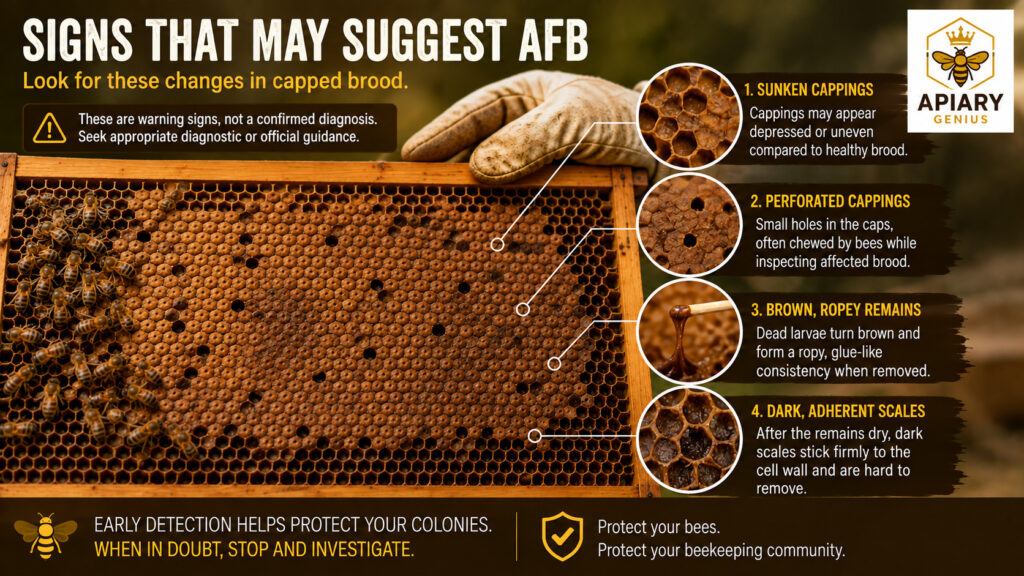
One of the classic presentations involves abnormal cappings over diseased brood.
The cappings may darken, become moist-looking, sink inward, or develop small holes as workers inspect or attempt to remove diseased brood.
According to USDA ARS, infected larvae commonly die after the cell has been sealed. As the dead larva decomposes and shrinks, the capping can become concave rather than retaining the normal appearance of healthy capped brood.
This tendency for classic AFB signs to appear in capped brood is useful during an inspection, but abnormal cappings are not unique to American foulbrood.
Changes in larval and pupal remains
The remains beneath suspicious cappings may change from the normal pearly white color toward cream, tan, brown, and eventually darker brown as decomposition progresses.
At certain stages, the material can develop the sticky consistency associated with the traditional ropiness test.
As the remains dry, they may form dark scales along the lower wall of the brood cell. A particularly important characteristic of classic AFB scale is that it adheres tightly to the cell wall and can be difficult to remove.
A protruding pupal tongue may occasionally be visible when a pupa dies from the disease, although its absence does not exclude AFB.
These findings are useful diagnostic clues, not permission to treat every dark cell, perforated capping, or dead larva as confirmed American foulbrood.
American Foulbrood vs. European Foulbrood
American foulbrood and European foulbrood are both bacterial brood diseases, but they are caused by different organisms and often produce different patterns in the hive.
AFB is associated with Paenibacillus larvae. European foulbrood (EFB) is associated with Melissococcus plutonius.
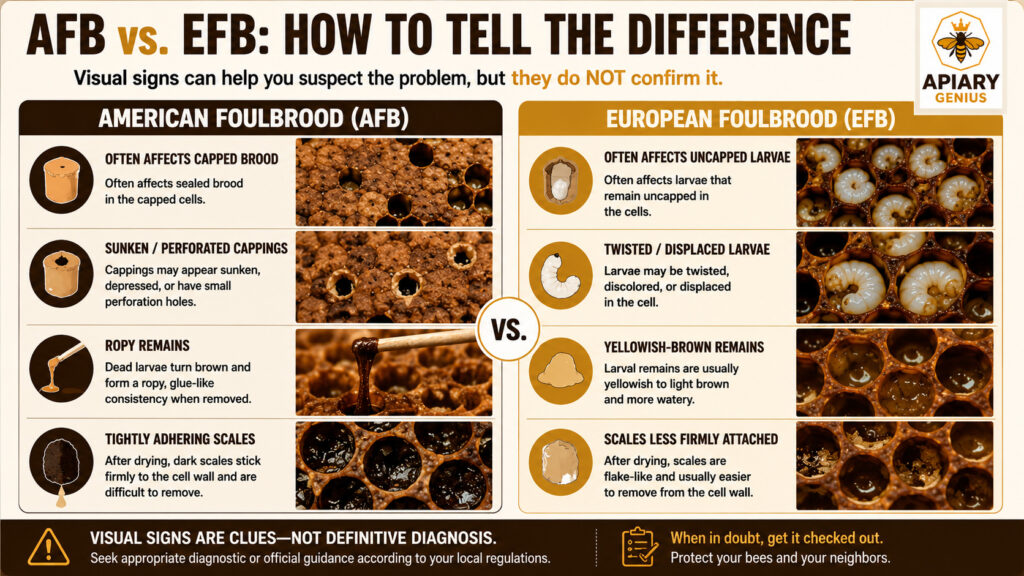
A useful practical distinction is the developmental stage at which diseased brood commonly becomes most obvious.
With classic AFB, infected larvae often die after their cells have been capped. This is why sunken, darkened, or perforated capped cells are strongly associated with the disease.
With European foulbrood (EFB), affected larvae more commonly die while cells are still uncapped. USDA ARS guidance on European foulbrood describes affected larvae as frequently appearing twisted in their cells or dying in abnormal positions. EFB remains may turn yellowish to brown and form scales, but those scales are generally more easily removed than the tightly adhering scales associated with AFB.
Consistency can also differ. Classic decomposing AFB remains may become sticky and ropy, whereas recently dead EFB larvae are not typically ropy.
In practical terms:
AFB more commonly suggests:
- problems associated with capped brood
- sunken or perforated cappings
- brown, sticky remains that may become ropy
- tightly adhering dark scales
- occasional protruding pupal tongues
EFB more commonly suggests:
- disease visible primarily in uncapped larvae
- larvae that appear twisted or displaced in their cells
- yellowish to brown collapsed larvae
- scales that are generally less firmly attached
- remains that are not typically ropy
These differences are useful, but they are not infallible.
Brood diseases do not always present exactly like photographs in a manual, and abnormal brood may result from conditions other than either foulbrood disease.
A beekeeper should therefore use these differences for differential identification, not as a substitute for confirmation when the diagnosis remains uncertain.
When the consequences of a diagnosis may include movement restrictions, destruction of contaminated material, veterinary decisions, or other regulatory action, diagnostic confidence matters.
How American Foulbrood Spreads Between Colonies
AFB spreads primarily through movement of P. larvae spores.
Inside an infected colony, workers attempting to clean dead brood can distribute spores. Contaminated material may then reach other susceptible larvae through brood food.
The problem becomes larger when contaminated material moves outside the colony.
Robbing
A severely weakened colony may become vulnerable to robbing.
Bees from stronger colonies can enter the weakened hive, collect contaminated honey, and carry spores back to their own colonies. USDA ARS identifies robbing and contaminated honey as important mechanisms through which AFB can spread.
This is one reason suspicious comb or honey should never be left exposed where bees from neighboring colonies can access it.
Drifting
Bees sometimes enter colonies other than their own. This behavior, known as drifting, can contribute to movement of pathogens and contaminated material within an apiary.
It should be viewed as one potential transmission pathway rather than the only or primary explanation for spread.
Contaminated frames and equipment
Moving frames, comb, boxes, or other contaminated hive materials between colonies can spread spores.
This is one reason randomly exchanging brood or food frames among colonies is risky when disease status is uncertain.
Used beekeeping equipment can present the same problem if its disease history is unknown.
Beekeeping tools and management
The beekeeper can unintentionally become a transmission route.
Hive tools, gloves, equipment, extracted comb, and other materials that move from a suspicious colony to healthy colonies without appropriate biosecurity can potentially move contamination as well.
Similarly, exposing bees to honey originating from an infected colony can create risk.
Good apiary management therefore means thinking not only about what is happening inside one hive, but also about everything that moves between hives.
How to Diagnose American Foulbrood
Diagnosis should begin with careful observation but should not necessarily end there.
Clinical signs can create a strong suspicion of AFB. Depending on the location and circumstances, further evaluation may involve an apiary inspector, an appropriate field diagnostic test, laboratory examination, culture, molecular methods, or another recognized diagnostic procedure.
USDA research has described diagnostic approaches for detecting and identifying P. larvae, including culture and molecular methods such as PCR.
An important distinction is that the meaning of a laboratory result depends on the sample, the diagnostic method, the clinical situation, and the disease-control system in that jurisdiction. Detecting P. larvae or its spores in a sample should not automatically be interpreted by an inexperienced beekeeper as equivalent to a complete clinical diagnosis in every circumstance.
The traditional ropiness test
One familiar field technique is the ropiness—or “rope”—test.
A small disposable stick or similar probe is inserted into suspicious brown brood remains and slowly withdrawn. Material affected by classic AFB may stretch into a sticky thread.
Penn State Extension describes ropiness as one of the characteristic diagnostic clues associated with the disease.
But the rope test has an important limitation:
It should not be treated as an infallible standalone diagnosis.
The appearance and consistency of diseased brood change over time. A suspicious colony may not produce the classic response at the exact moment it is examined, while unusual brood remains may also be misinterpreted by an inexperienced beekeeper.
If you perform any field manipulation of suspected diseased material, treat the probe and anything contacting that material as potentially contaminated.
Field diagnostic tests
Commercial field tests may be available in some regions and can provide additional evidence when used correctly.
Their availability, approved use, and role in an official diagnosis can vary by jurisdiction. Follow the manufacturer’s instructions and the requirements of the relevant bee-health authority rather than assuming that a home test automatically replaces official confirmation.
Laboratory or official diagnosis
When AFB is suspected, laboratory testing or inspection by an authorized bee-health professional can provide greater diagnostic confidence and may be required as part of an official disease-control process.
The exact system differs by country and region. In the United States, apiary inspection and disease-control programs vary by state. European requirements also differ among countries and jurisdictions.
The safest principle is simple:
Recognize suspicious signs yourself, but determine what confirmation and reporting process applies where your apiary is located before taking irreversible action.
What to Do If You Suspect American Foulbrood
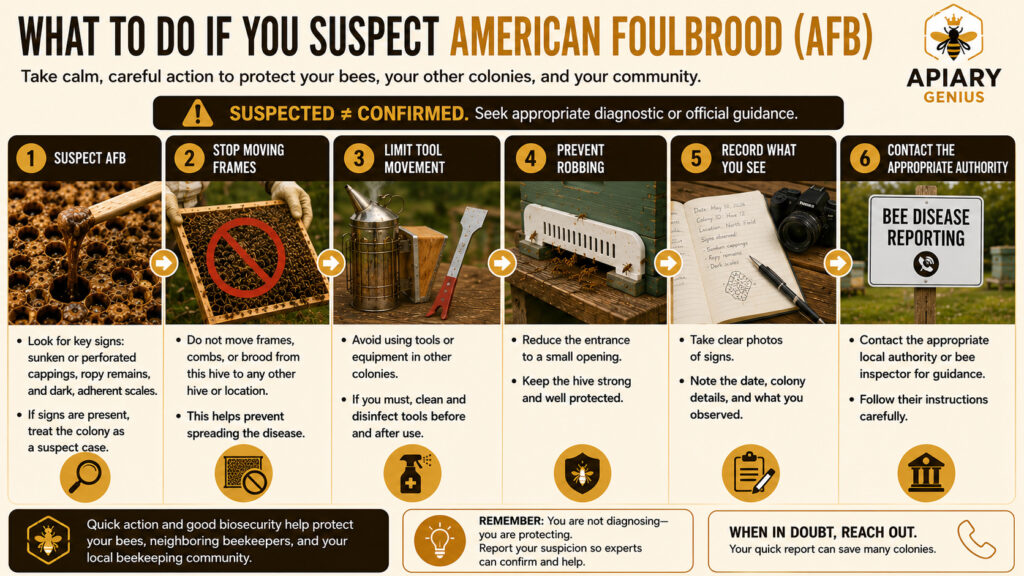
If you discover brood that strongly resembles AFB, avoid continuing your normal inspection routine as though nothing has happened.
The immediate objective is to reduce the chance of moving contaminated material while you determine what the problem actually is.
Stop moving hive material
Do not transfer suspicious brood frames, comb, honey, or other hive components into healthy colonies.
Avoid swapping equipment between colonies until the situation is clarified.
Limit tool movement
Treat hive tools, gloves, and other equipment used on the suspicious colony as potentially contaminated.
Do not immediately use them in another colony without following appropriate biosecurity guidance.
Reduce opportunities for robbing
Do not leave suspicious comb or honey exposed where other bees can access it.
Robbing can transform a problem in one colony into a wider apiary disease issue.
Record what you observed
Note which colony is involved and what you saw, including the location of suspicious brood and the type of symptoms.
Clear photographs may also be useful when seeking qualified advice, provided taking them does not require unnecessary manipulation of potentially contaminated material.
Contact the appropriate authority
Check the rules that apply to your location.
In some jurisdictions, suspected AFB must be reported. For example, official guidance for England identifies AFB as a notifiable disease and directs beekeepers who suspect foulbrood to contact the appropriate bee-health authority.
Scottish Government guidance on foulbrood likewise describes statutory controls applying to American foulbrood.
Do not assume those exact requirements apply everywhere.
U.S. requirements can differ by state, and requirements across Europe are not uniform.
Check your state, national, or regional agricultural, animal-health, or apiary authority and follow the instructions that apply where you keep bees.
Can American Foulbrood Be Treated?
This question requires an important distinction between controlling susceptible bacterial activity and eliminating P. larvae spores.
In the United States, FDA-approved antibiotics exist for the control of American foulbrood under veterinary oversight.
The U.S. Food and Drug Administration explains that approved antimicrobial drugs can be used for certain bacterial diseases of honey bees under applicable veterinary requirements.
But antibiotics do not eliminate the resistant P. larvae spores from contaminated hive materials.
That distinction is critical.
A colony can have clinical disease suppressed while contaminated comb and equipment remain a potential source of future infection. Medication therefore should never be interpreted as equivalent to sterilizing an infected hive or eliminating the spore reservoir.
Antibiotic use also raises regulatory and antimicrobial-resistance considerations. Research has documented antimicrobial resistance in P. larvae, reinforcing the importance of responsible veterinary oversight rather than routine or indiscriminate use.
For U.S. beekeepers, this article is not a drug-prescribing guide. Work with an appropriately licensed veterinarian and follow current FDA requirements, veterinary instructions, and product labeling.
Outside the United States, available medicines and legal approaches may be very different. Some jurisdictions manage confirmed AFB primarily through statutory disease-control measures rather than antibiotic treatment.
There is therefore no responsible universal answer of “give the colony this treatment.”
The correct management decision depends on diagnosis, local regulations, veterinary requirements where applicable, and the contamination status of the colony and its equipment.
What to Do With Infected Frames and Hive Equipment
AFB management becomes particularly difficult because spores can remain associated with contaminated comb and equipment.
Do not move frames from a confirmed or strongly suspected infected colony into another hive simply because some of the comb still looks usable.
Wax comb deserves particular caution because contaminated brood material, cell surfaces, and stored honey may contain spores. Depending on the jurisdiction, confirmed infected comb may need to be destroyed or handled according to an official disease-control program.
Other equipment may be treated differently.
Wooden hive bodies, frames, plastic components, tools, protective clothing, extraction equipment, and wax comb do not necessarily have the same approved decontamination options.
Bee-health authorities in different locations may permit or recommend different approaches. Depending on the material and jurisdiction, these may include destruction or approved decontamination methods, which may include specialized services such as irradiation where these are available and authorized.
What is appropriate depends on:
- the type of material
- the disease status of the colony
- available validated decontamination options
- local regulations
- instructions from the relevant disease-control authority
Do not improvise a chemical or heat-treatment recipe from general Internet advice.
Utah State University Extension discusses sanitation approaches for beekeeping equipment while emphasizing that methods effective against some hive pathogens are not necessarily effective against American foulbrood spores.
When AFB has been confirmed, obtain equipment-specific instructions from the relevant inspector, extension specialist, agricultural authority, or other qualified bee-health service before attempting reuse.
How to Prevent American Foulbrood
Prevention focuses largely on keeping P. larvae spores from moving into uninfected colonies.
Inspect brood regularly
Brood inspection helps identify abnormal patterns before a severely weakened colony becomes a larger source of contamination.
During routine inspections, look beyond the simple presence of eggs and larvae. Pay attention to brood uniformity, capping appearance, dead brood, unusual scales, and changes that cannot be readily explained.
A consistent inspection routine is easier to maintain when you understand when and how to inspect a beehive without unnecessarily disrupting the colony.
Be cautious with used equipment
Used frames and drawn comb are valuable, but their disease history matters.
Do not introduce equipment from an unknown or suspicious source simply because it looks clean. AFB spores are microscopic; visual cleanliness is not evidence that contaminated material is safe.
Where local inspection or bee-health services are available, seek appropriate advice before introducing questionable used equipment into your apiary.
Avoid exposing colonies to honey of uncertain disease status
Honey associated with an infected colony can contain P. larvae spores and can contribute to transmission when accessible to bees.
Avoid feeding colonies honey of uncertain disease status or leaving questionable honey and comb exposed where bees can rob it.
Practice sensible tool hygiene
Avoid carrying potentially contaminated brood material from hive to hive on tools, gloves, or equipment.
If a colony appears suspicious, change your normal workflow rather than inspecting every other hive with the same equipment.
Control robbing
Do not leave comb, honey, or syrup exposed around the apiary.
Keep colonies in suitable condition to defend themselves where possible, and respond promptly when a weak colony becomes vulnerable to robbers.
Consider overall colony health
Not every poor brood pattern is AFB.
Varroa mites and associated viral pressure can also contribute to unhealthy brood and colony decline. Maintaining an effective mite-management program—and knowing how to monitor and control Varroa mites—helps reduce competing health problems that can complicate brood assessment.
Good prevention is therefore partly disease-specific biosecurity and partly disciplined overall apiary management.
Can You Reuse Equipment After American Foulbrood?
Sometimes—but this question cannot be answered responsibly with a universal yes or no.
The first distinction is between comb and other hive equipment.
Comb associated with an infected colony is especially problematic because wax, brood remains, stored food, and cell surfaces can carry contamination. In jurisdictions where destruction is required for infected comb, attempting to save it would be inappropriate and potentially contrary to local disease-control rules.
Wooden hive components may have different options depending on local policies. Approved specialized decontamination methods may be available in some locations, while other regions may require or recommend destruction of particular materials.
Plastic components may not be suitable for exactly the same treatment methods as wooden equipment. Tools and protective equipment also require material-appropriate procedures.
Honey-processing equipment presents another situation because sanitation procedures must be both effective and appropriate for food-contact surfaces.
The important point is that “disinfect the hive” is not a single procedure.
Before reusing anything from a confirmed AFB colony:
- Identify exactly what material is involved.
- Determine whether local regulations allow reuse.
- Determine what validated decontamination methods apply to that material.
- Follow the relevant authority’s instructions precisely.
If an approved decontamination service is available locally, it may provide an option for certain equipment. But no procedure should be assumed effective against AFB spores unless reliable guidance specifically supports that use for the material involved.
Common American Foulbrood Management Mistakes
AFB is serious, but some of the greatest risks come from incorrect responses after suspicious brood is discovered.
Assuming one symptom proves AFB
A perforated capping, spotty brood pattern, or dead larva is not enough by itself to justify a definitive diagnosis.
Use visual signs to recognize a suspected problem and then follow the appropriate confirmation process.
Ignoring suspicious brood because there is no bad smell
Odor is inconsistent and should not be used as a screening requirement.
A colony can deserve further investigation without producing an obvious smell.
Treating a rope test as absolute proof
Ropiness is a valuable classic sign, but it belongs within a larger diagnostic picture.
Do not base irreversible management decisions solely on one field test.
Moving suspicious frames to another colony
Transferring brood or food frames from a questionable colony can move spores with them.
Until disease status is clarified, keep potentially contaminated material isolated.
Continuing inspections with potentially contaminated tools
Moving directly from a suspicious colony to healthy colonies with the same hive tool, gloves, or other contaminated equipment undermines apiary biosecurity.
Assuming antibiotics sterilize equipment
They do not.
Antibiotics may control susceptible bacterial activity under appropriate veterinary and regulatory conditions, but they do not eliminate resistant P. larvae spores from contaminated comb and equipment.
Automatically burning everything without checking local requirements
AFB management rules vary.
Destruction may be required or recommended in some circumstances and jurisdictions, but beekeepers should not make major regulatory or colony-management decisions from generalized online advice alone.
Contact the relevant authority when AFB is suspected or confirmed and determine what applies to your location and equipment.
Reusing equipment because it looks clean
AFB spores are microscopic. A beekeeper cannot establish that contaminated equipment is safe simply by looking at a box or frame.
Known disease history and validated decontamination procedures matter more than surface appearance.
Frequently Asked Questions About American Foulbrood
What causes American foulbrood?
American foulbrood is caused by Paenibacillus larvae, a spore-forming bacterium that infects susceptible honey bee larvae.
Does American foulbrood affect adult bees?
Clinical American foulbrood affects developing brood rather than adult honey bees.
Adult workers can nevertheless carry and distribute P. larvae spores within a colony and potentially between colonies, making them important in disease transmission.
What are the most recognizable American foulbrood symptoms?
Classic warning signs include an irregular brood pattern, dark or sunken cappings, perforated cappings, brown decomposing brood, ropy remains, and tightly adhering dark scales. A protruding pupal tongue may occasionally occur.
No single symptom should automatically be treated as definitive confirmation.
Is a spotty brood pattern proof of AFB?
No.
Many colony problems can produce irregular brood. Queen performance, other brood diseases, Varroa-associated health problems, nutritional stress, and additional colony-health problems should remain part of the differential assessment.
Is American foulbrood the same as European foulbrood?
No.
AFB is caused by Paenibacillus larvae, whereas EFB is associated with Melissococcus plutonius.
AFB more commonly produces obvious disease in capped brood, while EFB commonly affects larvae before capping. These tendencies are useful for differential identification but should not be treated as infallible diagnostic rules.
What is the rope test for American foulbrood?
The traditional ropiness test involves inserting a small disposable probe into suspicious decomposing brood and slowly withdrawing it. Classic AFB remains may stretch into a sticky thread.
The result is a diagnostic clue, not a substitute for the broader clinical picture or appropriate confirmation.
Can American foulbrood be cured with antibiotics?
Antibiotics may be legally used to control AFB in some jurisdictions, including under veterinary oversight in the United States, but they do not eliminate P. larvae spores from contaminated comb and equipment.
That is why antibiotic suppression of disease should not be confused with eradication of the contamination risk.
Do I have to report American foulbrood?
That depends on where you keep bees.
AFB is legally notifiable in some jurisdictions. England and Scotland, for example, operate statutory controls for foulbrood. Requirements in the United States vary by state, and rules elsewhere in Europe vary by jurisdiction.
Check with your local agricultural, animal-health, or apiary authority.
Should I burn a hive with American foulbrood?
Do not make that decision solely from a web article or a single suspicious symptom.
Destruction of infected colonies, comb, or equipment is part of AFB control in some jurisdictions and circumstances, but the appropriate action depends on disease confirmation, local rules, available approved decontamination options, and instructions from the responsible authority.
Can I reuse boxes from an infected colony?
Possibly, depending on the material, local regulations, and availability of a validated and approved decontamination method.
Do not assume that a procedure suitable for wooden equipment is suitable for wax comb, plastic components, tools, or other materials. Seek equipment-specific guidance after confirmation of the disease.
Can AFB spread through honey?
Honey associated with an infected colony can contain P. larvae spores. Robbing and exposure of bees to contaminated honey can therefore contribute to transmission.
Avoid feeding bees honey of uncertain disease status or leaving potentially contaminated honey accessible to colonies.
Can a colony look healthy and still present an AFB risk?
Clinical disease can begin with relatively few affected cells, and contamination is not always obvious during a quick inspection.
That is one reason disease history, careful brood inspection, and caution with used equipment are important.
Final Thoughts
American foulbrood deserves a careful response because the disease combines two difficult characteristics: it can initially be easy to overlook, and its bacterial spores can persist in contaminated hive material.
The most useful skill for a beekeeper is therefore not memorizing one “perfect” AFB symptom. It is learning to recognize combinations of suspicious brood signs, understand the limits of visual diagnosis, and respond in a way that does not spread potentially contaminated material.
If you see sunken or perforated cappings, abnormal brown brood remains, tightly attached scales, ropiness, or other unexplained brood abnormalities, treat the situation seriously—but distinguish suspected AFB from confirmed AFB.
Stop unnecessary movement of frames and equipment, protect other colonies from robbing and cross-contamination, and determine what diagnostic and reporting process applies where you keep bees.
Responsible AFB management is ultimately about more than one colony. Good diagnosis, biosecurity, regulatory compliance, and careful handling of contaminated equipment help protect the rest of the apiary and reduce the risk of carrying a persistent brood pathogen into future colonies.
Sources
- USDA Agricultural Research Service — American Foulbrood Disease
- USDA Agricultural Research Service — European Foulbrood Disease
- Penn State Extension — Honey Bee Diseases: American Foulbrood
- U.S. Food and Drug Administration — Helping Agriculture’s Helpful Honey Bees
- U.S. Food and Drug Administration — Using Medically Important Antimicrobials in Bees: Questions and Answers
- USDA Agricultural Research Service — Diagnosis of American Foulbrood Disease in Honeybees
- Utah State University Extension — Cleaning and Sterilizing Beekeeping Equipment
- UK Government — Honey Bees: Protecting Them From Pests and Diseases
- Scottish Government — Foulbrood