
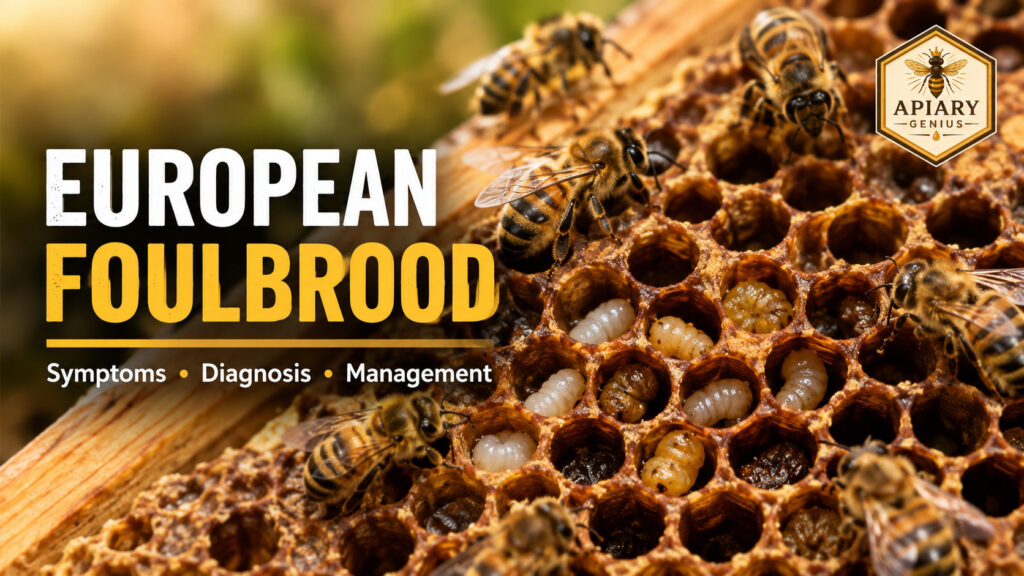
European foulbrood is a bacterial disease of honey bee brood that can range from a limited, temporary problem to a serious colony-health issue. For beekeepers, the challenge is not simply recognizing abnormal larvae. It is knowing which signs raise suspicion, what other problems can look similar, when confirmation is needed, and how to respond without spreading disease through the apiary.
European foulbrood, commonly abbreviated EFB, is caused by Melissococcus plutonius. Visual signs can provide important clues, but they are not enough to justify assuming that every abnormal brood pattern is EFB. American foulbrood, sacbrood, chalkbrood, Varroa-associated problems, nutritional stress, queen problems, and other colony-health issues can also produce unhealthy or irregular brood.
Responsible management therefore follows a logical sequence: recognize suspicious signs, limit opportunities for spread, confirm the diagnosis when appropriate, consider the condition of the entire colony, and then choose management measures that comply with local regulations.
Table of Contents
What Is European Foulbrood?
European foulbrood is an infectious bacterial disease affecting honey bee larvae. It can affect colonies with very different levels of severity. Some colonies show relatively limited clinical disease and recover as conditions improve. Others develop extensive brood loss, weakening, or recurring disease that requires active intervention.
EFB should not be thought of simply as a milder form of American foulbrood. They are distinct diseases caused by different bacteria and have important differences in their biology, typical presentation, persistence, diagnosis, and management.
According to the USDA Agricultural Research Service overview of European foulbrood, EFB is often most noticeable during periods of intense brood rearing, particularly in spring, although disease activity can occur outside that pattern.
The condition of the colony matters. Clinical signs may become more apparent when brood-rearing demands are high relative to available resources, while symptoms may decline as colony conditions and forage improve.
That variability is one reason beekeepers should evaluate both the brood itself and the larger colony context.
What Causes European Foulbrood in Honey Bees?
EFB is caused by Melissococcus plutonius.
Young larvae become exposed when contaminated food is fed to them by nurse bees. The bacterium multiplies in the larval gut and competes with the developing larva for nutrients. Affected larvae commonly die before their cells are capped, although some can survive until after capping.
An important distinction is the difference between infection and visible clinical disease.
The presence of the pathogen does not mean every colony will show identical symptoms or suffer the same outcome. Colony strength, brood-rearing pressure, food availability, hygienic behavior, and other stressors can influence whether infection develops into obvious disease.
EFB therefore should not be reduced to a simple formula in which exposure automatically produces a predictable visual pattern.
European Foulbrood Symptoms and Warning Signs
European foulbrood symptoms are usually detected during a brood inspection rather than by observing adult bees at the hive entrance.
A beekeeper may first notice that the brood no longer looks healthy and uniform.
Common warning signs can include:
- a patchy or irregular brood pattern
- larvae lying in abnormal or twisted positions
- larvae losing their normal pearly-white appearance
- yellowish, brownish, or gray-brown discoloration
- larvae that appear deflated, collapsed, or melted
- visible tracheal structures in affected larvae
- dried larval remains that may form relatively loose scales
- an unusual odor in some heavily affected colonies
None of these signs should be treated as individually diagnostic.
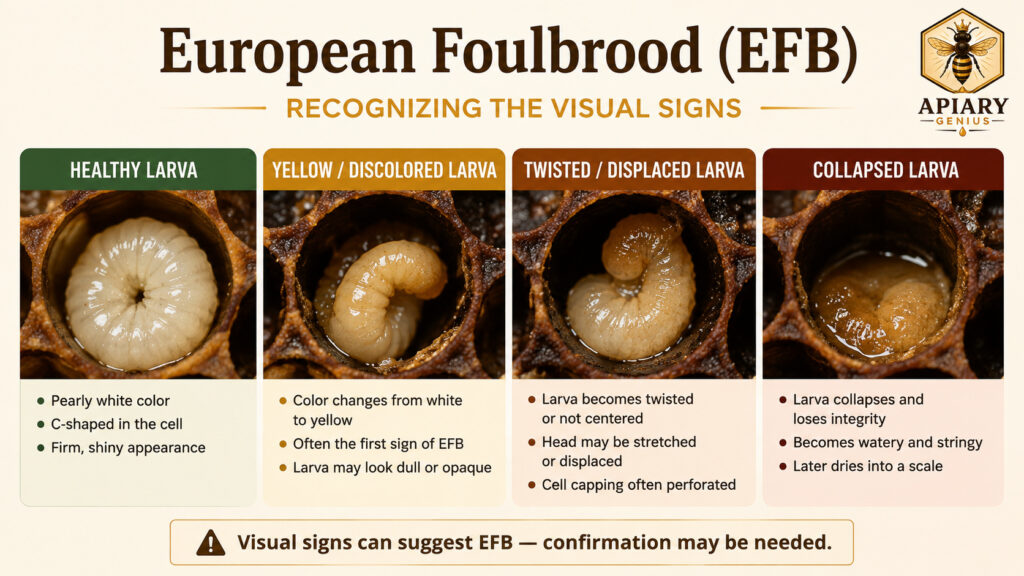
Abnormal Larval Position
Healthy young larvae normally lie curled in a characteristic C-shaped position at the bottom of their cells.
Larvae affected by EFB may become displaced or twisted. Some appear corkscrew-like, while others may lie lengthwise along the cell wall. As disease progresses, larvae may lose their normal segmentation and appear increasingly collapsed.
Color Changes
Healthy larvae are normally pearly white.
Suspicious larvae may become cream-colored or yellow before progressing toward yellow-brown, brown, or darker shades as they deteriorate.
Color alone is not enough for diagnosis. A dead or unhealthy larva can change color for several reasons, so discoloration should be interpreted alongside position, consistency, brood pattern, colony condition, and other signs.
Patchy Brood
EFB can produce an irregular brood pattern as diseased larvae die and worker bees remove them.
However, a spotty brood pattern is a warning sign rather than an EFB diagnosis. Poor queen performance, brood interruption, Varroa-related damage, other brood diseases, and nutritional problems can also produce missing or irregular brood.
When brood health looks abnormal, a careful inspection is more useful than jumping immediately to a single diagnosis. Beekeepers who want to improve the consistency of those inspections can review our guide to the best time to inspect a beehive.
Odor
Some EFB-affected brood may develop a sour or unpleasant smell, particularly when secondary microorganisms are involved. Other cases may have little or no distinctive odor.
For that reason, smell should never be used as a stand-alone diagnostic test. The absence of a sour odor does not rule out EFB, and an unpleasant odor does not confirm it.
What Does European Foulbrood Look Like in a Hive?
During an inspection, EFB often appears as an uneven mixture of healthy and unhealthy developing brood rather than as one identical sign in every affected cell.
The University of Florida IFAS Extension guidance on European foulbrood describes healthy larvae as plump and pearly white, while diseased larvae can become shrunken, deflated, rubbery, dehydrated, or discolored.
On a suspicious frame, normal white larvae may therefore sit close to larvae at different stages of deterioration. This variation across the brood area can be more informative than focusing on a single unusual cell.
Many affected larvae die while their cells are still uncapped. That tendency is diagnostically useful because it contrasts with the classic presentation of American foulbrood, in which affected larvae commonly die after the cell has been capped.
But this difference is not absolute.
EFB can sometimes involve capped brood, and disease presentation can vary. Likewise, other brood disorders can alter cappings and produce irregular brood.
The goal of visual inspection is therefore to recognize a pattern consistent with suspected EFB, not to prove the diagnosis from appearance alone.
European Foulbrood vs. American Foulbrood
European foulbrood and American foulbrood are both bacterial diseases of honey bee brood, but they are biologically distinct.
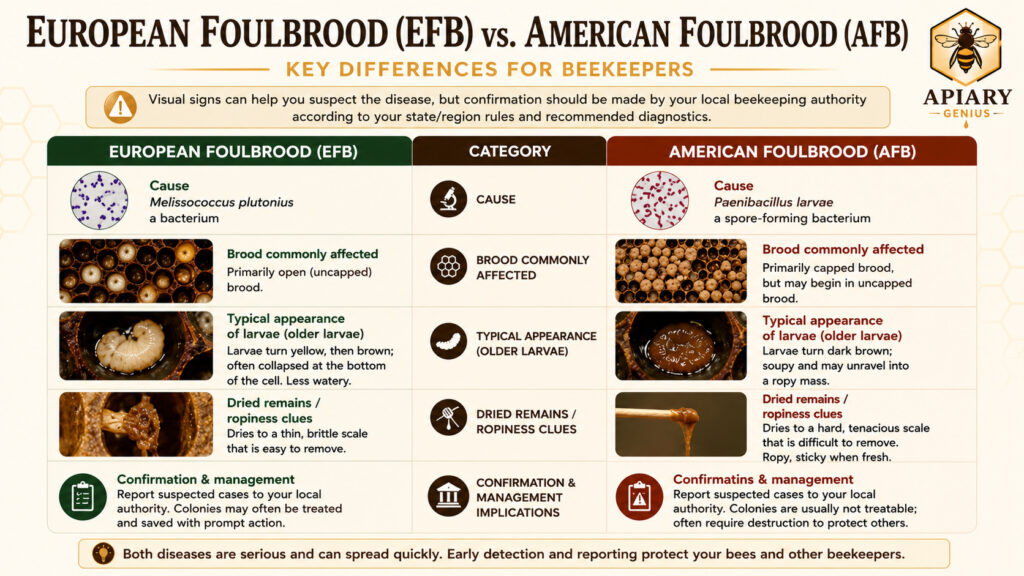
European foulbrood is caused by Melissococcus plutonius.
American foulbrood is caused by Paenibacillus larvae, a bacterium capable of producing highly resistant spores.
That difference has major implications for disease persistence and management.
Brood Stage
With classic EFB, diseased larvae frequently die before their cells are capped. Consequently, obvious signs are often seen in open brood.
With classic AFB, infected larvae usually die after the cells have been capped.
This is a useful field distinction, but it should not be treated as an infallible rule.
Appearance of Larvae
EFB-affected larvae may become yellowish or brown, lose their normal shape, appear twisted or displaced, collapse, and eventually form darker dried remains.
AFB commonly produces decomposing brood beneath affected cappings. The cappings may become dark, sunken, greasy-looking, or perforated as adult bees attempt to remove diseased material.
Ropiness
The classic “rope test” is associated primarily with American foulbrood. Decomposed AFB brood may sometimes stretch into a rope-like strand when manipulated with a suitable probe.
Classic EFB remains are generally not ropy.
However, the rope test should not be treated as universal proof of AFB or as a guaranteed way to exclude EFB. Disease presentation varies, and atypical cases can complicate field interpretation.
Scales
Both diseases can eventually leave dried remains.
EFB scales are generally more readily removed from cells. AFB scales characteristically become tightly attached to the lower cell wall and can be difficult for bees or the beekeeper to remove.
Again, these are comparative field characteristics—not substitutes for appropriate confirmation.
Odor
Odor can vary in both diseases and should not be used to confirm or exclude either EFB or AFB.
Persistence and Management Implications
The biology of Paenibacillus larvae makes AFB particularly difficult to control because its spores can remain infectious for long periods.
Melissococcus plutonius does not have the same spore-forming biology, but EFB can still persist within an apiary, contaminate comb and equipment, and recur after apparent recovery.
That means neither disease should be handled casually.
If the signs could represent AFB rather than EFB, avoid making irreversible management decisions from visual appearance alone. Our detailed guide to American foulbrood symptoms and management explains its diagnostic and management considerations separately.
The USDA ARS American foulbrood guidance also provides a useful authoritative comparison with EFB.
How European Foulbrood Spreads Between Colonies
Within an infected colony, M. plutonius can circulate as nurse bees feed larvae and house bees remove diseased or dead brood.
Spread between colonies can occur through several pathways.
One of the most important is beekeeper-mediated movement.
Moving brood frames, comb, honey, or other contaminated hive material from an affected colony into a healthy colony can transport the pathogen. Using contaminated tools between colonies can create another pathway.
Robbing can also spread disease when bees enter affected colonies and carry contaminated material back to their own hive.
Drifting bees may contribute to transmission as well.
These routes explain why good biosecurity becomes especially important once suspicious brood is discovered. Routine practices that are normally useful—such as equalizing colonies by exchanging brood frames—can become risky when disease status is uncertain.
Do not transfer suspect brood or comb into another colony simply because the receiving colony appears stronger.
Why Some Colonies Develop European Foulbrood
Exposure to M. plutonius is only part of the EFB story.
Clinical disease is often associated with conditions that make it more difficult for the colony to maintain brood care and remove affected larvae efficiently.
Nutrition and Brood-Rearing Pressure
Rapid brood expansion creates high demand for pollen, nectar, nurse bees, and brood food.
If that demand exceeds available resources, larvae may be more vulnerable and the colony may struggle to maintain healthy brood.
This helps explain why EFB has historically been associated with spring brood expansion and why disease signs can sometimes decline during favorable nectar flows.
A colony suffering a genuine food shortage may require nutritional support as part of broader colony management. Feeding, however, should be based on actual colony needs rather than treated as a stand-alone cure for bacterial disease. Our guide to feeding bees through different seasons covers nutritional management in more detail.
Colony Strength
Strong colonies with sufficient nurse bees and effective hygienic behavior may be better able to remove diseased larvae before infection becomes severe.
A weak or declining colony may have fewer resources available for brood care and hygienic removal.
Queen Condition
A poor brood pattern can result from disease, but it can also reflect queen performance.
When a colony has both brood-health problems and an aging or failing queen, requeening may be considered as part of a broader management strategy where appropriate. Requeening is not a diagnostic test or guaranteed cure for EFB, but improving colony genetics and brood performance can be relevant in some management programs.
If queen replacement is warranted for the colony as a whole, see our step-by-step guide to requeening a beehive.
Other Stressors
A colony may face multiple health pressures at the same time.
For example, heavy Varroa pressure and associated viruses can damage brood and weaken the colony. This can complicate interpretation because abnormal brood does not automatically point to EFB.
If Varroa status is unknown, evaluate it separately using an appropriate monitoring method rather than assuming all brood abnormalities come from one disease. See our guide to Varroa mite control for that separate health assessment.
How to Diagnose European Foulbrood
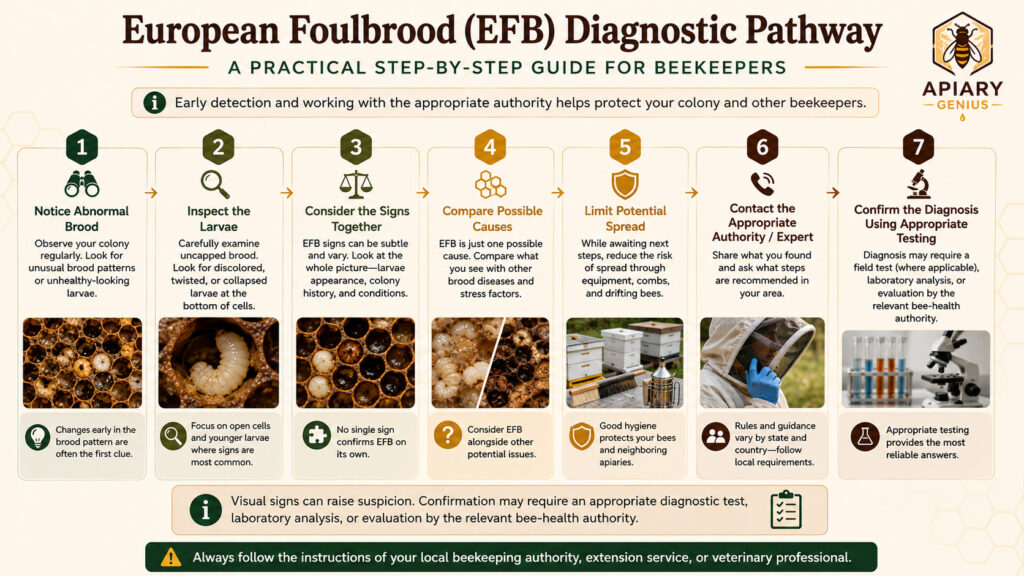
European foulbrood diagnosis begins with inspection, but it should not necessarily end there.
Visual signs can identify a suspected case. Confirmation may involve an experienced bee inspector, a validated field diagnostic test, microscopy, molecular testing, or another recognized laboratory method depending on the jurisdiction.
Research published through the USDA Agricultural Research Service has emphasized that EFB can be difficult to diagnose from visual symptoms alone. A USDA-supported validation study of European foulbrood diagnostic methods compared field lateral-flow testing with microscopy and molecular detection and found strong agreement among the methods studied.
Field Inspection
Start by examining multiple areas of brood rather than one unusual cell.
Look for patterns:
- Are abnormal larvae concentrated in one area or scattered?
- Are affected cells mostly open or capped?
- Are larvae twisted or displaced?
- What colors and consistencies are present?
- Is the brood pattern irregular?
- Are there signs that point toward AFB, sacbrood, chalkbrood, queen failure, Varroa-related damage, or another problem?
Documenting what you see can be useful, particularly if you need to contact an inspector, veterinarian, diagnostic laboratory, or local bee-health authority.
Field Diagnostic Tests
Lateral-flow diagnostic tests for M. plutonius are available in some regions and are used by inspectors and beekeepers under appropriate circumstances.
They can provide valuable evidence, but a field test should be used according to its instructions and interpreted within the larger diagnostic context.
A negative field result does not justify ignoring strongly suspicious disease when professional or laboratory confirmation is warranted.
Laboratory Confirmation
Laboratories may identify M. plutonius using methods such as microscopy or molecular assays.
For U.S. beekeepers, the USDA Bee Disease Diagnosis Service provides diagnostic testing for appropriate samples originating in the United States and its territories.
Beekeepers elsewhere should use the diagnostic services and reporting routes designated by their national or regional authorities.
The key principle is simple: suspicion based on appearance and confirmation of disease are not the same thing.
What to Do If You Suspect European Foulbrood
If brood looks consistent with EFB, avoid continuing the inspection as though nothing unusual has happened.
First, minimize opportunities to move contaminated material.
Do not transfer suspect brood frames, comb, honey, or other hive material into healthy colonies.
Avoid using the same potentially contaminated tools on other colonies until they have been handled according to appropriate biosecurity guidance.
Record which hive is affected and what you observed.
Next, determine the reporting and diagnostic requirements where you live.
Regulations vary significantly by jurisdiction.
For example, in England and Wales, European foulbrood is a notifiable disease. UK government guidance on honey bee pests and diseases instructs beekeepers who suspect EFB to contact the National Bee Unit or their local bee inspector and to restrict movement of colonies, equipment, and honey from the affected site while the situation is investigated.
Do not assume that this exact procedure applies everywhere in the United States or Europe.
In the United States, requirements can vary by state. Contact the relevant state apiary inspector, department of agriculture, veterinarian, or bee-disease diagnostic service when necessary.
The most important immediate principle is to avoid spreading potentially infected material while you determine what the disease actually is and what local rules require.
Can European Foulbrood Be Treated?
There is no single European foulbrood treatment protocol that is appropriate for every colony and every jurisdiction.
Management depends on factors such as disease severity, colony strength, time of year, local regulations, diagnostic confidence, available forage, recurrence history, and the condition of contaminated comb.
Possible management approaches can include improving colony conditions, replacing contaminated brood comb, requeening in appropriate circumstances, shook-swarm procedures, destruction of severely affected colonies where required or appropriate, and—in jurisdictions where legally permitted—veterinary-supervised antimicrobial treatment.
Improving Colony Conditions
If food shortage is contributing to colony stress, correcting that shortage can support colony recovery, but feeding is not a stand-alone treatment for confirmed EFB.
Improved forage or nutrition also cannot substitute for diagnosis, biosecurity, or other disease-management measures when they are needed.
Shook Swarm
A shook swarm can be used in some EFB control programs to separate adult bees from contaminated brood comb and establish them on clean equipment or foundation.
This is a significant management intervention, not something to perform automatically after seeing one suspicious larva.
In England and Wales, for example, the National Bee Unit guidance on controlling European foulbrood includes shook swarm among official control options and places its use within a regulated disease-management system.
The timing, colony condition, handling of old brood comb, and legal requirements all matter. Beekeepers should follow their applicable official guidance rather than copying a protocol designed for another jurisdiction.
Requeening
Requeening can sometimes be incorporated into EFB management, particularly when colony genetics, hygienic behavior, or queen performance are concerns.
It should be viewed as one component of colony management rather than a guaranteed treatment for an active bacterial infection.
Antibiotics
Antibiotic use requires particular caution.
Antibiotics can suppress susceptible bacterial populations and may reduce clinical signs, but they should not be presented as a universal cure for EFB. They do not remove every management factor that contributed to disease, and inappropriate use raises concerns about antimicrobial resistance, residues, and recurrence.
In the United States, honey bees are treated as food-producing animals for veterinary drug regulation. The U.S. Food and Drug Administration explains veterinary oversight of antibiotics used in honey bees, and applicable products must be used under current federal requirements, approved labeling, and relevant state laws.
In the United States, certain oxytetracycline products have approved honey bee indications that include control of EFB caused by susceptible M. plutonius. This does not mean a beekeeper should diagnose EFB visually and devise an antibiotic regimen independently.
European countries and UK jurisdictions may have different drug authorizations, veterinary requirements, residue rules, and disease-control programs.
Always follow the applicable agricultural, veterinary, food-safety, and bee-health regulations in your location.
Managing Frames, Comb, and Hive Equipment
EFB management is not only about the adult bees.
Brood comb and other hive materials can participate in disease persistence and transmission, which means contaminated equipment needs deliberate handling.
Do not automatically move suspect frames into another colony.
Likewise, do not assume every component of an affected hive must receive identical treatment.
Brood comb, wooden hive bodies, metal tools, plastic components, honey supers, feeders, gloves, and other equipment differ in their potential exposure and in the cleaning, disposal, or reuse procedures that may be appropriate.
If disease is confirmed, follow the equipment-management recommendations of the relevant inspector or authority.
Comb replacement can be particularly important because contaminated brood comb can act as a continuing reservoir of infectious material. In regulated disease-control programs, some affected comb may need to be destroyed rather than reused.
Avoid improvising strong chemical disinfectants or heat treatments without authoritative instructions. A method that is suitable for one material may damage another, create residue risks, or fail to achieve the intended disease-control result.
Good equipment management also means keeping suspect material separated until its status is resolved.
How to Prevent European Foulbrood
No management system can guarantee that a colony will never encounter M. plutonius, but good biosecurity and colony management can reduce opportunities for disease to spread and become severe.
Start with careful brood inspection.
Learn what healthy larvae and a normal brood pattern look like so that subtle changes are easier to recognize. Early detection gives you more time to investigate a problem before moving potentially contaminated material through the apiary.
Avoid transferring brood or comb from colonies with unexplained brood disease.
Be cautious with used equipment from unknown sources.
Reduce robbing where practical, especially around weak or diseased colonies.
Keep hive tools and other equipment clean, and increase biosecurity when disease is suspected.
Maintain adequate colony nutrition and avoid allowing colonies to remain severely food-stressed when intervention is appropriate.
Monitor other major health pressures rather than treating EFB as though it occurs in isolation.
Finally, manage brood-comb replacement as part of a broader disease-prevention and equipment-management strategy, particularly when comb has been associated with confirmed disease.
Prevention is less about one special EFB technique and more about maintaining colonies in which disease is detected early, contaminated material is not casually exchanged, and stressors are addressed before they compound one another.
Can European Foulbrood Come Back?
Yes. European foulbrood can recur.
A colony that no longer shows obvious diseased larvae is not necessarily protected from future disease.
Recurrence may reflect persistent contamination, unresolved colony stress, or reintroduction from another colony.
This is one reason management should address more than visible symptoms. If clinical signs disappear but important risk factors remain unresolved, the likelihood of another outbreak may remain.
After an affected colony appears to recover, continue monitoring brood closely.
Review what may have contributed to the outbreak. Consider colony strength, food availability, queen performance, comb condition, other disease pressures, and your equipment-transfer practices.
In regulated areas, follow any required follow-up inspection or movement restrictions.
The goal is not merely to make abnormal larvae disappear. It is to reduce the chance that the same disease cycle becomes established again.
Common European Foulbrood Management Mistakes
Several mistakes can make an EFB problem harder to understand or control.
Diagnosing from one symptom. A twisted yellow larva or patchy brood pattern can justify closer investigation, but neither automatically proves EFB.
Diagnosing by odor. Odor is variable and is not a reliable way to confirm the disease.
Assuming a negative rope test means EFB. A non-ropy larva does not automatically establish an EFB diagnosis.
Ignoring American foulbrood as a differential diagnosis. Confusing the two diseases can lead to inappropriate management and potentially serious biosecurity consequences.
Moving suspect frames to stronger colonies. Transferring brood from a colony with unexplained disease can spread pathogens.
Treating antibiotics as the entire solution. Antimicrobial treatment, where legal and appropriate, does not replace diagnosis, colony management, equipment decisions, or biosecurity.
Following another country’s disease rules. Disease-control and veterinary requirements vary by jurisdiction.
Ignoring other colony-health problems. EFB can occur alongside nutritional stress, queen problems, Varroa pressure, or other diseases.
Returning to normal equipment sharing too quickly. Disease management should include consideration of potentially contaminated comb and tools, not just the appearance of the adult bee population.
Frequently Asked Questions About European Foulbrood
What causes European foulbrood?
European foulbrood is caused by the bacterium Melissococcus plutonius. Young larvae become infected through contaminated brood food, and the bacterium multiplies in the larval gut.
What are the main European foulbrood symptoms?
Common signs include an irregular brood pattern, larvae in abnormal or twisted positions, yellow-to-brown discoloration, and collapsed or deteriorating larvae. These signs raise suspicion but do not automatically confirm EFB.
Does European foulbrood affect capped or uncapped brood?
Classic EFB is most commonly associated with larvae that die before their cells are capped, so signs are often most obvious in open brood. However, some affected larvae can survive until after capping, so brood stage should not be treated as an absolute diagnostic rule.
Is European foulbrood the same as American foulbrood?
No. EFB is caused by Melissococcus plutonius, while AFB is caused by Paenibacillus larvae. Their typical brood presentation, persistence, diagnosis, and management differ.
Is European foulbrood always fatal to a colony?
No. Disease severity varies. Some colonies can improve as conditions become favorable, while others develop extensive disease, weaken significantly, or experience recurrence.
Can a strong nectar flow make EFB disappear?
Clinical signs may sometimes decline when forage conditions improve and colonies have abundant resources. However, disappearance of visible symptoms should not be interpreted as proof that all disease risk has been eliminated.
Can European foulbrood be diagnosed visually?
Visual inspection can identify a suspected case, but it does not always provide definitive confirmation. Field tests, microscopy, molecular methods, inspectors, or diagnostic laboratories may be appropriate depending on the circumstances and jurisdiction.
Should I use antibiotics for European foulbrood?
Do not automatically use antibiotics because brood looks suspicious. Drug authorization and veterinary requirements vary by jurisdiction, so establish an appropriate diagnosis and follow current local regulations and approved product requirements.
Should infected comb be reused?
Do not move confirmed or suspected infected brood comb into healthy colonies. Whether particular comb, frames, boxes, or other equipment should be destroyed, cleaned, replaced, or reused depends on the disease situation and applicable official guidance.
Is European foulbrood reportable?
That depends on jurisdiction. For example, EFB is a notifiable disease in England and Wales, while requirements elsewhere differ. Check with the appropriate state, national, or regional bee-health or animal-health authority.
Final Thoughts
European foulbrood rewards careful observation rather than quick conclusions.
Learn to recognize the warning signs: abnormal larval positions, discoloration, collapsed larvae, irregular brood, and unusual dried remains. But remember that none of those features, by itself, proves that a colony has EFB.
The most useful approach is to move logically from suspicion to confirmation and then to management.
Protect neighboring colonies while the problem is investigated. Consider American foulbrood and other causes of abnormal brood. Use field or laboratory diagnostics when appropriate. Follow local reporting and veterinary requirements. Address colony nutrition, queen condition, contaminated comb, and other stressors rather than focusing on a single visible symptom.
Most importantly, treat European foulbrood as its own disease—not as a less important version of American foulbrood.
Good diagnosis, sound biosecurity, and management appropriate to both the colony and the jurisdiction give beekeepers the best chance of controlling the immediate problem while reducing the risk of recurrence.
Sources
- USDA Agricultural Research Service — European Foulbrood Disease
- USDA Agricultural Research Service — Bee Disease Diagnosis Service
- USDA Agricultural Research Service — Validation of Diagnostic Methods for European Foulbrood
- University of Florida IFAS Extension — Identification and Treatment of European Foulbrood in Honey Bee Colonies
- UK Government — Honey Bees: Protecting Them From Pests and Diseases
- National Bee Unit — The Control of European Foulbrood
- U.S. Food and Drug Administration — Helping Agriculture’s Helpful Honey Bees