
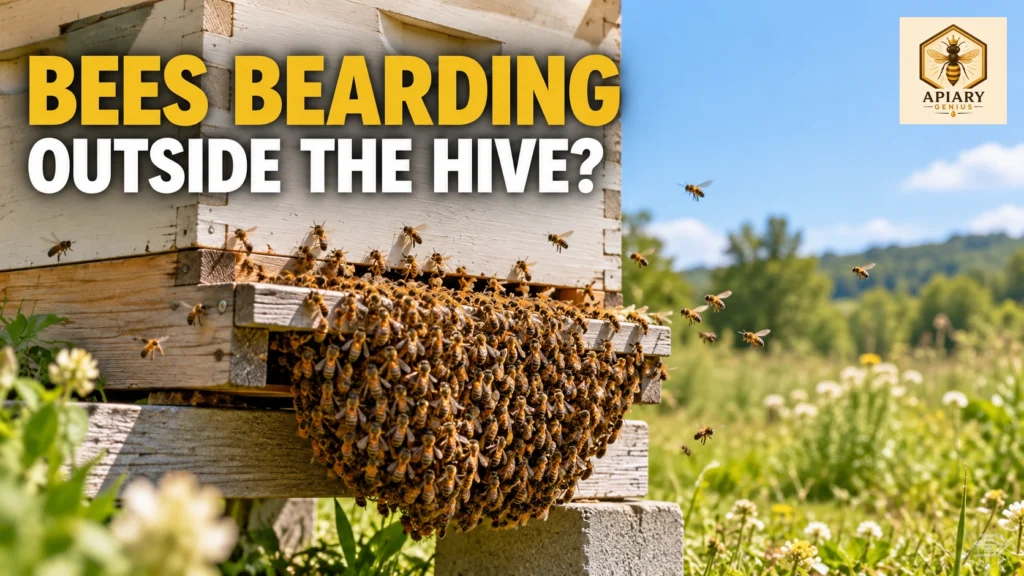
Seeing bees bearding outside hive entrances can look alarming, especially when hundreds or thousands of workers cover the front of the box or hang beneath the landing board. In many cases, however, this is a normal colony response to warm conditions rather than evidence that something is seriously wrong.
The key is not to diagnose the colony from the beard alone. Weather, time of day, colony strength, available space, swarm signs, water access, recent hive changes, treatments, and what is happening inside the hive all matter.
Bearding is a behavior, not a diagnosis.
Quick Answer
When you see bees bearding outside hive entrances, the behavior is usually part of colony thermoregulation, especially during warm conditions. Workers may temporarily gather outside while the colony uses fanning, water collection, evaporative cooling, movement within the nest, and changes in worker density to regulate internal conditions. Research on honey bee bearding supports its role as a thermoregulatory behavior.
A large beard does not automatically mean the hive is overheating, overcrowded, or preparing to swarm. Recent research has also found that beards can become largest during the evening or night under warm conditions.
If the bees look calm, normal colony activity continues, and there are no dead, dying, trembling, crawling, or incapacitated bees, observation may be all that is needed.
Table of Contents
What Is Bee Bearding?
Bee bearding happens when a group of workers temporarily gathers outside the hive, often around the entrance, landing board, lower edge of the box, or front wall.
The cluster may contain a relatively small number of bees or thousands of workers. In large beards, bees can hang from one another and form the beard-like mass that gives the behavior its name.
A recent study in Insectes Sociaux described bearding as a thermoregulatory evacuation in which workers temporarily leave the nest interior and form a cluster outside. The bees are still part of the colony and have not departed to establish another nest.
That distinction is important because bearding and swarming are not the same behavior.
Why Do Bees Beard Outside the Hive?
The strongest explanation for normal bearding is thermoregulation.
A honey bee colony has to regulate conditions inside the nest while thousands of adult bees are producing metabolic heat and developing brood is sensitive to temperature.
Workers have several ways to manage heat.
They can:
- redistribute themselves within the hive;
- fan their wings to move air;
- collect water;
- use water for evaporative cooling;
- change worker density in different parts of the nest;
- and temporarily move some workers outside.
Research on colony thermoregulation shows that these behaviors operate together as part of a coordinated colony-level response to environmental conditions.
Water is particularly important during warm conditions. Honey bees collect water for several colony needs, including cooling the hive through evaporation.
Bearding can therefore reduce the number of adult bees occupying the hive interior while other cooling behaviors continue.
This is why a beard should not automatically be interpreted as evidence that the colony’s cooling system has failed.
The beard itself can be part of that system.
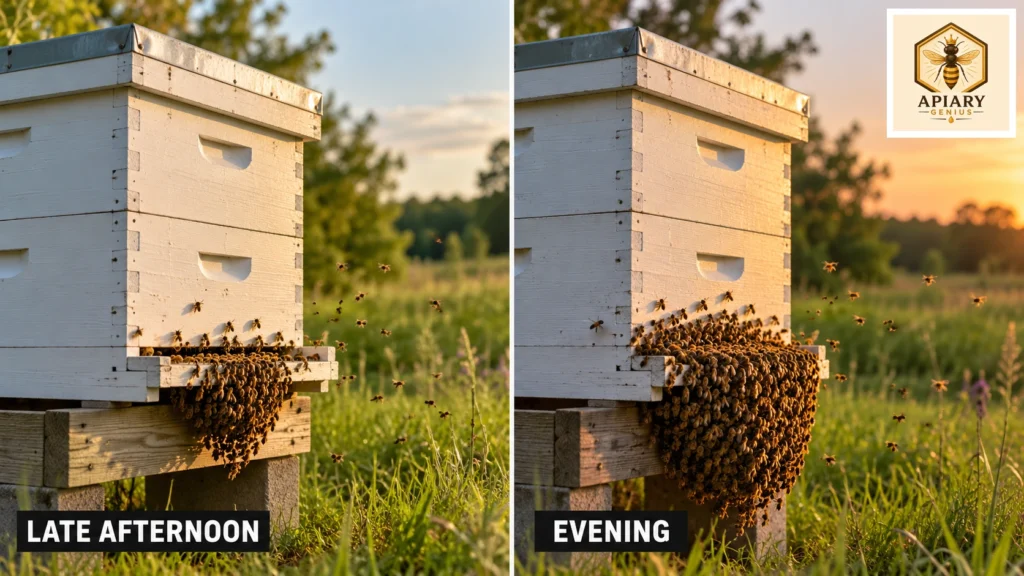
Why Bearding Often Gets Bigger in the Evening
A common assumption is that bearding should disappear as soon as the hottest part of the afternoon passes.
Research shows that the pattern can be more complicated.
In the recent Insectes Sociaux study, the largest naturally occurring beards were consistently observed during the evening and night, generally later than the daily peak in environmental temperature. Beards that formed in the evening could also persist much longer than experimentally induced afternoon beards.
The researchers discussed several factors that may contribute to this pattern, including the return of foragers to the colony and changes in the colony’s nighttime options for thermoregulation.
That does not mean every colony will beard according to the same schedule.
Weather, colony population, hive configuration, water availability, forage activity, genetics, and local conditions can all influence what you see.
So bees hanging outside the hive after sunset are not automatically showing abnormal behavior.
Is Bearding a Sign the Hive Is Too Hot?
Heat is an important trigger for bearding, but seeing bees outside does not necessarily mean the hive is dangerously overheating.
Honey bee colonies have multiple responses to warm conditions. Workers can fan, move within the nest, collect and distribute water, use evaporative cooling, and change the density of bees occupying different areas.
Bearding can be another part of that response.
Instead of asking only, “Is the hive too hot?” look at the complete situation.
Consider:
- recent weather;
- direct sun exposure;
- access to water;
- entrance fanning;
- colony activity;
- whether the beard appears calm;
- and whether other signs of distress are present.
If the colony receives intense sun or the apiary location repeatedly creates management concerns, review the broader site conditions rather than treating the beard itself as the problem. See How to Choose the Best Location for a Beehive.
Most importantly, distinguish calm clustering from distress.
A quiet mass of bees hanging from the hive is a different situation from bees dying at the entrance, trembling, crawling abnormally, or behaving chaotically.
Does Bearding Mean the Hive Is Overcrowded?
Not necessarily.
A strong colony naturally contains more adult bees, and larger colonies can form larger beards.
The recent bearding study found that beard size and duration increased with colony size. Importantly, however, the proportion of the colony participating in bearding did not increase with colony size.
That means a large beard may simply be associated with having a large colony.
You cannot diagnose harmful congestion by counting the bees outside.
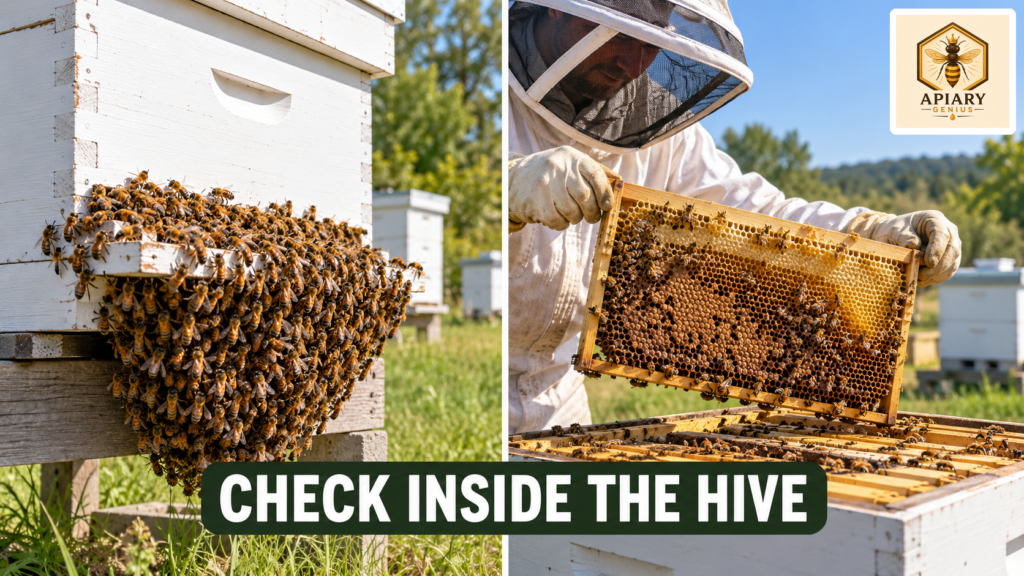
If congestion is a concern, inspect internal evidence instead.
Look at:
- how much drawn comb is available;
- how fully existing comb is being used;
- brood-nest space;
- nectar storage;
- backfilling of brood-nest cells;
- colony strength;
- available room;
- and evidence of swarm preparation.
A beard can give you a reason to look more closely at the colony.
It does not tell you by itself that the hive is overcrowded.
Bearding vs. Swarming: How to Tell the Difference
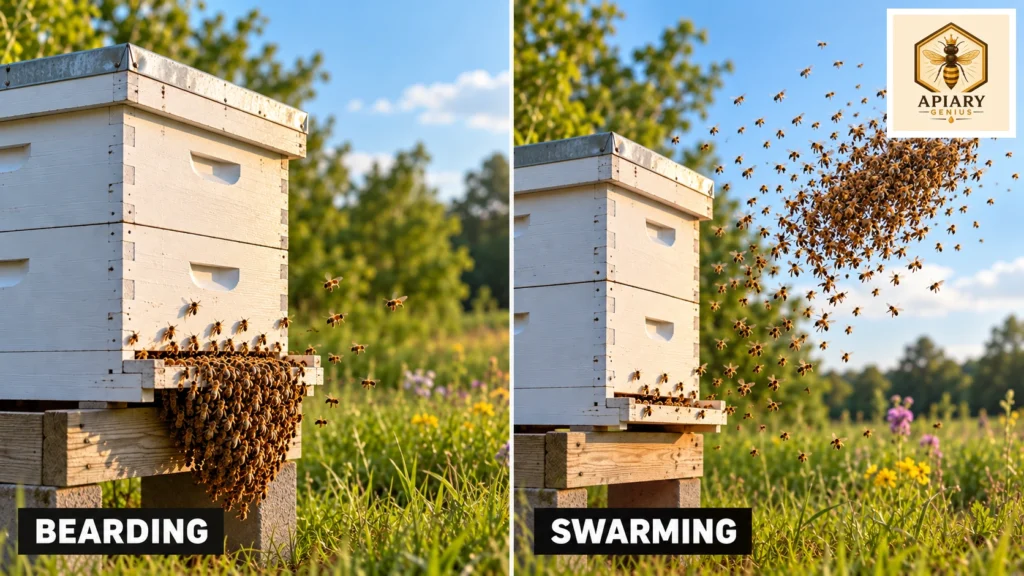
Bearding and swarming can both put large numbers of bees outside the hive, but they are fundamentally different behaviors.
Bearding
- Workers remain attached to or very close to the hive.
- The cluster is often relatively calm.
- The colony remains established inside the box.
- The beard may grow or shrink as weather and time of day change.
- The behavior is commonly associated with thermoregulation.
Swarming
- A large group of bees actually leaves the colony.
- The bees become airborne and depart with a queen.
- Swarming is part of colony reproduction.
- Preparation normally takes place inside the hive before departure.
- Queen cells and other colony evidence may help identify swarm preparation.
University of Georgia Extension describes honey bee swarming as the natural process by which colonies reproduce and establish new colonies.
Therefore, an exterior beard should not be treated as proof that a colony is about to swarm.
If an inspection reveals genuine swarm-preparation evidence, use the dedicated guide on How to Prevent Bee Swarming: 9 Proven Methods for Beekeepers.
If you discover queen cells and need to determine what they mean, see Queen Cells in a Beehive: Swarm, Supersedure, or Emergency?.
Does Bearding Mean You Need to Add a Honey Super?
Not necessarily.
A dramatic beard can make the colony look as though it has run out of room, but the number of bees outside does not tell you how much usable comb remains inside.
A honey super should be added because actual colony and nectar-storage conditions justify additional space—not simply because the beard looks large.
Evaluate:
- drawn comb availability;
- frame utilization;
- nectar flow;
- nectar storage;
- storage congestion;
- available space;
- and brood-nest conditions.
If these conditions suggest that the colony genuinely needs more honey-storage room, see When to Add a Honey Super: Timing, Signs, and the 7/10 Rule.
The beard itself should not be your supering rule.
Can a Varroa Treatment Cause Bearding?
Some registered Varroa treatments can be associated with changes in bee behavior, including bearding, but the effect is product-specific.
Formic Pro provides a useful documented example.
The EPA-accepted Formic Pro label states that colonies are expected to expand their cluster during the first few days after application as part of controlling vapor concentration and specifically notes that bearding behavior may be observed. The same label provides product-specific requirements concerning treatment conditions, entrance configuration, screen bottom boards, colony disturbance, and application procedures.
This does not mean every Varroa product causes bearding.
It also does not mean that management instructions for Formic Pro should be applied to another treatment.
If bearding appears during treatment:
- Identify the exact product being used.
- Check the current registered label.
- Follow its temperature requirements.
- Follow its entrance and ventilation instructions.
- Follow the labeled dose and application method.
- Do not change hive configuration in a way that conflicts with the label.
- Investigate severe distress or unusual mortality separately.
Pesticide labels are not optional management suggestions. The Formic Pro label, for example, explicitly states that using the product inconsistently with its labeling violates federal law.
Treatment-related bearding should therefore be interpreted in the context of the specific product, its label, and the condition of the colony.
Bees Bearding Outside Hive Entrances: What to Check
When you walk up to a hive covered with live bees, resist the urge to intervene immediately.
Use the situation around the beard to determine what it probably means.
1. Check the weather
Has the day been warm, humid, or unusually hot?
Warm conditions make thermoregulatory bearding more likely.
2. Check the time of day
Bearding may become more visible later in the day and can persist after dark.
Recent research found that large beards frequently peaked during evening or nighttime conditions in the colonies studied.
3. Watch the cluster
Are the bees hanging quietly together?
Or are they running rapidly, fighting, falling from the entrance, or behaving abnormally?
Calm clustering and chaotic entrance behavior should not be interpreted the same way.
4. Consider colony strength
A highly populous colony may naturally produce a larger beard than a smaller colony.
5. Evaluate available hive space
If an inspection is warranted, determine how much usable comb and storage space actually remain.
Do not estimate congestion from exterior beard size.
6. Look for brood-nest congestion or backfilling
Check whether stored nectar is increasingly occupying cells that would otherwise be available in the brood nest.
7. Look for swarm-preparation evidence
If swarming is a concern, look inside the colony for meaningful evidence rather than using exterior clustering as a predictor.
Queen cells, brood-nest conditions, colony population, and recent colony history provide more useful information.
8. Check water availability
Honey bees use water as part of their cooling system, including evaporative cooling during warm conditions.
Make sure colonies have reasonable access to a dependable water source.
9. Think about recent hive manipulation
Consider whether you recently:
- rearranged boxes;
- combined colonies;
- changed equipment;
- changed an entrance;
- added or removed components;
- or performed another substantial manipulation.
Timing can provide useful context.
10. Check recent treatments
If a Varroa treatment or other registered hive pesticide is being used, read its current label before changing entrance configuration, ventilation, screens, or other treatment-related conditions.
11. Look for dead or abnormal bees
This is an important dividing line.
Dead, dying, crawling, trembling, disoriented, or incapacitated bees are not simply “a bigger beard.”
If those signs are present, use Why Are There Dead Bees in Front of My Hive? Normal vs. Warning Signs to investigate the problem separately.
12. Watch what happens over time
Normal bearding can expand and contract as environmental and colony conditions change.
Persistent clustering that no longer fits the weather, colony behavior, treatment situation, or other observations deserves a closer inspection.
What to Do When Bees Are Bearding
Your response should depend on what else you observe.
If the bearding looks normal
If the bees appear calm, colony activity looks otherwise normal, the weather makes thermoregulatory bearding plausible, and there are no additional warning signs, immediate intervention may not be necessary.
Observe the colony.
Make sure reasonable water access is available.
Avoid repeatedly disturbing the hive just because bees are outside.
If internal conditions need to be checked, choose an appropriate inspection period rather than opening the colony unnecessarily during the hottest part of the day. See Best Time to Inspect a Beehive: 10 Expert Tips for Beginners.
If other warning signs are present
Investigate the warning sign rather than trying to eliminate the beard.
For example:
- inspect actual brood-nest or storage congestion;
- look for genuine swarm-preparation evidence;
- interpret queen cells if present;
- verify treatment directions;
- investigate dead or incapacitated bees separately;
- and examine rapidly changing or abnormal colony behavior.
The management decision should address the underlying condition—not simply the fact that bees are outside.
What Not to Do
- Do not spray the beard with water simply to disperse the bees. Water is important to colony cooling, but spraying an exterior beard is not a diagnostic or management solution.
- Do not smoke or force bees back inside without a clear reason. They may be outside as part of the colony’s thermoregulatory response.
- Do not add a honey super solely because the beard looks large. Check actual storage and space conditions first.
- Do not diagnose swarming from exterior clustering alone. Look for meaningful evidence inside the colony.
- Do not modify entrances, ventilation, screen configurations, or other hive components in conflict with treatment-label directions.
- Do not open the colony unnecessarily during the hottest part of the day merely because bees are bearding.
- Do not treat calm bearding as an emergency without additional warning signs.
When Bearding Deserves a Closer Inspection
A beard deserves more investigation when other observations suggest that something beyond ordinary thermoregulation may be happening.
Examples include:
- persistent unusual clustering that no longer matches weather conditions;
- strong evidence of brood-nest congestion;
- severe storage congestion;
- queen cells or other swarm-preparation evidence;
- unusual agitation or chaotic entrance activity;
- dead or dying bees;
- crawling, trembling, or incapacitated workers;
- suspected treatment-associated stress;
- abnormal mortality;
- rapidly changing colony behavior;
- or concerning findings inside the hive.
None of these signs means that the beard itself caused the problem.
The goal is to determine whether normal bearding is occurring alongside another condition that requires management.
FAQ
Is bee bearding normal?
Yes, often.
Seeing bees bearding outside hive entrances can be a normal part of thermoregulation, particularly during warm conditions.
A beard alone does not prove that the colony is overcrowded, dangerously overheated, or preparing to swarm.
Does bearding mean bees are going to swarm?
No—not by itself.
Bearding involves workers temporarily clustering on or near their established hive. Swarming is a reproductive event in which a large group of workers departs with a queen to establish another colony.
If swarming is a concern, look for actual swarm-preparation evidence inside the hive.
Why do bees beard at night?
Nighttime bearding can occur during warm conditions and is not automatically abnormal.
Recent research found that the largest beards in the colonies studied often occurred during evening and nighttime periods. Experimentally induced evening beards also tended to last longer than afternoon beards.
Not every colony will follow the same daily pattern.
Does bearding mean my hive is overcrowded?
Not necessarily.
Larger colonies can produce larger beards, but beard size alone does not establish harmful congestion.
Evaluate available comb, brood-nest conditions, nectar storage, backfilling, colony strength, available room, and swarm-preparation evidence instead.
Should I add a honey super when bees are bearding?
Not because of the beard alone.
Add a honey super when actual colony conditions, frame use, nectar flow, and available storage space indicate that more room is appropriate.
A large beard is not a substitute for inspecting those conditions.
Should I open the hive entrance more when bees are bearding?
Not automatically.
The correct entrance configuration depends on the hive, management situation, and any treatment currently being used.
If a registered Varroa treatment is in place, follow its label exactly. Do not change the entrance or ventilation in a way that conflicts with treatment instructions.
Should I spray bearding bees with water?
No.
Do not spray a calm beard simply to force the bees back inside.
Instead, make sure colonies have reasonable access to water and evaluate whether any genuine warning signs are present.
Can Varroa treatment cause bees to beard?
Some products can be associated with bearding under particular treatment conditions.
For example, the EPA-accepted Formic Pro label specifically states that bearding behavior may be observed after application.
That evidence is product-specific. Do not assume every Varroa treatment produces the same response. Always follow the current label for the exact product you are using.
Sources
University of Georgia Extension — Honey Bee Swarms and Bees in Walls
U.S. Environmental Protection Agency — Formic Pro, EPA Registration No. 75710-3