
Few sights are more impressive than thousands of honey bees pouring out of a hive and gathering in a buzzing cluster on a nearby branch. For the bees, swarming is a natural and successful way to reproduce at the colony level. For a beekeeper, however, an unexpected swarm can mean losing a large portion of the workforce just when the colony should be building toward peak honey production.
Learning how to prevent bee swarming is therefore one of the most important spring and early-summer management skills a beekeeper can develop.
Swarm prevention is not about stopping healthy bees from following their instincts at all costs. Instead, good management focuses on recognizing the conditions that encourage swarming and making timely adjustments before the colony becomes fully committed to leaving.
A strong colony may swarm when population growth, incoming nectar, brood production, available comb space, queen condition, and seasonal conditions combine to create the right circumstances. Once the colony begins producing active swarm cells, simply adding another empty box may be too little, too late.
This guide explains why honey bees swarm, how to recognize the warning signs, and nine practical methods you can use to reduce the risk while keeping your colonies productive and healthy.
Table of Contents
What Is Bee Swarming?
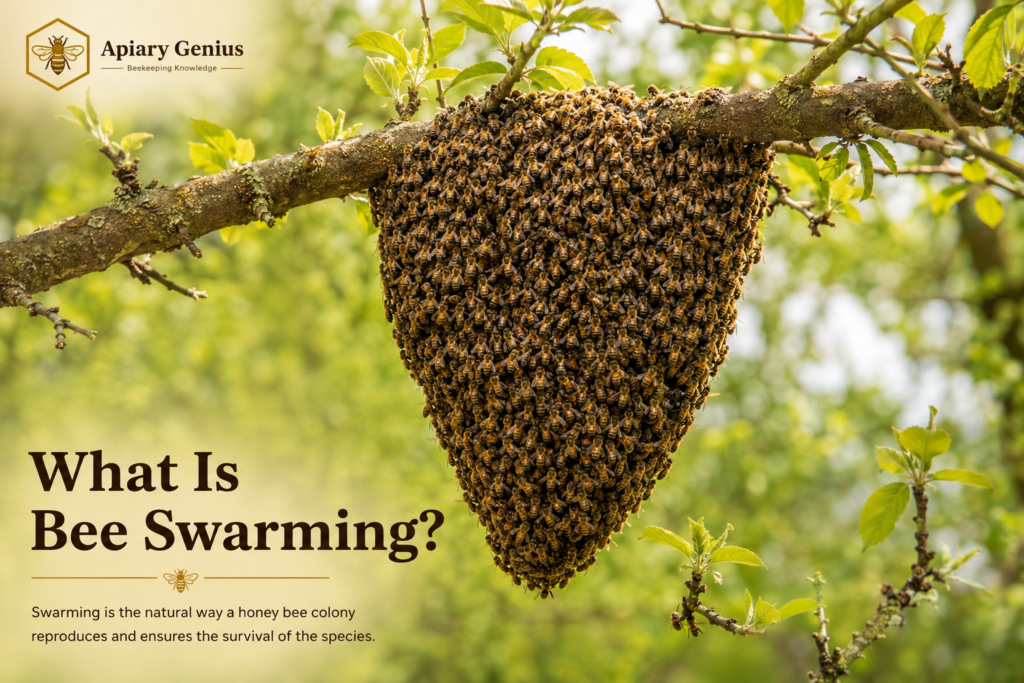
Swarming is the natural reproductive process of a honey bee colony.
Instead of reproducing only at the level of individual bees, a mature colony can effectively divide itself into two colonies. The established queen leaves the original hive with a substantial portion of the worker population. The remaining bees stay behind and raise or complete the development of a replacement queen.
The departing bees form what we call a swarm.
After leaving the hive, they commonly gather temporarily on a tree branch, fence, shrub, building, or another nearby surface. Scout bees then search the surrounding area for a suitable permanent nesting cavity.
The clustered swarm is therefore not necessarily establishing a colony at that location. It may simply be waiting while scouts evaluate potential homes.
For a managed hive, the consequences can be significant.
The original colony suddenly loses a large number of adult workers as well as its established queen. It must then wait for a new queen to emerge, mature, mate successfully, and begin laying.
This interruption can reduce colony growth and honey production, particularly when swarming occurs close to a major nectar flow.
This is why swarm management is especially important for beekeepers who want strong colonies for honey production.
Why Do Honey Bees Swarm?
Swarming is not caused by one single factor.
A colony normally reaches the swarming state through a combination of biological and environmental conditions. Understanding these conditions is much more useful than simply searching for queen cells during every inspection.
Understanding these causes is the first step in learning how to prevent bee swarming before the colony becomes fully committed to leaving the hive.
Rapid Colony Population Growth
Spring creates ideal conditions for colony expansion in many climates.
As flowers begin producing pollen and nectar, the queen increases egg laying and the amount of brood expands. Several weeks later, thousands of young workers emerge.
The hive can change from a relatively small overwintered population into an extremely strong colony surprisingly quickly.
If that growth exceeds the available functional space inside the hive, swarm pressure increases.
Brood Nest Congestion
A hive can technically contain empty space while still having a congested brood nest.
This distinction is important.
If nectar and pollen are being stored in cells around or inside the brood area faster than the queen can use those cells for laying, the queen’s available laying space becomes restricted.
This condition is sometimes described as the brood nest becoming “honey-bound.”
Simply placing an empty box far above the active brood nest does not always immediately solve this problem. What matters is whether the bees have usable space where they need it.
Reduced Distribution of Queen Pheromone
Queen pheromones play an important role in colony organization.
As a colony becomes extremely populous and crowded, queen pheromone may be distributed less effectively among the workers.
This is associated with the colony beginning to rear new queens.
The appearance of developed queen cells is consequently one of the most important indications that swarm preparation has progressed beyond simple crowding.
Strong Nectar Flows
An abundant nectar flow is generally good news for beekeepers, but it can also accelerate congestion.
Thousands of foragers may bring nectar into the hive each day. Bees need empty comb in which to deposit and ripen it.
If adequate storage space is unavailable, incoming nectar can quickly occupy valuable comb.
A colony that simultaneously has a rapidly expanding population, large brood nest, abundant resources, and insufficient usable space can develop strong swarming pressure.
Genetics and Queen Characteristics
Not every colony has the same tendency to swarm.
Genetics can influence swarming behavior, while queen age and colony condition may also affect swarm tendency.
A young, productive queen is not a guarantee that a colony will never swarm. Strong colonies with young queens can still swarm when conditions favor reproduction.
However, queen management and selecting stock with desirable characteristics can form part of a long-term swarm-management strategy.
When Is Swarming Season?
There is no universal calendar date for swarming.
Climate, latitude, elevation, rainfall, floral resources, colony strength, and local weather all influence the timing.
In many temperate areas, swarm pressure increases during spring and early summer as colonies expand rapidly and major nectar flows begin.
This is why experienced beekeepers pay more attention to what is happening in the colony and surrounding environment than to a fixed date.
Watch for:
- Rapidly expanding brood
- Increasing adult bee population
- Strong pollen and nectar collection
- Drones and drone brood
- Crowded brood frames
- Nectar filling brood-space cells
- Queen cups containing eggs or larvae
- Developing queen cells
A strong colony can change considerably in only a short period during spring.
Regular inspections during the swarm season allow you to identify these changes before the colony reaches an advanced stage of preparation.
Queen Cups vs. Swarm Cells: Know the Difference
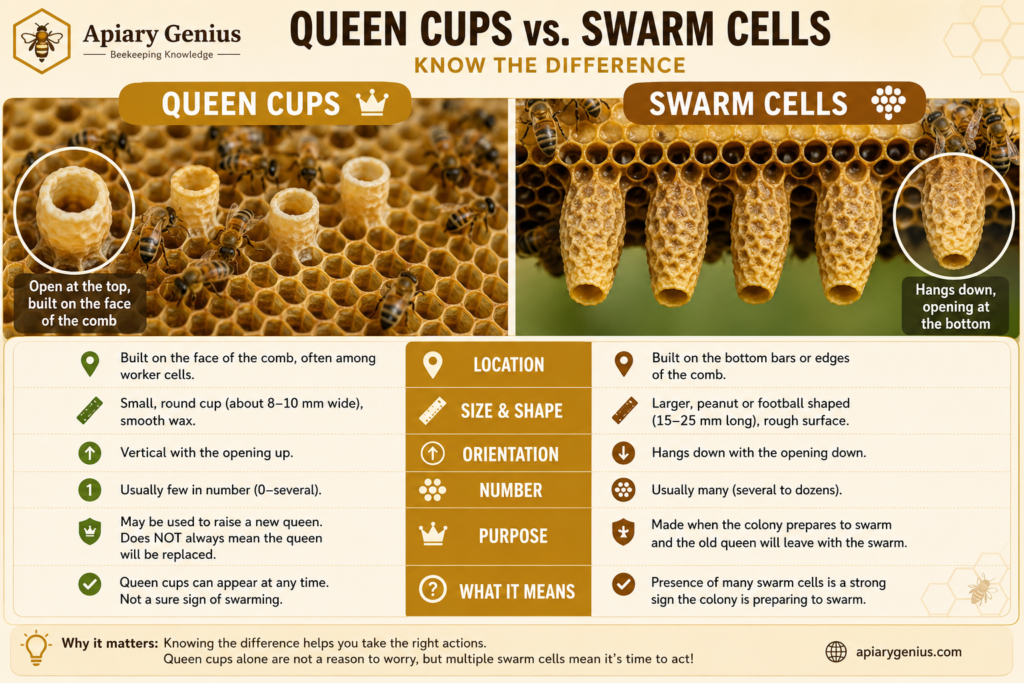
One of the most common beginner mistakes is assuming that every queen cup means the colony is about to swarm.
It does not.
Small, empty queen cups can be present in colonies even when there is no immediate swarm preparation.
The important question is whether those structures are being used.
A queen cup containing an egg or larva and royal jelly deserves much closer attention. As development continues, the colony extends the structure into a larger queen cell.
Swarm cells are often found along the lower portions or edges of brood combs, although location alone should never be your only diagnostic criterion.
Also distinguish swarm preparation from emergency queen replacement or supersedure.
The entire colony condition matters.
Ask yourself:
Is the current queen present?
Are fresh eggs visible?
How crowded is the colony?
How many queen cells are present?
Where are they located?
Is the colony expanding rapidly?
Has the brood nest become restricted?
Combining these observations gives you a much better diagnosis than reacting to a single unusual cell.
How to Prevent Bee Swarming: 9 Proven Methods
The best swarm-management strategy begins before the colony becomes committed to swarming.
Here are nine methods that can help.
Give the Colony Enough Space Before It Becomes Crowded
Providing sufficient usable space is one of the foundations of swarm prevention.
If you are learning how to prevent bee swarming, providing enough usable space before congestion develops is one of the most important steps.
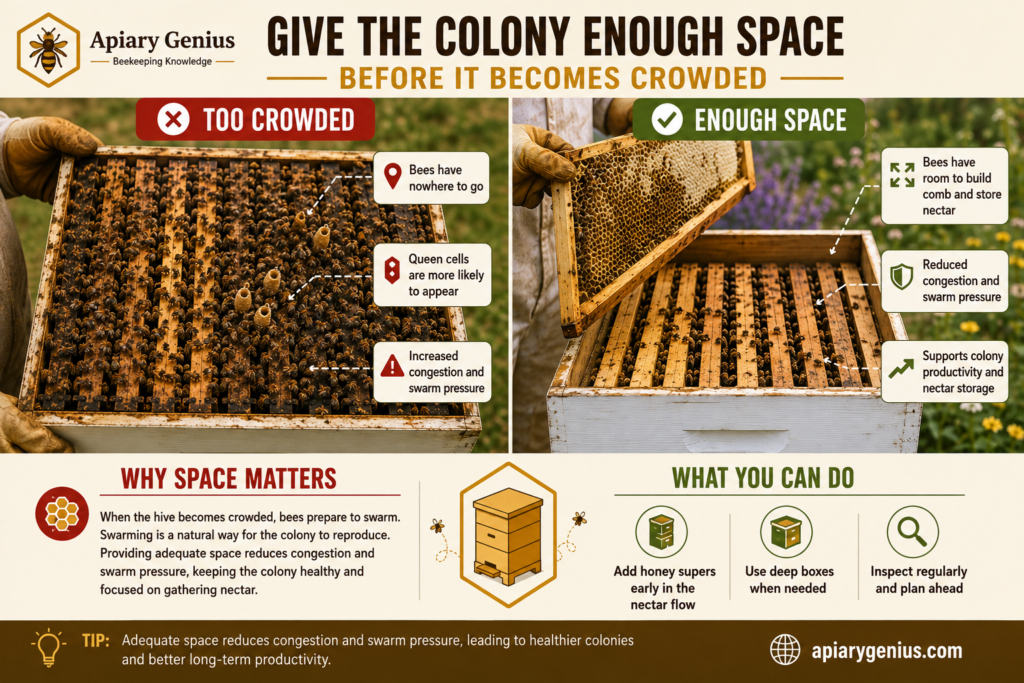
The key word is before.
Waiting until every frame is packed with bees and nectar before adding space can leave you behind the colony’s development.
During a strong nectar flow, storage space can disappear quickly.
Monitor your supers and brood chambers during regular inspections. Add appropriate space according to the colony’s strength, local nectar flow, and the hive system you use.
Empty drawn comb is particularly useful because bees can use it immediately.
Foundation requires the colony to build comb first, which requires time, energy, favorable conditions, and sufficient wax-producing workers.
That does not mean adding boxes endlessly.
Too much space can create management problems of its own, especially for smaller colonies or during cold conditions.
The goal is to stay slightly ahead of a rapidly growing colony rather than dramatically oversizing the hive.
Signs Your Hive Needs More Space
Look for:
- Most available comb being occupied
- Heavy bee coverage across frames
- Rapid nectar storage
- Limited empty cells for the queen
- Bees crowding heavily between boxes
- A strong colony approaching a nectar flow
Space management works best when it anticipates growth rather than responds to severe congestion.
Keep the Brood Nest Open
Adding a honey super does not automatically mean the queen has enough room to lay.
A colony can have empty space elsewhere while nectar and pollen restrict the active brood nest.
During appropriate weather and when colony strength allows, experienced beekeepers may rearrange suitable empty drawn comb to provide additional laying space.
This must be done carefully.
Brood should remain sufficiently consolidated so workers can regulate its temperature. Separating brood excessively—particularly during cool spring weather—can stress the colony and potentially chill brood.
Management should therefore reflect the climate, colony strength, and hive configuration.
For colonies using multiple brood boxes, some management systems include reversing brood chambers when the brood nest is concentrated in the upper box and suitable empty comb is below.
However, this should not be done automatically.
If brood spans both boxes, reversing them can divide the brood nest. Local weather conditions also matter.
The principle is more important than the technique:
Make sure a rapidly expanding queen has usable laying space without unnecessarily disrupting the brood nest.
Add Honey Supers at the Right Time
Honey supers provide room for incoming nectar and eventually stored honey.
Adding them at the correct time can reduce congestion and help maintain a strong foraging force.
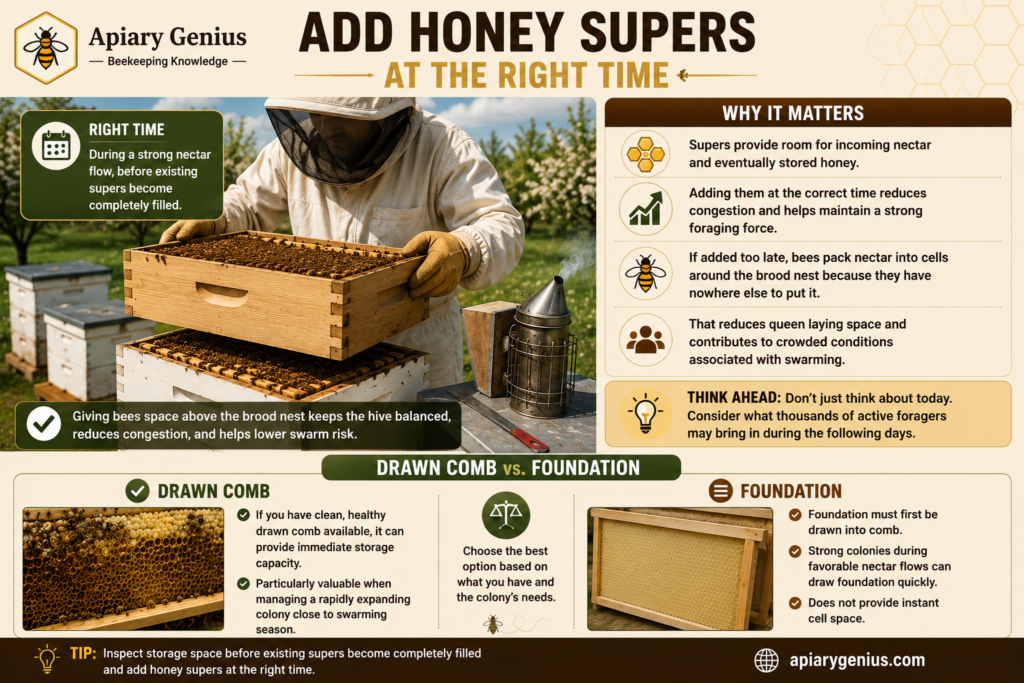
If supers are added too late, bees may begin packing nectar into cells around the brood nest because they have nowhere else to put it.
That reduces queen laying space and contributes to the crowded conditions associated with swarming.
For beekeepers wondering how to prevent bee swarming during a strong nectar flow, adding supers at the right time can help reduce congestion before it becomes a serious problem.
During a major nectar flow, inspect storage space before existing supers become completely filled.
Do not think only about what the colony looks like today. Consider what thousands of active foragers may bring into the hive during the followin⁶g days.
Drawn Comb vs. Foundation
If you have clean, healthy drawn comb available, it can provide immediate storage capacity.
Foundation must first be drawn into comb.
Strong colonies during favorable nectar flows can draw foundation quickly, but it still does not provide instant cell space.
For this reason, drawn comb can be particularly valuable when managing a rapidly expanding colony close to swarming season.
Inspect Colonies Regularly During Swarm Season
You cannot manage what you do not observe.
Regular inspections are essential when learning how to prevent bee swarming because they allow you to spot congestion, queen cells, and rapid colony growth before a swarm develops.
The exact inspection interval depends on local conditions and what you found during the previous inspection, but the important point is to avoid leaving a powerful colony unchecked for long periods during peak swarm season.
During an inspection, do not look only for the queen.
Check:
- Eggs and young larvae
- Brood pattern
- Available laying space
- Nectar and pollen storage
- Colony population
- Drone production
- Queen cups
- Charged or developed queen cells
- Available super space
- Signs of pests or disease
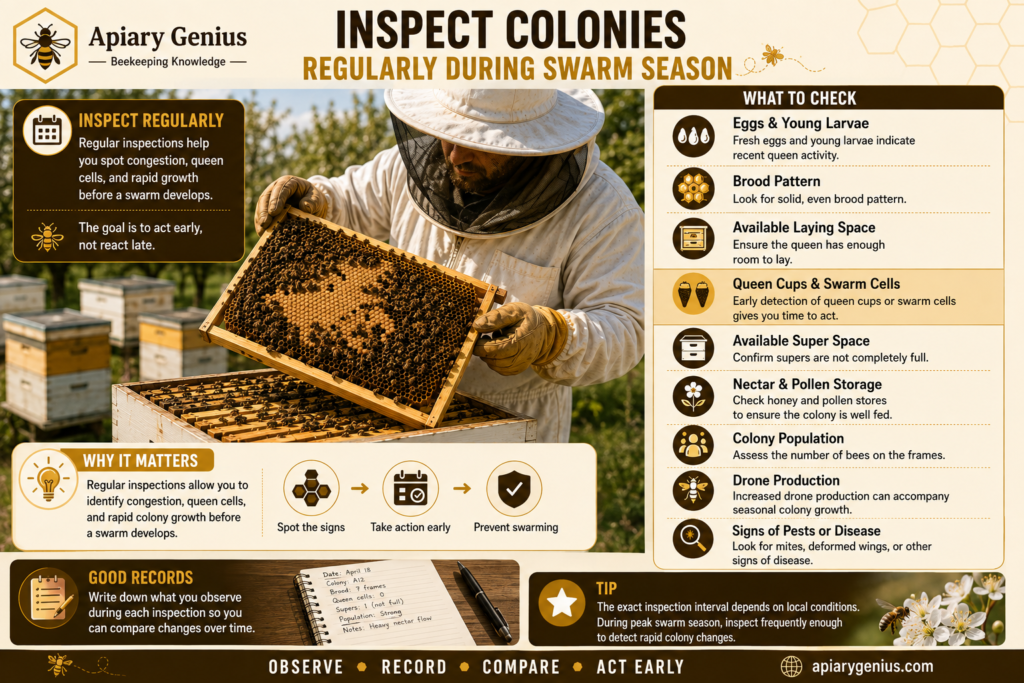
Good records make these inspections much more valuable.
Write down what you observe.
For example:
April 18 — strong colony, 7 frames brood, queenright, heavy nectar coming in, one empty super added, no charged queen cells.
At the next inspection, you can compare actual changes rather than relying on memory.
Swarm management is largely about recognizing trends.
A colony that is merely strong today may be extremely crowded a week later under favorable spring conditions.
Split Strong Colonies Before They Swarm
Splitting is one of the most effective tools available for managing strong colonies.
For beekeepers learning how to prevent bee swarming, making a timely split can relieve crowding and reduce swarm pressure before the colony leaves the hive.
A split is essentially a controlled division of a colony performed by the beekeeper.
Instead of allowing the bees to send a swarm into the environment, you deliberately divide brood, bees, food resources, and queen status between two colonies.
This can relieve congestion and reduce the population pressure contributing to swarming.
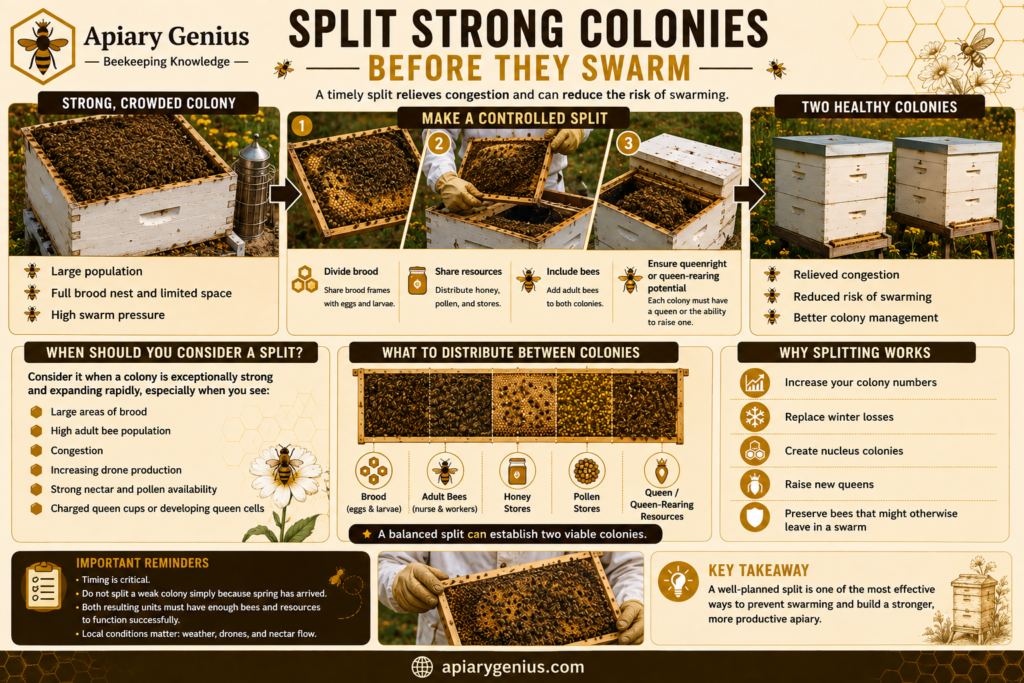
Splits can also help you:
- Increase your colony numbers
- Replace winter losses
- Create nucleus colonies
- Raise new queens
- Preserve bees that might otherwise leave in a swarm
Timing is critical.
Do not split a weak colony simply because spring has arrived.
Both resulting units must have enough bees and resources to function successfully.
Local conditions also matter. A queenless split that must raise its own queen requires suitable drones and weather for successful mating later.
When Should You Consider a Split?
Consider it when a colony is exceptionally strong and expanding rapidly, especially when you see:
- Large areas of brood
- High adult bee population
- Congestion
- Increasing drone production
- Strong nectar and pollen availability
- Charged queen cups or developing queen cells
Once developed swarm cells appear, the need for decisive management becomes much greater.
Splitting a colony is more involved than simply adding a super, but it directly addresses the colony’s reproductive momentum.
Manage Queen Cells Correctly
Finding queen cells often causes new beekeepers to immediately destroy every one.
Understanding what queen cells mean is an important part of learning how to prevent bee swarming, because their presence can reveal how far a colony has progressed toward swarming.
That can be a mistake.
First determine why the colony is producing queens.
Queen cells can be associated with swarming, supersedure, or emergency queen replacement.
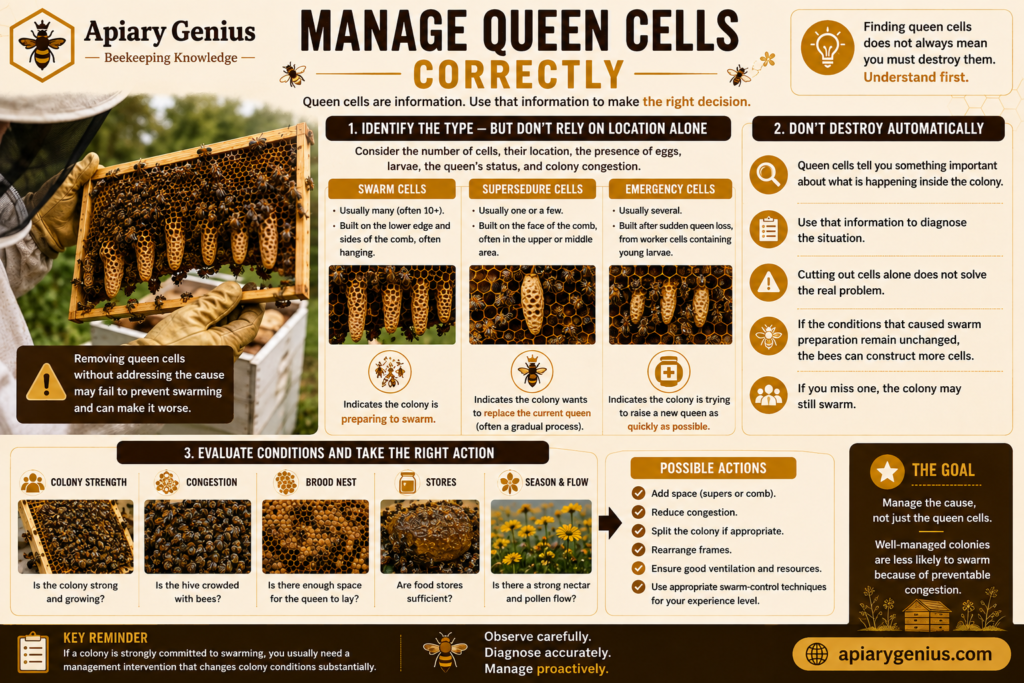
If you destroy cells without understanding the queen status, you could leave a colony with no viable way to produce a replacement queen.
Even when the cells are clearly swarm cells, repeatedly cutting them out is not a reliable long-term strategy by itself.
Why?
Because you may miss one.
And if the conditions that caused swarm preparation remain unchanged, the bees can construct more.
Removing cells does nothing by itself to solve severe congestion, lack of laying space, or the colony’s reproductive state.
If a colony is strongly committed to swarming, you usually need a management intervention that changes colony conditions substantially.
This may mean making a split or using another established swarm-control technique appropriate to your experience level.
Never Rely on Queen-Cell Destruction Alone
Think of queen cells as information.
They tell you something important about what is happening inside the colony.
Use that information to diagnose the situation rather than treating the visible cell as the entire problem.
Requeen When Appropriate
Queen management can form part of a broader swarm-prevention program.
Young queens are often associated with vigorous brood production and may have a lower tendency to swarm than older queens under comparable conditions.
However, replacing a queen is not a magic solution.
A colony with a young queen can still swarm if it becomes extremely congested or enters strong reproductive conditions.
Requeening should therefore complement good space and population management rather than replace them.
Consider queen quality alongside:
- Brood pattern
- Colony temperament
- Productivity
- Disease resistance
- Swarming tendency
- Overall colony performance
If you repeatedly breed from colonies with undesirable swarming behavior, you may unintentionally perpetuate that characteristic in your apiary.
Selecting queens from productive, healthy colonies with manageable behavior is a better long-term approach.
Equalize Colony Strength When Appropriate
If you manage several colonies, one hive may become exceptionally strong while another remains relatively weak.
Careful equalization can sometimes reduce pressure on the strongest colony while supporting another.
For example, experienced beekeepers may transfer appropriate frames of capped brood from a very strong, healthy colony to a weaker healthy colony.
When that capped brood emerges, it adds workers to the receiving colony.
At the same time, removing brood from the overcrowded colony reduces some of its population pressure and creates additional space.
This technique requires caution.
Do not transfer frames blindly between colonies.
You must consider:
- Disease and pest status
- Queen location
- Colony strength
- Weather
- Food availability
- Brood age
- The ability of the receiving colony to care for additional bees or brood
Never use equalization as an excuse to move questionable brood from an unhealthy colony into a healthy one.
Apiary-wide management should improve colony health, not spread problems between hives.
Keep Accurate Records and Learn Your Local Swarm Cycle
The final method is also one of the most underrated.
Keep records.
Swarming conditions differ dramatically by region and year.
Your local climate determines when plants bloom. Rainfall affects nectar flows. Temperature influences brood expansion and foraging. Different colonies grow at different rates.
After several seasons of good records, patterns begin to emerge.
Record information such as:
- Inspection date
- Queen status
- Number of brood frames
- Available laying space
- Queen-cell status
- Supers added
- Major blooms
- Feeding
- Splits
- Requeening
- Swarms
- Honey harvest
Suppose one colony swarms on April 28.
Your notes might reveal that two weeks earlier it already had a rapidly expanding brood nest, heavy nectar intake, drone brood, and very little empty comb.
That information is valuable next season.
Instead of thinking, “My bees swarm around the end of April,” you begin thinking, “I need to start evaluating strong colonies for swarm pressure several weeks before that.”
That is the difference between reactive and preventive beekeeping.
What to Do If You Find Swarm Cells
Imagine opening a strong hive and finding several developed queen cells.
Do not panic, and do not immediately destroy everything.
First, assess the colony carefully.
Step 1: Look for Eggs
Fresh eggs indicate that a laying queen was present very recently.
If you find no eggs, do not automatically conclude the colony is queenless. Queens preparing to swarm may reduce or stop laying shortly before departure.
Step 2: Determine Whether the Original Queen Is Present
Finding her provides valuable information.
If the colony has capped swarm cells, no eggs, fewer bees than expected, and you cannot locate the old queen, consider the possibility that a swarm has already departed.
Step 3: Examine the Queen Cells
Are they empty cups?
Do they contain eggs?
Larvae and royal jelly?
Are they capped?
The developmental stage helps you understand how far the colony has progressed.
Step 4: Evaluate Colony Population and Space
Look at the entire hive.
A dozen queen cells in an extremely crowded, powerful colony tell a different story from a small number of cells in a weak colony with a failing queen.
Step 5: Choose a Suitable Management Strategy
If swarm preparation is advanced, simply adding a super may not reverse it.
A properly planned split is often a stronger intervention because it changes the population and reproductive structure of the colony.
For beginners who are unsure whether they are seeing swarm, supersedure, or emergency cells, getting help from an experienced local beekeeper or beekeeping association can prevent costly mistakes.
Why Cutting Out Queen Cells Often Fails
This deserves special emphasis because it is one of the most persistent swarm-management mistakes.
Imagine that a colony is overcrowded, has little laying space, is receiving large quantities of nectar, and has already begun queen rearing.
You find ten queen cells and remove them.
What changed?
The hive is still crowded.
The brood nest is still restricted.
The colony is still strong.
Nectar is still arriving.
Its biological conditions remain largely unchanged.
The workers may simply start additional queen cells.
There is also the possibility of missing a cell hidden between comb, along a frame edge, or somewhere you did not inspect carefully.
Queen-cell removal can have a place within certain management systems, but it should not be mistaken for a complete solution to the underlying swarm pressure.
Manage the colony, not just the cells.
Common Swarm-Prevention Mistakes
Even attentive beekeepers can make mistakes during the rapid growth of spring colonies.
Understanding the most common ones can save you bees and honey.
Adding Supers Too Late
A super added after the colony has already committed to swarming may provide storage space without eliminating the swarm impulse.
Plan ahead.
Assuming Empty Hive Volume Means Available Space
Bees need functional comb where it matters.
An empty box of undrawn foundation is not equivalent to empty drawn cells in or near an expanding brood area.
Destroying Every Queen Cell Automatically
Always determine why queen cells are present before removing them.
You could interfere with necessary queen replacement.
Splitting Weak Colonies
A split should relieve an overly strong colony, not turn one struggling colony into two weaker ones.
Inspecting Too Infrequently
Spring colony growth can be extremely fast.
Long intervals between inspections can allow a colony to progress from apparently manageable conditions to advanced swarm preparation.
Over-Manipulating the Brood Nest
Creating space is useful; scattering brood carelessly is not.
Weather and colony strength must always be considered.
Ignoring Local Conditions
Advice written for one climate may be poorly timed for another.
Use local flowering patterns, colony development, drone availability, and weather as your guide.
Swarm Prevention vs. Swarm Control
These terms are often used interchangeably, but distinguishing them improves your management decisions.
Knowing the difference between prevention and control makes it much easier to understand how to prevent bee swarming before the colony becomes fully committed to leaving.
Swarm prevention means taking action before the colony becomes strongly committed to swarming.
Examples include:
- Providing adequate laying space
- Adding supers before storage becomes congested
- Monitoring colony growth
- Splitting exceptionally strong colonies proactively
- Managing queens appropriately
Swarm control becomes necessary after clear swarm preparations are underway.
At that stage, the beekeeper may need a more substantial intervention, such as a well-planned colony split.
This distinction explains why a technique that works beautifully on one colony may appear useless on another.
Adding a super to a growing colony before swarm preparations begin can help prevent congestion.
Adding the same super after numerous advanced queen cells are present may not stop the swarm.
Timing changes the outcome.
Does Adding a Super Prevent Swarming?
Sometimes—but not always.
When deciding how to prevent bee swarming, remember that adding a super works best as an early preventive measure rather than a last-minute solution.⁸
Adding supers is an important preventive tool because it creates room for incoming nectar and reduces storage congestion.
However, a super cannot solve every cause of swarming.
If the brood nest is already restricted or the colony has entered advanced swarm preparation, adding a box alone may be insufficient.
Think of supering as part of a system rather than a guaranteed anti-swarm treatment.
The best results come from combining:
adequate storage space + adequate brood space + regular inspections + timely population management.
Can a Hive Swarm More Than Once?
Yes.
A strong colony can produce additional swarms after the primary swarm.
The first swarm typically leaves with the established queen.
Under some circumstances, subsequent swarms—often called afterswarms—can leave with virgin queens.
Multiple swarms can greatly reduce the population remaining in the original colony.
This is another reason why finding advanced queen cells deserves careful management rather than a quick, superficial response.
Can First-Year Colonies Swarm?
Yes.
A common assumption is that a package or nucleus colony cannot swarm during its first season.
While an established overwintered colony may present a greater spring swarm risk, a first-year colony can also become strong enough to swarm when conditions are favorable.
Abundant forage, rapid population growth, good weather, and insufficient space can accelerate development.
Manage what you see in the hive rather than assuming the colony’s age makes swarming impossible.
Does Swarming Mean You Are a Bad Beekeeper?
No.
Swarming is natural honey bee biology.
Even well-managed colonies can swarm.
The goal of good beekeeping is not to pretend that swarming can be eliminated completely. The goal is to understand the factors that increase its likelihood and manage colonies early enough to reduce unnecessary losses.
In fact, a colony preparing to swarm is often exceptionally strong.
The problem is not necessarily colony weakness—it may be that the colony has become successful enough to reproduce.
Your job is to channel that strength productively.
What If Your Bees Have Already Swarmed?
If you believe a colony has already swarmed, inspect carefully rather than immediately making major changes.
You may notice:
- A sudden reduction in adult bee population
- No original queen
- Reduced or absent fresh eggs
- Capped queen cells
- More room inside the hive than during the previous inspection
Avoid automatically destroying all remaining queen cells.
The colony may need one of those queens to replace the queen that left.
After a swarm, the colony normally experiences a brood break while the replacement queen develops, emerges, mates, and begins laying.
Be patient.
Repeatedly disturbing the colony during queen emergence and mating can be counterproductive.
After sufficient time, verify that the colony has successfully become queenright and that the new queen is laying normally.
If queen replacement fails, intervention may eventually be necessary.
A Simple Swarm-Prevention Routine for Beginners
Swarm management becomes easier when you turn it into a repeatable routine.
A consistent routine is one of the best ways to learn how to prevent bee swarming while keeping strong colonies productive throughout the swarm season.
During the local swarm season:
First, assess colony strength.
Is the population increasing rapidly?
Second, inspect brood-space availability.
Does the queen have empty cells available for laying?
Third, check nectar-storage space.
Are the supers filling rapidly?
Fourth, examine queen cups and queen cells.
Are they empty, charged, open, or capped?
Fifth, look at the overall trend.
Compare what you see with your previous inspection notes.
Finally, act early.
Add appropriate space, manage the brood nest carefully, equalize colonies when suitable, or split exceptionally strong colonies before swarm preparation becomes advanced.
The earlier you recognize the direction in which a colony is moving, the more options you have.
Frequently Asked Questions About Preventing Bee Swarms
What is the best way to prevent bees from swarming?
The best way to learn how to prevent bee swarming is to combine regular hive inspections with good space and colony management. Make sure the queen has enough room to lay, provide adequate space for incoming nectar, and watch closely for congestion or developing queen cells during swarm season. Exceptionally strong colonies may also benefit from a timely split. Acting early is usually more effective than trying to stop a colony after it has already become committed to swarming.
Will adding another brood box stop swarming?
It can help when lack of usable brood space is contributing to congestion and the intervention is made early enough. It may not stop a colony that is already strongly committed to swarming.
Should I destroy swarm cells?
Do not destroy queen cells automatically. First determine whether they are associated with swarming, supersedure, or emergency queen replacement. Removing swarm cells without correcting the conditions behind swarm preparation is often unreliable.
How often should I inspect for swarm cells?
Inspection frequency should reflect colony growth and local swarm conditions. During periods of rapid spring expansion, colonies need to be checked regularly enough to detect congestion and queen rearing before a swarm leaves. Do not rely on a fixed calendar alone.
What happens to the old queen when bees swarm?
The established queen generally leaves with the primary swarm, while bees remaining in the original hive complete the process of raising a replacement queen.
Will a young queen prevent swarming?
A young queen may reduce swarm tendency in some circumstances, but it does not make a colony swarm-proof. Strong colonies with young queens can still swarm when population growth and congestion create favorable conditions.
Does feeding bees cause swarming?
Supplemental feeding can stimulate colony growth under some circumstances. If rapid expansion is not matched with appropriate space and management, congestion can develop. Feeding decisions should therefore be based on colony needs, season, forage availability, and your management goals rather than used automatically.
Is a swarm dangerous?
A clustered swarm away from an established nest is often less defensive because it has no brood nest or stored honey to protect. However, bees can still sting. Keep people and animals at a safe distance and contact an experienced beekeeper or local swarm-removal service if removal is necessary.
Conclusion: Prevent Swarming by Staying Ahead of Your Bees
Learning how to prevent bee swarming is ultimately about learning to anticipate colony growth.
Honey bees do not suddenly decide to swarm for no reason. The process develops as population, brood production, resources, space, queen biology, and seasonal conditions interact.
The beekeeper who notices those changes early has options.
Provide adequate storage space before the hive becomes packed with nectar. Make sure the queen has usable laying space. Inspect strong colonies regularly during the local swarm season. Understand the difference between empty queen cups and active queen cells. Split exceptionally strong colonies when appropriate, and never assume that simply cutting out queen cells has solved the underlying problem.
Most importantly, learn from your own apiary.
Record when colonies expand, when major nectar flows begin, when drones appear, when you first see charged queen cells, and when swarms occur.
Over time, swarm prevention stops being a frantic search for queen cells and becomes something much more valuable: anticipating what your colony is likely to do next and managing it before the bees make the decision for you.