
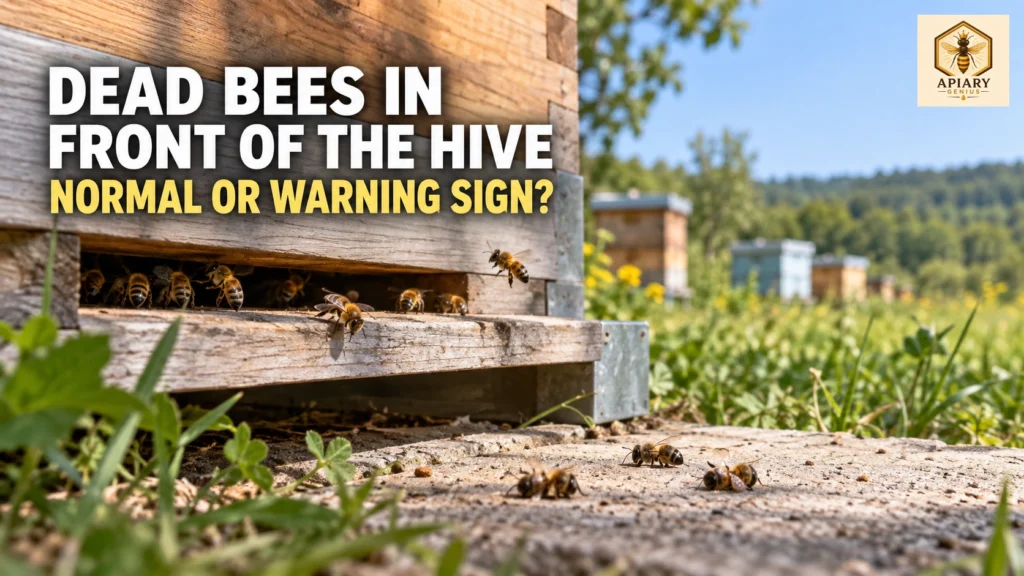
Finding dead bees in front of hive entrances can be alarming, but the sight alone does not tell you what went wrong. Honey bee colonies continually lose individual workers, and healthy colonies also remove dead bees and debris from inside the nest as part of normal housekeeping. UF/IFAS Extension describes worker “undertaker” behavior in which bees carry dead bees, brood, pests, and waste out of the hive.
What matters most is the pattern around the deaths. A gradual or seasonal accumulation is very different from a sudden die-off accompanied by crawling, trembling, fighting, weak flight, reduced entrance traffic, or rapid colony decline.
Instead of diagnosing the colony from the number of bodies alone, look at when the deaths appeared, what the living bees are doing, whether other colonies are affected, what is happening inside the hive, and what changed recently.
Quick Answer
A small accumulation of dead bees in front of hive entrances may simply reflect normal colony housekeeping or seasonal mortality. Worker bees die naturally, and other workers remove corpses from the hive.
A sudden or unusual die-off deserves closer investigation, especially when you also see crawling or trembling bees, flight problems, fighting at the entrance, sharply reduced colony activity, depleted food stores, abnormal brood, or signs of serious Varroa pressure.
There is no universal number of dead bees that separates normal mortality from a serious problem. Colony size, season, weather, housekeeping activity, and recent events all influence what you may see.
Treat dead bees as an observation, not a diagnosis.
Table of Contents
Is It Normal to See Dead Bees in Front of a Hive?
Yes. Seeing some dead bees outside a functioning colony can be normal.
Worker honey bees perform housekeeping tasks that include removing dead bees and other material from the nest. Some workers also die away from the hive while foraging, so the bees visible near the entrance represent only part of the colony’s natural mortality.
This is why counting bodies alone can be misleading. A colony that is actively cleaning may temporarily leave more visible dead bees near the entrance without necessarily having a serious health problem.
Pay closer attention when mortality is:
- suddenly much heavier than what you normally see;
- continuing or increasing rather than declining;
- accompanied by crawling, trembling, paralysis, or disorientation;
- associated with fighting or frantic entrance activity;
- occurring in several colonies at approximately the same time;
- accompanied by rapidly declining adult bee populations;
- associated with critically low food stores, abnormal brood, or strong evidence of Varroa-related decline.
The change from the colony’s normal pattern is usually more useful than an isolated number.
Dead Bees in Front of Hive Entrances: Look at the Pattern, Not Just the Number
Before opening the colony, spend a few minutes observing the entrance, landing board, and surrounding ground.
The goal is not to immediately name a disease or pesticide. It is to collect context.
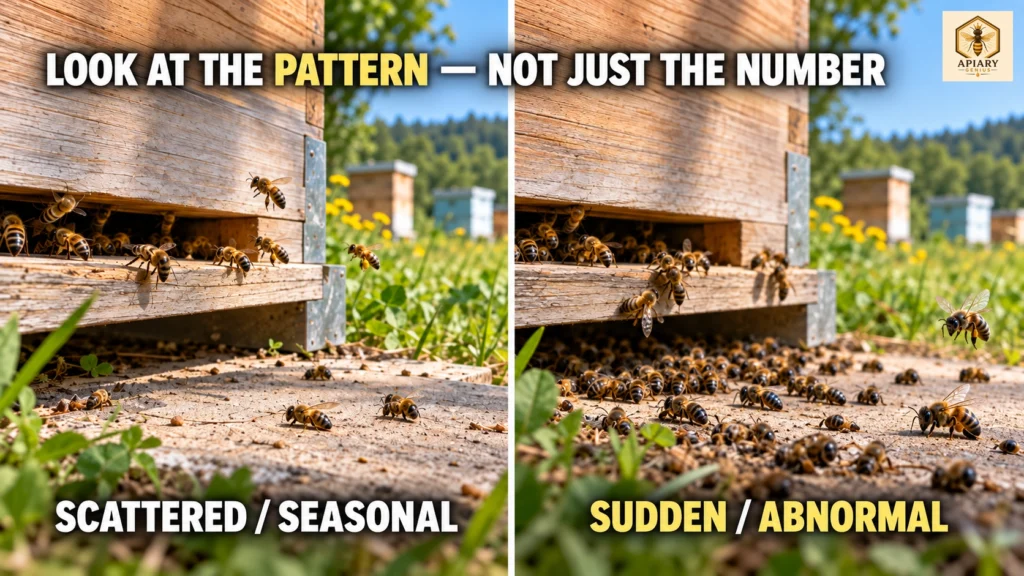
Did the Die-Off Appear Suddenly?
A sudden change deserves more attention than a stable background level of mortality.
Ask:
- Were these bees here yesterday?
- Did the accumulation appear over several hours, several days, or gradually?
- Did something change nearby?
- Was there a pesticide application that you actually know occurred?
- Did you recently feed, move, combine, treat, or heavily manipulate the colony?
- Did the weather change abruptly?
A pile of dead bees can occur during an acute pesticide incident, but that observation alone does not prove pesticide poisoning. The U.S. Environmental Protection Agency also notes that heavily diseased colonies can have large numbers of dead bees near the hive.
Are Bees Dead, Crawling, Trembling, or Unable to Fly?
Look at the living bees as carefully as the dead ones.
Potential warning signs include bees:
- crawling through grass instead of flying;
- repeatedly attempting to fly and falling;
- moving abnormally or with poor coordination;
- trembling or shaking;
- appearing weak or unusually lethargic;
- showing paralysis or difficulty moving.
These observations matter, but they do not point automatically to one diagnosis.
Penn State Extension notes that paralysis viruses can be associated with shaking, poor locomotion, paralysis, and hairless or shiny bees. Deformed Wing Virus and other severe viral infections can also produce recognizable signs.
However, visible symptoms alone do not justify assuming that every crawling or shaking bee has a specific virus.
Is There Fighting at the Entrance?
Fighting changes the diagnostic picture.
Robbing can produce:
- unusually intense flight around a hive;
- bees searching seams and cracks;
- bees attempting to enter outside the normal entrance;
- wrestling or fighting;
- increased defensiveness;
- shredded wax cappings or hive debris;
- increased numbers of dead bees.
UF/IFAS Extension lists entrance fighting, attempts to enter through hive joints, debris, and increased dead bees among the signs of robbing.
If those behaviors fit what you are seeing, use the full Apiary Genius guide to identify and stop robbing bees.
Is One Hive Affected or Several?
Compare colonies before deciding what the problem is.
If one hive has unusual mortality while neighboring colonies appear normal, investigate conditions specific to that colony, including:
- colony strength;
- food stores;
- Varroa history;
- robbing pressure;
- brood condition;
- queen status;
- recent management.
If dead bees in front of hive entrances suddenly appear at several colonies at roughly the same time, a shared event becomes more important to investigate.
That could include weather, forage conditions, management activities, or environmental exposure. It still does not identify the cause by itself.
What Season and Weather Conditions Are You Seeing?
Season matters.
Summer workers generally live for weeks, while winter bees can survive for months. Penn State Extension explains that winter bees can live much longer than summer workers.
In cold weather, bees also spend long periods clustered inside the hive. Dead bees may accumulate before conditions permit more cleanup activity.
Winter therefore can change when and where mortality becomes visible, even when the deaths themselves occurred over a longer period.
But a winter pile should not automatically be dismissed as normal. Food availability, cluster strength, moisture, Varroa history, and other colony conditions still matter.
Normal Housekeeping and Seasonal Bee Death
Death is a continuous part of colony life.
Worker bees remove corpses and other debris from the nest, helping maintain colony hygiene. UF/IFAS Extension describes undertaker bees carrying dead bees and other waste away from the colony.
Normal mortality is more likely when:
- colony activity looks appropriate for the season;
- entrance traffic is orderly;
- surviving bees move and fly normally;
- there is no unusual fighting;
- mortality is not rapidly increasing;
- the colony has adequate food;
- brood and adult population appear generally appropriate for the season.
Winter can make natural mortality appear more dramatic, but winter losses often involve several interacting factors.
A weak colony, inaccessible food, excess moisture, Varroa-associated disease, and prolonged adverse weather can all contribute to colony failure. Washington State University Extension recommends diagnosing winter losses from multiple colony clues rather than assuming a single cause.
When Dead Bees May Point to Pesticide Exposure
Pesticide exposure deserves consideration when mortality is sudden, unusual, and consistent with a plausible exposure event.
Possible warning signs may include:
- large numbers of dead or dying bees appearing quickly;
- crawling or staggering bees;
- failure to fly normally;
- abnormal movement or paralysis;
- abrupt reduction in foraging activity;
- similar problems appearing in several colonies.
But none of these observations alone proves pesticide poisoning.
EPA notes that piles of dead bees can occur in acute pesticide bee-kill incidents, while other colony health problems can also produce substantial mortality.
Do not conclude that a farm, neighbor, mosquito-control program, or particular chemical caused the event unless you have supporting evidence.
Instead ask:
- Was an application actually observed or documented?
- When did mortality begin?
- Are several colonies affected?
- Are nearby colonies unaffected?
- What unusual behaviors are present?
- Could robbing, starvation, Varroa-associated decline, disease, or severe weather also fit the evidence?
The pattern should trigger an investigation—not an automatic diagnosis.
When Robbing or Fighting Is the Cause
Dead bees outside the hive combined with active fighting and abnormal entrance activity can point toward robbing.
During robbing, bees from another colony attempt to enter and take stored honey. Guards may fight them at the entrance and other openings.
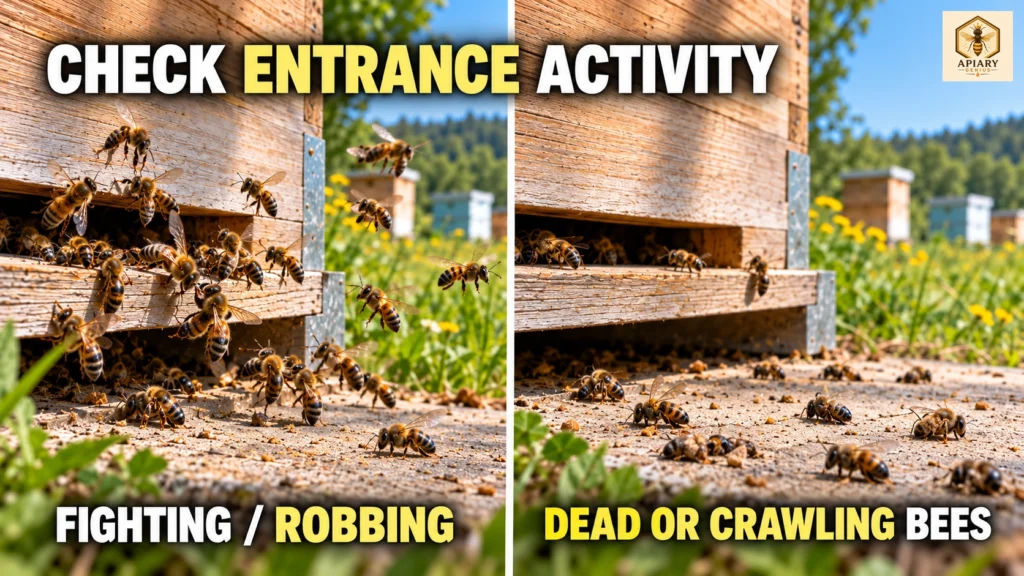
Look for the combination of:
- wrestling bees;
- unusually chaotic flight;
- bees inspecting cracks or box joints;
- repeated attempts to enter through unusual openings;
- shredded wax cappings or debris;
- increased defensiveness;
- declining stores.
UF/IFAS reports these behaviors as characteristic signs of robbing and notes that targeted colonies may have increased numbers of dead bees at the entrance.
Dead bees alone are not enough to diagnose robbing.
If the entrance behavior fits this pattern, see Robbing Bees: How to Tell If Your Hive Is Being Robbed and How to Stop It for the complete management steps.
Starvation and Winter Stress
A colony may have dead bees outside while the most useful evidence is actually inside the hive.
When starvation is possible, look for:
- little accessible honey close to the cluster;
- a small or shrinking cluster;
- large numbers of bees positioned headfirst in cells;
- food remaining on distant frames but unavailable to the cluster;
- evidence that the colony entered winter weak or poorly provisioned.
Washington State University Extension identifies adult bees found headfirst in cells, together with inadequate nearby stores, as an important starvation clue in dead winter colonies. It also emphasizes that winter colony failure may involve overlapping factors rather than one simple cause.
A hive can contain honey and still experience starvation if bees cannot reach it during prolonged cold.
If stores are inadequate but the colony is still alive, determine whether emergency feeding is appropriate rather than assuming the problem is simply “winter mortality.”
For more detail, see:
Disease, Viruses, and Varroa-Related Colony Decline
Some colony health problems cause adult populations to decline without producing one distinctive outside sign that identifies the cause.
Varroa deserves particular attention because the mite damages developing bees and contributes to the spread and amplification of important honey bee viruses.
Penn State Extension identifies uncontrolled Varroa populations as a major driver of damaging Deformed Wing Virus infections, while USDA research continues to identify Varroa-virus interactions as major contributors to colony losses.
Possible accompanying observations include:
- dwindling adult populations;
- spotty or abnormal brood;
- bees with visibly deformed wings;
- crawling or weak bees;
- evidence of poor brood emergence;
- a history of elevated mite levels;
- inadequate or ineffective Varroa management.
But do not work backward from one symptom and declare a specific virus.
Penn State describes shaking, hairless or shiny appearance, poor locomotion, and paralysis in connection with paralysis viruses, while also explaining that laboratory methods may be necessary when a specific infection needs confirmation.
If Varroa pressure may be contributing, see How to Control Varroa Mites: The Complete 2026 Guide.
If deformed-wing bees or a strong Varroa-virus pattern are present, see Deformed Wing Virus in Honey Bees: Symptoms, Varroa Link, and Management.
Likewise, do not diagnose Nosema from crawling bees or population decline alone. If the colony’s broader signs genuinely justify investigating Nosema, see Nosema in Honey Bees: Symptoms, Diagnosis, and Management.
Heat, Chilling, and Other Environmental Stress
Weather can contribute to colony stress, but it should not become a catch-all diagnosis.
Honey bees actively regulate nest temperature. During high heat, workers collect water, distribute droplets inside the colony, and fan their wings to provide evaporative cooling. Oregon State University Extension describes these responses and notes that water demand increases during extreme heat.
During hot conditions, check:
- whether the colony has reliable access to water;
- whether entrance activity and fanning appear normal;
- whether the hive has experienced an unusual increase in heat exposure;
- whether another stressor is occurring at the same time.
Cold weather presents different problems.
Winter bees form a thermoregulating cluster and consume stored carbohydrates to maintain heat. Their ability to reach distant food can become limited when temperatures are too low for the cluster to move effectively.
Weak populations, inadequate accessible stores, moisture, severe weather, and Varroa-associated disease may interact. WSU Extension cautions that separating weather as the sole cause of winter colony death can be difficult.
What to Check Inside the Hive
If weather and colony condition allow a safe inspection, use your outside observations to guide what you check inside.
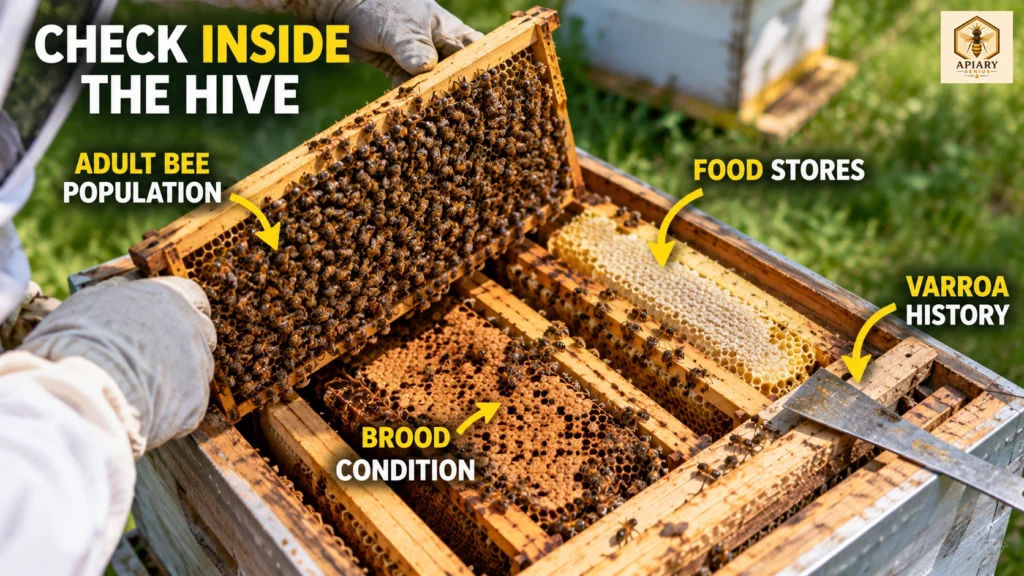
1. Check the adult population.
Does the colony look reasonably strong for the season, or has the population unexpectedly dwindled?
2. Check food stores.
Look at both the amount of food and whether it is accessible to the cluster.
3. Examine the brood area.
Look at brood pattern, larvae, capped brood, emerging adults, and obvious abnormalities.
4. Review Varroa history.
Ask when you last monitored, what the result was, whether treatment was needed, and whether any treatment was effective.
5. Look for robbing evidence.
Shredded cappings, depleted stores, entrance fighting, and chaotic flight make robbing more plausible.
6. Look for disease-compatible signs without overdiagnosing them.
Deformed wings, abnormal brood, shiny or hairless bees, crawling, and similar signs may narrow the possibilities, but a single sign rarely proves one disease.
7. Compare neighboring colonies.
A comparison colony can be extremely useful. One affected hive may point toward a colony-specific problem, while simultaneous abnormalities across several colonies raise the importance of shared conditions or exposures.
The goal is to combine evidence until one explanation becomes more plausible than the alternatives.
What to Do If You Suspect Pesticide Poisoning
If pesticide exposure is reasonably suspected, document what is happening before drawing conclusions.
Record:
- the date and approximate time mortality was first noticed;
- which colonies are affected;
- whether neighboring colonies appear normal;
- the distribution of dead and dying bees;
- abnormal behaviors such as crawling, trembling, paralysis, or failed flight;
- weather conditions;
- any pesticide application you actually observed or can verify.
Take clear photographs and video of the affected hive, entrance, surrounding ground, and unusual bee behavior.
Do not claim that a particular pesticide or active ingredient caused the event without evidence.
If an official investigation or laboratory analysis may be appropriate, contact the relevant authority promptly and follow its sampling instructions rather than inventing your own protocol.
For U.S. beekeepers, EPA provides a dedicated page for reporting bee kills. EPA also provides guidance on reporting pesticide incidents involving wildlife or the environment.
State pesticide regulatory agencies may also be involved in investigating suspected pesticide misuse.
If an investigation may be necessary, document the scene before cleaning away all of the affected bees.
When You Should Act Quickly
Investigate promptly when the pattern has changed substantially from ordinary colony mortality.
Act quickly when:
- large numbers of bees suddenly die or become incapacitated;
- many living bees are crawling, trembling, paralyzed, or unable to fly;
- several colonies develop similar signs at approximately the same time;
- active robbing or intense entrance fighting is occurring;
- the colony is rapidly losing population;
- food stores are critically low;
- Varroa- or virus-compatible signs accompany colony decline;
- the colony is struggling during severe weather;
- you have reasonable grounds to suspect a pesticide incident.
“Act quickly” does not mean “diagnose quickly.”
Address immediate threats you can identify, document unusual events, inspect the colony when appropriate, and gather enough evidence to choose the correct response.
Common Diagnosis Mistakes
One of the easiest mistakes in beekeeping is turning one observation into a complete diagnosis.
“There are a lot of dead bees, so it must be pesticide poisoning.”
Not necessarily. Acute pesticide exposure can cause major bee kills, but other colony health problems can also produce large numbers of dead bees near a hive.
“Crawling bees mean a virus.”
Not by themselves. Some severe viral infections affect movement, but crawling or failed flight should be interpreted with other colony evidence.
“It happened in winter, so they froze.”
Winter colony failure can involve food availability, cluster strength, moisture, Varroa, viruses, and adverse weather together.
“There is honey in the hive, so starvation is impossible.”
A winter cluster may sometimes be unable to reach honey located away from it during sustained cold.
“Dead bees near the entrance mean Colony Collapse Disorder.”
No. EPA describes Colony Collapse Disorder as a sudden disappearance of most worker bees with very few dead bees near the colony. A pile of dead bees therefore does not fit the classic CCD pattern.
“One symptom identifies one disease.”
Many adult-bee symptoms overlap. Entrance behavior, food stores, brood condition, season, Varroa history, apiary-wide patterns, and recent events should be considered together.
The most useful diagnosis comes from a pattern of evidence, not one dramatic clue.
FAQ
Is it normal to see dead bees in front of a hive?
Yes. Some dead bees outside the hive are expected because workers die naturally and other workers remove corpses and debris from the nest.
What matters is whether mortality fits the colony’s normal seasonal pattern or has suddenly increased alongside abnormal behavior, fighting, weak colony activity, depleted stores, or other warning signs.
There is no universal number of dead bees that defines “normal.”
Why are there more dead bees outside my hive in winter?
Winter can make mortality more noticeable.
Cold temperatures keep bees clustered for long periods, and housekeeping activity may be limited. Winter colonies also depend heavily on cluster strength and accessible food reserves.
A winter accumulation should therefore be interpreted alongside stores, cluster size, moisture, weather, and Varroa history rather than automatically being labeled normal or abnormal.
Does a pile of dead bees mean pesticide poisoning?
No.
A sudden pile of dead bees can be consistent with an acute pesticide incident, but it is not diagnostic by itself. Other colony health problems can also produce large numbers of dead bees near a hive.
Look at timing, abnormal behavior, the number of colonies affected, recent events, and internal colony condition before drawing conclusions.
Why are bees crawling in front of the hive and unable to fly?
Several problems can produce crawling or impaired flight.
Possibilities include severe viral disease, Varroa-associated problems, pesticide exposure, deformed wings, chilling, or other physiological stress.
The behavior needs to be interpreted with other evidence. Crawling bees appearing suddenly across several colonies present a different diagnostic pattern from crawling bees in a colony with deformed wings, dwindling population, and a history of poor Varroa control.
Can robbing cause dead bees outside the hive?
Yes.
Guard bees and robber bees may fight at the entrance, producing dead bees around the colony. Robbing is more convincing when dead bees occur together with wrestling, chaotic flight, attempts to enter through seams, increased defensiveness, or shredded wax debris.
For management steps, see Robbing Bees: How to Tell If Your Hive Is Being Robbed and How to Stop It.
Should I remove dead bees from in front of the hive?
For an ordinary small accumulation, cleaning the landing area or ground is optional. Clearing existing bodies can also make it easier to see whether fresh mortality continues afterward.
If you suspect an unusual pesticide-related incident, however, document the scene before cleaning it. If reporting or investigation may be appropriate, follow instructions from the relevant regulatory authority before discarding potential evidence.
Sources
- UF/IFAS Extension — Welcome to the Hive! Honey Bee 4-H Project Book
- UF/IFAS Extension — Robbing Behavior in Honey Bees
- Penn State Extension — Viruses in Honey Bees
- Penn State Extension — Honey Bee Management Throughout the Seasons
- Washington State University Extension — Honey Bee Colonies That Fail to Overwinter Have a Tale to Tell
- Oregon State University Extension — How to Help Bees Survive a Heat Wave
- U.S. EPA — Colony Collapse Disorder
- U.S. EPA — Report Bee Kills
- U.S. EPA — How to Report Pesticide Incidents Involving Wildlife or the Environment
- USDA Agricultural Research Service — Varroa, Viruses, and Recent Honey Bee Colony Losses