
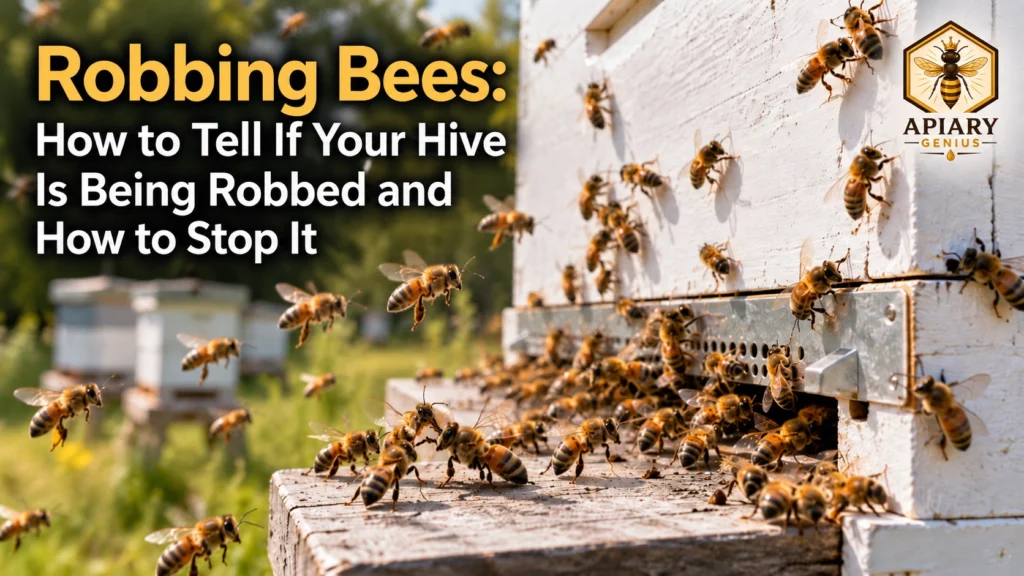
If you suddenly see heavy bee traffic around a hive, robbing bees may be your first concern. But a crowded entrance by itself does not prove that a hive is being robbed. Orientation flights, returning foragers, and other normal colony activity can also create surprisingly heavy traffic around the entrance.
Robbing becomes much more likely when several clues appear together: bees fighting at the entrance, outsiders searching cracks and seams, shredded wax cappings or unusual debris, dead bees, and a rapid loss of stored honey.
If an active robbing event is underway, your first priority is not a long inspection. Stop exposing food, close the hive, and make the colony easier to defend.
Once the immediate pressure has stopped, investigate the second question: Why was this colony vulnerable?
The most useful way to approach suspected robbing is:
Observation → evidence → diagnosis → action.
Quick Answer
A busy hive entrance alone is not enough to diagnose robbing bees. Look for several signs together: fighting at the entrance, bees repeatedly probing cracks or seams, attempts to force entry, shredded wax cappings, unusual numbers of dead bees, and honey stores disappearing unusually quickly.
According to UF/IFAS Extension, robber bees may use the normal entrance as well as joints, holes, cracks, and other openings to reach a colony’s stores.
If you believe robbing is happening right now:
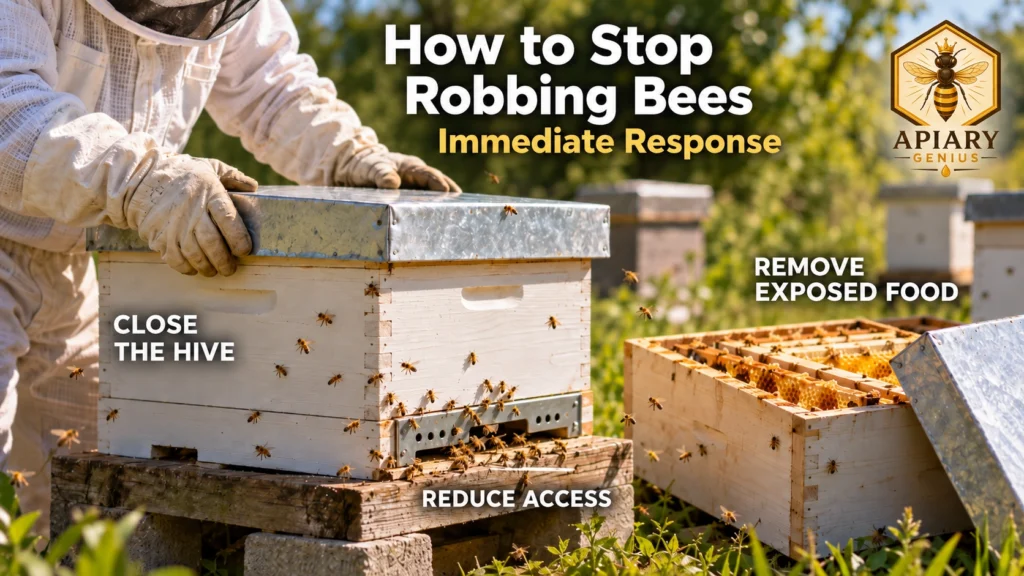
- Reassemble and close any hive you have open.
- Cover or remove exposed honey, syrup, comb, wet supers, and other sugary attractants.
- Clean up spills.
- Reduce the entrance to something the colony can realistically defend.
- Seal unintended openings around boxes, lids, and bottom boards.
- Consider a robbing screen when appropriate.
- If severe robbing continues despite these measures, relocating the vulnerable colony may be necessary.
Do not depend on smoke to stop the event. UF/IFAS specifically states that smoking bees is not an effective way to stop robbing behavior.
Table of Contents
- What Are Robbing Bees?
- How to Tell If Your Hive Is Being Robbed
- Robbing Bees vs. Orientation Flights
- Why Bees Rob Other Hives
- How to Stop Robbing Bees
- What Not to Do During a Robbing Event
- What to Check After the Robbing Stops
- How to Prevent Robbing Bees
- Frequently Asked Questions
- Sources
What Are Robbing Bees?
Robbing occurs when honey bee workers enter another colony and steal nectar or stored honey. Bees may also rob concentrated sugar resources such as syrup if they can reach them.
UF/IFAS Extension describes robbing as behavior that may begin with only a few bees but can escalate as successful robbers return to their colony and recruit additional workers.
For a foraging bee, another colony’s honey stores can represent an unusually concentrated carbohydrate source. Instead of visiting many flowers, a robber that successfully enters another hive may obtain a large reward from one location.
Peer-reviewed research published in Animal Behaviour has also documented coordinated changes in honey bee foraging and nest-defense behavior during honey robbing.
Robbing is especially likely when nectar becomes scarce, but it should not be described as only a late-summer problem.
The important trigger is resource scarcity, particularly a nectar dearth.
The timing of a dearth depends on local flowering patterns, climate, rainfall, drought, agricultural forage, and region. A colony can therefore face robbing pressure at different times of year.
The practical lesson is simple: watch local forage conditions rather than relying only on the calendar.
How to Tell If Your Hive Is Being Robbed
The best diagnosis comes from a pattern of evidence, not from one dramatic observation.
Heavy entrance traffic tells you that something is happening. It does not tell you why.
Before intervening, watch both the entrance and the rest of the hive.
Ask yourself:
- Are bees entering normally?
- Are guards repeatedly fighting incoming bees?
- Are suspicious bees searching somewhere other than the normal entrance?
- Is there unusual wax debris?
- Are stores disappearing?
- Did the activity begin after feeding, harvesting, or opening the colony?
Multiple clues pointing in the same direction provide much stronger evidence than traffic alone.
Fighting and Forced Entry at the Entrance
Fighting is one of the strongest visible signs of robbing.
Guard bees normally inspect incoming workers. During an active robbing event, you may see repeated wrestling, biting, grappling, or bees tumbling from the landing board as resident bees try to stop intruders.
UF/IFAS identifies fighting at the entrance as one of the characteristic signs of robbing. Affected colonies may also become unusually defensive, and the number of dead bees around the entrance may increase.
Watch the pattern for several minutes rather than reacting to a single scuffle.
Normal foragers usually arrive and leave with purpose. Bees attempting to rob may hesitate, encounter guards repeatedly, retreat, and make additional attempts to enter.
Still, fighting by itself does not tell the whole story.
Look at what suspicious bees are doing around the rest of the equipment.
Bees Searching Cracks, Seams, and Other Openings
One of the most useful clues is activity away from the main entrance.
Watch:
- joints between hive bodies
- lid edges
- corners
- bottom boards
- ventilation openings
- warped equipment
- cracks or gaps between components
Robber bees may investigate these locations looking for a route that is easier to enter than the defended entrance.
UF/IFAS specifically notes that robbers can use joints, holes, cracks, and other openings in addition to the normal hive entrance.
This makes seam-searching behavior especially useful diagnostically.
A strong colony can have hundreds of legitimate workers moving rapidly through its normal entrance without being robbed.
Persistent bees testing several access points around the outside of the hive are more suspicious.
Wax Cappings, Dead Bees, and Sudden Loss of Stores
Now look for physical evidence.
Shredded wax cappings or unusual wax debris may appear as robbers open capped honey cells.
Fighting may also produce an increase in dead or injured bees near the entrance.
UF/IFAS includes shredded wax cappings, increased mortality, and depletion of stored nectar and honey among the signs associated with robbing.
A rapid decline in stores is particularly informative if you recently inspected the colony and know approximately how much honey it contained.
But keep the evidence in context.
Wax debris can also result from ordinary colony activity, and some dead bees around a hive are normal.
The diagnosis becomes much stronger when several clues agree:
Fighting + bees searching seams + wax debris + disappearing stores
is much more convincing than:
“There are lots of bees outside.”
Robbing Bees vs. Orientation Flights
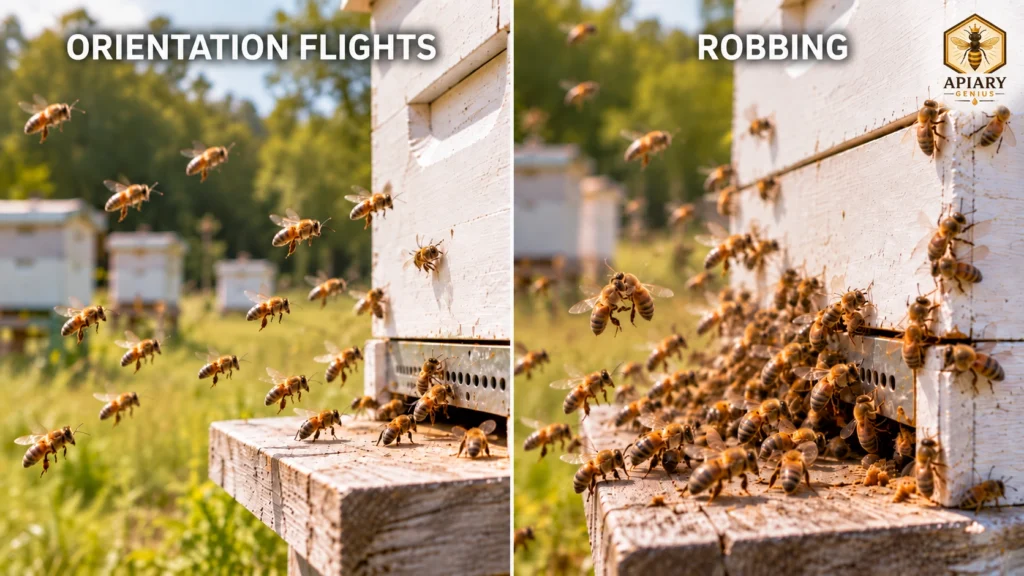
Confusing robbing bees vs. orientation flights is one of the easiest mistakes for a new beekeeper to make.
Both can produce a dramatic cloud of bees in front of a hive.
Their purpose and behavior, however, are very different.
What Orientation Flights Look Like
Orientation flights are learning flights.
Young honey bees perform flights around their home colony before becoming experienced foragers. These flights allow them to learn the position of their hive and important features of the surrounding landscape.
Research published in Nature using harmonic radar showed how honey bees progressively explore their surroundings during repeated orientation flights.
To the beekeeper, orientation flights often look like bees hovering, looping, or flying back and forth in front of the entrance. Many appear to face toward the hive while learning its location.
The activity can look intense, especially when many young bees orient at approximately the same time.
But several signs that would make robbing more likely should normally be absent.
You should not expect widespread fighting, persistent forced entry through cracks, large amounts of shredded cappings, or rapid depletion of honey simply because bees are orienting.
Orientation flights are bees learning where home is.
Robbing is bees attempting to obtain another colony’s food.
Clues That Point More Strongly to Robbing
Do not focus only on the number of bees.
Focus on what they are doing.
Repeated fights with guards point more strongly toward robbing.
Bees persistently testing box joints, lid edges, or cracks are suspicious.
Fresh wax debris combined with abnormal entrance conflict strengthens the diagnosis further.
Context also matters.
Suppose the unusual activity begins during a nectar dearth shortly after you:
- fed syrup
- spilled syrup
- harvested honey
- left wet supers exposed
- opened several colonies
- performed a prolonged inspection
Those circumstances increase your reason to investigate robbing.
Penn State Extension notes that strong colonies may rob smaller or weaker colonies when nectar becomes scarce and discusses robbing screens as one management tool during dearth conditions.
The important principle is nectar scarcity, not a specific month everywhere in the United States.
If the only thing you see is a peaceful cloud of bees flying near their own entrance without fighting or evidence of store loss, continue observing before assuming the hive is under attack.
Why Bees Rob Other Hives
Robbing usually develops when three conditions come together:
Reward + opportunity + inadequate defense.
There is a valuable food resource, bees find a way to reach it, and the targeted colony cannot successfully defend every route of entry.
Nectar Dearth and Resource Scarcity
Nectar dearth is one of the most important triggers.
During a strong nectar flow, thousands of foragers can collect food efficiently from flowers.
When that flow ends, a colony may still contain a large population of experienced foragers even though profitable nectar sources have become much harder to find.
Honey stored inside another colony then becomes an attractive resource.
UF/IFAS explains that bees are less likely to rob when nectar is readily available and more likely to do so when nectar resources become scarce.
The timing varies by location.
A dearth can follow:
- the end of a major bloom
- drought
- prolonged rain
- unusually hot or dry conditions
- seasonal changes in forage
- changes in agricultural flowering
That is why there is no single universal “robbing season.”
Learn what is flowering around your apiary and pay attention when a major nectar source disappears.
Weak or Poorly Defended Colonies
Not every colony can defend the same entrance equally well.
Small colonies, recent splits, nucs, and colonies that have lost significant population may have fewer workers available to guard a large opening.
UF/IFAS notes that weaker colonies can be particularly vulnerable because they have proportionally fewer bees available for defense.
But do not turn that observation into an automatic diagnosis.
A weak colony is not automatically queenless or diseased.
A colony may be small because it is a recent split. Brood production may have been interrupted. Foragers may have been lost. Nutritional stress may be involved. Queen performance, Varroa pressure, or another health problem may also need investigation.
Protect the colony first.
Determine why it is weak after the immediate robbing pressure has stopped.
Exposed Honey, Syrup, Wet Supers, and Open Feed
Beekeepers can unintentionally create an ideal robbing opportunity.
Possible triggers include:
- a dripping feeder
- syrup spilled near a hive
- honey frames left uncovered
- exposed cappings
- wet supers left accessible after extraction
- open containers containing honey residue
- extraction equipment covered in honey
- open feeding accessible to many colonies
UF/IFAS specifically identifies honey, syrup, unattended supers, open hives, feeders, and honey-processing areas as potential robbing resources.
The Canadian Food Inspection Agency’s Honey Bee Producer Guide also recommends practices that reduce exposure to honey and syrup, minimize feeder leaks, and discourage robbing.
If supplemental feeding is necessary, use practices that minimize exposure to bees outside the intended colony.
For more detail, see Feeding Bees: The Complete Guide for Every Season.
Honey-handling practices matter too. If you are removing supers or extracting honey, see How to Harvest Honey.
Long Inspections and Unintended Hive Openings
Opening a hive temporarily removes much of its normal physical protection.
Boxes are separated.
Frames containing honey may become exposed.
Honey odors spread.
The normal guarded entrance may no longer be the only practical route into the colony.
During a strong nectar flow, that exposure may create little trouble.
During a dearth, it can provide exactly the opportunity searching bees need.
UF/IFAS recommends working colonies carefully but efficiently during dearth conditions, covering honey supers, and avoiding unnecessary exposure.
The CFIA biosecurity guide similarly emphasizes minimizing the time colonies and comb remain exposed during management.
The practical rule is simple:
Know why you are opening the hive, complete the inspection efficiently, and keep honey covered.
For more inspection guidance, see Best Time to Inspect a Beehive.
How to Stop Robbing Bees
Once you have enough evidence that active robbing is occurring, stop diagnosing and start protecting the colony.
Your priorities are:
Remove the reward → reduce access → make the remaining entrance defensible.
Close the Hive and Remove the Stimulus
If you are inspecting the colony, reassemble it.
Do not keep pulling frames to determine why the hive is weak while robber bees are already finding exposed resources.
That diagnosis can wait.
Then remove the attraction.
Cover exposed frames.
Protect supers.
Remove accessible syrup.
Clean spilled honey or syrup.
Secure exposed comb, extraction residue, and anything else that smells strongly of honey.
UF/IFAS identifies removing the stimulus as a central part of stopping an active robbing event.
This step is easy to underestimate.
Reducing the entrance while syrup continues dripping nearby does not remove the reason bees are concentrating around the colony.
Reduce the Entrance and Seal Unintended Openings
Next, make the hive easier to defend.
Reduce the entrance appropriately for the colony’s strength and current conditions.
Then examine the outside of the hive for additional access points.
Check for:
- gaps between boxes
- poorly aligned hive bodies
- warped equipment
- gaps beneath the lid
- cracks
- unintended bottom-board openings
UF/IFAS recommends reducing the entrance and temporarily blocking unintended openings during active robbing.
Do not interpret that advice as “seal the colony airtight.”
Bees still need a functional entrance and adequate ventilation, particularly during hot weather.
An entrance reducer is also not a guaranteed cure.
If a large robbing frenzy has already developed, reducing the entrance may help the resident guards but may not immediately stop the event by itself.
Use a Robbing Screen When Appropriate
A robbing screen changes how bees reach the hive entrance.
Resident bees can learn the altered route, while robber bees attracted to the familiar entrance position may have more difficulty reaching the actual opening.
Penn State Extension recommends robbing screens as one management tool during nectar dearth conditions.
They can be especially useful for vulnerable colonies when robbing pressure is developing or when robbing risk is high.
But a robbing screen is not magic.
It cannot compensate for:
- dripping syrup
- exposed honey
- uncovered supers
- large gaps elsewhere in the hive
- a severely compromised colony
Use it as part of an overall response rather than as a guaranteed stand-alone solution.
When Relocating a Vulnerable Colony May Be Necessary
Sometimes severe pressure continues despite removing exposed food, reducing the entrance, sealing alternative openings, and protecting the colony.
In that situation, relocation may become necessary.
UF/IFAS recommends relocating a victim colony when other control measures fail to reduce robbing pressure, allowing the colony time to recover and become better able to defend itself.
Relocation should not replace diagnosis.
Once the colony is safe, determine why it became vulnerable.
Otherwise, the same underlying problem may still exist later.
What Not to Do During a Robbing Event
Do not keep the hive open for a long diagnostic inspection while robbing is active.
Do not leave honey frames exposed while deciding what to do.
Do not leave wet supers, cappings, syrup containers, or extraction residue accessible to bees.
Do not create another open food source to “distract” the robbers. You may simply recruit more bees to concentrated food in the apiary.
Do not assume smoke will stop the event.
UF/IFAS specifically states that smoking bees is not an effective method for stopping robbing behavior.
Smoke remains an important tool for ordinary hive management, but it should not be presented as a proven solution to active robbing.
Do not use improvised chemical repellents around the hive entrance. A substance that repels incoming bees may also interfere with the resident colony.
Do not seal an occupied hive airtight without considering airflow, temperature, and colony safety.
And do not automatically combine a weak robbed colony with another hive before understanding why it became weak.
The CFIA Honey Bee Producer Guide emphasizes minimizing direct and indirect contact that could move pests between bee populations.
Combining colonies or transferring brood can be useful management techniques in the right situation, but health status and management context should be considered first.
What to Check After the Robbing Stops
Once the intense activity has ended and opening the colony is unlikely to immediately restart the event, your objective changes.
Now ask:
What damage occurred, and why was this colony unable to defend itself?
Colony Strength and Queen Status
Begin with the adult bee population.
Is the colony large enough to defend the equipment it occupies?
Is there significantly more hive space than the remaining bees can protect?
Has the population recently declined?
Was the colony recently split?
Then evaluate queen status using evidence appropriate for the season.
Depending on conditions, you may look for:
- eggs
- young larvae
- a reasonable brood pattern
- normal brood-nest activity
- the queen herself, if seen
Do not assume that a robbed colony is queenless simply because it is weak.
Likewise, finding a queen does not automatically explain the colony’s condition.
A queenright colony may still have insufficient population because of seasonal decline, nutritional problems, brood interruption, Varroa pressure, disease, or other stress.
The objective is to explain the weakness rather than attach a convenient label to it.
Remaining Food Stores
Determine how much food remains.
A severe robbing event can remove significant stores in a short period.
UF/IFAS notes that robbers can continue exploiting an accessible resource until its nectar and honey stores are depleted.
If supplemental feeding is necessary afterward, do not recreate the same conditions that contributed to the robbing event.
Use an appropriate protected feeder.
Prevent leaks.
Keep external surfaces clean.
Avoid creating an exposed food source beside a colony that is still vulnerable.
If the event occurs as colonies are preparing for winter, reassess the colony’s stores and overall seasonal condition.
See How to Prepare Your Beehive for Winter for the broader winter-preparation process.
Varroa and Disease Risk After Inter-Colony Contact
Robbing is not only about lost honey.
It also creates substantial contact between bees from different colonies.
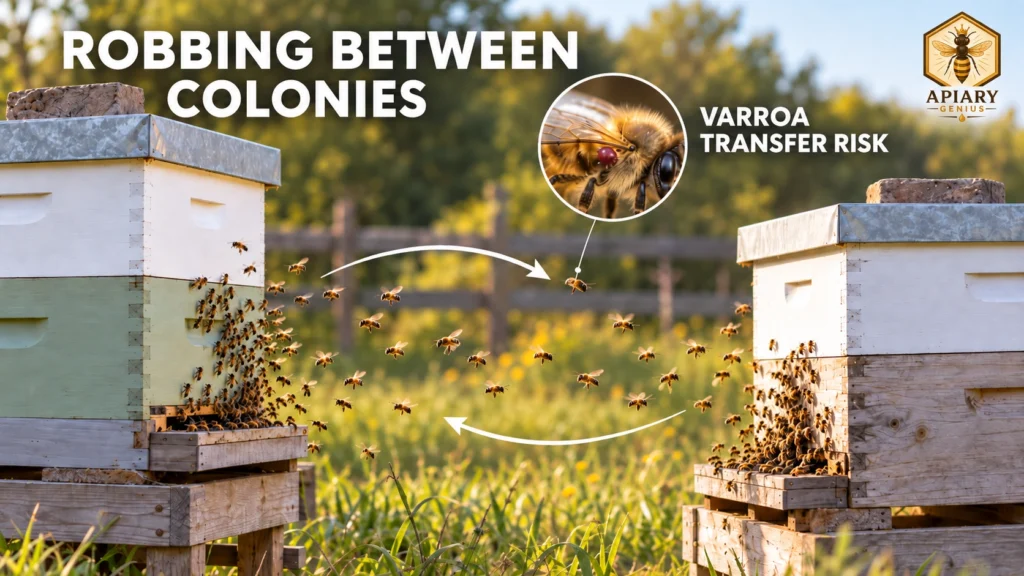
UF/IFAS notes that robbing can promote bee drift and increase opportunities for pests or pathogens to move between colonies.
The CFIA biosecurity guide likewise treats robbing and other inter-colony movement as relevant biosecurity concerns.
There is particularly important evidence involving Varroa destructor.
In a peer-reviewed study published in PLOS ONE, researchers David Peck and Thomas Seeley examined Varroa movement from heavily infested collapsing colonies to neighboring colonies.
Their observations showed that large numbers of mites could reach recipient colonies when those colonies robbed heavily mite-infested collapsing colonies.
This provides experimental evidence that robbing can contribute to Varroa transmission under the conditions studied.
But the distinction is important:
A robbing event does not automatically prove that Varroa or any particular disease was transmitted.
Instead, increased inter-colony contact should be treated as a reason to reassess colony health and your monitoring program.
After significant robbing, review your Varroa monitoring rather than automatically applying a treatment without evidence.
For more information, see How to Control Varroa Mites.
How to Prevent Robbing Bees
The easiest robbing event to manage is the one that never becomes established.
To prevent robbing bees, reduce both the attraction and the opportunity.
That means:
- keeping concentrated food unavailable to outsiders
- maintaining defensible entrances
- minimizing unnecessary hive exposure
- maintaining sound equipment
- identifying colonies that are unable to defend their resources
Manage Entrances During a Dearth
Entrance size should match colony strength and current conditions.
A small colony should not be forced to defend an unnecessarily large opening during a period of intense robbing pressure.
UF/IFAS recommends entrance reduction during nectar dearths as a preventive measure.
However, ventilation still matters.
The goal is not to create the smallest opening possible regardless of conditions.
The goal is a defensible entrance that still meets the colony’s ventilation and traffic needs.
Robbing screens may also be useful for vulnerable colonies when robbing pressure is expected.
Feed Without Creating an Open Food Source
Feeding can help a colony when natural food is inadequate, but careless feeding can also create a robbing opportunity.
The CFIA honey bee biosecurity guidance recommends feeding in ways that minimize exposure, reducing feeder leaks, and cleaning honey or syrup spills.
UF/IFAS also recommends keeping external feeder surfaces free of syrup and cleaning spills quickly.
Good practices include:
- using protected feeders
- repairing leaking feeders
- cleaning syrup from external surfaces
- avoiding exposed open feed near vulnerable colonies
- keeping stored feed securely closed
- preventing honey-contaminated equipment from remaining accessible
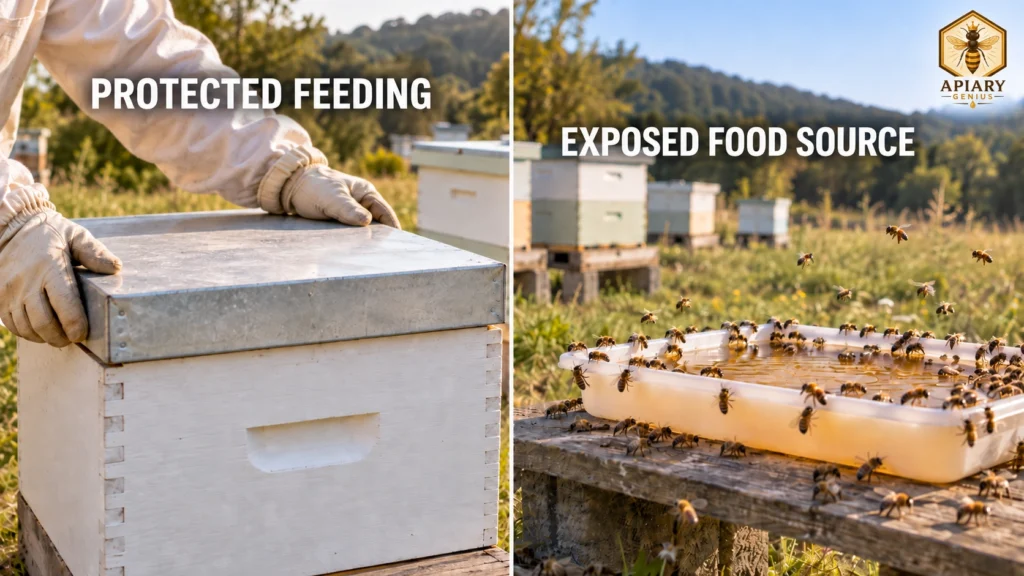
For a detailed feeding strategy, see Feeding Bees: The Complete Guide for Every Season.
Keep Inspections Short and Honey Covered
During a nectar dearth, prepare before opening the hive.
Know what you need to inspect.
Have your tools and replacement equipment ready.
Protect honey-containing frames and supers rather than leaving them exposed.
UF/IFAS recommends working efficiently and keeping supers covered when robbing risk is high.
The CFIA biosecurity guide also recommends minimizing the time colonies and comb remain exposed during management.
There is no need to turn every inspection into a race.
The objective is simply to avoid leaving an attractive food source exposed longer than necessary.
A useful rule is:
Open with a purpose, inspect efficiently, cover honey, and close the hive when the job is finished.
Strengthen or Reassess Vulnerable Colonies
If the same colony repeatedly becomes a target, an entrance reducer may be treating only the symptom.
Evaluate the larger picture.
Check:
- adult bee population
- brood condition
- queen performance
- food availability
- Varroa pressure
- signs of other health problems
- hive equipment
- unused hive space
- cracks and unintended openings
UF/IFAS recommends maintaining healthy colonies, keeping equipment in good condition, and avoiding more space or stored resources than a colony can effectively protect.
If you are considering equalizing, transferring brood, or combining colonies, first consider health and biosecurity.
The goal is not simply to make robber bees disappear for one afternoon.
The goal is to leave the colony in a condition where it can better protect itself the next time natural forage becomes scarce.
Frequently Asked Questions
How can you tell if bees are robbing a hive?
Do not diagnose robbing from heavy entrance traffic alone. Look for several clues together: fighting at the entrance, bees attempting to enter through cracks or seams, persistent forced entry, shredded wax cappings, increased dead bees, and rapid loss of stored honey.
Multiple signs are much stronger evidence than traffic by itself.
How do you stop robbing bees quickly?
Close any open hive, remove or cover exposed honey and syrup, clean spills, reduce the entrance, and seal unintended openings.
A robbing screen may help. If severe pressure continues despite these measures, relocating the vulnerable colony may be necessary.
What is the difference between robbing and orientation flights?
Orientation flights are learning flights that help young bees learn the location of their hive and surrounding landmarks.
They may produce heavy flight activity but normally lack the fighting, forced entry, seam searching, wax debris, and rapid store loss associated with robbing.
Why do bees suddenly start robbing another hive?
A nectar dearth is a major trigger.
Exposed honey, syrup, leaking feeders, uncovered supers, prolonged inspections, accidental openings, and poorly defended colonies can provide opportunities that turn searching behavior into active robbing.
Will an entrance reducer stop robbing?
An entrance reducer can make the opening easier for resident guards to defend and is recommended as part of robbing management.
However, it cannot guarantee that a severe established attack will stop. Exposed food and other access points must also be addressed.
Do robbing screens work?
Robbing screens can reduce access by robber bees and are recommended as a management tool during periods of high robbing pressure.
They work best as part of a broader strategy that also removes exposed food and secures unintended openings.
Can robbing bees spread Varroa mites or disease?
Robbing increases contact between colonies and can create opportunities for pests and pathogens to move between them.
Experimental research has shown Varroa movement associated with colonies robbing heavily mite-infested collapsing colonies.
However, a robbing event does not automatically prove that Varroa or any specific disease was transmitted.
Should I close a hive completely during robbing?
Reassemble an open hive, reduce the intended entrance, and seal unintended gaps, but do not casually make an occupied colony airtight.
Bees still require appropriate ventilation and a functional entrance. Temperature, weather, and colony safety must be considered.
Can a strong hive be robbed?
Yes.
Strong colonies are generally better able to defend themselves, but they are not immune. Large openings, damaged equipment, prolonged exposure of honey, or an intense robbing event can create opportunities even in otherwise healthy colonies.
What should I check after a hive has been robbed?
Check the adult bee population, queen status, brood condition, remaining food stores, hive equipment, entrance size, Varroa status, and the reason the colony was unable to defend itself.
Do not automatically feed, combine, requeen, or treat until you understand what the colony actually needs.
Sources
- University of Florida IFAS Extension — Robbing Behavior in Honey Bees
- Penn State Extension — Honey Bee Management Throughout the Seasons
- Canadian Food Inspection Agency — Honey Bee Producer Guide to the National Bee Farm-level Biosecurity Standard
- Peck & Seeley — Mite Bombs or Robber Lures? The Roles of Drifting and Robbing in Varroa Destructor Transmission From Collapsing Honey Bee Colonies to Their Neighbors — PLOS ONE
- Grume et al. — Honey Robbing Causes Coordinated Changes in Foraging and Nest Defence in the Honey Bee, Apis Mellifera — Animal Behaviour
- Capaldi et al. — Ontogeny of Orientation Flight in the Honeybee Revealed by Harmonic Radar — Nature