
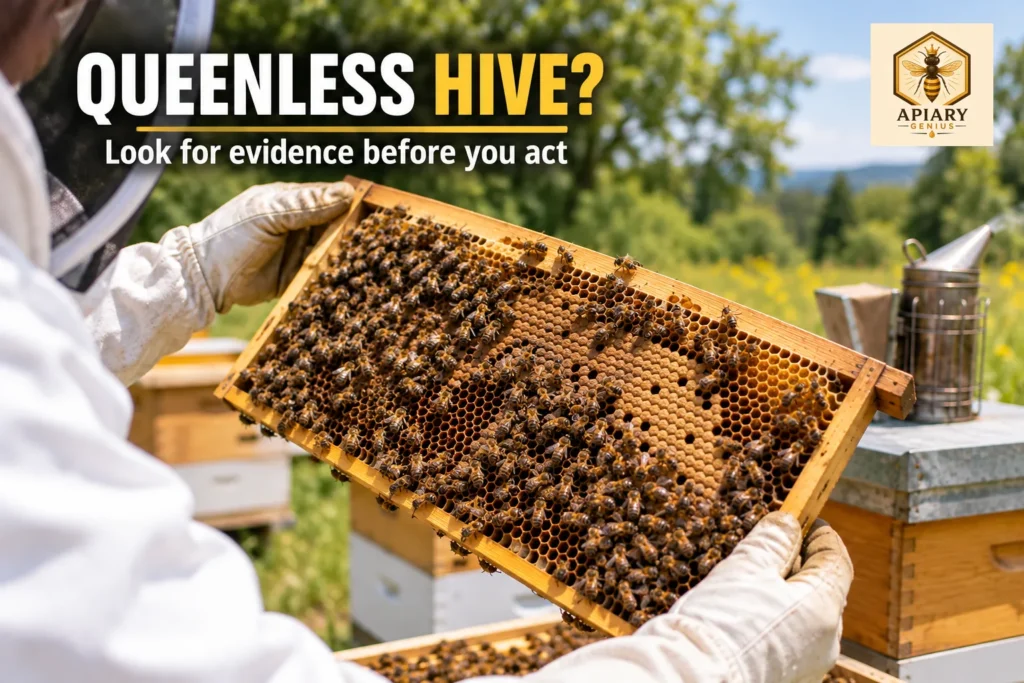
A queenless hive can be difficult to diagnose because the most obvious clue—failing to find the queen—is also one of the least reliable.
Queens hide behind workers, move between frames, and can be surprisingly difficult to spot. A colony that recently swarmed may contain a virgin queen that has not started laying. A newly mated queen may also be present even though you cannot yet find eggs.
That is why diagnosing queenlessness should be based on the colony’s evidence, not simply on whether you see the queen.
Look at the youngest brood available. Check the ages and progression of the remaining brood. Examine queen cells carefully. Think about what happened during the last inspection or whether the colony recently swarmed. Then decide whether the evidence fits a truly queenless colony, a colony raising a replacement, or one that already has a virgin or newly mated queen.
The goal is simple:
Suspect → Observe → Check the brood timeline → Rule out a virgin or newly mated queen → Confirm → Act.
Making that distinction before adding a queen can prevent an unnecessary—and potentially unsuccessful—requeening attempt.
Quick Answer
A queenless hive may have no eggs or very young larvae, progressively aging brood with no new brood replacing it, or emergency queen cells started after the loss of the queen.
However, no single sign proves queenlessness.
A colony can have no eggs while a virgin queen is maturing or mating. You may also simply fail to find a perfectly healthy queen.
Before introducing a new queen, inspect the brood carefully, determine how old the youngest brood is, examine any queen cells, and review the colony’s recent history. When uncertainty remains and you have another healthy colony available, a frame containing eggs and very young larvae can provide additional evidence about queen status.
Table of Contents
What Does a Queenless Hive Mean?
A queenless colony is a colony that has lost its functional queen and has not yet successfully established a replacement.
That does not necessarily mean the hive contains no queen at the moment you inspect it.
A colony may pass through several different stages after losing its laying queen. At first it may genuinely have no queen. Later it may contain developing queen cells. After a queen emerges, the colony can contain a virgin queen but still have no eggs. After mating, there may also be a short period before obvious new brood appears.
This distinction matters because those situations require different decisions.
A genuinely queenless colony that cannot replace its queen may need help. A colony with a healthy virgin queen, however, may need little more than time and favorable mating conditions.
How a Colony Becomes Queenless
A colony can lose its queen in several ways.
The queen may die naturally, become injured, disappear during an inspection, or be accidentally killed. Management actions such as making a split can intentionally create a queenless unit. Swarming also creates a temporary interruption in laying in the parent colony because the old queen leaves with the swarm while the colony establishes a daughter queen.
If you suspect queen loss shortly after an inspection, split, or swarm, that recent history becomes an important part of the diagnosis.
For example, finding no eggs shortly after a known swarm means something very different from finding no eggs in a colony that previously had a laying queen and shows no evidence of replacement queen production.
If you are managing colony divisions, see our guide to splitting a beehive. If the colony recently showed swarm activity, our guide to preventing bee swarming provides additional context.
What Happens After the Queen Is Lost
Workers can respond rapidly when queen signals disappear.
If suitable young female larvae are available, workers can begin emergency queen rearing by enlarging worker cells around selected larvae and feeding those larvae for queen development.
Timing is critical.
Honey bee eggs hatch at about three days. Queen development takes roughly 16 days from egg to adult emergence. Workers therefore cannot simply turn any old capped worker brood into a queen. They need appropriately young female larvae.
This is why the age of the youngest brood present when the queen disappears determines whether the colony still has the biological material needed to raise a replacement.
Once a virgin queen emerges, the process still is not finished. She must mature, take one or more mating flights when conditions allow, return successfully, and begin laying.
A colony can therefore appear broodless for a meaningful period even while a legitimate replacement process is underway.
For more detail on how colonies produce queens, see our queen rearing guide.
Signs Your Beehive May Be Queenless
The signs of a queenless hive are most useful when several pieces of evidence point in the same direction.
Some clues are strong. Others are only supporting observations.
The absence of eggs, the age of the youngest brood, and the state of queen cells usually tell you more than colony noise or temperament.
No Eggs or Very Young Larvae
Finding no eggs is an important clue—but not proof.
If a laying queen disappears, new eggs stop immediately. Existing eggs remain visible for only about three days before hatching.
Young larvae then become progressively older.
That gives you a biological clock.
Suppose you inspected a colony a week ago and saw eggs, but today there are no eggs and the youngest brood consists of larvae several days old. That pattern suggests egg laying stopped sometime between inspections.
If you return later and find only capped brood with no new eggs or larvae, the evidence becomes stronger that there has been a brood interruption.
But there is an important exception:
A colony with a virgin or newly mated queen may also have no eggs.
Always interpret the absence of eggs alongside the colony’s timeline.
Emergency Queen Cells
Emergency queen cells can provide strong evidence that workers detected queen loss and began trying to replace her.
Unlike queen cups alone, active emergency queen cells contain developing queen brood and are constructed around suitable young female brood after queen loss.
But queen cells require interpretation.
Ask:
- Are they open and actively being provisioned?
- Are they capped?
- Has a queen already emerged?
- Have the cells been torn down?
- Did the colony recently swarm?
- Could the cells be supersedure or swarm cells rather than emergency cells?
The presence of queen cells tells you that queen-related events are occurring. It does not automatically tell you what the colony’s queen status is today.
Destroying queen cells before understanding that timeline is one of the easiest ways to interfere with a colony that is already replacing its queen.
Changes in the Brood Pattern
A queenless colony does not instantly become broodless.
Instead, brood ages out.
After the queen stops laying, the eggs already present hatch. Larvae continue developing. Worker cells are normally capped around the end of the larval period, and worker bees emerge about 21 days after their eggs were laid.
This creates a recognizable progression:
eggs → young larvae → older larvae → capped brood → no worker brood
If you inspect repeatedly and see that progression without new eggs appearing behind it, the colony has experienced a break in worker-brood production.
A poor or spotty brood pattern by itself is less specific. Queen quality, brood disease, nutrition, genetics, pests, and other problems can affect brood appearance.
The important question for queenless diagnosis is not merely, “Does this brood look perfect?”
It is:
“Is new worker brood continuing to appear?”
Changes in Colony Behavior
Beekeepers sometimes describe queenless colonies as noisier, more restless, more defensive, or unusually unsettled.
Those observations can be useful prompts to investigate further.
They should not be used as proof.
Weather, nectar availability, robbing pressure, handling, colony strength, genetics, and other conditions can alter behavior.
Treat unusual behavior as a reason to inspect the brood nest—not as permission to order and introduce another queen.
Not Seeing the Queen Does Not Mean the Hive Is Queenless
This is the most important principle in the entire diagnosis.
You usually do not need to physically find the queen to determine that a colony is queenright.
Fresh eggs in an appropriate pattern can be stronger practical evidence of recent queen activity than spending an extra 20 minutes searching every frame for her.
The Queen May Simply Be Difficult to Find
A queen can disappear under a mass of workers, move to the opposite side of a frame, cross onto another frame while you inspect, or move into another brood box.
Unmarked queens are particularly easy to overlook.
Instead of turning an inspection into a queen hunt, first search for evidence of her work.
Fresh eggs are tiny and can be difficult to see. Hold the frame so light reaches the bottom of the cells and look carefully through the central brood area.
When inspections are necessary, choosing suitable weather and working conditions can also reduce unnecessary disturbance. See our guide to the best time to inspect a beehive.
A Virgin Queen May Be Present
Virgin queens create one of the most common diagnostic traps.
A virgin queen is smaller and more mobile than a mature laying queen and can be difficult to locate on the comb.
More importantly, she does not emerge from her queen cell and immediately begin laying.
Penn State Extension reports that a virgin queen spends roughly five to eight days in the hive before taking her mating flight or flights. Mating and the transition to egg laying add more time.
During this period, you can have:
- no eggs,
- no young worker larvae,
- diminishing older brood,
- no obvious laying queen,
and still have a queen.
If the colony recently produced queen cells and one has emerged normally, give the queen-development timeline serious weight before concluding that the hive has failed.
A Newly Mated Queen May Not Be Laying Yet
Even successful mating does not guarantee that eggs will be visible the instant you inspect.
The beekeeper rarely knows the exact hour a virgin queen emerged, matured, flew, mated, returned, and began reproductive development.
Weather can further affect mating opportunities.
Therefore, an inspection during this transition may reveal no eggs even though the colony is progressing normally.
Repeatedly opening the hive simply because you are anxious to see eggs can add disturbance without giving the queen more time.
Use the timeline and the colony’s history to decide when another inspection will actually provide new information.
How to Confirm Whether a Hive Is Queenless
Confirming a queenless hive should be a process of assembling evidence rather than relying on one missing queen, one behavioral change, or one brood observation.
The strongest diagnosis usually comes from answering several questions together:
- What is the youngest brood present?
- Is new brood still being produced?
- What do the queen cells show?
- What happened recently?
- Is a virgin or newly mated queen plausible?
- Does a test frame provide additional evidence?
Check for Eggs and Young Larvae
Begin in the brood nest.
Look carefully for eggs and the smallest larvae.
A normal queen-laid egg is usually positioned near the bottom of a cell. Very young larvae appear as tiny curved larvae surrounded by brood food.
If you find recently laid eggs distributed appropriately through worker brood cells, a functioning queen has been laying recently even if you never see her.
If you find no eggs, move to the next question rather than immediately declaring the colony queenless.
How old are the youngest larvae?
That answer begins your brood timeline.
Read the Brood Timeline
Honey bee development gives you one of the best diagnostic tools in the hive.
For worker bees:
- the egg stage lasts about 3 days;
- the larval stage follows;
- worker cells are capped at roughly day 8–9 after the egg was laid;
- adult workers emerge at about day 21.
For queens, development from egg to adult takes about 16 days.
Imagine that a laying queen was lost today.
During the next few days, you could still see eggs she laid before disappearing.
After those eggs hatch, you could still see progressively older larvae.
Later, only capped brood may remain.
Eventually, the final worker brood laid by the old queen emerges.
The colony does not switch from “queenright” to “empty brood nest” overnight. The brood nest records what happened.
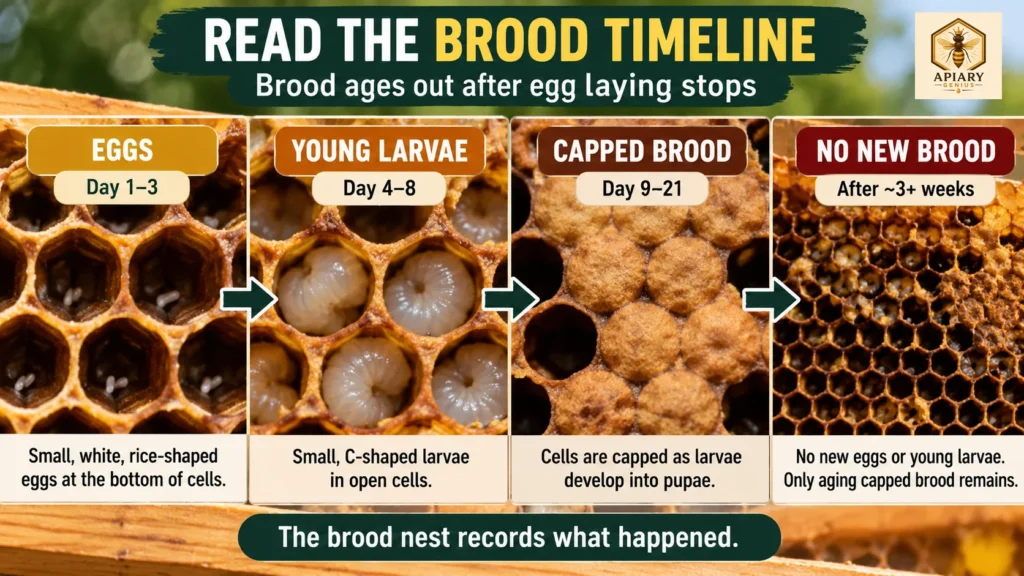
That makes the age of the youngest brood much more informative than simply noticing that brood is present.
If you know when you last saw eggs, when a swarm occurred, when you made a split, or when you saw a queen cell, combine those dates with the developmental timeline.
Inspect Queen Cells Carefully
Do not simply count queen cells.
Read them.
An open queen cell containing a larva and royal jelly represents a different stage from a capped queen cell. A cell from which a queen has emerged normally provides different information from one that has been torn open from the side.
If a queen cell has already produced a virgin queen, the hive may now contain no eggs even though the replacement process is proceeding.
That is exactly when an impatient beekeeper may mistakenly introduce another queen.
If you are unsure whether the colony is raising a queen, compare what you see with the expected roughly 16-day development period from egg to adult queen.
Review What Happened During Recent Inspections
Your notes can be as valuable as what is on the frame.
Ask yourself:
- When did I last see eggs?
- When did I last see a normal laying pattern?
- Did I see the queen recently?
- Did I make a split?
- Did I remove queen cells?
- Did I accidentally injure or lose a queen?
- Did the colony swarm?
- Were capped queen cells present during the previous inspection?
- Was a queen recently introduced?
The same brood pattern can mean very different things depending on those answers.
A broodless colony two days after a questionable inspection and a broodless colony several weeks after a known swarm should not automatically receive the same treatment.
Use a Test Frame When Appropriate
If you have another healthy queenright colony, a frame containing eggs and very young larvae can help resolve an uncertain diagnosis.
Choose healthy brood from a colony with no suspected brood disease and make absolutely sure you do not transfer the donor queen.
Place the frame where the suspect colony can care for the brood.
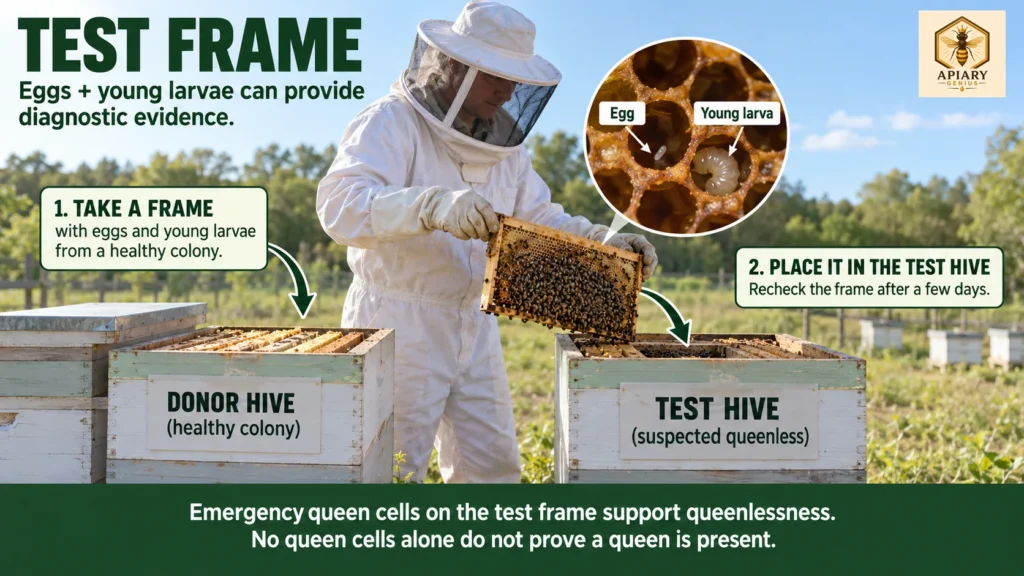
A colony that lacks a queen and has suitable conditions may begin constructing emergency queen cells from appropriate young brood. That response provides strong additional evidence that the colony perceived itself as queenless.
A lack of emergency cells, however, should be interpreted cautiously rather than treated as absolute proof that a productive laying queen exists. Colony condition, a virgin queen, and other circumstances can complicate the response.
The test frame also gives a genuinely queenless colony suitable young brood from which it may be able to start a replacement queen.
Queenless Hive or Virgin Queen? How to Tell the Difference
This is often the hardest decision in queen diagnosis.
Both situations can produce:
- no eggs,
- no young larvae,
- aging capped brood,
- difficulty finding a queen.
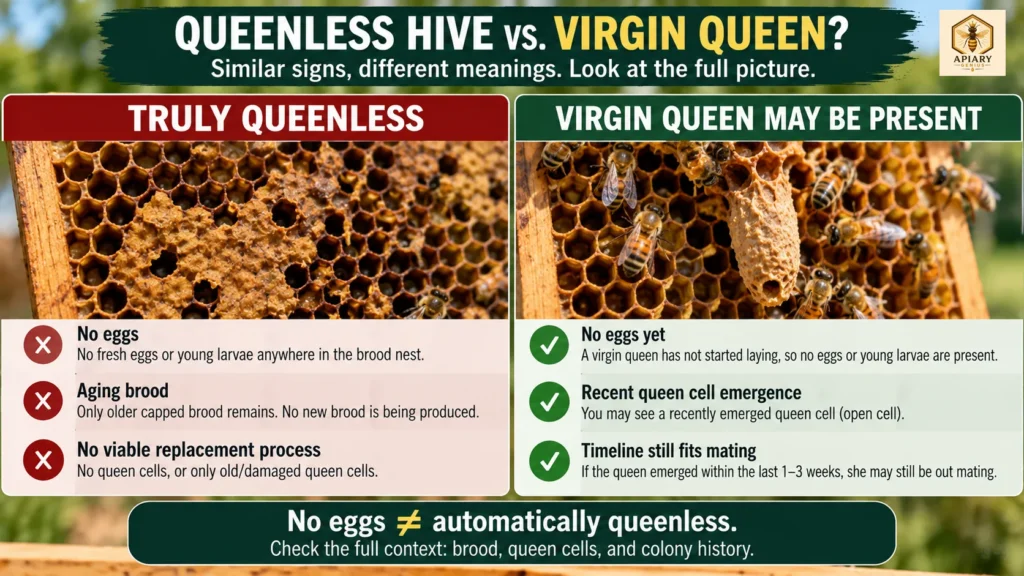
The difference is usually revealed by history and timing.
If the colony recently swarmed or had viable queen cells and enough time has passed for a queen to emerge—but not necessarily enough time for her to mature, mate, and establish a laying pattern—a virgin queen is a realistic explanation.
Penn State Extension places queen emergence at about 16 days from the egg and reports that virgin queens generally spend another five to eight days in the hive before taking mating flights.
That means a colony raising its own replacement naturally experiences a substantial brood break.
Look for evidence such as an emerged queen cell and a timeline consistent with queen development. Avoid repeatedly disturbing the colony merely because eggs have not appeared as quickly as you hoped.
Conversely, if there are no eggs, no suitable young brood, no convincing replacement process, no plausible virgin-queen timeline, and a test frame triggers emergency queen production, true queenlessness becomes much more likely.
The question is not:
“Can I find a queen?”
It is:
“Does the biological timeline explain what I am seeing?”
Queenless Hive vs. Laying Workers
A colony that remains without normal queen and brood signals long enough can develop laying workers.
This is not the same problem as a recently queenless hive.
Worker honey bees are female, but they do not mate. When some workers develop active ovaries, they can lay unfertilized eggs, which develop into drones rather than workers.
The appearance of laying workers therefore changes both the diagnosis and the management options.
Signs That Suggest Laying Workers
Typical evidence includes:
- multiple eggs in many cells;
- eggs attached to cell walls rather than consistently positioned at the bottom;
- a scattered, irregular laying pattern;
- drone brood developing in worker-sized cells;
- little or no normal worker brood.
Do not diagnose laying workers from a single cell containing two eggs.
Newly established queens can occasionally lay more than one egg in a cell while their laying pattern settles. What matters is the overall pattern across the brood area and what those eggs develop into.
A laying-worker colony generally shows a widespread, disorganized pattern dominated by unfertilized, drone-producing eggs.
Why the Difference Matters Before Requeening
A recently queenless colony and an established laying-worker colony do not respond identically to queen introduction.
Once laying workers are established, introducing a caged queen can be considerably more difficult, and simply purchasing a queen and placing her in the hive may result in rejection.
That is why early diagnosis matters.
If the colony is truly queenless but has not progressed to laying workers, normal requeening options may still be straightforward.
If laying workers are established, use a management strategy appropriate to that condition rather than treating the colony as newly queenless.
For the standard queen-introduction process, see our guide on how to requeen a beehive.
What to Do If Your Hive Is Truly Queenless
Once you have enough evidence to confirm a queenless hive, the right response depends on colony strength, season, available brood, availability of queens and drones, and your management goals.
There is no single solution that is best for every colony.
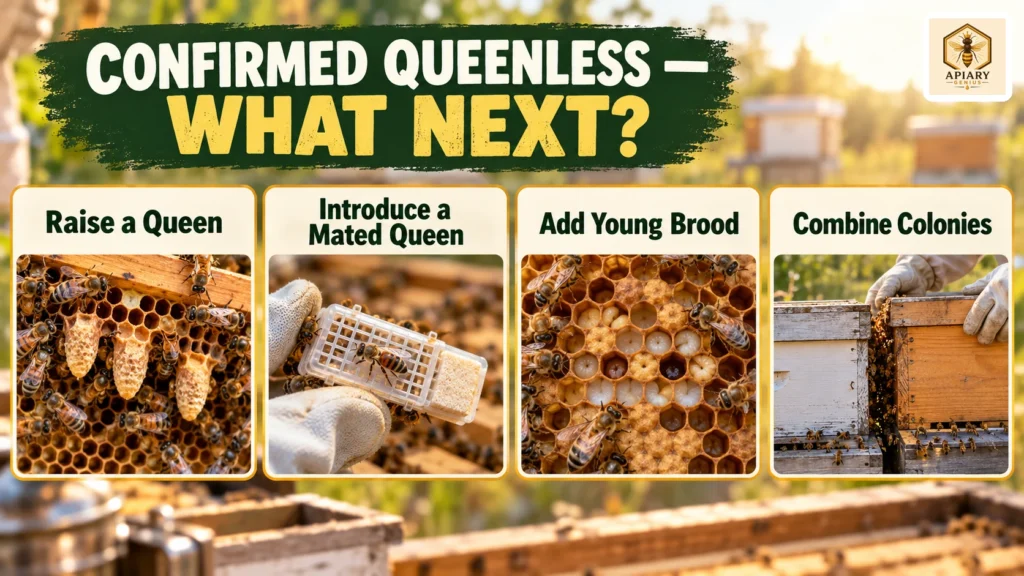
Let the Colony Raise a New Queen
If the colony has suitable young female brood—or already has healthy developing emergency queen cells—you may allow it to complete the process naturally.
This option takes time.
A queen requires about 16 days from egg to adult emergence. After emerging, she must mature and mate before beginning to lay.
The colony therefore experiences a brood break while the replacement queen develops and establishes herself.
Success also depends on conditions suitable for mating and the availability of drones.
If you choose this route, avoid repeatedly destroying queen cells or opening the colony simply to check whether the process has finished.
Our queen rearing guide explains queen development and queen-production principles in greater detail.
Introduce a Purchased Mated Queen
A purchased mated queen can reduce the time required to restore egg laying compared with waiting for the colony to raise, mature, and mate its own queen.
But first confirm that the colony is actually queenless.
Introducing a valuable mated queen into a colony that already contains a virgin, newly mated, or otherwise overlooked queen creates unnecessary risk of rejection.
Also inspect for existing queen cells and follow the queen supplier’s introduction instructions.
For a detailed introduction procedure, use our guide on how to requeen a beehive.
Add a Frame of Eggs and Young Brood
If the colony is genuinely queenless and lacks brood young enough to produce a queen, a frame containing eggs and very young larvae from a healthy queenright colony can give workers suitable material for emergency queen production.
This can serve two purposes:
It can help with diagnosis, and it can provide the colony with brood from which to attempt replacement.
Only transfer brood between colonies you consider healthy. Avoid spreading comb or brood from colonies with suspected brood disease.
Remember that adding brood does not magically produce a laying queen in a few days. The colony still has to rear a queen, she must emerge, mature, mate successfully, return, and begin laying.
Combine the Colony With Another Hive
Sometimes saving a queenless colony as an independent unit is not the best choice.
A weak colony with a shrinking population, poor seasonal timing, inadequate resources, or other serious problems may benefit more from being combined with a healthy queenright colony.
Before combining colonies, evaluate health carefully. Do not combine a diseased colony with a healthy one merely to preserve the remaining bees.
Also confirm queen status before combining so that you do not unknowingly place two queens into a management situation you did not intend.
Combining can be especially practical when there is insufficient time or colony strength to complete successful queen replacement before unfavorable seasonal conditions.
How Long Can a Hive Stay Queenless?
There is no useful universal number of days after which every queenless hive suddenly fails.
What matters is what happens to the colony while it remains without normal worker-brood production.
Worker bees require about 21 days from egg to adult emergence. Once the old queen’s final brood has emerged, no replacement workers will appear unless a new queen has begun laying early enough to restart the cycle.
Meanwhile, existing adult workers continue aging.
During the active season, worker life spans are measured in weeks, although seasonal worker longevity varies substantially. The longer the interruption in brood production continues, the more the colony’s age structure and population can deteriorate.
Extended queenlessness also increases concern about laying workers.
So instead of asking only, “How many days can this hive survive?” ask:
“Does this colony still have a credible path to producing a new generation of workers?”
A strong colony with a developing queen cell and a clear replacement timeline is in a very different position from a dwindling colony with no young brood, no queen cells, and laying-worker signs.
When Should You Stop Waiting for a Queen?
Waiting is appropriate when the evidence supports a normal replacement timeline.
Waiting indefinitely is not.
Use known events whenever possible.
If you saw a capped queen cell, record the date. If the colony swarmed, record the date. If you made a queenless split, record the date. If you later find an emerged cell, update your timeline.
Then compare what happens with normal queen development.
A queen takes about 16 days to develop from egg to adult. A virgin queen generally needs additional time before mating flights, and mating depends on suitable conditions. After mating, egg laying still may not be immediately obvious at your next inspection.
You should become increasingly concerned when the expected timeline has clearly passed and you still find:
- no eggs or worker larvae;
- no convincing evidence of a viable queen;
- no useful queen cells;
- continued population decline;
- or signs of laying workers.
At that point, another diagnostic step—such as a test frame—or a corrective management decision may be more appropriate than simply waiting another week without a reason.
Use dates, not anxiety, to decide when to inspect.
Common Mistakes When Dealing With a Queenless Hive
The first major mistake is assuming that not finding the queen means she is gone.
The second is assuming that no eggs means no queen. A virgin or recently mated queen can create exactly that situation.
Another common mistake is ignoring brood age. Simply recording “brood present” wastes valuable information. Record whether you saw eggs, young larvae, older larvae, capped brood, or some combination.
Beekeepers also get into trouble by destroying queen cells before identifying why those cells exist. A colony may already be successfully replacing its queen.
Introducing a purchased queen too quickly is another costly error. If a virgin or hidden queen is already present, the introduced queen may not be accepted.
The opposite mistake is waiting without a timeline. “Give them another week” is useful only when you know what biological event you are waiting for.
Other mistakes include diagnosing laying workers from one or two cells with multiple eggs, transferring brood without considering colony health, and treating agitation or unusual sound as definitive evidence of queenlessness.
The better approach is consistent:
Read the brood. Read the queen cells. Read the timeline. Then act.
Frequently Asked Questions
How can you tell if a beehive is queenless?
Do not rely on whether you can physically find the queen.
Look for a combination of evidence: absence of eggs and very young larvae, progressively aging brood without replacement, emergency queen cells, recent colony history, and whether a virgin or newly mated queen could reasonably be present.
When uncertainty remains and another healthy colony is available, adding a frame containing eggs and young larvae can provide additional diagnostic evidence.
How long can a hive survive without a queen?
There is no single survival deadline that applies to every hive.
The important problem is the interruption in worker production. Worker honey bees take about 21 days from egg to adult emergence, so after the old queen’s final brood emerges, the colony receives no new workers until a replacement queen begins laying and her brood completes development.
Colony strength, season, worker longevity, resources, and whether laying workers develop all affect how quickly the situation becomes serious.
Will a queenless hive make a new queen?
It can—if it has suitably young fertilized brood and the colony is capable of rearing a queen.
Workers can select young female larvae and rear them as emergency queens by providing queen-specific feeding and building queen cells around them.
If the colony has been without suitable young brood for too long, it cannot create a queen from old capped brood. The beekeeper may need to provide young brood, introduce a queen, or choose another management option.
Can a queenless hive accept a new queen?
Yes, a genuinely queenless colony can accept an introduced queen, but queen acceptance is not guaranteed.
Before introducing her, confirm that another queen—especially a virgin—is not already present and inspect for queen cells according to your chosen introduction method.
Colonies with established laying workers can be more difficult to requeen and may require a different strategy.
How long after losing a queen will bees make queen cells?
Workers can begin the emergency queen-rearing response very quickly after queen loss when suitably young female larvae are available.
However, there is no single rigid number of hours that should be used as a stand-alone field test for every colony. How quickly developing emergency queen cells become obvious to the beekeeper depends on factors including the age of available brood, colony condition, resources, and when the hive is inspected.
Use developing queen cells together with brood age and recent colony history rather than relying on an exact hour count to diagnose queenlessness.
Can a hive have no eggs but still have a queen?
Yes.
A virgin queen may be present but not yet mated. A newly mated queen may not yet have established visible egg laying. Egg laying can also be temporarily interrupted under some colony conditions.
That is why “no eggs” is an important clue rather than automatic proof of queenlessness.
What is the difference between a queenless hive and laying workers?
A recently queenless hive has lost its queen but may not yet contain reproductive workers.
In a laying-worker colony, some workers have developed active ovaries and lay unfertilized eggs. Those eggs become drones.
Typical signs include multiple eggs in many cells, eggs placed irregularly or on cell walls, scattered brood, and drone brood developing in worker-sized cells.
Laying-worker colonies can also be more difficult to requeen successfully.
Should I add a queen if I cannot find the old queen?
No—not based on that fact alone.
First look for eggs, young larvae, brood progression, queen cells, and evidence of a recent swarm or replacement queen.
If the colony already contains a virgin, newly mated, or simply difficult-to-find queen, introducing another queen may result in rejection and the loss of the purchased queen.
Confirm queen status before intervening.
Sources
- Penn State Extension — An Introduction to Queen Honey Bee Development
- Penn State Extension — Beekeeping: Cell Builder Basics
- Penn State Extension — Honey Bee Management Throughout the Seasons
- Penn State Extension — Colony Division: An Easy Method to Split a Colony
- University of Georgia Cooperative Extension — Honey Bees and Beekeeping
- Mid-Atlantic Apiculture Research and Extension Consortium — The Colony and Its Organization
- University of Georgia Bee Program — Non-infectious Diseases and Pests