
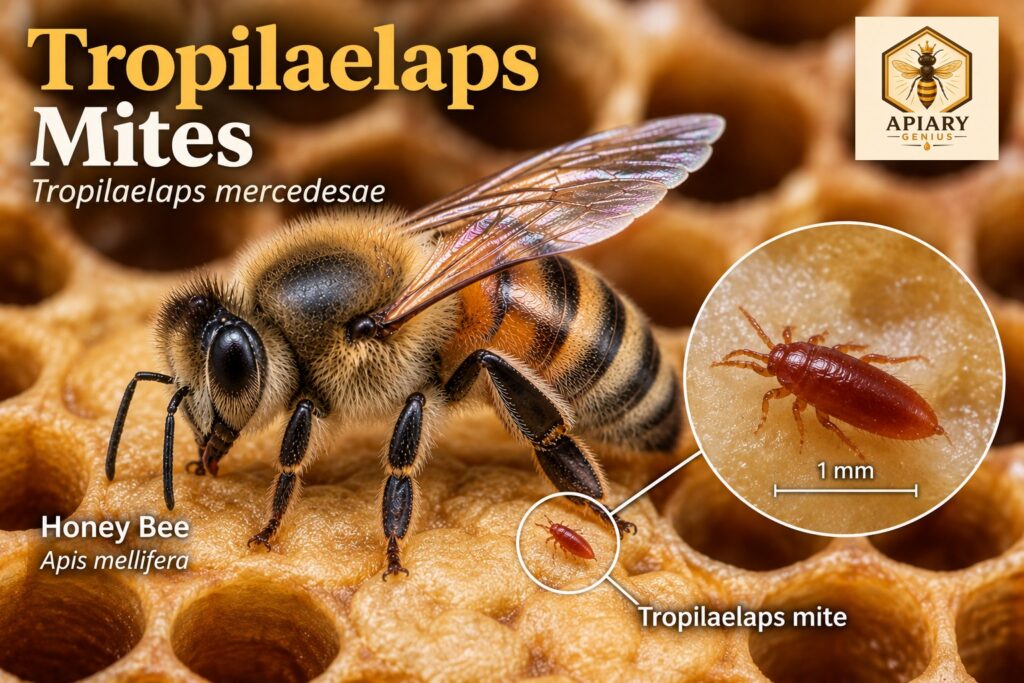
Tropilaelaps mites are parasitic mites of honey bees that deserve close attention from beekeepers—even in places where they have not been detected. Their biology differs enough from that of Varroa destructor that relying only on familiar Varroa monitoring habits or treatment assumptions can create important blind spots.
For U.S. beekeepers, the most important current fact is that Tropilaelaps is not known to be established in the country. The USDA APHIS National Honey Bee Survey reports that Tropilaelaps spp. have not been detected in the United States. However, the mite’s known geographic range has expanded westward from its long-established range in Asia, making surveillance and early recognition increasingly important.
Unlike Varroa, Tropilaelaps mites spend relatively little time on adult bees. Much of their successful reproductive cycle is closely associated with honey bee brood. That biological difference affects how infestations develop, how inspectors look for mites, and why some monitoring methods designed around Varroa on adult bees may be less sensitive for Tropilaelaps.
The practical goal is not to make every beekeeper a mite taxonomist. It is to understand what Tropilaelaps is, recognize when closer investigation is justified, know which detection methods have important limitations, and take the correct next step if a suspicious mite is found.
Quick Answer
Tropilaelaps mites are small, fast-moving parasitic mites that reproduce in honey bee brood cells. They can damage developing bees and are associated with transmission of viruses including Deformed Wing Virus. They are established across parts of Asia and have expanded into additional areas of western Eurasia.
As of September 8, 2026, USDA APHIS surveillance continues to report that Tropilaelaps spp. have not been detected in the United States.
A beekeeper should not diagnose Tropilaelaps from patchy brood, deformed bees, crawling bees, or colony decline alone. Those signs overlap with Varroa infestation, viral disease, brood disease, queen problems, and other colony stresses. Suspicion should lead to careful examination and, where Tropilaelaps is exotic or reportable, contact with the appropriate apiary or plant-health authority.
Table of Contents
What Are Tropilaelaps Mites?
Tropilaelaps is a genus of parasitic mites associated with honey bees. Four species are currently recognized, but they do not all have identical host relationships or importance to managed western honey bees, Apis mellifera.
Two species, Tropilaelaps mercedesae and Tropilaelaps clareae, are particularly important because they can reproduce in A. mellifera colonies. Much of the recent scientific work on surveillance, biology, geographic expansion, and management focuses specifically on T. mercedesae. Findings from that species should not automatically be generalized to every member of the genus.
Adult Tropilaelaps mites are small, elongated, and reddish brown. Great Britain’s official bee-health guidance describes them as approximately 1 mm long and 0.5 mm wide. Their narrow shape differs noticeably from the broader, more oval appearance of an adult female Varroa mite.
They can also move rapidly across comb.
Because other mites can occur in hive debris, however, finding a small brown mite does not by itself confirm Tropilaelaps. Shape, movement, location within the colony, and ultimately correct identification all matter.
The Tropilaelaps Life Cycle
The biology of Tropilaelaps is one of the main reasons beekeepers should not think of it simply as another version of Varroa.
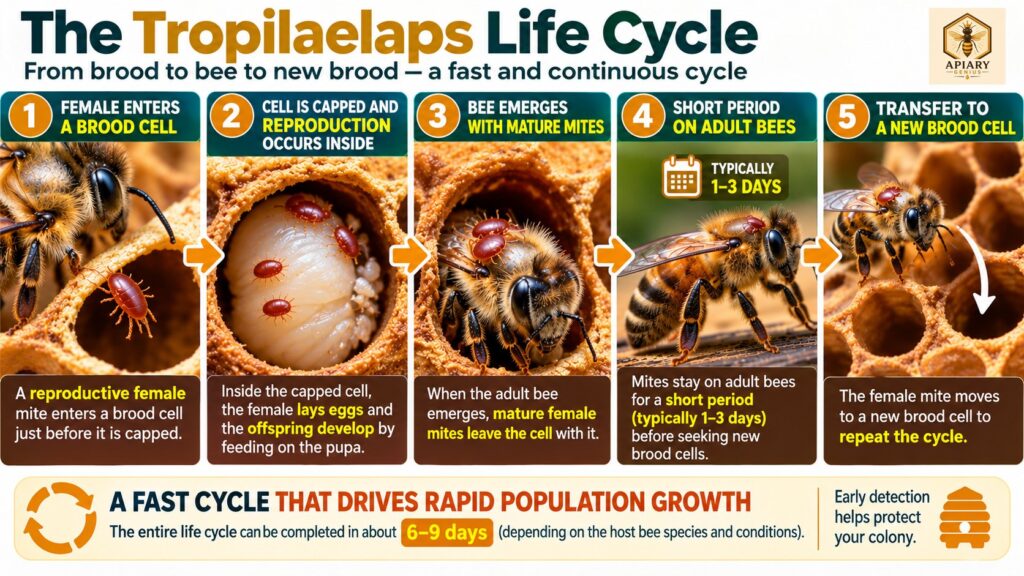
Reproduction occurs in honey bee brood cells. A reproductive female enters a suitable brood cell before it is capped. Once the cell is sealed, the mites feed and reproduce while the developing bee is inside.
The offspring develop rapidly. Mature mites can leave the cell when the adult bee emerges and then seek another suitable brood cell in which to continue the reproductive cycle.
Research on T. mercedesae consistently emphasizes its relatively short period outside brood cells. The life-cycle section of a 2026 comprehensive review in Frontiers in Insect Science describes adult mites as typically surviving only one to two days on adult bees after emergence, although some literature describes dispersal periods extending to about three days.
That is important.
It means that a substantial part of the mite population can be associated with brood rather than spending prolonged periods riding adult workers.
A colony producing brood continuously can therefore provide repeated opportunities for reproduction, and mite populations can increase rapidly under favorable conditions.
The short adult-bee phase also has a direct consequence for surveillance: a sample consisting only of adult bees may encounter a relatively small fraction of the total mite population at the moment it is collected.
Why Honey Bee Brood Is So Important to the Mite
Tropilaelaps is strongly dependent on honey bee brood.
Developing larvae and pupae provide the feeding and reproductive environment the mites need. For T. mercedesae, access to suitable brood is central to successful reproduction.
That dependence has several practical consequences.
First, colonies maintaining extensive brood can provide continuous reproductive opportunities. Second, interrupting brood production can interfere with mite reproduction. Third, monitoring methods focused mainly on adult bees may sample only mites that happen to be outside brood cells during their relatively short dispersal period.
This is why brood examination deserves particular attention when Tropilaelaps is suspected.
During a routine hive inspection, knowing what healthy brood normally looks like makes it easier to recognize an unusual combination of poor brood pattern, damaged developing bees, and suspicious mites.
None of those observations alone confirms Tropilaelaps. They indicate that closer investigation may be warranted.
Where Are Tropilaelaps Mites Found?
Historically, Tropilaelaps mites were primarily associated with Asia. Their known distribution has expanded, particularly in the case of T. mercedesae.
The geographic picture should not be reduced to broad statements such as “Tropilaelaps is in Europe” or “Tropilaelaps is only in Asia.” Distribution is changing, and confirmed locations need to be described with geographic and temporal precision.
Recent scientific literature documents T. mercedesae beyond its traditional Asian range, including reports from parts of Central Asia, the Caucasus, and Russia.
Because this distribution is evolving, the following geographic information is date-sensitive and should be rechecked when this article is updated.
Current Status in the United States and North America
As of September 8, 2026, Tropilaelaps spp. are not known to be established in the United States.
The USDA APHIS National Honey Bee Survey, conducted annually since 2009, reports that surveillance has verified the absence of Tropilaelaps spp. from U.S. survey samples.
The Honey Bee Health Coalition’s Tropilaelaps resources likewise describe the mite as not yet detected in North America and provide preparedness and identification materials for beekeepers.
This does not mean U.S. beekeepers should attempt preventive treatment for an infestation that has not been detected. In an exotic-pest situation, the priorities are awareness, early detection, correct identification, reporting, and an appropriate official response.
USDA Agricultural Research Service is also studying prevention, early detection, and rapid response through a dedicated Tropilaelaps research project, reflecting the importance of preparedness before an introduction occurs.
Current Situation in Europe and Other Regions
Tropilaelaps should not be described as established throughout Europe.
Instead, recent evidence shows westward range expansion involving specific areas of western and central Eurasia. Scientific reports from recent years have documented T. mercedesae in locations including Georgia, Russia, Uzbekistan, and Kazakhstan.
A particularly important development occurred on August 31, 2026, when Türkiye confirmed an outbreak of Tropilaelaps spp. The outbreak was first detected in Çavuşlu, Artvin Province.
Great Britain subsequently introduced safeguard measures affecting honey bees and several related commodities from Türkiye, effective September 4, 2026. The official GOV.UK Tropilaelaps restrictions for Türkiye describe the safeguard measures following the outbreak, including restrictions affecting honey bees, used beekeeping equipment, unprocessed apiculture by-products, and certain apiculture products in honeycomb.
These developments illustrate why Tropilaelaps distribution should be reported using specific locations and dates rather than broad continental labels.
Tropilaelaps vs. Varroa: What’s the Difference?
Both Tropilaelaps and Varroa destructor are parasitic mites capable of damaging honey bee brood and contributing to virus transmission.
But their appearance, movement, and life-history strategies differ enough to affect both detection and management.
Beekeepers already familiar with Varroa mite control have a useful starting point, but Varroa assumptions should not automatically be transferred to Tropilaelaps.
Appearance and Movement
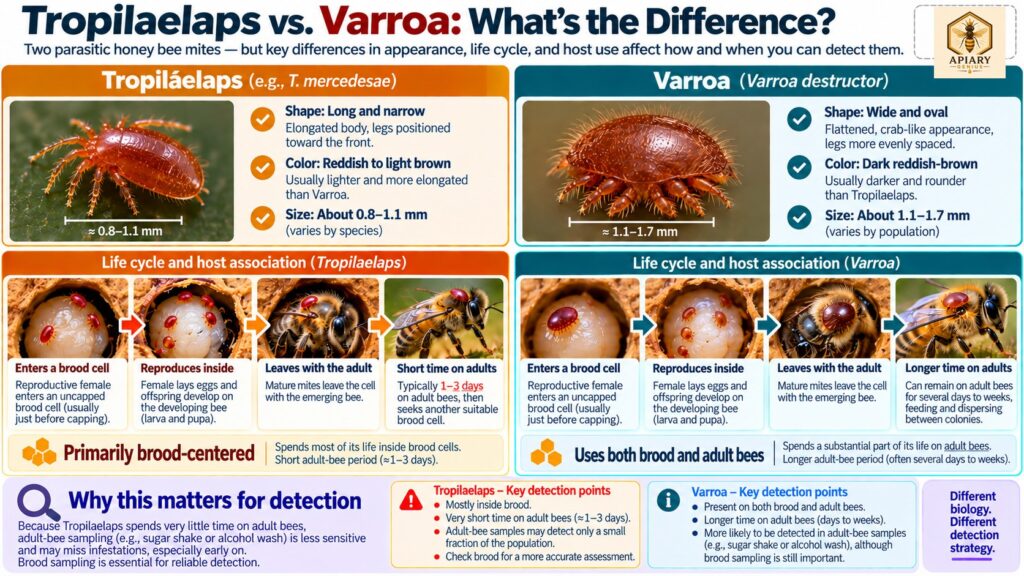
Adult female Varroa mites have a broad, flattened, oval appearance.
Adult Tropilaelaps mites are narrower and more elongated. They can also move rapidly across comb and hive surfaces.
Color alone is not a reliable distinction because both can appear reddish brown. Shape, proportions, movement, and where the mite is found provide more useful clues.
Washington State University Extension provides identification material specifically intended to help distinguish harmful Tropilaelaps from other mites that may occur in honey bee colonies.
Life Cycle and Time on Adult Bees
The biggest practical difference is not appearance. It is biology.
Varroa also reproduces in capped brood, but Varroa mites can spend meaningful periods dispersing on adult bees. That makes adult-bee sampling central to standard Varroa monitoring.
T. mercedesae, by contrast, has a comparatively short adult-bee dispersal period and is strongly dependent on brood.
This changes the probability of finding the parasite in a sample taken only from adult bees.
It also explains why a monitoring method that performs well for Varroa cannot automatically be assumed to have the same sensitivity for Tropilaelaps.
Colony Damage and Virus Transmission
Both mites can physically damage developing bees through parasitism and interact with viral disease.
Heavy Tropilaelaps infestation can be associated with damaged brood, abnormal adult bees, reduced colony performance, and eventual colony decline.
Tropilaelaps can also participate in the transmission and amplification of honey bee viruses, including Deformed Wing Virus.
The visible consequences may therefore overlap considerably with severe Varroa-associated disease.
That overlap is precisely why symptoms alone cannot identify which mite is responsible.
Signs and Symptoms of Tropilaelaps in Honey Bees
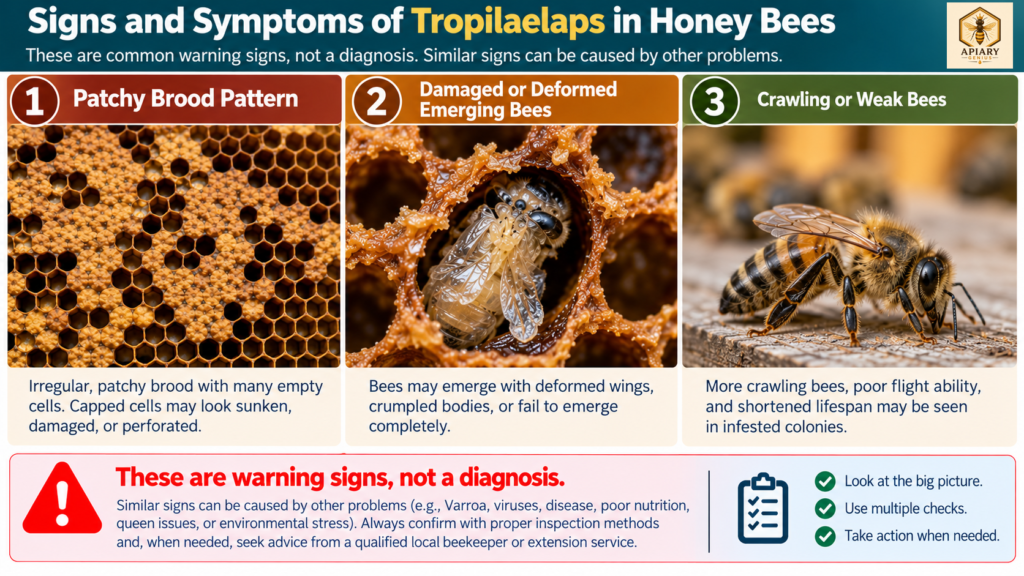
Tropilaelaps symptoms in honey bees are not specific enough to diagnose an infestation by themselves.
Varroa, viral disease, brood diseases, nutritional problems, queen failure, pesticide exposure, and other colony stresses can produce overlapping signs.
Symptoms should therefore be treated as a reason to investigate—not as proof that Tropilaelaps is present.
Irregular or Patchy Brood
Infested brood may fail to develop normally.
A beekeeper may notice a scattered or irregular brood pattern, damaged pupae, opened cells, or brood that otherwise appears unhealthy.
Official British bee-health guidance includes irregular or poor brood patterns among signs associated with Tropilaelaps infestation.
However, patchy brood has many possible causes. Queen problems, chilled brood, brood diseases, Varroa-associated disease, and hygienic removal of abnormal brood can all alter the pattern.
The correct next step is closer examination rather than diagnosis by brood pattern.
Damaged or Deformed Adult Bees
Adult bees emerging from heavily parasitized cells can be undersized or malformed. Abnormal abdomens and shortened or deformed wings have been reported in affected colonies.
Those signs overlap strongly with Deformed Wing Virus associated with Varroa.
Seeing a bee with deformed wings is therefore not evidence that Tropilaelaps is present.
It is evidence that colony health deserves investigation.
Crawling Bees and Colony Decline
Severely affected colonies may contain bees unable to fly normally, including crawling adults near the hive entrance or on the ground.
As infestation and associated disease pressure increase, colonies may lose population, perform poorly, and eventually decline.
Again, these are nonspecific signs.
The useful diagnostic question is not simply, “Does this colony look like it has Tropilaelaps?”
It is: “Can I find and correctly identify the organism associated with what I am seeing?”
How to Check a Colony for Tropilaelaps Mites
Tropilaelaps detection requires a different mindset from routine Varroa monitoring because a large proportion of the mite population can be associated with brood.
No single field method should be treated as perfect under every circumstance. Recent studies are particularly useful because researchers have directly compared surveillance methods rather than assuming that methods developed for Varroa perform identically against Tropilaelaps.
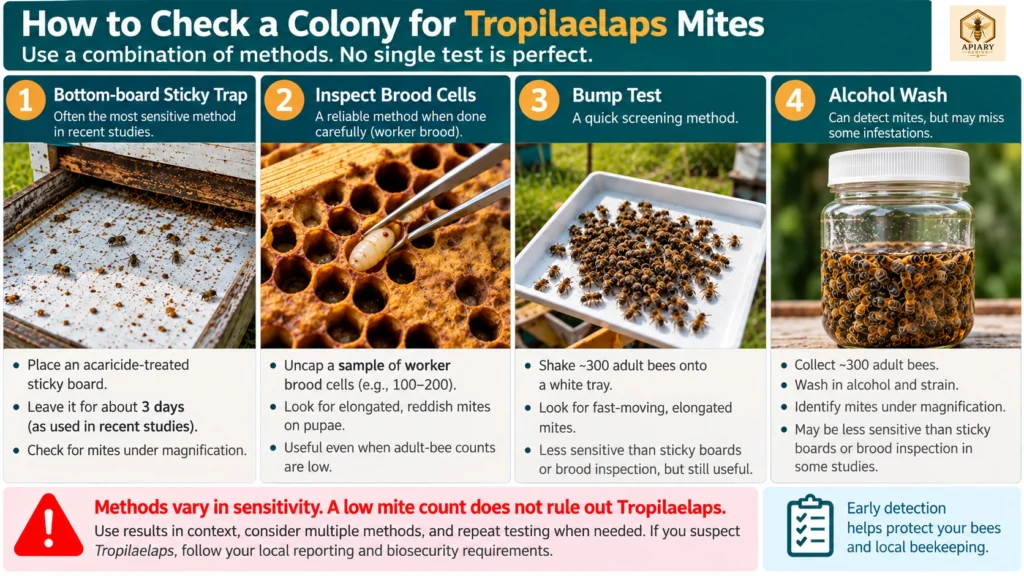
Inspecting Brood and Brood Cells
Brood examination takes advantage of the mite’s strong association with developing bees.
Suspicious capped brood can be uncapped and examined carefully for adult mites and developing mite stages. Researchers have evaluated brood-uncapping protocols specifically as surveillance tools for Tropilaelaps.
Because the mites can move rapidly, good lighting and careful observation are important.
A brood-based approach also makes biological sense: rather than waiting to encounter mites during their short period outside brood cells, the inspector examines the part of the colony where much of their reproductive cycle occurs.
Recent field research has found rapid brood uncapping useful as a surveillance method, although detection sensitivity varies with infestation level, sampling effort, and the exact method used.
Sticky Boards and Debris Examination
Sticky boards can collect mites falling naturally through a colony.
Boards placed beneath the brood nest can be examined carefully for small, elongated mite candidates. Once mites are trapped, their shape can be examined more easily with magnification.
Washington State University Extension includes natural mite fall and sticky-board examination among useful approaches for detecting Tropilaelaps.
Recent research has also evaluated sticky mats combined with an acaricide as a surveillance protocol. In a 2026 Scientific Reports study of known-infested colonies in Papua New Guinea, acaricide-treated sticky mats detected infestations in 92% of tested colonies, compared with 41% for alcohol wash under the conditions of that experiment.
Those percentages should not be interpreted as universal performance guarantees. They describe one field study with particular colonies, infestation conditions, sampling procedures, and treatments.
Why Adult-Bee Sampling Can Be More Difficult
Alcohol washes and similar adult-bee sampling methods are established tools for assessing Varroa because a meaningful fraction of the relevant Varroa population can be found on adult bees.
The situation is different with Tropilaelaps.
Because T. mercedesae typically spends only a short period outside brood cells, relatively few mites may be on adult workers at the moment a sample is collected.
An alcohol wash can detect Tropilaelaps if mites are present on the sampled bees. It is therefore inaccurate to say that alcohol washing never detects them.
The concern is sensitivity.
Recent field studies comparing monitoring methods provide evidence that adult-bee sampling can perform less reliably than certain brood-, mite-fall-, or environmental-detection approaches under some infestation conditions.
Why Some Varroa Monitoring Methods Can Miss Tropilaelaps
The core issue is where the mites are when the sample is taken.
If a monitoring method samples adult bees while much of the Tropilaelaps population is associated with brood, the sample may contain only a small fraction of the mites actually present in the colony.
A low count could therefore be falsely reassuring if interpreted using assumptions developed specifically for Varroa.
This does not make adult-bee sampling useless. It means the result has to be interpreted in the context of Tropilaelaps biology.
In a 2026 Scientific Reports study comparing six detection methods in infested A. mellifera colonies, environmental DNA swabs and acaricide-treated sticky mats produced the highest detection sensitivity under the study conditions, while alcohol wash and the bump test were substantially less sensitive.
A separate 2026 study examining current T. mercedesae monitoring methods likewise found important sensitivity differences between adult-bee, sticky-trap, and brood-based approaches.
The practical lesson is not that every existing Varroa test should be discarded.
It is that effective early detection of Tropilaelaps may require looking beyond mites riding adult bees and incorporating brood examination, mite-fall approaches, or newer diagnostic technologies where appropriate.
What Should You Do If You Suspect Tropilaelaps?
If you are in a country or region where Tropilaelaps is absent, exotic, regulated, or notifiable, a suspicious mite should primarily be treated as a biosecurity and identification issue.
Do not begin improvising treatments before determining what you have actually found.
Do Not Move Bees or Equipment Unnecessarily
Moving colonies, brood frames, adult bees, used equipment, or other potentially affected material could spread mites if an infestation were genuine.
Keep the apiary situation as stable as practical while seeking instructions from the appropriate authority.
Great Britain’s official bee-health guidance specifically instructs beekeepers who suspect Tropilaelaps not to remove colonies, equipment, or honey from the site until authorized by the National Bee Unit.
Exact legal requirements vary by jurisdiction. A U.S. beekeeper should therefore follow U.S. and state procedures rather than applying another country’s regulatory instructions.
Document What You Observe
Record useful information without unnecessarily moving potentially infested material.
Document the date, apiary location, affected colony or colonies, brood appearance, where the suspicious mite was seen, and any relevant recent movement of bees or equipment.
Clear close-up photographs or video may help an inspector evaluate the situation and determine what needs to be collected for identification.
A photograph alone should not be treated as definitive species confirmation when regulatory action could depend on correct identification.
Follow Local Reporting Requirements
Reporting procedures differ among countries and may also differ between states or provinces.
In Great Britain, Tropilaelaps is a notifiable pest and suspected cases must be reported to the appropriate bee-health authority.
For U.S. beekeepers, the Honey Bee Health Coalition’s Tropilaelaps preparedness material advises contacting the state apiary inspector when the mite is suspected. Where a state does not have an apiary inspector, or that inspector cannot be reached, the appropriate state Plant Regulatory Official can help coordinate official sampling and identification.
This distinction matters because Tropilaelaps is currently an exotic-pest concern in the United States.
Do not assume that a treatment reported in research from a country where the mite is established is the appropriate response to a suspected U.S. detection.
Early reporting, confirmation, and containment come first.
Tropilaelaps Management and Control
Management is fundamentally different in an area where Tropilaelaps is established from an area where it remains an exotic pest.
Where the mite is established, research supports integrated approaches based on its biology, including brood management, surveillance, and appropriately authorized acaricidal measures.
Where it is absent, the first response is not routine treatment. It is biosecurity, reporting, identification, and official guidance.
Brood Interruption and Cultural Approaches
Because T. mercedesae depends strongly on honey bee brood, deliberately interrupting brood production can disrupt mite reproduction.
Research has examined queen confinement, colony division, brood interruption, and related manipulations as components of integrated control.
The biological principle is straightforward: when suitable brood is unavailable, mites lose the environment required for reproduction while their ability to persist for prolonged periods on adult bees is limited.
A controlled field study published in Scientific Reports in 2024 evaluated combinations of cultural and chemical measures against T. mercedesae and found substantial suppression from integrated approaches involving brood interruption.
A brood break can also occur as a consequence of other beekeeping operations, including splitting a beehive.
That does not mean an ordinary colony split should be treated as a validated standalone Tropilaelaps treatment. Timing, colony condition, reinfestation pressure, local mite biology, and official management recommendations still matter.
What Research Says About Chemical Control
Multiple acaricides and organic-acid approaches have been studied against T. mercedesae.
Research and reviews describe activity from some compounds and treatment approaches familiar from Varroa management, including amitraz, formic acid, oxalic acid, and other acaricidal materials.
But there is a critical distinction:
A treatment producing an effect in a scientific study does not automatically mean that a product is legally registered or approved for Tropilaelaps control in a particular jurisdiction.
A 2026 comprehensive review in Frontiers in Insect Science discusses several Varroa-control compounds that have been investigated against Tropilaelaps, while also describing limitations involving efficacy, resistance, residues, colony conditions, bee effects, and regional practices.
A 2024 field study in Thailand found strong control under the study conditions when brood-interruption strategies were combined with formic-acid or oxalic-acid approaches.
Those findings are scientific evidence.
They are not a universal treatment prescription, dosage recommendation, or statement that a particular product is registered for use against Tropilaelaps in the United States or elsewhere.
Why Treatment Advice Depends on Location
Pesticide, veterinary-medicine, and bee-health regulations differ substantially among jurisdictions.
A product authorized against a particular pest in one country may have a different label, different restrictions, or no relevant authorization in another.
This distinction becomes especially important with an exotic organism.
If Tropilaelaps were suspected in a U.S. apiary, independently choosing an acaricide based on an overseas field trial could interfere with surveillance or containment efforts and bypass the appropriate reporting process.
Where the mite is established, beekeepers should follow current local regulatory, extension, veterinary, and pesticide-label guidance.
Where the mite is not established, follow the exotic-pest reporting and response process first.
Tropilaelaps, Deformed Wing Virus, and Colony Health
Tropilaelaps damage is not limited to direct parasitism.
Like Varroa, Tropilaelaps mites interact with honey bee viruses. Deformed Wing Virus is particularly important.
Scientific studies and recent reviews support the ability of T. mercedesae to carry and transmit DWV, contributing to the combination of parasitic damage and virus-associated disease that can harm developing bees and weaken colonies.
This relationship helps explain why heavily infested colonies may contain bees with malformed wings, reduced vitality, and shortened lifespan.
But a deformed-wing bee is still not diagnostic evidence of Tropilaelaps.
Varroa is a major vector and amplifier of DWV and remains the much more relevant mite threat in areas such as the United States, where Tropilaelaps has not been detected.
For a detailed explanation of the virus, its symptoms, transmission, and colony implications, see our guide to Deformed Wing Virus in honey bees.
The sequence matters:
Observe the colony problem, investigate possible causes, find the parasite if present, confirm its identity, and interpret virus-associated symptoms in context.
Do not work backward from deformed wings to a specific mite diagnosis.
How Beekeepers Can Reduce the Risk of Spread
In regions where Tropilaelaps is absent or geographically restricted, prevention depends heavily on limiting pathways that can move the parasite between apiaries and across borders.
Live bees and colonies represent obvious potential pathways because mites can travel with their hosts. Brood deserves particular attention because reproductive mites may be concealed inside capped cells.
Used beekeeping equipment and comb may also become subject to movement controls during an official outbreak. Great Britain’s September 2026 measures involving Türkiye, for example, covered not only honey bees but also used beekeeping equipment, unprocessed apiculture by-products, and certain apiculture products in honeycomb.
At the beekeeper level, sensible risk reduction means knowing the origin of purchased bees and equipment, following applicable import and movement requirements, inspecting colonies carefully, and avoiding movement of potentially affected material after a suspicious finding.
Biosecurity also depends on familiarity.
The first time a beekeeper learns what Tropilaelaps looks like should ideally be before encountering a suspicious mite.
That is why surveillance education matters even in countries where the pest remains absent.
Frequently Asked Questions
Are Tropilaelaps mites in the United States?
As of September 8, 2026, USDA APHIS reports that Tropilaelaps spp. have not been detected in the United States through the National Honey Bee Survey. The United States continues surveillance and preparedness work because the mite’s known geographic distribution has expanded.
Are Tropilaelaps mites worse than Varroa?
There is no useful universal ranking. Tropilaelaps, particularly T. mercedesae, can reproduce rapidly and seriously damage susceptible Apis mellifera colonies. Varroa, however, remains much more geographically widespread and is already a major established threat to managed honey bees across much of the world. Their relative impact depends on geography, brood availability, colony conditions, virus pressure, host biology, and management.
Can you see Tropilaelaps mites with the naked eye?
Yes. Adult Tropilaelaps mites can be visible without a microscope. They are approximately 1 mm long, reddish brown, elongated, and fast moving. Magnification is still useful for examining their shape and distinguishing suspicious mites from other organisms found in hive debris.
Does an alcohol wash detect Tropilaelaps?
It can. An alcohol wash can recover Tropilaelaps mites that happen to be on adult bees in the sample.
The limitation is sensitivity. Because Tropilaelaps spends a comparatively short period on adult bees, a sample may miss mites that are associated with brood. In one 2026 field study of known-infested colonies, alcohol wash detected infestation in 41% of tested colonies under that experiment’s conditions.
That figure should not be treated as a universal detection rate.
Can Tropilaelaps transmit Deformed Wing Virus?
Yes. Research supports T. mercedesae as a vector of Deformed Wing Virus. Virus transmission can compound the damage caused by mite parasitism. However, deformed wings alone do not indicate Tropilaelaps, because DWV is also strongly associated with Varroa.
What should I do if I find a suspicious mite?
Do not assume the mite is Tropilaelaps based on appearance alone, and do not unnecessarily move colonies, brood, bees, or equipment.
Document what you found and contact the appropriate apiary inspection or plant-health authority for your jurisdiction. In the United States, preparedness guidance directs beekeepers first toward their state apiary inspector, with the relevant state Plant Regulatory Official as an alternative where appropriate.
If Tropilaelaps is exotic or reportable where you live, correct identification and rapid reporting are more important than attempting an improvised treatment.
Sources
- USDA APHIS — National Honey Bee Surveys
- USDA Agricultural Research Service — Tropilaelaps Prevention, Early Detection and Rapid Response Research
- Honey Bee Health Coalition — Tropilaelaps Mites
- GOV.UK — Honey Bees: Protecting Them From Pests and Diseases
- GOV.UK — 1 September 2026: Tropilaelaps Mite Restrictions: Türkiye
- Scientific Reports — Evaluation of Methods for Early Detection of Tropilaelaps Mites (2026)
- Scientific Reports — Sensitivity of Current Tropilaelaps mercedesae Monitoring Methods (2026)
- Scientific Reports — Managing Tropilaelaps mercedesae Through Combined Cultural and Chemical Control Methods (2024)
- Frontiers in Insect Science — Tropilaelaps mercedesae: An Emerging Global Threat to Apiculture (2026)
- Washington State University Extension — Navigating the Mite Spectrum in Honey Bee Colonies