
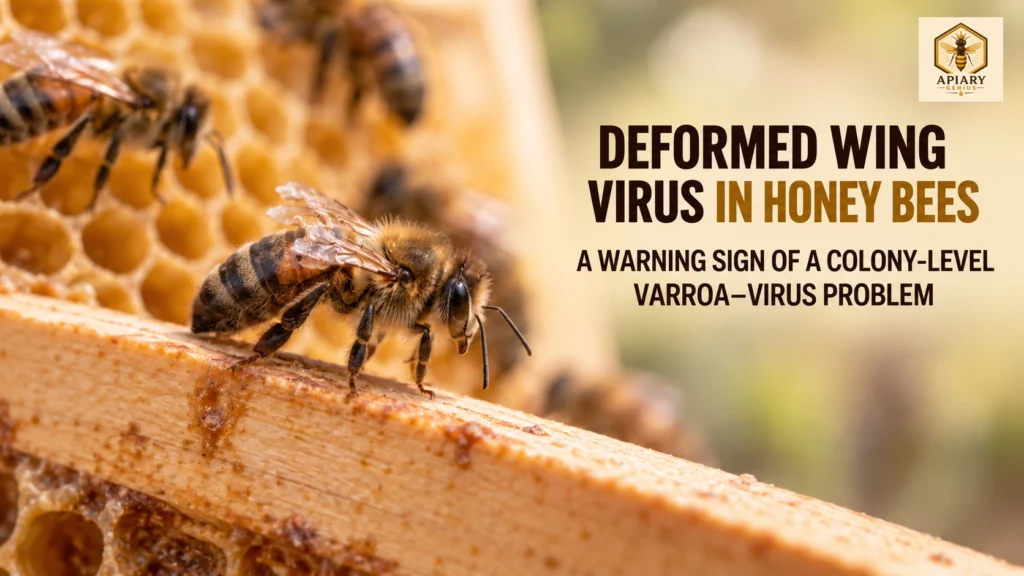
Deformed wing virus in honey bees is best known for producing workers with shriveled, shortened, or malformed wings. However, the visible deformity is only one possible expression of a broader colony-health problem.
Many infected bees emerge with wings that look normal. Conversely, finding one bee with abnormal wings does not, by itself, prove that Deformed Wing Virus caused the deformity. The most useful response is therefore not to diagnose a colony from one bee, but to investigate the colony as a whole—especially its Varroa pressure, brood condition, adult population, and recent health history.
DWV becomes particularly dangerous when Varroa destructor mites transmit and amplify it among developing bees. Reducing mite pressure is the central management priority, but mite control does not instantly remove virus that has already built up inside the colony. Bees damaged during development will not grow normal wings after treatment. Improvement, when it occurs, is seen in later generations developing under lower mite and virus pressure.
Quick Answer: Deformed or crumpled wings are a serious warning sign, especially when Varroa mites are present, but they are not a stand-alone confirmation of DWV. Check mite pressure promptly, assess brood and adult population strength, and take effective Varroa-control action when indicated. Laboratory testing may help when the cause of severe, unusual, or unclear disease needs confirmation.
Important: Do not wait for large numbers of visibly deformed bees before monitoring Varroa. Many DWV infections remain covert, meaning infected bees show no obvious wing deformity.
Table of Contents
What Is Deformed Wing Virus in Honey Bees?
Deformed Wing Virus, usually abbreviated DWV, is an RNA virus that infects honey bees. It can affect bees during multiple life stages and may occur as either a covert infection, with no easily recognized outward signs, or an overt infection associated with obvious disease.
A major review in the Annual Review of Virology describes DWV as one of the most prevalent and intensively studied honey bee viruses and explains how the global spread of Varroa destructor dramatically changed its epidemiology.
The name “Deformed Wing Virus” can create a misleadingly narrow picture. Deformed wings are an important clinical sign, but DWV is not simply a condition of the wings. It can interfere with development, shorten adult lifespan, reduce a bee’s ability to function, and contribute to colony decline when infection pressure is high.
It is therefore helpful to distinguish three related but different findings:
- DWV infection: Viral material is present in a bee or sample.
- Clinical DWV disease: Infection is associated with observable harm or abnormalities.
- Colony-level DWV impact: Virus, usually interacting with Varroa and other stressors, is affecting population replacement, brood health, performance, or survival.
These findings can overlap, but they are not interchangeable.
What Causes Deformed Wing Virus?
DWV disease is caused by infection with viruses in the Deformed Wing Virus complex. The virus depends on living host cells to replicate. Whether infection remains covert or develops into serious disease depends on several interacting factors, including viral load, transmission route, bee developmental stage, mite exposure, colony condition, and possibly the viral variant involved.
A bee can acquire DWV without developing visibly malformed wings. Severe deformity is more likely when high-level infection affects the bee during development, particularly when a Varroa mite transmits the virus while feeding on brood.
This means the practical cause of a colony’s DWV problem is rarely captured by the statement “the bees caught a virus.” A more useful explanation is that virus transmission, Varroa parasitism, viral amplification, and colony vulnerability have combined to produce disease.
Poor nutrition, queen problems, pesticide exposure, other pathogens, and adverse weather may also influence colony performance. They should not automatically be relabeled as DWV merely because the virus is detected.
Why Varroa Mites Make DWV Much More Dangerous
DWV existed in honey bee populations before Varroa became globally widespread. What changed was the mite’s ability to feed on bees and brood while efficiently moving virus between hosts.
Varroa mites reproduce inside capped brood cells. A foundress mite enters shortly before the cell is capped, feeds during bee development, and later leaves with her offspring when the adult bee emerges. This places vulnerable developing bees under simultaneous parasite and virus pressure.
Varroa can make DWV much more dangerous in several ways:
- Mites transmit virus directly while feeding.
- They create an efficient transmission route into bee tissues.
- Repeated mite feeding causes physical and physiological harm.
- Mite-associated transmission can contribute to high viral loads.
- Growing mite populations expose increasing numbers of developing bees.
- Workers that emerge with high viral loads or shortened lifespans may be unable to replace normal colony losses.
The USDA Agricultural Research Service overview of varroosis explains that Varroa damages bees, shortens their lifespan, and vectors several viruses, including DWV. It also notes that high virus levels may persist after a colony has been treated for mites.
Varroa is not the only documented route of DWV transmission. However, it fundamentally changes the scale, efficiency, and consequences of viral transmission within a colony. That is why a DWV investigation should almost always include a proper Varroa assessment.
Deformed Wing Virus Symptoms
The most recognizable deformed wing virus symptoms appear in newly emerged or young adult workers. Compatible signs may include:
- Shriveled, crumpled, or twisted wings
- Shortened or incompletely expanded wings
- Other malformed wing structures
- Inability to fly
- Bees crawling on combs, the hive floor, or outside the entrance
- Reduced adult lifespan
- Reduced worker population
- Poor colony growth or performance
- Decline that appears disproportionate to the amount of brood being produced
Some affected bees may also have shortened or abnormal abdomens, but no single physical sign is exclusive to DWV. University of Florida IFAS Extension guidance emphasizes that honey bee viral infections may be present without obvious distress and that clinical expression varies among viruses, bee life stages, and individual bees.
Crawling bees are particularly nonspecific. They can appear in colonies affected by other viruses, pesticide exposure, nutritional stress, chilling, injury, or age-related problems.
Chronic Bee Paralysis Virus, for example, is a different virus with its own characteristic disease patterns. It should not be confused with DWV simply because some bees are unable to fly.
The significance of a symptom increases when it appears alongside evidence such as elevated Varroa pressure, multiple newly emerged bees with compatible deformities, a declining adult population, or broader signs of mite-associated disease.
Can Bees Have DWV Without Deformed Wings?
Yes. Bees can carry and replicate DWV without showing visibly deformed wings.
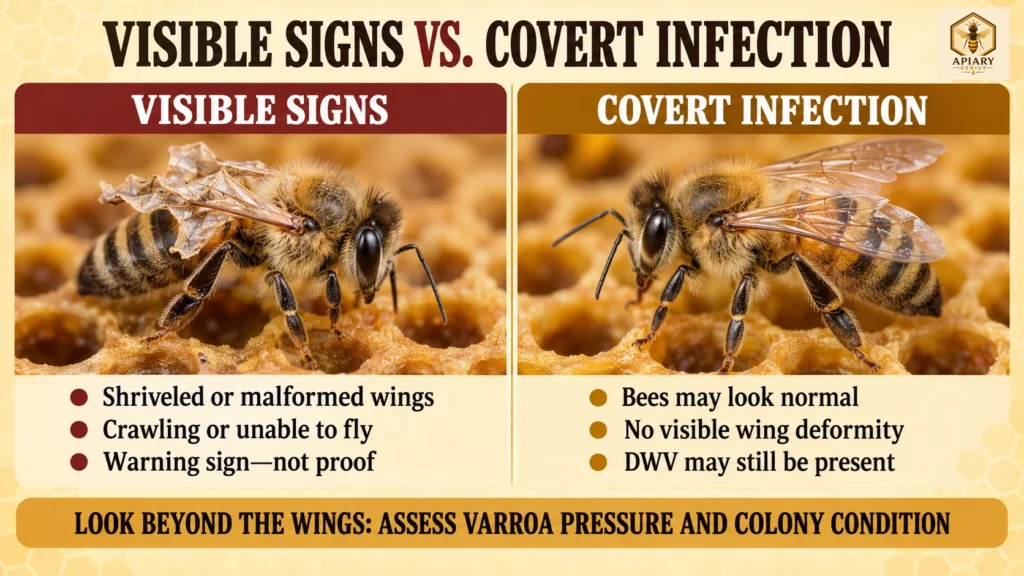
These are often described as covert, inapparent, or subclinical infections. A bee may look normal while still carrying detectable viral material, and covert infection can still affect performance or longevity under some conditions.
As Penn State Extension explains, modern molecular tools can detect honey bee viruses even when infected bees show no obvious symptoms.
This is why looking only for honey bee deformed wings is an unreliable screening method. A colony can have substantial virus activity before the beekeeper notices obviously malformed workers. By the time numerous visibly affected bees appear, many other bees may already have been exposed during development.
The reverse distinction is equally important: abnormal wings are compatible with DWV, but they do not prove it. Developmental injury, emergence problems, or other conditions can produce abnormal-looking bees.
The beekeeper should interpret visible signs as evidence that warrants investigation, not as a complete diagnosis.
What Deformed Wings Actually Tell You About the Colony
A bee with deformed wings tells you that something interfered with normal development. In a Varroa-infested colony, DWV should rank high among the suspected causes, but the observation must be placed in context.
Ask four questions:
- Is this an isolated bee or a repeated pattern? One abnormal bee is different from regularly finding affected workers.
- What is the current Varroa pressure? Visible mites are useful evidence, but their absence during casual inspection does not demonstrate a low infestation.
- What does the brood nest look like? Note brood continuity, abnormal brood, opened or damaged cappings, and whether enough healthy adults are emerging.
- Is the adult population maintaining itself? A colony producing brood but steadily losing adult strength may have reduced worker longevity.
Do not destroy or medicate a colony based on one abnormal bee. At the same time, do not dismiss the finding. Record when and where the bee was found, examine the colony’s overall condition, and perform an appropriate mite assessment.
A visible case is best treated as a warning from the colony—not as the entire diagnosis.
How Deformed Wing Virus Spreads
DWV has more than one documented transmission pathway.
Varroa-mediated transmission is the most important practical concern in many managed honey bee populations. When mites feed on infected bees and later parasitize susceptible hosts, they can transmit DWV among developing and adult bees. This direct transmission route is strongly associated with higher viral loads and more serious disease.
Other reported pathways include:
- Oral or food-associated exposure
- Trophallaxis, when bees exchange food
- Contact among bees
- Transmission involving brood food or hive resources
- Queen-to-egg and other reproductive transmission routes
- Transmission associated with cannibalism of infected brood
The existence of these routes explains why removing or reducing mites does not automatically eliminate every viral infection. DWV can remain within the bee population, and infected workers or brood may still be present after a mite-control intervention.
However, Varroa control remains the most actionable management priority because mites dramatically increase viral transmission and amplification. Reducing this pressure gives subsequent bee generations a better opportunity to develop without repeated mite-associated exposure.
DWV-A vs. DWV-B
DWV is not genetically uniform. The two variants most commonly discussed by beekeepers and researchers are DWV-A and DWV-B. Recombinant forms can also occur when related viral genomes exchange genetic material.
Both DWV-A and DWV-B have been associated with honey bee disease and Varroa. Their prevalence varies across locations and over time.
It is tempting to label one variant as universally more dangerous, but the evidence does not support such a simple rule. Comparative results can depend on:
- The particular virus strain
- The bee population being studied
- Bee life stage
- Infection dose and route
- Varroa involvement
- Geographic conditions
- Whether a study examines individual bees or whole colonies
Some experimental work has found greater virulence for DWV-B under particular conditions, while other research has demonstrated serious effects from DWV-A. Studies of variant replacement and recombination add further complexity.
A beekeeper-focused interpretation should therefore remain cautious: either variant can matter, and colony decisions should not depend on assuming that one is harmless.
Routine beekeepers generally do not need to identify the variant before addressing high mite pressure. Variant-specific testing is more relevant to diagnostic investigations, surveillance, and research.
How DWV Affects Developing and Adult Bees
Many of the deformities associated with DWV originate before the adult bee emerges. A developing bee exposed to high viral pressure—especially through Varroa parasitism inside a capped cell—may suffer disrupted development.
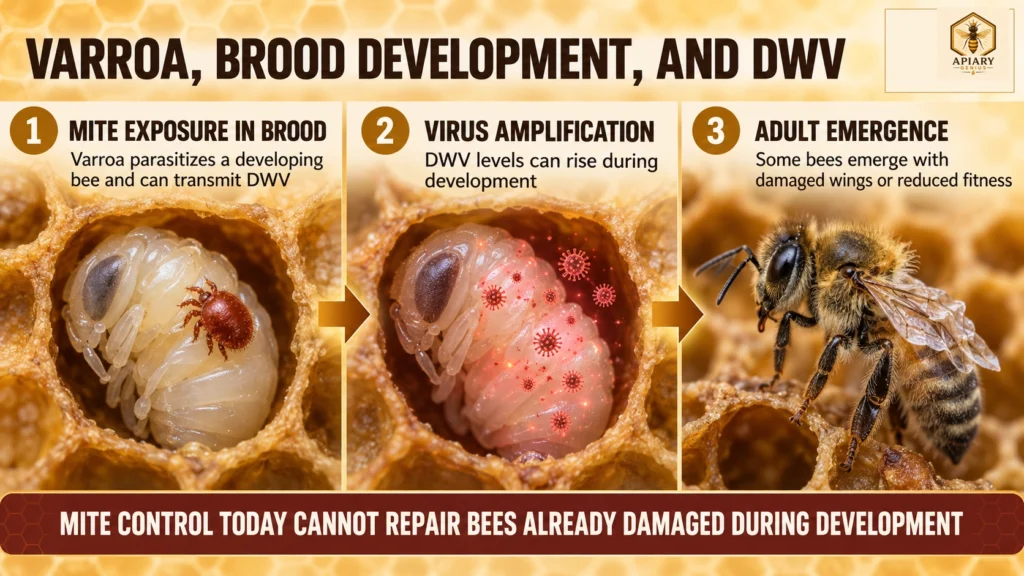
When the adult emerges, the damage has already occurred. A worker with shriveled or shortened wings cannot be treated so that those wings later expand into normal ones.
Affected adults may be unable to fly, forage, orient normally, or complete other colony tasks. Their lifespan may be reduced. Some are removed by nestmates or leave the hive and die outside, so the beekeeper may underestimate how many affected bees were produced.
Bees that emerge looking normal are not necessarily unaffected. Covert DWV infection has been associated in research with reduced survival and impaired behavior. This helps explain how a colony may lose adult strength without displaying large numbers of obviously deformed bees.
This developmental timing is essential for interpreting treatment results. Mite reduction today protects future brood more than it helps bees whose development has already been compromised.
How Deformed Wing Virus Affects the Whole Colony
A honey bee colony depends on a steady flow of workers living long enough to perform age-related tasks. When too many bees emerge damaged or die prematurely, population replacement falls behind.
Possible colony-level consequences include:
- Fewer healthy nurse bees
- Poor support for developing brood
- Reduced foraging capacity
- Difficulty regulating brood-nest temperature
- Declining adult population
- Weak preparation for nectar shortages or winter
- Increased vulnerability to robbing and other stressors
- Eventual failure when healthy workers cannot replace losses
The colony may appear to have substantial brood while the adult population continues to shrink. This apparent contradiction can occur when emerging workers have reduced longevity.
DWV should still not be treated as the automatic explanation for every weak colony. Queen failure, starvation, brood disease, pesticide exposure, Nosema, and other stressors may produce overlapping colony-level patterns.
The beekeeper must look at the complete evidence rather than assigning a cause from one symptom.
DWV, Varroa, and Parasitic Mite Syndrome
Parasitic Mite Syndrome, commonly abbreviated PMS, describes a broader disease pattern associated with heavy Varroa pressure and mite-vectored infections. It is not the name of one virus, and it should not be diagnosed from one irregular brood frame.
Compatible colony signs may include:
- High Varroa pressure
- Spotty or deteriorating brood patterns
- Sunken, damaged, or perforated brood cappings
- Abnormal or dying brood
- Reduced eggs or developing larvae
- Rapidly declining adult populations
- Visible mites on bees or comb
- Workers with deformed wings
The USDA Agricultural Research Service overview of varroosis describes PMS as a range of signs associated with high Varroa infestation and warns that some of its brood signs may be mistaken for bacterial brood diseases.
Because poor brood patterns have multiple possible causes, suspicious brood should be examined carefully. American foulbrood, European foulbrood, sacbrood, queen problems, chilling, and nutritional stress require different interpretations and responses.
DWV may be one part of PMS, but the syndrome reflects a complex colony failure involving mite damage, viral disease, and declining population function.
How to Diagnose Deformed Wing Virus
Diagnosis works best as a progression from observation to colony-level evidence and, where necessary, laboratory confirmation.
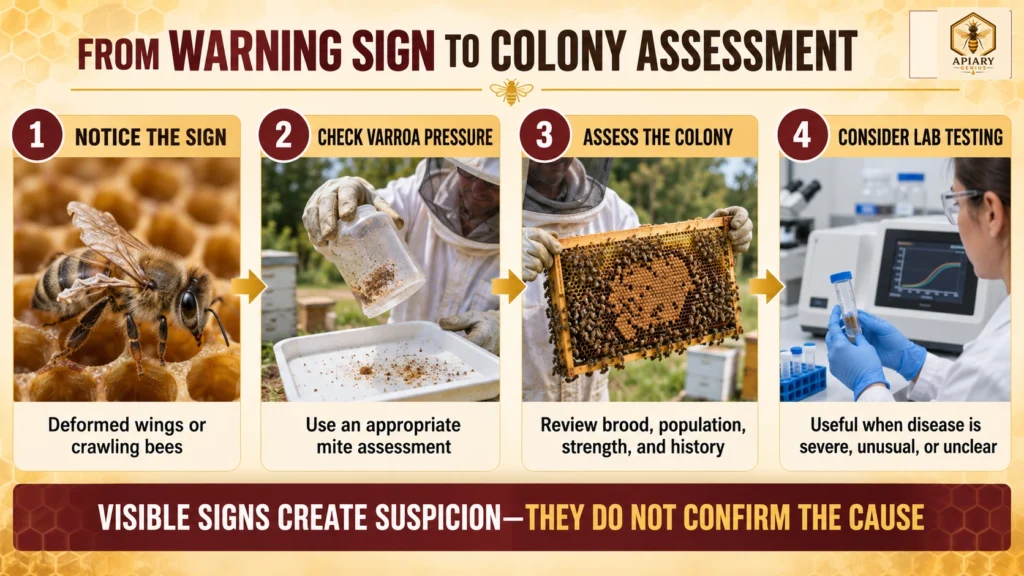
Checking Varroa Pressure
A proper mite assessment is more informative than briefly searching adult bees for visible mites. Varroa often remains hidden in brood cells, between body segments, or on bees in positions that are difficult to see.
Use an established monitoring method appropriate to your apiary and local guidance. Record the result and compare it with the colony’s previous results, season, brood condition, treatment history, and applicable regional recommendations.
This article does not assign a universal intervention threshold because thresholds and treatment choices vary with season, region, colony condition, sampling method, and management objectives.
For detailed monitoring methods and management options, read the Apiary Genius guide on how to control Varroa mites.
Looking at Colony-Level Signs
During a suitably timed beehive inspection, examine more than the affected individual.
Record:
- How many abnormal bees you see
- Whether they appear newly emerged
- Whether crawling bees are present
- Adult population strength
- Brood amount and continuity
- Suspicious brood or damaged cappings
- Food availability
- Queen status
- Recent mite-monitoring results
- Treatments used and whether follow-up monitoring occurred
- Similar signs in neighboring colonies
Photos, sample dates, mite counts, treatment records, and notes about colony population are far more useful to a diagnostic laboratory than the statement “my bees have deformed wings.”
PCR and Laboratory Testing
Reverse-transcription PCR and quantitative PCR can detect viral RNA. Quantitative methods may also estimate the amount of viral material in a sample.
A positive result demonstrates that DWV genetic material was detected. It does not automatically prove that DWV caused every observed symptom or that it was the only factor involved in colony decline.
Interpretation depends on sampling method, sample type, virus quantity, clinical signs, mite pressure, colony history, and other test findings. Detection and disease causation are related questions, but they are not identical.
UF/IFAS guidance on common honey bee viruses identifies ELISA and RT-(q)PCR as important laboratory approaches for detecting viral infections. These techniques require specialized equipment and trained personnel.
When Laboratory Testing Is Useful
Routine laboratory testing is not mandatory every time a beekeeper finds one abnormal bee. In many apiaries, immediate mite monitoring and colony assessment provide the most useful first actions.
Testing adds more value when:
- Severe losses have no clear explanation
- Several colonies show unusual or rapidly progressing disease
- Symptoms overlap with other pathogens or toxic exposure
- A commercial operation needs diagnostic documentation
- A breeding, research, or surveillance program requires confirmation
- A beekeeper, inspector, or veterinarian needs to compare possible causes
- Variant identification would contribute to a specific investigation
Before sending samples, contact the laboratory or appropriate apiary authority. Ask what specimens to collect, how many bees or brood samples are required, whether samples should be frozen or preserved, and how they must be shipped.
Poorly selected or badly preserved samples can reduce the usefulness of even a technically accurate test.
Laboratory results should be combined with field evidence. A virus-positive sample from a collapsing colony may be important, but investigators must still consider Varroa, nutrition, queen status, other pathogens, pesticide exposure, and environmental stress.
What to Do If You See Bees With Deformed Wings
Use a structured response rather than reacting to the appearance of one bee.
- Document the observation. Photograph the bee if possible and note where it was found.
- Determine whether the sign is isolated or recurring. Look for other abnormal or crawling bees without prolonging the inspection unnecessarily.
- Assess the colony. Check population strength, brood condition, queen evidence, food stores, and suspicious brood.
- Measure Varroa pressure. Do not rely only on visible mites or deformed bees.
- Review recent management. Check when mites were last monitored, what control method was used, and whether effectiveness was verified.
- Act on mite pressure promptly. Use a legal, colony-appropriate, season-appropriate method following the product label and local guidance.
- Recheck after intervention. Confirm that mite pressure was actually reduced.
- Monitor later generations. Evaluate whether newly emerging bees and colony strength improve.
- Seek diagnostic help when the pattern is severe, unusual, or unclear.
Removing a visibly deformed worker may prevent that individual from remaining in the colony, but it does not solve the underlying problem. By the time the adult emerges, broader exposure may already exist among the brood and adult population.
Avoid combining multiple unverified remedies. An improvised response can stress the colony, contaminate hive products, violate treatment requirements, or obscure whether mite control succeeded.
Is There a Treatment for Deformed Wing Virus?
There is no simple beekeeper-applied antiviral medication that directly cures DWV in a colony.
Management focuses primarily on reducing Varroa pressure, limiting future mite-mediated transmission, supporting adequate colony conditions, and allowing subsequent generations to develop under lower pressure.
This distinction matters:
- Correct: Reducing Varroa pressure reduces one of the most important DWV transmission and amplification pathways.
- Incorrect: Varroa treatment instantly cures DWV.
- Incorrect: A supplement repairs bees that have already emerged with deformed wings.
- Incorrect: A natural product is a proven antiviral treatment because it produced promising laboratory results.
Experimental antiviral approaches, immune-related technologies, antibodies, RNA interference, and nutritional interventions are active areas of research. Experimental success does not automatically create an approved, field-proven treatment for beekeepers.
Use only authorized mite-control products and methods according to their labels and local regulations. Do not improvise dosages or assume that “natural” means safe, effective, residue-free, or legal.
Why Varroa Control Is the Main Management Strategy
Because Varroa is a highly effective vector and amplifier of DWV, controlling the mite is the most practical way to reduce future disease pressure.
The goal is not merely to kill some mites. The goal is to keep mite exposure low enough that healthy future workers can develop and maintain colony function.
Why Timing Matters
Mite control has its greatest value before large numbers of important workers are damaged during development.
Late action may reduce mites but still leave the colony with:
- Virus already circulating at high levels
- Developing bees that were previously parasitized
- Short-lived workers
- Too few healthy adults to care for brood
- Inadequate time to rebuild before winter or another stress period
Do not wait for mass wing deformities. Monitoring is intended to reveal increasing risk before unmistakable colony decline appears.
Why One Treatment May Not Solve the Problem
Treatment effectiveness varies with brood status, product, application conditions, mite resistance, reinvasion, colony strength, and correct use.
A treatment can appear successful while leaving enough mites to rebuild the infestation. Mites may also enter again through drifting, robbing, or contact with other colonies.
A 2025 USDA Agricultural Research Service investigation found unusually high levels of DWV-A, DWV-B, and Acute Bee Paralysis Virus in samples connected with severe commercial colony losses. Researchers also identified serious amitraz-resistance concerns in mites collected from affected operations.
USDA noted that the findings did not rule out other long-recognized challenges to honey bees. The investigation provides important current context, but it does not prove that DWV caused every recent U.S. colony loss or that amitraz fails in every apiary.
Monitoring After Treatment
Post-treatment monitoring answers a crucial question: did the intervention reduce mite pressure sufficiently?
Without follow-up monitoring, a beekeeper may assume the colony is protected while mites remain abundant because of application problems, resistance, reinvasion, or a mismatch between the method and colony conditions.
Continue observing:
- Mite-monitoring results
- Newly emerged bees
- Adult population trend
- Brood condition
- Food availability
- Queen performance
- Signs in nearby colonies
For detailed monitoring procedures and treatment selection, return to the complete Varroa-control guide. Those details should not be duplicated inside a DWV article.
Can a Colony Recover From Deformed Wing Virus?
A colony can sometimes improve after effective mite reduction, but recovery is not guaranteed.
Recovery occurs at the colony level. It does not mean that an individual bee’s deformed wings return to normal.
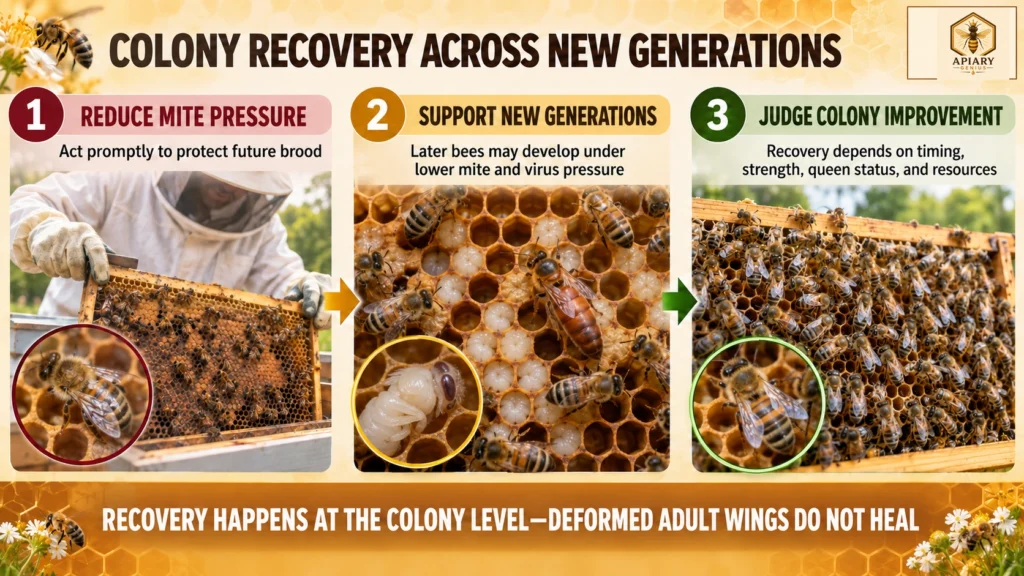
Improvement depends on whether:
- Mite pressure is reduced effectively
- The queen continues producing adequate brood
- Enough healthy workers remain to care for that brood
- Future generations develop under lower vector pressure
- The colony has sufficient food and an adequate population structure
- Reinvasion or treatment failure does not restore high mite pressure
- Other serious diseases or stressors are not overwhelming the colony
A PLOS ONE study documented the persistence of subclinical DWV infections after Varroa removal and a turnover of the bee population.
This does not mean mite control is ineffective. It means recovery should be judged through trends in mite pressure, healthy bee emergence, adult population, brood condition, and overall colony function—not by expecting the virus to disappear immediately.
A severely depleted colony may lack the workforce or time needed to rebuild, even after mite pressure falls. Recovery should never be promised, and no universal recovery timeframe applies to every colony.
DWV and Winter Colony Losses
Late-season Varroa and virus pressure is especially important because the colony must produce long-lived workers capable of surviving the winter period.
Summer workers usually live relatively short lives during active brood rearing and foraging. Winter bees must remain functional much longer. If they develop while heavily exposed to Varroa and high DWV pressure, their longevity and physiological condition may be compromised.
This creates a dangerous pattern:
- The colony appears populous earlier in the season.
- Mite numbers and virus pressure increase as brood cycles continue.
- Long-lived winter bees develop under damaging conditions.
- Adult population declines faster than expected.
- The colony enters winter with too few healthy workers.
- The cluster shrinks and may eventually fail.
USDA reports that colonies with high virus titers can struggle to overwinter and that apparently strong colonies may dwindle later in the year.
DWV is not responsible for every winter loss. Starvation, queen failure, moisture problems, inadequate population, other pathogens, pesticides, and weather can also contribute.
DWV management should therefore be part of broader beehive winter preparation, not a substitute for it.
How to Reduce the Risk of DWV
Risk reduction centers on preventing high Varroa pressure and detecting colony deterioration early.
Practical priorities include:
- Monitor Varroa with a recognized method rather than waiting for visible mites.
- Keep clear records for each colony.
- Use an integrated management strategy appropriate to your region.
- Follow treatment labels exactly.
- Consider brood conditions, temperature, honey-super status, and colony condition when selecting legal treatments.
- Verify mite reduction after treatment.
- Watch for reinvasion and unexpected mite rebounds.
- Avoid moving heavily infested brood or bees into healthier colonies.
- Reduce robbing and uncontrolled drifting where practical.
- Maintain adequate nutrition without presenting supplements as antiviral cures.
- Keep colonies queenright and capable of producing replacement workers.
- Investigate unusual brood or adult-bee signs rather than assuming every problem is DWV.
- Coordinate mite awareness with nearby beekeepers when possible.
No management program can guarantee a virus-free colony. A more realistic objective is to prevent the high mite and virus pressure associated with clinical disease and colony failure.
Common Deformed Wing Virus Management Mistakes
Waiting for deformed bees before checking mites. Most infected bees may not display the classic wing sign. Visible disease can appear after substantial exposure has already occurred.
Assuming one abnormal bee confirms DWV. The observation is compatible with DWV but does not identify the cause on its own.
Assuming normal-looking wings mean the colony is virus-free. Covert infections are common.
Treating mites without measuring them. Without pre- and post-treatment monitoring, you cannot reliably judge initial pressure or control effectiveness.
Expecting instant recovery. Bees already damaged during development will not be repaired, and virus can remain after mite numbers decline.
Using unproven antiviral remedies. Laboratory findings or testimonials do not establish a safe, legal, colony-level cure.
Repeating the same control product without considering performance. Incorrect application, resistance, or reinvasion may cause repeated failure.
Applying a universal mite threshold. Decisions must reflect validated local guidance, season, colony condition, and monitoring method.
Ignoring the rest of the colony. Brood condition, adult population, queen status, nutrition, and other diseases affect interpretation and recovery.
Calling every poor brood pattern PMS or DWV. Several brood diseases and management problems can create similar patterns.
Attributing every winter loss to DWV. Winter mortality is frequently multifactorial.
Confusing DWV with Chronic Bee Paralysis Virus. Flightlessness can occur in more than one condition, but these are separate viruses with different characteristic signs.
Frequently Asked Questions About Deformed Wing Virus
Can bees have deformed wing virus without deformed wings?
Yes. Many DWV infections are covert or subclinical, meaning infected bees show no obvious wing deformity. Normal-looking wings do not rule out infection.
Does Varroa cause deformed wing virus?
Varroa mites do not create the virus, but they are major vectors and amplifiers of DWV. They transmit virus while feeding and greatly increase the risk that infection becomes damaging at individual and colony levels. DWV also has transmission routes that do not involve Varroa.
Does one deformed bee mean the whole colony has DWV?
No. One bee with abnormal wings does not confirm DWV or establish the condition of every bee in the colony. It is a warning sign that should prompt a colony assessment and Varroa check.
Can bees recover from deformed wing virus?
An individual bee with permanently deformed wings will not grow normal wings. A colony may improve if mite pressure is reduced early and effectively and if it retains enough strength to raise healthier future generations.
Is there a treatment for deformed wing virus?
There is no simple beekeeper-applied antiviral cure. Management centers largely on controlling Varroa and improving the conditions under which future bees develop.
Should I remove bees with deformed wings?
You may remove a visibly impaired bee, but doing so will not control the colony-level infection. The more important actions are assessing Varroa pressure, evaluating colony condition, and addressing the underlying mite–virus problem.
Can DWV remain after Varroa treatment?
Yes. Infected bees and brood may remain, viral material can persist, and a treatment may not eliminate every mite. That is why follow-up monitoring and assessment of later bee generations are important.
Is DWV responsible for winter colony losses?
DWV and Varroa can contribute significantly to winter mortality, particularly when long-lived winter bees develop under high mite and virus pressure. However, not every winter loss is caused by DWV, and multiple stressors may be involved.
Does a positive PCR result prove DWV killed the colony?
No. It confirms that viral genetic material was detected in the tested sample. Determining whether DWV caused or contributed to the loss requires interpretation alongside viral quantity, symptoms, mite pressure, sample quality, colony history, and other possible causes.
Final Thoughts
Deformed wing virus in honey bees should be understood as a colony-level virus–Varroa problem, not merely a defect affecting a few individual wings.
Shriveled or malformed wings are valuable warning signs, but they are neither required for infection nor sufficient to confirm a diagnosis. The most useful beekeeper response is to connect the observation to evidence: measure Varroa pressure, inspect the colony carefully, review its recent management, and obtain diagnostic assistance when the pattern is severe or unclear.
Effective Varroa reduction cannot repair bees that were damaged before emergence, and it does not make amplified virus disappear overnight. Its value lies in reducing one of the most important transmission pathways so that future generations have a better chance of developing normally.
Judge progress over time through verified mite reduction, healthier emerging bees, stable brood care, and an improving adult population—not through the expectation of an instant cure.
Sources
- Penn State Extension — Viruses in Honey Bees
- University of Florida IFAS Extension — Common Viruses of Florida Honey Bees: Diagnosis and Management
- USDA Agricultural Research Service — Varroosis
- USDA Agricultural Research Service — 2025 Investigation of Viruses, Varroa, and Miticide Resistance
- Annual Review of Virology — Deformed Wing Virus in Honeybees and Other Insects
- Current Opinion in Insect Science — Epidemiology of a Major Honey Bee Pathogen, Deformed Wing Virus
- PLOS ONE — Persistence of Subclinical Deformed Wing Virus Infections Following Varroa Mite Removal