
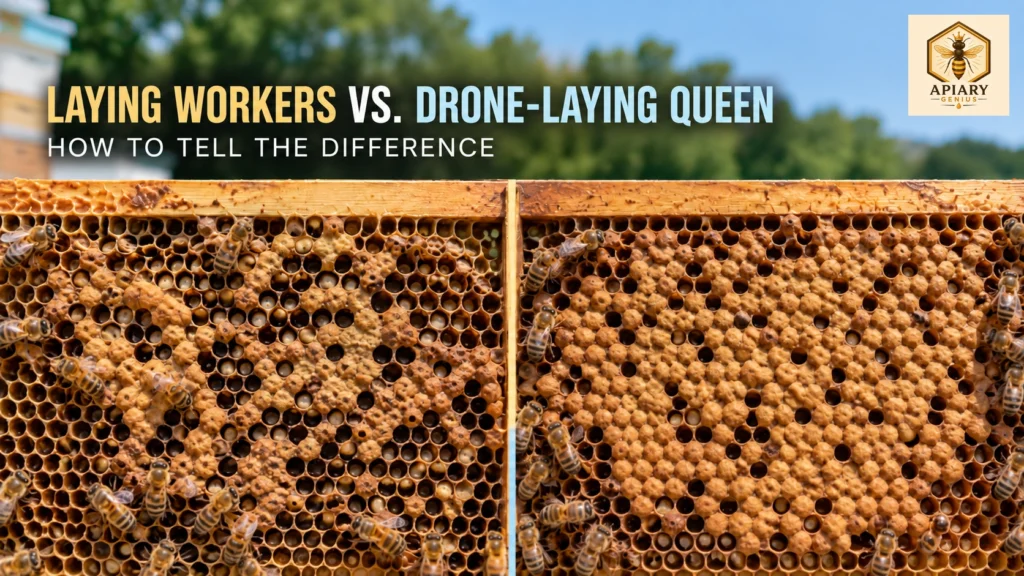
Finding multiple eggs, scattered drone brood, or raised drone cappings in worker-sized cells can make a hive look seriously wrong. But those signs do not automatically mean you have laying worker bees.
A drone laying queen can produce some of the same symptoms, and a newly laying queen can temporarily place multiple eggs in cells as she settles into a normal laying pattern. The safest diagnosis comes from combining several clues rather than relying on one dramatic-looking frame.
Look at the number and position of the eggs, the overall brood pattern, whether drone brood is appearing in worker-sized cells, whether current worker brood remains, whether a queen is present, and what has happened in the colony recently.
The distinction matters because the management response for laying worker bees can be very different from the response to a confirmed drone laying queen.
Quick Answer
Laying worker bees usually develop after a colony has been without a functional queen—and especially without young brood—for an extended period. Because workers do not mate, the eggs they lay are unfertilized and normally develop into drones. Their eggs are often scattered, may appear several to a cell, and may be placed off-center or along cell walls.
A drone laying queen is still a queen, but she is laying unfertilized eggs because she was inadequately mated, has depleted viable stored sperm, or otherwise cannot fertilize eggs normally. Her egg placement may remain more queen-like even though too much of the resulting brood is drone brood.
Multiple eggs and drone brood are clues, not a diagnosis. A newly laying queen may also place more than one egg in some cells temporarily. Michigan State University Extension specifically cautions against diagnosing laying workers from multiple eggs alone.
Table of Contents
Laying Worker Bees vs. a Drone-Laying Queen: The Key Difference
The key difference is who is laying the unfertilized eggs.
In a normally functioning colony, a successfully mated queen can lay both fertilized and unfertilized eggs. Fertilized eggs normally develop into females—workers or queens—while unfertilized eggs develop into male drones.
Worker bees do not mate. If a worker’s ovaries become active and she starts laying, her eggs are unfertilized and normally produce drones.
A drone laying queen is different. She is a queen, but she is no longer fertilizing eggs successfully—or she may never have mated adequately in the first place.
NC State Extension notes that queens may become drone layers because of inadequate mating, depleted sperm reserves, or damage to stored sperm.
That biological difference creates two management problems.
With a drone laying queen, the beekeeper may be able to remove the failing queen and replace her.
With established laying worker bees, simply introducing a new queen may not work reliably because queen acceptance can be difficult.
Why Laying Workers Develop
Laying worker bees can develop when a colony remains without a functional queen—and especially without young brood—for an extended period.
Under normal colony conditions, reproduction by workers is strongly suppressed.
Queen-associated chemical signals are part of that suppression. Experimental research has shown that queen mandibular pheromone helps inhibit worker ovary development.
Young larvae also contribute signals that influence worker reproductive physiology. Research examining queen and young-larval pheromones found that both can suppress worker ovary activation.
When a colony loses its functional queen, queen-associated inhibition declines. If the colony also loses open brood as time passes, another important source of reproductive suppression disappears.
Some workers may then activate their ovaries and begin laying.
There is no reliable rule that says laying workers always begin after exactly a certain number of days. Colony condition, brood status, population, and other biological factors vary.
The practical point is that the risk becomes greater after an extended period without a functional queen and especially without open brood.
If you are not yet sure whether the colony is truly queenless, first work through the broader signs in How to Tell If a Beehive Is Queenless: Signs, Diagnosis, and What to Do Next.
Once worker egg laying becomes established, the colony has a serious population problem. Worker-laid eggs do not restore the worker force the colony needs for brood care, foraging, defense, thermoregulation, and other essential work.
Why a Queen Starts Laying Drone Brood
A healthy mated queen stores sperm after mating and can release sperm as eggs pass through her reproductive tract.
If she cannot fertilize eggs successfully, those eggs remain unfertilized and develop into drones.
A queen may become a drone layer for several reasons.
She may have failed to mate adequately. She may have been poorly mated. An older queen may eventually exhaust viable stored sperm. Stored sperm may also be damaged under unfavorable conditions.
NC State Extension describes inadequate mating, depleted sperm stores, and chilling as possible causes of a queen producing only or predominantly drone brood.
This should not be confused with normal drone production.
Healthy colonies naturally raise drones when conditions favor colony reproduction. Normal drone brood is therefore not automatically a sign of queen failure.
The warning sign is a colony that should be producing workers but instead develops excessive drone brood, especially when drones appear throughout worker-sized comb and normal worker production is disappearing.
How to Tell Which Problem Your Hive Has
The most reliable diagnosis comes from combining several observations.
Do not decide that you have laying worker bees simply because you find multiple eggs. Do not decide that the queen is a drone layer simply because you find drone brood.
Instead, work through the colony systematically.
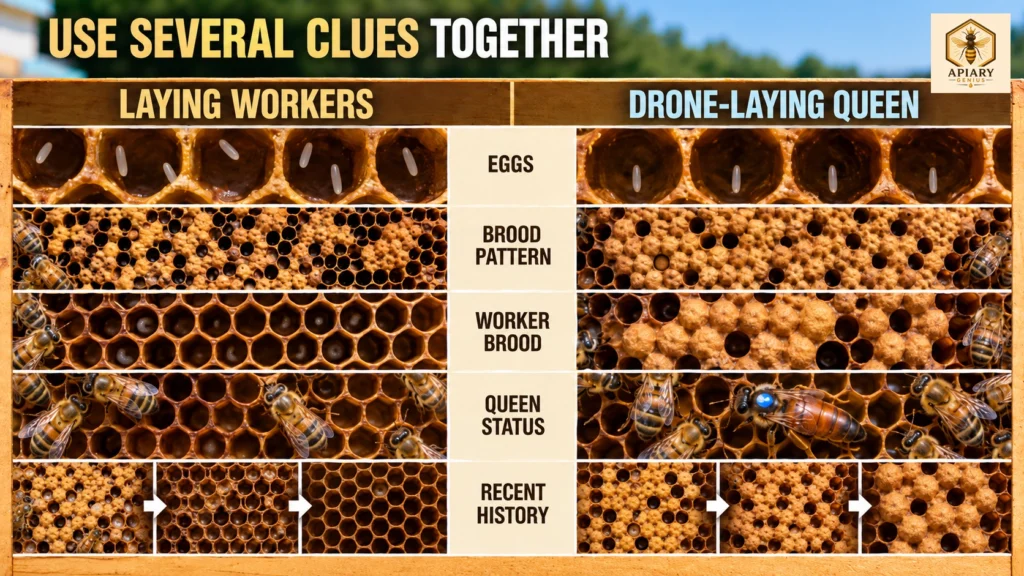
Look at the Number and Position of the Eggs
A normal laying queen typically places an egg near the center of the bottom of the cell.
Laying workers often produce a less orderly picture.
You may find several eggs in one cell, eggs positioned off-center, or eggs attached to the sides of cells. Multiple workers may also be laying in different parts of the brood area.
This can make the egg pattern appear scattered and inconsistent.
A drone laying queen may retain a more queen-like laying pattern. Eggs may be placed more consistently near the bottoms of cells and may appear one per cell, even though the resulting brood is predominantly drones.
These are tendencies, not absolute rules.
A newly laying queen can temporarily place more than one egg in some cells. Michigan State University Extension notes that this can occur particularly when a new queen has only recently begun laying.
That is why egg position, egg number, and later brood development should be considered together.
Read the Brood Pattern
Step back from individual cells and inspect the whole brood area.
Established laying workers often produce a disorganized pattern because more than one worker may be depositing eggs and the normal queen-centered brood pattern has been lost.
You may see scattered eggs, irregular patches of brood, and raised drone cappings distributed through areas that would normally contain worker brood.
A drone laying queen may still produce a more organized pattern because a single queen is moving across the comb and laying systematically.
However, a failing queen can also produce a poor or spotty brood pattern.
So brood pattern alone does not prove which condition is present.
Ask whether the frame looks more like the work of one primary egg layer moving systematically across the comb or irregular egg laying by multiple bees.
Check for Drone Brood in Worker Cells
Drone brood developing in worker-sized cells is an important warning sign.
Drone pupae are larger than worker pupae, so their cappings may bulge noticeably above worker-sized cells. When many unfertilized eggs have been placed in worker cells, the brood surface can take on a rough, uneven appearance.
Laying workers can produce this pattern because their eggs are unfertilized.
A drone laying queen can produce the same pattern because she is also laying unfertilized eggs in cells where worker brood would normally develop.
NC State Extension describes a drone-laying queen as producing predominantly drone brood and notes the noticeably protruding cappings of drone brood.
Therefore:
Drone brood in worker-sized cells tells you that unfertilized eggs are being laid where worker brood should be. It does not identify the egg layer by itself.
Look for Current Worker Brood
Current worker brood can help establish a timeline.
Because ordinary laying workers do not mate, they normally cannot produce the fertilized eggs needed to create female worker offspring.
If you find a normal progression of worker eggs, young worker larvae, and capped worker brood in a coherent pattern, a functional queen was laying fertilized eggs recently.
But brood age matters.
Capped worker brood can remain after a queen has disappeared or begun failing. Its presence does not prove that she is still functioning normally today.
Look for the progression of brood stages.
Are fresh eggs present?
Are young worker larvae present?
Is new worker brood continuing?
Or is worker brood aging out while irregular drone brood becomes increasingly dominant?
That sequence is more informative than the presence of one brood stage alone.
Consider Whether a Queen Is Present
Finding a queen is valuable evidence, but it does not end the diagnosis.
If you find a queen while the colony is producing predominantly drone brood in worker-sized cells, a drone laying queen becomes much more likely.
But remember:
Queen present does not always mean queen functioning normally.
A queen may be present and still be inadequately mated, depleted of viable sperm, or otherwise reproductively failing.
The opposite is also important.
Failing to find the queen during one inspection does not prove she is absent. Queens can be difficult to locate, especially in populous colonies.
Use queen sightings together with eggs, larvae, brood pattern, and colony history.
Use the Colony’s Recent History
Recent colony history can make an uncertain brood pattern much easier to interpret.
Ask:
Did the colony recently swarm?
Was the old queen removed?
Did you recently introduce a queen?
Has the colony recently raised an emergency or supersedure queen?
Was there a long period with no eggs or open brood?
Has an older queen’s worker-brood pattern been deteriorating?
If a young queen has only recently started laying and you find a limited number of cells with multiple eggs, do not rush to diagnose laying worker bees.
Michigan State University Extension recommends allowing ambiguous cases to develop long enough for older larvae and capped brood to reveal whether the colony is producing workers or drones.
On the other hand, a colony that has been queenless for an extended period, has lost its open brood, and later develops scattered eggs on cell walls plus drone brood in worker cells fits the laying-worker diagnosis much more strongly.
If you also find queen cells and are unsure what they mean, see Queen Cells in a Beehive: Swarm, Supersedure, or Emergency?.
Why Multiple Eggs Alone Do Not Prove You Have Laying Workers
Multiple eggs are one of the classic signs associated with laying worker bees, but they are not exclusive to them.
A newly laying queen may temporarily deposit more than one egg in a cell.
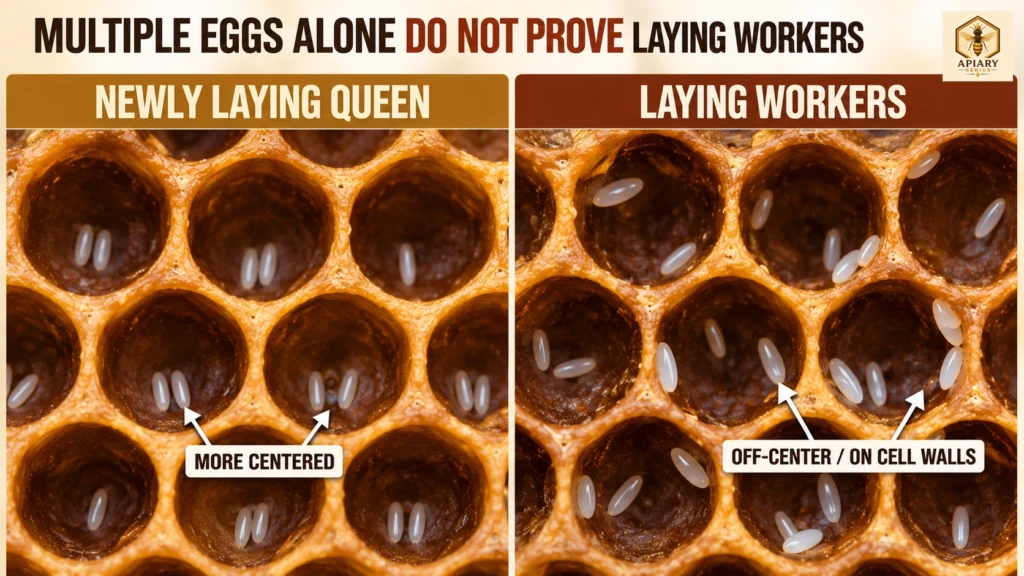
Michigan State University Extension reports seeing multiple queen-laid eggs particularly in colonies where new queens have only recently started laying.
Instead of asking only:
“How many eggs are in the cell?”
Ask several questions together:
Where are the eggs positioned?
Is the laying pattern organized or scattered?
Is normal worker brood being produced?
Are drones developing in worker-sized cells?
Is a queen present?
Was a newly mated queen expected to begin laying recently?
What was the colony’s queen and brood status during the previous weeks?
If only fresh eggs are present and the situation is uncertain, waiting long enough for the brood type to become clearer may prevent an unnecessary intervention.
A few multiple-egg cells from a new queen should not be treated the same way as widespread irregular egg laying accompanied by disappearing worker brood and scattered drone brood.
What to Do If You Have Laying Workers
If the evidence strongly indicates laying worker bees, first consider the colony’s strength, the season, and the resources you have available.
An established laying-worker colony should not be treated exactly like an ordinary queenless colony.
Direct introduction of an adult queen can be difficult once laying workers are established, and rejection is a significant risk. Michigan State University Extension guidance notes that colonies with laying workers commonly fail to accept a new queen and may kill her.
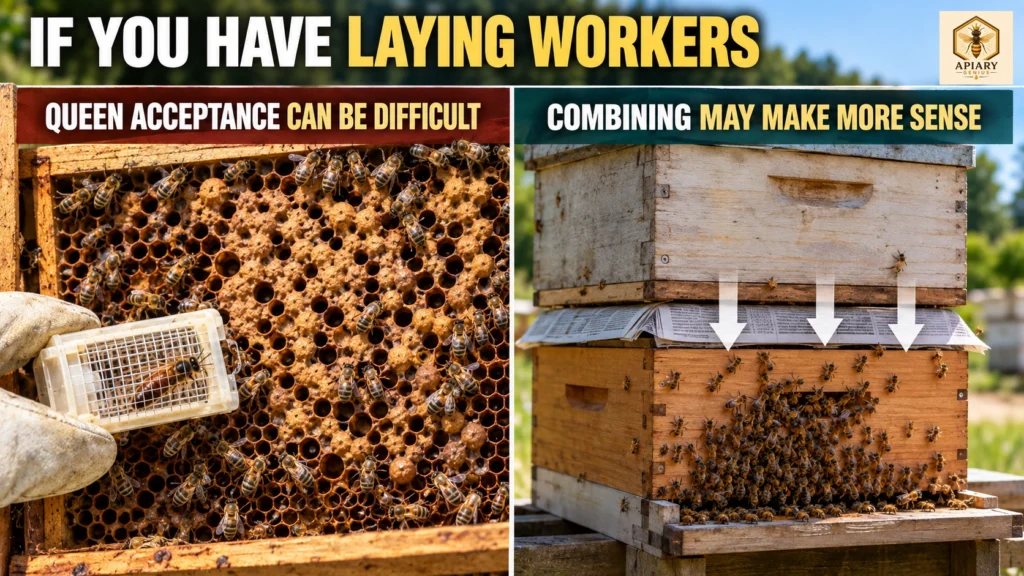
That does not mean every laying-worker colony is impossible to recover.
It means the response should match the condition of the colony.
If the colony is weak, declining, or late in the season, combining it with a healthy queenright colony may be more practical than risking a valuable replacement queen.
A newspaper combine is one commonly recommended method. The temporary newspaper barrier allows the populations to mix more gradually as the paper is removed by the bees. Michigan State University Extension describes this approach as a practical option for laying-worker colonies.
If the colony is still strong and you have additional bee and brood resources, other recovery approaches may be possible. Experienced beekeepers sometimes use resources from healthy colonies or a queenright nucleus colony rather than exposing a purchased queen directly to an established laying-worker population.
The best option depends on:
- colony population;
- season;
- remaining food stores;
- availability of queenright colonies;
- availability of healthy brood or a nucleus colony;
- availability of replacement queens;
- time remaining for the colony to rebuild.
Do not weaken several healthy colonies severely in an attempt to save one badly declining unit.
Shake-out methods are also used by some beekeepers, but they should not be presented as a guaranteed cure. Shaking bees away from the hive does not provide a reliable way to prove that every laying worker has been eliminated.
What to Do If You Have a Drone-Laying Queen
Management is generally more straightforward when you have confidently identified a drone laying queen.
If a queen is present but continues producing predominantly drone brood where worker brood should be, the colony needs a functional queen if it is to resume normal worker production.
Before acting, make sure you are not looking at a newly laying queen whose egg-laying behavior has not yet stabilized.
A few multiple-egg cells soon after a new queen begins laying are not enough to condemn her.
The diagnosis becomes much stronger when you see a persistent pattern of drone brood in worker-sized cells, little or no new worker brood, and a queen that continues laying unfertilized eggs.
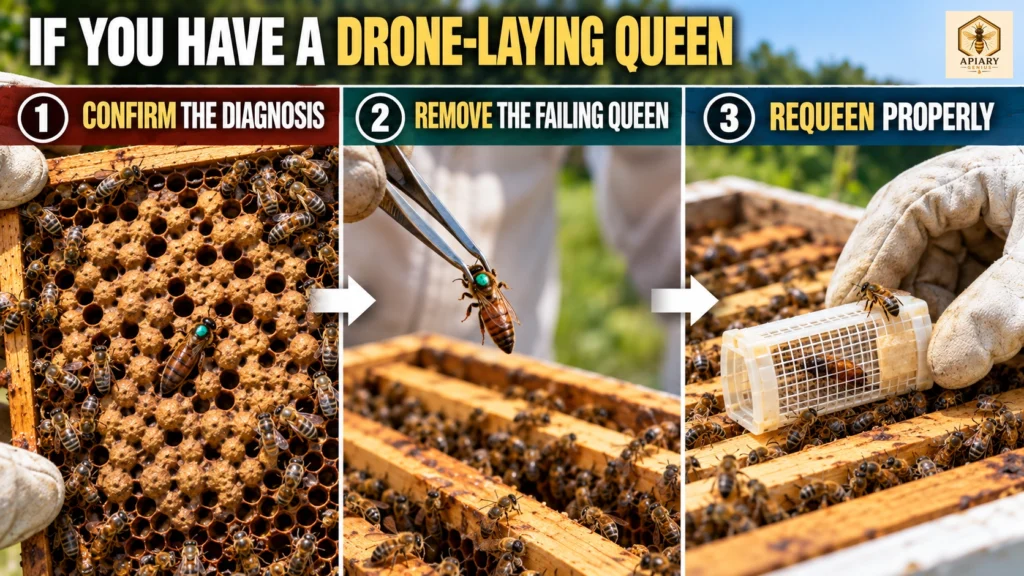
NC State Extension recommends replacement when a queen is confirmed to be a drone layer.
Once you are confident in the diagnosis, remove the failing queen before introducing a replacement.
Then use an appropriate queen-introduction process rather than simply releasing a valuable queen into the colony.
For the full replacement procedure, see How to Requeen a Beehive: Step-by-Step Guide for Beginners.
If you intend to produce replacement queens yourself and the colony resources, season, and drone population are suitable, see Queen Rearing: A Complete Guide to Raising Your Own Queens. Queen rearing is a separate management process and should not delay action in a colony whose worker population is already declining.
When Combining the Colony May Make More Sense
Not every failing colony needs to remain an independent colony.
Combining may make more sense when the problem has progressed so far that recovery would require more resources than the colony is likely to return.
This may be the better option when:
- the laying-worker colony has lost much of its useful worker population;
- a drone-laying queen has left the colony too weak to rebuild efficiently;
- the season is too advanced for a replacement queen to rebuild the population;
- suitable replacement queens are unavailable;
- you have a strong, healthy queenright colony that can absorb the remaining bees.
If the failing colony contains a drone laying queen, remove that queen before combining the colony with a queenright colony.
With laying workers, newspaper combining can give the declining colony’s remaining workers a way to join a functional queenright unit without depending on direct acceptance of a newly introduced queen. Michigan State University Extension recommends newspaper combining as one management option for established laying-worker colonies.
Only combine colonies that are otherwise healthy.
If you suspect American foulbrood, European foulbrood, or another significant transmissible disease, diagnose that problem before transferring bees, brood, comb, or equipment into another colony.
The objective is not simply to preserve every hive box as a separate unit. It is to preserve useful bees and resources without putting a healthy colony at unnecessary risk.
Common Diagnosis and Management Mistakes
Diagnosing laying worker bees from multiple eggs alone.
A newly laying queen may temporarily put more than one egg in a cell. Always consider egg placement, brood development, queen status, and colony history.
Assuming any drone brood means the queen has failed.
Healthy colonies naturally raise drones. The concern is abnormal drone production, especially widespread drone brood in worker-sized cells combined with declining worker production.
Assuming a queen is healthy simply because you found her.
A queen may be present but still be unmated, inadequately mated, depleted of viable sperm, or otherwise failing.
Assuming the colony is queenless because you could not find the queen.
One unsuccessful queen search is not sufficient evidence. Eggs, larvae, brood pattern, and colony history often provide better information.
Introducing a purchased queen directly into an established laying-worker colony without considering acceptance risk.
Established laying workers can make queen introduction difficult, and rejection may cost you the replacement queen.
Treating a shake-out as a guaranteed solution.
Shake-out methods are used in beekeeping, but they should not be described as a certain biological reset.
Ignoring season and colony strength.
A rescue that is biologically possible may not be practical. A badly depleted colony late in the season may be better combined with a strong queenright colony.
FAQ
Can a new queen lay multiple eggs in one cell?
Yes. A newly laying queen can temporarily place more than one egg in some cells. This is why multiple eggs alone do not prove that a colony has laying worker bees.
Look at egg position, brood pattern, the type of brood that develops, whether the colony recently produced or received a new queen, and whether normal worker brood begins appearing.
Will laying worker bees accept a new queen?
They may not.
Once laying worker bees are established, direct queen introduction can be difficult, and the introduced queen may be rejected or killed. Queen acceptance is therefore not something to assume.
Depending on colony strength and circumstances, combining the colony with a strong queenright colony or using other colony resources may be more practical than directly introducing a purchased queen.
Can laying worker bees produce worker bees?
Normally, no.
Worker honey bees do not mate, so their eggs are unfertilized. In ordinary managed honey bee colonies, unfertilized eggs develop into male drones, while fertilized eggs produce females.
This is why a colony with established laying workers cannot replace its aging worker population through worker-laid eggs.
Why is there drone brood in worker-sized cells?
Drone brood in worker-sized cells means unfertilized eggs have been laid in cells normally used to rear workers.
Those eggs may have come from laying workers or from a drone laying queen.
Because both conditions can produce this sign, drone brood in worker cells should be interpreted together with egg placement, brood pattern, queen status, current worker brood, and colony history.
How can you tell if a queen has become a drone layer?
Look for a queen that is present but persistently produces predominantly drone brood, especially drone brood developing in worker-sized cells while normal worker production disappears.
Her eggs may still be placed relatively neatly at the bottoms of cells because a queen is laying them.
Before replacing her, consider whether she has only recently started laying. If the pattern persists and worker production does not resume, the evidence for a drone laying queen becomes much stronger.
Sources
- Michigan State University Extension — Laying Worker With a Queen Cell
- Michigan State University Extension — Is This Queen Okay?
- NC State Extension — How to Install a Package of Honey Bees
- PubMed — The Effect of Queen Pheromones on Worker Honey Bee Ovary Development
- PubMed — Queen and Young Larval Pheromones Impact Nursing and Reproductive Physiology of Honey Bee Workers
- University of Florida IFAS Extension — European Honey Bee Apis mellifera