
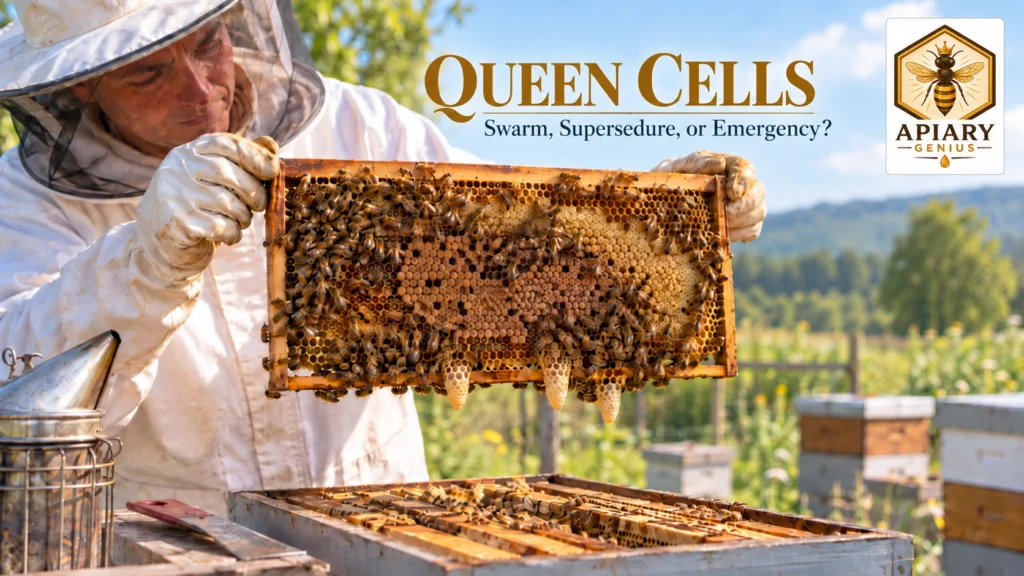
Finding queen cells during a hive inspection creates an immediate question: What are the bees trying to do?
They may be preparing to swarm. They may be replacing an existing queen through supersedure. Or they may be responding to the sudden loss of their queen by raising an emergency replacement.
The appearance and location of the cells provide useful clues, but neither should be treated as a diagnosis by itself. A queen cell near the bottom of a frame does not automatically prove that a colony will swarm, just as a cell on the face of the comb does not automatically prove supersedure or emergency queen rearing.
The better approach is to examine the entire colony.
Is the queen present? Are there eggs or very young larvae? How strong and crowded is the colony? How many active queen cells are present? Where are they located? Are they open or capped? What happened during the previous inspection?
That context matters because removing the wrong queen cells can create a bigger problem than the one you were trying to solve.
Quick Answer
Queen cells mean a colony is raising, or preparing to raise, a new queen, but the reason cannot always be determined from cell location alone. Swarm cells are associated with colony reproduction, supersedure cells with replacing an existing queen, and emergency queen cells with unexpected queen loss. Before removing any cells, check whether they are active, look for the queen, eggs, and young brood, evaluate colony strength and crowding, note cell position and developmental stage, and review what has happened in the colony recently.
Table of Contents
What Are Queen Cells?
Queen cells are specialized wax cells in which honey bees rear new queens.
They are much larger and more elongated than ordinary worker cells and hang downward as they develop. A mature queen cell often has a rough, textured exterior that beekeepers commonly compare to a peanut shell.
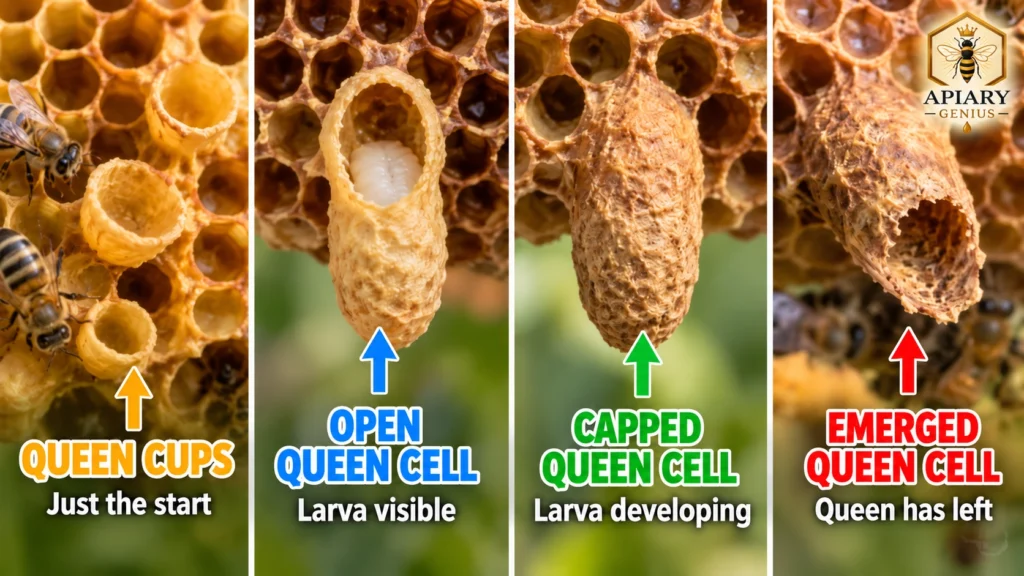
Finding one tells you that queen-related biology may be underway, but your first task is to determine whether you are looking at an active queen cell or simply an unused queen cup.
Queen Cups vs. Active Queen Cells
Honey bee colonies commonly build small cup-shaped structures known as queen cups.
Finding queen cups does not, by itself, mean the colony is preparing to swarm or replace its queen.
UF/IFAS Extension notes that queen cups are commonly present in colonies and are not themselves evidence that swarming is imminent.
A queen cup becomes biologically important when it is being used for queen rearing—for example, when it contains an egg or larva and workers begin provisioning and extending it for queen development.
That distinction can prevent unnecessary intervention.
If you find an empty cup, record it and continue inspecting the colony. If the structure contains an egg, larva, or brood food and is being extended downward, the colony is actively rearing a queen.
The useful question is therefore not simply:
“Are there queen cups?”
It is:
“Are the bees actively rearing queens?”
Open vs. Capped Queen Cells
An open queen cell shows that queen development is still underway before the cell has been sealed.
Depending on its age, you may be able to see a larva and brood food inside.
A capped queen cell represents a later developmental stage.
Honey bee queens develop quickly. Penn State Extension describes queen development as taking about 16 days from egg to adult emergence, with the cell being capped at roughly day eight or nine.
That does not mean you can discover a capped queen cell and calculate an exact emergence date.
Unless you know when the egg was laid or when the cell was capped, the exact age of the developing queen may be uncertain.
A cell you discover today may have been capped several days earlier.
The developmental stage still matters because a colony with newly started queen cells presents a different management situation from one containing mature capped cells that may be close to producing virgin queens.
Why Do Bees Make Queen Cells?
For most beekeepers who unexpectedly find active queen cells, three biological situations are especially important.
The colony may be preparing to reproduce by swarming.
It may be replacing an existing queen through supersedure.
Or it may be responding to sudden queen loss through emergency queen rearing.
Those categories are useful, but real colonies do not always arrange the evidence as neatly as a textbook diagram.
That is why cell location, number, and appearance should always be interpreted alongside queen status, brood age, colony strength, season, and recent colony history.
Swarm Cells
Swarming is natural colony-level reproduction.
Part of the colony leaves with a queen while the parent colony retains brood, stores, workers, and developing queen cells from which a replacement queen can emerge.
For a beekeeper, finding active swarm cells matters because the colony may already be well into that biological process.
What Swarm Cells Usually Look Like
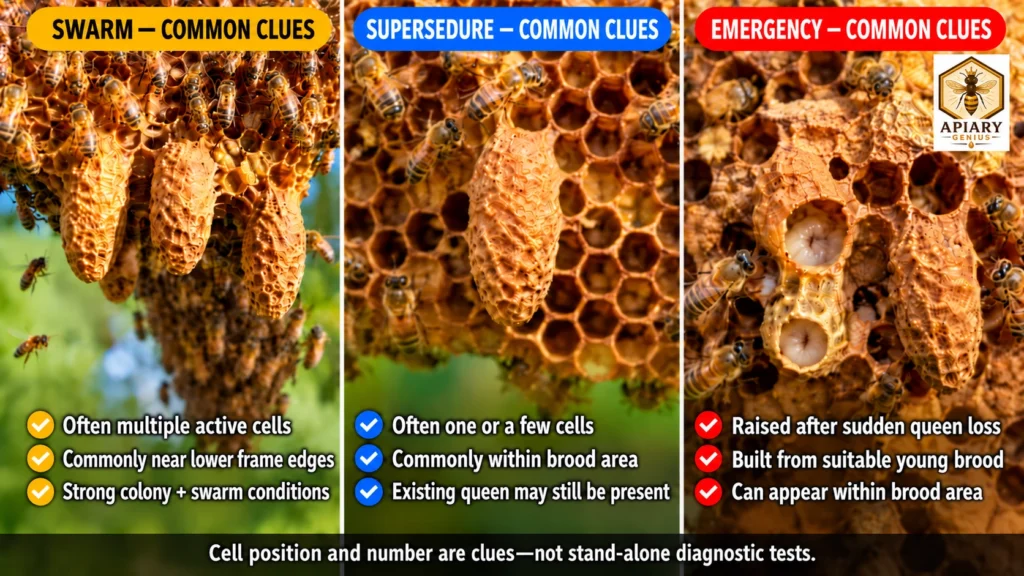
Swarm cells are commonly associated with the lower edges or outer areas of combs, and a swarm-preparing colony may produce multiple active queen cells.
UF/IFAS describes numerous queen cells along frame edges in a queenright colony as evidence that can be consistent with normal swarm preparation.
Utah State University Extension likewise explains that queen cells near the lower portions of frames can be associated with a strong, crowded colony preparing to swarm.
But can is the important word.
A colony preparing to swarm can build queen cells in other locations.
Location is therefore a useful clue—not a foolproof diagnostic test.
“Bottom of frame = swarm” is too simplistic.
What Else to Check Before Calling Them Swarm Cells
Instead of diagnosing swarming from position alone, inspect the colony around the cells.
Is the queen still present?
Are eggs or very young larvae present?
Is the colony heavily populated?
Is the brood nest becoming congested?
Is the colony expanding rapidly?
Is there enough room for the queen to continue laying and for workers to store incoming resources?
Does the season and local forage pattern fit a period when colonies in your area commonly swarm?
A strong, rapidly expanding queenright colony with multiple active queen cells and clear swarm conditions provides much stronger evidence than one queen cell near the bottom of a weak colony.
Season can help, but it should not become a rigid calendar rule. Swarm timing varies with climate, nectar flows, colony development, genetics, and management.
If the evidence points toward swarm preparation, use a broader swarm-management strategy rather than relying on cell destruction alone. See the Apiary Genius guide on how to prevent bee swarming.
What Swarm Cells Mean for the Colony
A colony building swarm cells may be preparing for a major transition.
In a typical primary swarm, the established queen leaves with part of the worker population while the parent colony remains behind with brood, food stores, workers, and developing queens.
The parent colony must then establish a new laying queen.
That means the colony can experience a brood interruption while a replacement queen finishes development, emerges, matures, mates, and begins laying.
By the time mature or capped swarm cells are present, the colony may be much further into swarm preparation than a beekeeper who has just discovered them realizes.
The management goal should therefore not be to destroy the visible evidence and assume the problem is solved.
The goal is to understand and manage the colony conditions producing that evidence.
Supersedure Cells
Supersedure is different from reproductive swarming.
Instead of dividing the colony, the bees are attempting to replace an existing queen.
The old queen may still be present while her replacement is being raised, so finding a queen does not rule out supersedure.
What Supersedure Cells Usually Look Like
Supersedure cells are often described as occurring on the face of the comb or within the brood area rather than being concentrated along the lower frame margins.
UF/IFAS notes that queen cells within or near the brood pattern are commonly associated with supersedure, while Utah State describes supersedure cells as often occurring in the middle areas of frames.
Again, often is not always.
Do not diagnose supersedure simply because a queen cell appears in the middle of a frame.
Use location together with queen status, brood condition, colony strength, swarm context, cell development, and recent colony history.
Why a Colony May Replace Its Queen
A honey bee queen is not simply an egg-laying machine. Her reproductive condition and chemical signals influence colony organization.
Workers may initiate supersedure when the existing queen is no longer adequately fulfilling her role.
Possible contributing factors can include age, injury, reproductive problems, disease, poor mating, or changes in queen signaling.
But avoid a common shortcut:
A poor or irregular brood pattern does not automatically prove that the queen is defective.
A peer-reviewed study by Lee and colleagues examined colonies with good and poor brood patterns and found that poor brood pattern was not reliably associated with measured queen-quality traits. When queens were moved between colony environments, brood patterns could change, showing that colony-level factors can strongly influence what the beekeeper sees on the comb.
Brood pattern therefore provides useful context, but it should not be used as a stand-alone measurement of queen quality.
Disease, brood mortality, nutrition, comb condition, worker behavior, and other colony factors can also affect brood appearance.
When Supersedure May Be Best Left Alone
If the colony is deliberately replacing a queen, automatically destroying the queen cells may interfere with the replacement process without solving whatever prompted it.
Establish the context first.
Is the current queen present?
Is she laying?
What does the brood look like?
Are the queen cells active and developing normally?
Is the colony showing convincing swarm conditions, or does the broader evidence point toward replacement?
Intervention may sometimes be appropriate, including beekeeper-directed requeening, but it should follow diagnosis.
If you decide that introducing a selected queen is the better option, follow a deliberate procedure rather than simply destroying replacement cells. See the Apiary Genius guide on how to requeen a beehive.
Emergency Queen Cells
Emergency queen rearing begins when a colony unexpectedly loses its queen and still has suitable young female brood from which a replacement queen can be raised.
Unlike swarm preparation, the colony must work with brood that was already present when the queen was lost.
How Emergency Queen Cells Are Made
Worker bees and queens both develop from fertilized eggs, but their developmental pathways differ dramatically because of the conditions under which they are reared, especially nutrition.
When the colony becomes queenless and suitable young female larvae remain, workers can select some of those larvae and modify their cells for queen rearing.
This means emergency queen cells may appear as enlarged cells extending outward and downward from areas where worker brood was already present.
They do not necessarily begin as conventional queen cups.
Their position can therefore reflect where suitable brood happened to be available.
Appearance should still be interpreted alongside colony history.
If you cannot find the queen, do not immediately assume she is gone. Queens can be difficult to locate, and a colony undergoing queen transition may contain a virgin queen that is particularly easy to miss.
For a broader diagnostic process, see how to tell if a beehive is queenless.
What to Check After Sudden Queen Loss
When emergency queen replacement is possible, brood age becomes particularly useful.
Fresh eggs indicate that a laying queen was present very recently.
Very young larvae can also help you reconstruct what happened.
Then inspect the queen cells.
Are workers actively developing cells around suitable young brood?
Are the cells open, capped, or in different stages?
Does the colony have enough workers and resources to support queen rearing?
Could the queen have been accidentally injured, killed, removed, or transferred during a recent inspection, split, or frame movement?
Recent history can be more informative than cell position.
If the colony truly lost its queen, its viable emergency queen cells may be its natural route to recovery.
Do not destroy those cells while you are still trying to determine what happened.
Are Emergency Queens Lower Quality?
The statement “emergency queens are poor queens” is too simplistic.
There is a genuine biological issue behind the concern: the developmental starting point matters.
Research on queen development has shown that larval age can influence queen characteristics. Queens started from younger larvae can differ from queens started later in larval development.
Nutrition matters as well.
Research by Sagili and colleagues found that workers preferentially selected better-nourished larvae for emergency queen rearing when given a choice.
Other developmental factors—including colony strength, nurse-bee availability, feeding conditions, and later mating success—can also influence the resulting queen.
These findings support careful queen-rearing practices.
They do not justify automatically condemning every naturally reared emergency queen.
A queen that originated through emergency rearing and later mates successfully, establishes satisfactory brood production, and heads a healthy colony should be evaluated on actual colony performance—not rejected merely because her origin was “emergency.”
For a deeper look at deliberate queen production, see the Apiary Genius queen-rearing guide.
Swarm vs. Supersedure vs. Emergency Queen Cells
The safest way to distinguish swarm, supersedure, and emergency queen cells is to combine several pieces of evidence.
| Evidence | Swarm | Supersedure | Emergency |
|---|---|---|---|
| Queen status | Existing queen is often present during preparation | Existing queen may still be present | Original queen is usually absent |
| Eggs and young brood | Commonly present during early preparation | May remain present while old queen lays | Brood age helps estimate when queen loss occurred |
| Cell number | Often multiple | Often fewer, but variable | Can be multiple |
| Cell position | Commonly lower edges or frame margins | Often on comb face or in brood area | Often develops from suitable brood on comb face |
| Cell stage | Open or capped | Open or capped | Open or capped depending on time since queen loss |
| Colony strength | Commonly strong and expanding | Variable | Variable |
| Swarm conditions | Usually important | Often absent or less convincing | Not required |
| Season | Often fits local swarm period | Can occur when replacement is needed | Can occur whenever queen loss and suitable brood coincide |
| Recent history | Rapid buildup or previous swarm signs may support diagnosis | Continuing queen presence can support supersedure | Sudden queen disappearance or recent manipulation may support emergency rearing |
No single row provides a diagnosis.
A bottom-positioned cell in a strong spring colony is evidence that supports swarming, but it is not proof.
A queen cell in the middle of a frame can fit supersedure or emergency queen rearing, but location does not automatically exclude swarming.
Multiple cells do not always mean swarm preparation.
A small number of cells does not automatically mean supersedure.
The colony’s complete story matters more than any isolated clue.
How to Diagnose Why Your Hive Has Queen Cells
When you unexpectedly find queen cells, resist the urge to remove them immediately.
Use the inspection to collect evidence first.
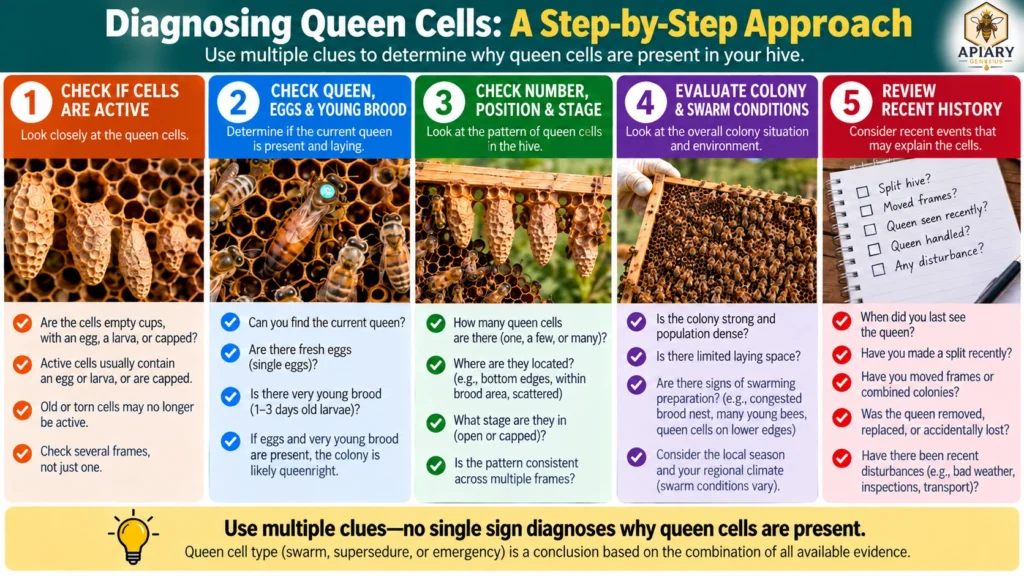
Step 1 — Check Whether the Cells Are Active
Begin by separating empty queen cups from cells in which queen rearing has actually started.
Look carefully inside open structures when you can do so without damaging them.
An empty cup has very different diagnostic significance from a structure containing an egg, developing larva, brood food, or actively growing queen cell.
Also note whether the cells are open or capped.
This confirms whether active queen rearing is occurring and gives you useful information about how far development has progressed.
Step 2 — Look for the Queen, Eggs, and Young Brood
Finding the queen is useful, but failing to find her is not proof that the colony is queenless.
Look for eggs and very young larvae.
They provide evidence that a laying queen was present recently even when you cannot locate her during the inspection.
Then interpret that evidence alongside the queen cells.
A queenright colony with multiple active queen cells and strong swarm conditions creates a very different diagnostic picture from a colony in which the queen disappeared after the last inspection and workers are raising replacements from available young brood.
If queen status remains uncertain, avoid irreversible action until you have stronger evidence.
Step 3 — Check Cell Number, Position, and Stage
Now use the queen cells themselves as diagnostic clues.
Record approximately how many active cells you see.
Note whether they occur near lower frame margins, along edges, or within the brood area.
Determine whether they are newly started, open and developing, or capped.
Do not turn those observations into rigid rules.
“Bottom” does not equal “swarm” with certainty.
“Middle” does not equal “supersedure” with certainty.
One cell versus several cells does not provide a universal diagnosis either.
Treat each observation as one piece of a larger puzzle.
Step 4 — Evaluate Colony Strength and Swarm Conditions
Step back from the queen cells and evaluate the entire hive.
Is the colony heavily populated?
Is the brood nest crowded?
Is it expanding rapidly?
Does the queen have adequate laying space?
Are incoming nectar and pollen contributing to rapid growth?
Does the colony’s overall condition fit reproductive swarm preparation?
A strong, crowded, queenright colony with active queen cells during favorable swarm conditions supports a swarm interpretation.
A colony with evidence of recent queen loss and emergency cells tells a different story.
If swarm preparation appears likely, management may involve more than cutting cells. Depending on your goals and colony condition, a properly planned hive split may be one possible management tool.
Step 5 — Review What Happened During Recent Inspections
Colony history can resolve ambiguities that one inspection cannot.
Ask what you saw during the previous visit.
Was the queen definitely present?
Were eggs present?
Were queen cups or active cells already starting?
Was the colony rapidly increasing in population?
Did you recently make a split?
Did you move brood frames between boxes?
Was the queen handled, marked, clipped, caged, or otherwise disturbed?
Could she have been injured during manipulation?
Good inspection records are extremely useful here.
A queen cell is a snapshot. Your records provide the timeline.
Regular, purposeful inspections make that timeline easier to interpret. See the Apiary Genius guide to the best time to inspect a beehive for more inspection guidance.
Should You Remove Queen Cells?
Not automatically.
The question “Should I remove queen cells?” cannot be answered safely until you have a reasonable diagnosis of why those cells exist.
The same action—cutting out a queen cell—can have completely different consequences in a swarming colony, a superseding colony, and a genuinely queenless colony.
When Removing Queen Cells Can Make Things Worse
Consider a colony that unexpectedly lost its queen and is raising replacements from the young brood that remained.
If you destroy all viable emergency queen cells without providing another queen or another route to queen replacement, you may remove the colony’s natural recovery mechanism.
The same principle applies to supersedure.
Destroying supersedure cells without understanding why workers are replacing the existing queen can interrupt replacement while leaving the underlying problem unresolved.
Before cutting cells, determine what role they may be serving.
Why Cutting Swarm Cells Alone Often Fails
Removing visible swarm cells can feel like removing the swarm problem.
But the cells themselves are not necessarily the biological cause.
Mississippi State University Extension notes that simply cutting swarm cells may fail because bees can construct additional cells if the colony remains in swarm condition.
UF/IFAS similarly treats queen-cell removal as a management technique that requires repeated, careful inspection rather than as a one-time cure.
If the colony remains crowded, rapidly growing, and strongly committed to reproductive swarming, removing the current queen cells may remove the symptom without changing the colony state that created them.
Swarm management should address the colony, not merely the wax structures.
When Intervention May Be Appropriate
Intervention becomes more defensible once you understand the likely situation and have a clear management objective.
A beekeeper may decide to manage swarm preparation, make a split, allow supersedure to continue, introduce a selected queen, or allow a queenless colony to raise its own replacement.
The appropriate choice depends on colony condition, season, local mating conditions, available equipment, disease status, queen availability, beekeeper goals, and how far queen development has progressed.
The principle remains simple:
Diagnose first. Act second.
What Happens After a Queen Cell Is Capped?
A capped queen cell is not the end of queen replacement.
The developing queen still has to complete metamorphosis, emerge, mature, mate successfully under suitable conditions, return to the colony, and begin laying.
That sequence creates an important period during which a healthy colony may temporarily contain no eggs.
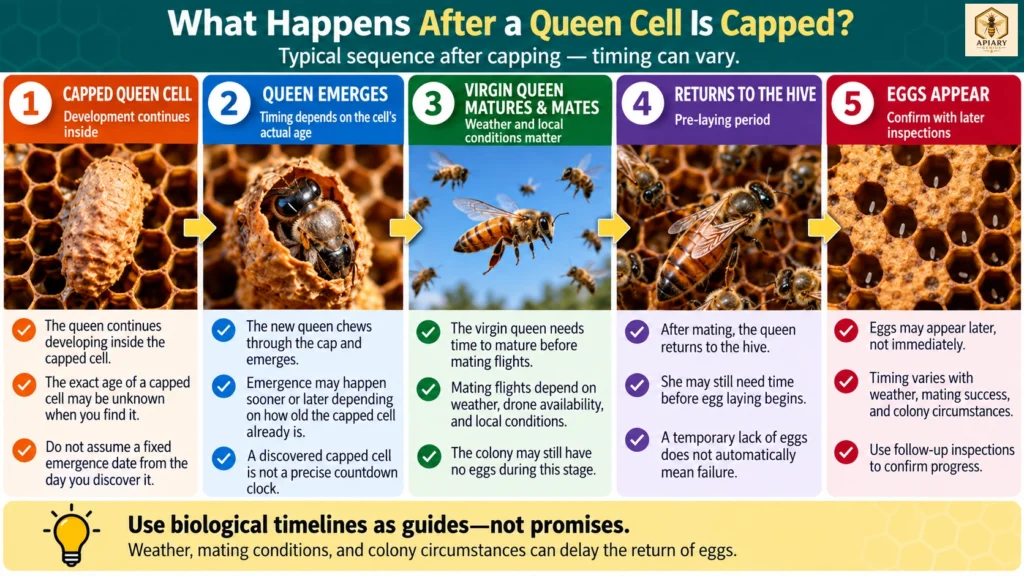
Queen Emergence
Penn State Extension describes queen development as taking approximately 16 days from egg to adult emergence, with the cell capped at about day eight or nine.
Those numbers are useful biological benchmarks.
But a beekeeper who discovers an already capped queen cell usually does not know exactly when it was capped.
Do not count a fixed number of days from the date you first noticed the cell and assume the queen must emerge on one exact date.
She may be several days further into development than you realize.
Virgin Queen and Mating Period
An emerged virgin queen is not immediately equivalent to an established laying queen.
She must mature and, when weather and drone conditions permit, complete mating flights before normal egg laying begins.
During this period, she can be difficult to find.
The colony may contain no eggs even though queen replacement is progressing normally.
This is where premature intervention can cause problems.
Introducing another queen simply because you cannot find eggs shortly after expected emergence can mean introducing her into a colony that already contains a viable virgin queen.
When to Expect Eggs Again
There is no single inspection date on which new eggs are guaranteed to appear.
Utah State Extension provides useful developmental timelines for colony-reared queens, while also noting that weather, local conditions, and available resources can affect the process.
Penn State likewise describes the progression from emergence through maturation, mating, and egg laying rather than treating it as an instantaneous transition.
Under favorable conditions, eggs may appear roughly within a couple of weeks after emergence, but the exact interval varies.
Weather can delay mating flights.
Drone availability and local mating conditions matter.
Queen development and colony circumstances matter.
Use biological timelines as guides—not promises.
If a colony eventually fails to establish a laying queen, intervention may become necessary. But the temporary absence of eggs after queen emergence does not automatically prove queen failure.
What to Do After You Find Queen Cells
The best immediate response is to preserve evidence before making an irreversible decision.
Queenright + strong colony + active queen cells + clear swarm context: investigate swarm preparation. Look at colony population, available space, cell stage, season, and swarm-management options rather than simply cutting cells.
Queen present + evidence of replacement + little convincing swarm context: investigate supersedure. Evaluate the existing queen and colony before interfering with replacement cells.
Queen absent + evidence of recent queen loss + active emergency cells: investigate emergency queen replacement. Determine whether the colony already has a viable route to producing another queen before introducing or removing anything.
Empty queen cups alone: record them and continue the inspection. Do not diagnose swarming from empty cups.
And if the evidence conflicts, uncertainty itself is useful information.
Record what you saw.
Avoid unnecessary irreversible intervention.
Reassess the colony at an appropriate interval.
The central lesson is simple:
Finding queen cells is an observation, not a diagnosis.
The cells tell you that queen-related biology is occurring.
The rest of the colony tells you why.
Frequently Asked Questions
1. What does it mean when you find queen cells in a hive?
Active queen cells mean the colony is raising a new queen. The reason may be reproductive swarming, supersedure of an existing queen, or emergency replacement after queen loss. Empty queen cups alone do not prove that active queen rearing or swarm preparation has begun.
2. What is the difference between queen cups and queen cells?
A queen cup is a small cup-shaped wax structure that may remain empty. Colonies commonly maintain these structures even when they are not actively raising queens. An active queen cell contains an egg or developing queen larva and is provisioned and extended as queen development proceeds.
3. How can you tell swarm cells from supersedure cells?
Location can help, but it is not definitive. Swarm cells are commonly associated with frame edges or lower areas, while supersedure cells are often found on the comb face or within the brood area. Diagnose using additional evidence, including queen status, eggs and brood, colony strength, cell stage, swarm conditions, season, and recent colony history.
4. What do emergency queen cells look like?
Emergency queen cells develop when workers redirect suitable young female brood into queen development after unexpected queen loss. Because they originate from brood that was already present, they may appear as enlarged cells projecting from areas of worker brood. Their appearance should still be interpreted alongside evidence of recent queen loss.
5. Should I remove queen cells from my hive?
Not until you understand why they are there. Destroying emergency replacement cells can interfere with recovery of a queenless colony, while cutting swarm cells alone may fail to stop a colony that remains committed to swarming. Diagnose first, then choose the management response.
6. Does finding queen cells mean my hive will swarm?
No. Queen cells can be associated with swarming, supersedure, or emergency queen replacement. Empty queen cups are even less conclusive. Active cells in a strong, queenright colony showing additional swarm conditions provide much stronger evidence of swarm preparation.
7. What should I do if I find capped queen cells?
First determine the likely reason for the cells and whether the original queen is still present. Avoid destroying capped cells until you understand the colony’s queen status and management options. A capped cell means queen development is already relatively advanced.
8. Can a hive have queen cells and still have a queen?
Yes. A queenright colony can build swarm cells before the established queen leaves, and a colony can begin superseding an existing queen while she is still present. Finding a queen and queen cells in the same hive is therefore entirely possible.
9. How long after a queen cell is capped will the queen emerge?
Queen development takes about 16 days from egg to adult emergence, and Penn State Extension places queen-cell capping at roughly day eight or nine. That suggests approximately a week may remain after capping, but if you discover an already capped cell, you usually do not know when it was sealed, so emergence cannot be predicted exactly from the discovery date.
10. How long after a new queen emerges should I expect eggs?
Not immediately. A virgin queen must mature, complete mating flights under suitable conditions, return successfully, and begin laying. Weather and other local conditions can change the timing, so developmental timelines should be treated as guides rather than exact deadlines.
11. Are emergency queens lower quality?
Not automatically. Research shows that larval age, nutrition, and developmental conditions can influence queen characteristics, so the circumstances under which emergency queen rearing begins matter. Emergency origin alone is not proof that the resulting queen will perform poorly.
12. Can queen cells be in the middle of a frame?
Yes. Supersedure and emergency queen cells may occur on the face of the comb or within brood areas, but swarm cells can also appear away from the lower edge. Queen-cell location is useful evidence, not a foolproof diagnostic rule.
Sources
- UF/IFAS Extension — Swarm Control for Managed Beehives
- UF/IFAS Extension — The Basics of Queen Management in Beekeeping Operations
- Utah State University Extension — Splitting a Beehive
- Mississippi State University Extension — Colony Growth and Seasonal Management of Honey Bees
- Penn State Extension — An Introduction to Queen Honey Bee Development
- Lee et al. — Is the Brood Pattern within a Honey Bee Colony a Reliable Indicator of Queen Quality?
- Sagili et al. — Honey Bees Consider Larval Nutritional Status Rather Than Genetic Relatedness When Selecting Larvae for Emergency Queen Rearing
- De Souza, Hartfelder & Tarpy — Effects of Larval Age at Grafting and Juvenile Hormone on Morphometry and Reproductive Quality Parameters
- Transcriptomic, Morphological, and Developmental Comparison of Adult Honey Bee Queens Reared From Eggs or Worker Larvae of Differing Ages