
You open a hive that was occupied recently and find almost no bees. The obvious question is: why did my bees leave the hive?
The empty box alone cannot answer that question. True absconding is possible, but so are swarming, progressive Varroa-virus decline, starvation, queen failure, severe pest pressure, and other forms of colony loss. Robbing or wax moth activity after the colony weakens can also change what the hive looks like by the time you inspect it.
The best way to investigate is to work backward from the evidence still inside the hive.
Empty hive = observation. Not diagnosis.
Quick Answer
If you are asking, “Why did my bees leave the hive?” start with what remains rather than assuming the colony absconded.
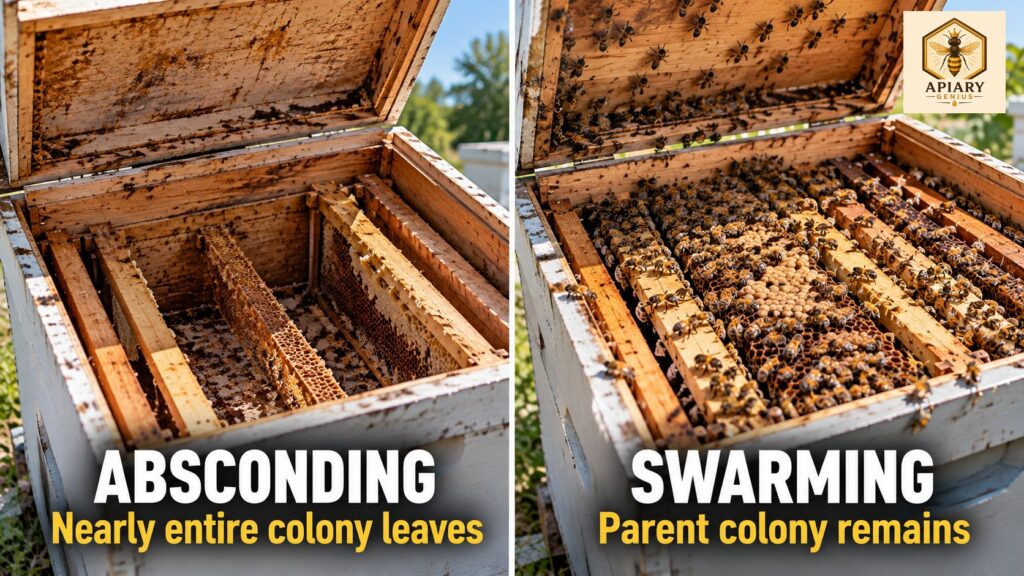
Absconding means most or nearly all of the colony, including the queen, abandons the nest. Swarming is different: a queen and part of the worker population leave to establish a new colony, while a functioning parent colony remains behind with workers, brood, and developing queens. (ask.ifas.ufl.edu)
A hive can also become nearly empty after progressive Varroa- and virus-associated decline, starvation, queen problems, severe small hive beetle damage, or another colony-loss event. Robbers and wax moths may arrive afterward and alter the evidence.
Before deciding what happened, check the brood, queen cells, food stores, dead bees, pest damage, robbing debris, Varroa history, recent queen status, population trend, and nearby colonies.
Table of Contents
What Does It Mean When a Hive Is Suddenly Empty?
A suddenly empty-looking hive tells you what you see now. It does not necessarily tell you what happened over the previous days or weeks.
A colony can decline gradually while still appearing active at the entrance. Older foragers may continue flying even as the brood nest deteriorates or too few healthy young workers are emerging to replace losses.
Varroa-associated viral disease, for example, can be associated with a dwindling adult population, damaged brood, deformed wings, and eventual colony failure. (extension.psu.edu)
Queen failure can also reduce the supply of replacement workers over time.
Starvation produces a different pattern. A colony may die in place, leaving dead bees and a cluster behind.
Robbing can then remove honey from an already weak or dead colony, making the hive appear much more depleted when you finally open it.
This is why an empty beehive with no bees visible should be treated as a diagnostic starting point, not proof that the bees deliberately moved somewhere else.
What Is Bee Absconding?
Bee absconding is the abandonment of the nest by most or nearly all of the colony, including the queen.
When beekeepers describe bees absconding, they are referring to something fundamentally different from normal daily foraging, drifting between colonies, or reproductive swarming.
In true absconding, the original nest is effectively deserted.
UF/IFAS distinguishes absconding from swarming by describing swarming as colony reproduction and absconding as abandonment of the hive. It also notes that African-derived honey bee populations are more prone to absconding than European-derived honey bees. (ask.ifas.ufl.edu)
Peer-reviewed research likewise describes temperate European honey bee subspecies as relatively reluctant to abscond compared with African subspecies. (link.springer.com)
That distinction matters in U.S. beekeeping. Absconding is a real biological behavior, but it should not become the default explanation every time a managed colony disappears.
You first need to rule out other forms of colony loss.
Absconding vs. Swarming: The Key Difference
Absconding and swarming can both involve large numbers of bees leaving a hive, but biologically they are very different events.
Absconding
In an absconding event:
- most or nearly all of the colony leaves;
- the queen leaves with the colony;
- the nest is effectively abandoned;
- little or no functioning resident colony remains.
Swarming
In a reproductive swarm:
- the colony divides;
- a queen leaves with part of the adult worker population;
- many workers remain in the original hive;
- brood remains;
- developing queens or queen cells support continuation of the parent colony.
UF/IFAS describes swarming as colony reproduction in which the colony divides rather than simply abandoning the nest. (ask.ifas.ufl.edu)
So a beekeeper who finds a smaller but still active colony with brood and queen cells may be looking at the aftermath of swarming.
A hive that is essentially deserted requires a broader investigation.
If the evidence points toward swarm preparation or a recent swarm, see How to Prevent Bee Swarming: 9 Proven Methods for Beekeepers.
If queen cells are present and you need to determine what they mean, see Queen Cells in a Beehive: Swarm, Supersedure, or Emergency?.
Why Did My Bees Leave the Hive? First Check What Was Left Behind
This is one of the most important parts of the diagnosis.
Do not immediately scrape frames, remove debris, redistribute comb, or clean the bottom board. First record what remains.
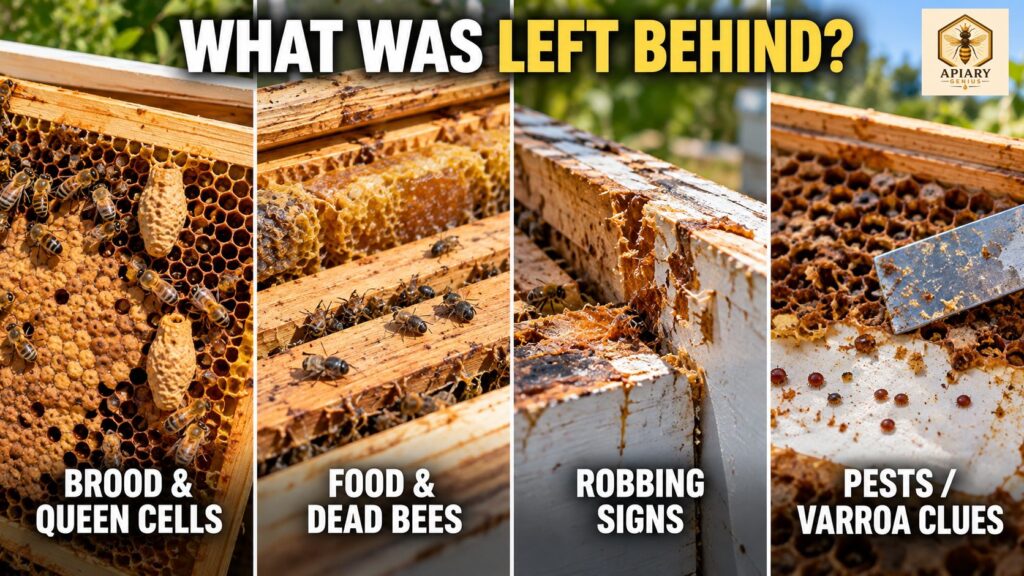
Look for the queen
If a queen is still present with a very small number of workers, straightforward whole-colony absconding becomes less convincing.
Not finding the queen does not prove she left with an absconding colony. She could have died, been lost during a queen-related failure, departed in a swarm, or simply be difficult to find.
Look for eggs and young larvae
Eggs and young larvae tell you that brood rearing occurred recently.
If neither is present, consider how long the colony may have been declining or empty. Absence of eggs can be associated with queen loss or failure, but it cannot diagnose the event by itself.
Examine capped brood
Remaining capped brood can be extremely useful.
A recently swarmed colony normally retains brood.
A severely declining colony may also leave scattered brood behind.
Look at brood quantity and quality. Note abnormal cappings, dead or partly removed pupae, irregular patterns, or other changes rather than recording only whether brood is present.
Check queen cells
Queen cells can shift the diagnosis toward swarming, supersedure, or emergency queen replacement depending on their context.
Do not assume that every queen cell proves the colony swarmed.
Interpret them with the remaining worker population, brood stages, queen status, season, and previous inspection history.
Check honey and pollen stores
Are substantial stores still present?
Is the hive almost completely depleted?
Are stores located far away from a dead cluster?
Food distribution can be informative, but low stores alone do not prove starvation. Other colonies may have robbed the hive after it weakened or died.
Look for dead adult bees
This can sharply change the diagnostic direction.
A large dead cluster or many dead adults inside the hive does not fit the same pattern as a deserted hive containing almost no adult bees.
Check:
- between frames;
- the bottom board;
- the entrance;
- inside empty cells;
- and the ground immediately around the hive.
Look for bees headfirst in cells
In the right context, dead bees positioned headfirst in cells can support a starvation diagnosis.
Washington State University Extension includes bees headfirst in cells beneath a dead cluster, together with inadequate accessible food, among useful clues when investigating winter starvation. (pubs.extension.wsu.edu)
Do not use this sign by itself.
Look for shredded wax cappings
Shredded cappings and light wax debris can indicate that robbers entered the colony.
UF/IFAS notes that robbing can leave shredded wax cappings and other hive debris and may continue until the available honey is depleted. (ask.ifas.ufl.edu)
Look for small hive beetles
A few adult beetles do not prove they caused the loss.
More concerning evidence includes:
- large numbers of larvae;
- slimed comb;
- discolored or fermented honey;
- damaged brood and stores;
- extensive larval activity.
Look for wax moth activity
Webbing, tunnels, larvae, cocoons, and damaged comb often indicate that comb has been poorly defended for some time.
Wax moths frequently expand after the bee population has already become weak. UF/IFAS specifically describes wax moths as pests that usually become problematic when a colony has been weakened by another cause. (ask.ifas.ufl.edu)
Look for Varroa- and virus-compatible signs
These can include:
- deformed wings;
- dwindling adult population;
- damaged or partly uncapped brood;
- abnormal pupae;
- previous high mite monitoring results;
- a history of inadequate or ineffective mite management.
None of those signs alone proves that Varroa caused the colony loss. A compatible pattern and colony history make the diagnosis stronger.
Compare nearby colonies
Do not examine the lost colony in isolation.
If several colonies in the same apiary weakened during the same period, consider whether they shared a Varroa problem, food shortage, environmental stress, management issue, or other common factor.
If only one colony failed while neighboring colonies remained strong, the diagnostic direction may be different.
Could the Colony Have Swarmed Instead?
If you are asking, “why did my bees leave the hive?” after noticing a sudden drop in population, a recent swarm is one possibility—but only if a functioning parent colony remains behind.
Yes, but normal reproductive swarming should not leave a previously healthy hive completely empty.
After a swarm leaves, the parent colony should still contain workers and brood.
Look for:
- a surviving worker population;
- capped brood;
- queen cells;
- emerged queen cells;
- signs of recent queen replacement;
- previous crowding or rapid colony growth;
- the season and local swarm period;
- observations from your previous inspection.
A sudden population reduction combined with abundant brood and swarm-type queen cells makes a recent swarm much more plausible.
By contrast, virtually no adult population remaining in the box is not the typical result of an ordinary reproductive swarm.
The distinction matters because a swarm is not simply “all the bees leaving.” The parent colony normally continues.
Could Varroa and Viruses Make a Colony Seem to Disappear?
Yes.
A colony under severe Varroa and virus pressure can progressively lose adult bees until the beekeeper discovers only a small remnant—or an apparently empty hive.
Penn State Extension describes Deformed Wing Virus and parasitic mite syndrome as potentially involving deformed bees, abnormal brood, uncapped or damaged pupae, and a dwindling adult population. Varroa mites play an important role in transmitting and amplifying DWV. (extension.psu.edu)
Washington State University Extension also treats Varroa history, deformed bees, brood condition, and previous mite monitoring as useful evidence when investigating colony losses. (pubs.extension.wsu.edu)
The important point is that the final disappearance may look sudden even when the biological decline was not.
Do not diagnose Varroa simply because almost no bees remain.
Ask:
- Were mites monitored during the preceding season?
- Were mite levels elevated?
- Was management delayed or absent?
- Did previous management appear ineffective?
- Were deformed-wing bees observed?
- Was the brood pattern deteriorating?
- Was the adult population already declining?
- Does the timing fit a period when healthy replacement workers were especially important?
When those clues agree, Varroa-virus pressure becomes a stronger explanation.
For detailed mite management, see How to Control Varroa Mites: The Complete 2026 Guide.
If deformed wings or other DWV-compatible signs were present, see Deformed Wing Virus in Honey Bees: Symptoms, Varroa Link, and Management.
Can Small Hive Beetles or Other Pests Cause Absconding?
Severe small hive beetle infestation can contribute to colony abandonment.
Oregon State University Extension describes severe infestations as involving slimy or discolored comb, masses of beetle larvae, damage to brood and food stores, and situations in which the queen may stop laying and the colony may abscond. (extension.oregonstate.edu)
That does not mean every beetle found in an abandoned hive caused the problem.
Small hive beetles can also take advantage of colonies that are already weak or unable to defend their comb effectively.
The distinction is important.
Finding a handful of adult beetles after colony loss provides much weaker evidence than finding:
- heavy larval reproduction;
- slime;
- fermented stores;
- extensive comb destruction;
- and a documented history of escalating beetle pressure while the colony was still occupied.
If those signs are present, see Small Hive Beetle Control: How to Identify, Prevent, and Manage an Infestation.
Wax moths deserve even more caution as an explanation for the original loss.
Healthy colonies normally suppress wax moth populations. UF/IFAS states that large wax moth populations usually become established after the bee colony has already been reduced by another problem and that wax moths are usually not the direct cause of colony demise. (ask.ifas.ufl.edu)
Therefore, extensive webbing in an abandoned hive may tell you what happened after the colony became too weak to defend the comb.
For moth-damaged or unprotected comb, see Wax Moth Control: How to Prevent and Manage Infestations in Beehives.
Did the Colony Starve Rather Than Leave?
Starvation and absconding usually leave different evidence.
A colony that starves generally dies in or around the nest rather than relocating as a functioning colony.
Look for a combination of clues such as:
- a dead cluster;
- significant numbers of dead adults inside the hive;
- bees headfirst in cells;
- very little food near the dead cluster;
- stores elsewhere in the hive that the cluster may not have been able to reach;
- winter or cold-weather conditions that restricted movement.
Washington State University Extension notes that colonies can die when food stores are insufficient or inaccessible, and describes headfirst bees beneath a dead cluster as one clue consistent with starvation. (pubs.extension.wsu.edu)
Do not diagnose starvation from a light hive alone.
A hive can be light because:
- the colony consumed its stores normally;
- robbers removed honey after the colony weakened;
- the colony entered the season with inadequate reserves;
- or several processes occurred in sequence.
If the evidence genuinely points toward inadequate food, see Feeding Bees: The Complete Guide for Every Season.
Could Robbing Change What the Empty Hive Looks Like?
Yes, and this is an important reason not to diagnose a colony loss from food stores alone.
A weakened, dead, or abandoned colony may become an easy source of honey for neighboring colonies.
Robbing bees can remove large amounts of honey and leave shredded wax cappings and other debris behind. UF/IFAS notes that robbers may continue until a resource is depleted. (ask.ifas.ufl.edu)
That can create a misleading post-loss scene.
For example:
A colony could die or become critically weak first.
Robbers could arrive afterward.
By the time you inspect the hive, most honey may be gone.
If you look only at the final amount of food, you might mistakenly conclude that starvation caused the original loss.
The opposite mistake is also possible: seeing robbing debris and deciding that robbing must have initiated the colony failure.
Ask which event probably came first.
When shredded cappings, depleted honey cells, unusual entrance activity, or other evidence suggests robbing, see Robbing Bees: How to Tell If Your Hive Is Being Robbed and How to Stop It.
What About a Newly Installed Package or Nuc?
A newly installed package or nuc deserves special caution because the colony is still becoming established.
A package begins with adult workers and a queen but without the package’s own established brood nest. The bees must accept the queen, build or occupy comb, begin brood production, and develop into a functioning colony.
NC State Extension recommends checking queen survival and release after installation and then confirming that she has begun laying. It also emphasizes adequate food during early establishment. (content.ces.ncsu.edu)
If a newly installed package seems to have disappeared, reconstruct what happened from installation onward.
Ask:
- Was the queen alive at installation?
- Was she accepted?
- Did you later see eggs?
- Did brood production begin?
- Were the bees building comb?
- Was adequate food available?
- Was the adult population stable at early inspections?
- Were severe weather, pests, disturbance, or other stresses present?
A nuc begins with brood, workers, comb, and usually an established laying queen, so the evidence will be different.
Do not invent a specific cause merely because the colony was new.
If a small population still remains but queen status is uncertain, see How to Tell If a Beehive Is Queenless: Signs, Diagnosis, and What to Do Next.
Is This Colony Collapse Disorder?
Not automatically.
Colony Collapse Disorder, or CCD, is not a general name for an empty hive.
The U.S. Environmental Protection Agency describes CCD as a syndrome in which most worker bees disappear while a live queen remains, brood remains, food stores remain relatively abundant, and relatively few dead adult bees are found around the colony. (epa.gov)
That is a specific pattern.
A colony that starved with a dead cluster should not automatically be called CCD.
A colony that absconded with its queen does not fit the classic CCD description.
A colony known to have suffered severe pest or disease pressure should not automatically receive the CCD label simply because only a few bees remain.
The practical rule is simple:
Do not use CCD as a synonym for “my bees disappeared.”
What to Check in an Empty or Nearly Empty Hive
Use the same sequence every time. A structured inspection reduces the chance that one dramatic clue will dominate your diagnosis.
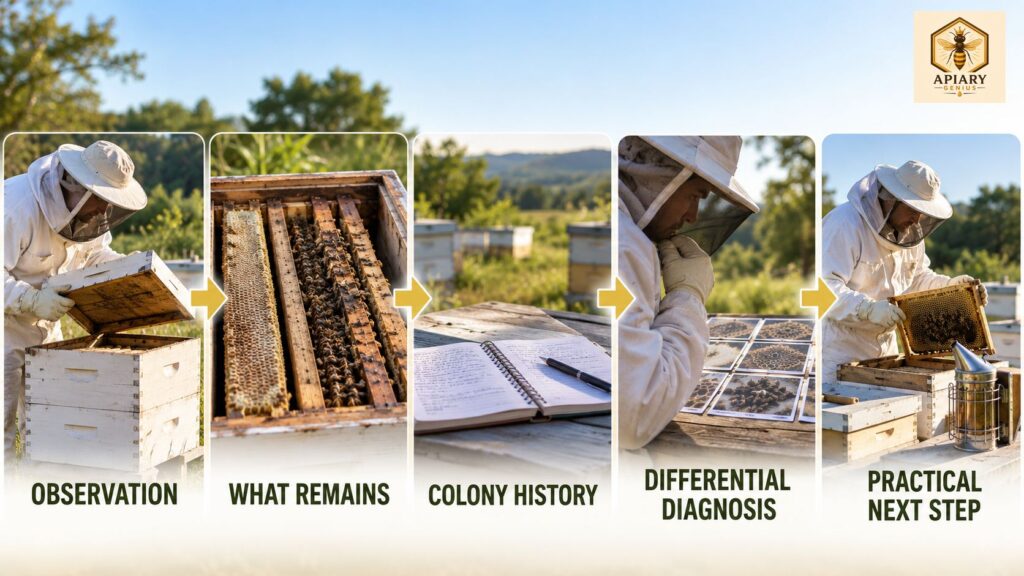
1. Confirm that the hive is truly empty
Look carefully between frames, in corners, in upper or lower boxes, and on the bottom board for a small surviving cluster.
2. Look for the queen
Record whether she is present, absent, or simply not found.
3. Look for eggs, larvae, and capped brood
Record both quantity and condition.
4. Check queen cells
Note whether they are open, capped, emerged, damaged, or still developing.
5. Check food stores
Examine honey and pollen distribution rather than judging only by total hive weight.
6. Look for dead bees
Check the comb, cells, bottom board, entrance, and nearby ground.
7. Examine brood condition
Look for abnormal cappings, dead larvae or pupae, unusual odors, or other suspicious brood signs.
8. Look for Varroa- or virus-compatible signs
Check for deformed wings, abnormal brood, signs of dwindling, and relevant information from previous inspections.
9. Look for small hive beetles
Record adult beetles, larvae, slime, fermented honey, and comb damage separately.
10. Look for wax moth activity
Webbing, tunnels, larvae, cocoons, and damaged comb can help establish how long the equipment may have been poorly defended.
11. Look for robbing debris
Shredded wax cappings and rapidly emptied honey cells may indicate activity that occurred after the colony weakened.
12. Review the colony’s recent population trend
Was the hive truly strong at the last inspection, or was the population already declining?
13. Review Varroa monitoring and management history
Actual records are more useful than trying to reconstruct mite pressure from memory.
14. Review recent queen status
When was the queen last seen?
When were eggs last confirmed?
Was brood production declining?
Were queen cells present?
15. Review feeding and food availability
Consider both total stores and whether the cluster could reach them.
16. Consider recent weather or environmental stress
Severe heat, cold, drought, prolonged dearth, storms, flooding, disturbance, or other environmental events may affect how you interpret the evidence.
17. Compare nearby colonies
A problem affecting several colonies may suggest something different from an isolated loss.
Do not expect every case to produce a perfect diagnosis.
The goal is to determine which explanation is best supported by the combined evidence and which explanations are contradicted by what remains.
What to Do With the Abandoned Comb and Equipment
Do not immediately move abandoned brood comb into another colony.
First consider why the colony was lost.
If brood comb shows signs that could indicate an infectious brood disease, especially American foulbrood or another serious disease, treat the equipment as potentially risky until the disease question is resolved.
American foulbrood is particularly important because Paenibacillus larvae spores can persist in contaminated equipment for long periods and spread through transferred material. Penn State Extension advises caution with equipment transfer when AFB contamination is possible. (extension.psu.edu)
Do not try to invent a sterilization procedure based on an uncertain diagnosis.
Instead, follow disease-specific guidance or contact the appropriate state apiary authority or diagnostic service when serious infectious disease is suspected.
If infectious disease is not suspected, protect unoccupied comb promptly.
Empty drawn comb can become vulnerable to:
- wax moths;
- small hive beetles;
- robbing;
- rodents;
- moisture;
- and weather damage.
NC State Extension notes that stored drawn comb requires protection from wax moth damage when it is no longer defended by bees. (content.ces.ncsu.edu)
If moth or beetle damage is already present, use the appropriate pest-specific guide rather than treating the abandoned equipment blindly.
Diagnose first. Reuse second.
What Not to Do
Do not assume the colony absconded just because the hive is empty.
An empty hive is evidence that the colony is gone or greatly reduced—not proof of how it happened.
Do not call every empty hive CCD.
CCD describes a specific syndrome, not every unexplained colony loss.
Do not conclude that Varroa killed the colony without supporting evidence.
Use mite-monitoring history, treatment history, brood condition, adult-bee signs, season, and population trend together.
Do not blame small hive beetles just because beetles are present afterward.
Determine whether severe beetle damage occurred while the colony was still active.
Do not blame wax moths solely because the abandoned comb contains webbing.
Wax moths commonly expand after colonies become weak or disappear.
Do not move suspicious brood comb into healthy colonies before considering disease risk.
You may move the original problem into another hive.
Do not immediately clean or discard every clue.
Photograph or record what you find before disturbing the scene.
Do not diagnose the event from one sign alone.
Low stores, queen cells, beetles, deformed bees, dead workers, or webbing must be interpreted in context.
Do not ignore colony records.
If the question is, “Why did my bees leave the hive?” your previous inspection notes may be more informative than the empty hive itself.
How to Reduce the Risk of Another Colony Loss
The best time to diagnose a colony problem is before the colony becomes an empty box.
Monitor Varroa routinely
Do not wait for obvious deformed bees or severe population decline before investigating mite pressure.
Use reliable monitoring and an effective management program appropriate to your operation.
Maintain adequate food
Track stores throughout the season, especially when forage is limited or winter is approaching.
Pay attention to food accessibility as well as total quantity.
Watch queen performance and brood
A declining brood pattern, prolonged lack of eggs, or other queen-related changes may be early evidence that the colony’s replacement population is in trouble.
Control severe pest pressure
Small hive beetles and other pests become especially important when colonies are weak or have more comb than they can defend.
Avoid unnecessary stress
Repeated disturbance, poor equipment conditions, inappropriate hive space, and other avoidable stresses can make a struggling colony harder to stabilize.
Keep useful records
Record:
- adult population;
- brood amount and pattern;
- queen status;
- food stores;
- Varroa monitoring;
- mite-management dates;
- pest observations;
- feeding;
- and unusual environmental events.
Those records transform an unexplained empty hive into a much more manageable diagnostic problem.
Respond to trends early
A colony that becomes slightly smaller at every inspection deserves attention.
Do not wait until almost every adult bee is gone.
FAQ
What is the difference between absconding and swarming?
Absconding means most or nearly all of the colony, including the queen, abandons the nest.
Swarming is colony reproduction. A queen leaves with part of the worker population, while workers, brood, and developing queens remain in the parent colony.
Do bees leave honey behind when they abscond?
They can.
Absconding does not require bees to remove every food store or all brood before leaving. Research on abandoned European honey bee nests found that brood, honey, and pollen can remain after absconding. (link.springer.com)
The amount present when you inspect the hive may be smaller than what was originally left because neighboring colonies can rob the abandoned stores afterward.
Can Varroa make a hive suddenly look empty?
Yes, but the underlying decline may have been gradual.
Varroa-associated viruses can contribute to abnormal brood, deformed bees, shortened colony viability, and dwindling adult populations. By the time the beekeeper notices the loss, very few bees may remain. (extension.psu.edu)
An empty hive alone, however, does not diagnose Varroa.
Can small hive beetles make bees leave the hive?
Severe small hive beetle infestation can contribute to absconding, particularly when heavy larval activity damages brood and food stores and causes extensive slime and fermentation. (extension.oregonstate.edu)
A few beetles found after colony loss do not prove they were the original cause.
How can I tell if my bees starved or absconded?
A starvation diagnosis is better supported by a dead cluster, dead bees remaining inside, bees headfirst in cells, and inadequate or inaccessible food in a compatible seasonal context.
Absconding is characterized by most or nearly all of the colony leaving the nest with the queen.
Robbing after either event can make the diagnosis more difficult by removing honey.
Why did my new package bees leave the hive?
Do not assume true absconding without checking the early establishment history.
Review queen survival and acceptance, egg laying, brood production, food availability, comb building, population changes, installation conditions, pests, weather, and other stresses.
NC State Extension emphasizes confirming queen release and egg laying after package installation and ensuring the new colony has adequate food. (content.ces.ncsu.edu)
Does an empty hive mean Colony Collapse Disorder?
No.
The EPA’s classic CCD description involves most workers disappearing while the queen remains, brood remains, food stores are relatively abundant, and relatively few dead adult bees are found near the colony. (epa.gov)
Many empty or failed colonies do not fit that pattern.
Can I reuse the comb after the bees are gone?
Often, yes—but only after considering why the colony disappeared.
Do not transfer suspect brood comb into healthy colonies if an infectious brood disease may be involved.
Once serious disease risk has been considered, protect usable empty comb from wax moths, small hive beetles, robbing, rodents, moisture, and weather damage.
Sources
- UF/IFAS Extension — Differences Between European and African Honey Bees
- Neumann et al., Apidologie — Differences in Absconding Between African and European Honeybee Subspecies
- Washington State University Extension — Honey Bee Colonies That Fail to Overwinter Have a Tale to Tell
- Penn State Extension — Viruses in Honey Bees
- Oregon State University Extension — The Small Hive Beetle: A Potential Pest in Honey Bee Colonies
- UF/IFAS Extension — Wax Moth Control
- UF/IFAS Extension — Robbing Behavior in Honey Bees
- U.S. Environmental Protection Agency — Colony Collapse Disorder
- NC State Extension — How to Install a Package of Honey Bees
- Penn State Extension — Honey Bee Diseases: American Foulbrood
- NC State Extension — Wax Moth Control in Stored Equipment