
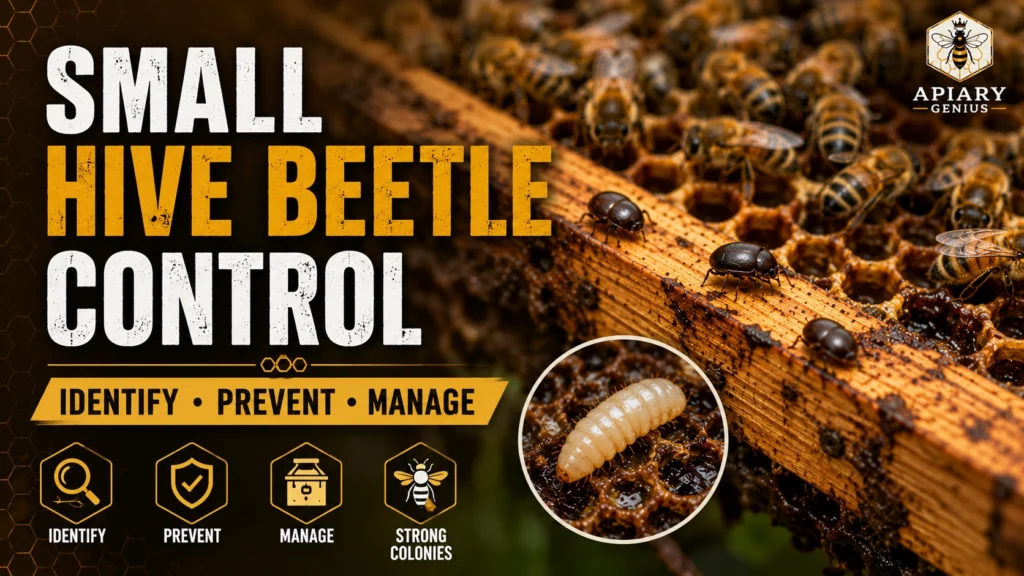
Finding small dark beetles running across a frame or disappearing into the corners of a hive can be unsettling, especially if you have never encountered them before. But seeing one or two adult small hive beetles does not automatically mean that a colony is failing.
The more important question is whether the beetles are successfully reproducing.
A serious small hive beetle infestation develops when larvae begin feeding through comb, pollen, brood resources, and stored honey. Their activity can contaminate honey, create the characteristic wet or “slimed” appearance associated with severe infestations, damage stored comb, and in extreme cases contribute to colony abandonment.
Effective small hive beetle control is therefore not about trying to eliminate every adult beetle from an apiary. In areas where the pest is established, complete eradication may not be realistic. The practical objective is to keep beetle populations below damaging levels and prevent successful reproduction.
That usually requires integrated management: maintaining strong colonies, matching hive space to the bee population, monitoring regularly, using mechanical traps where appropriate, keeping the apiary and honey-processing area clean, and responding quickly when larvae or contaminated comb appear.
This guide explains how to identify small hive beetles, determine how serious the problem is, decide what to do when you find them, and reduce the risk of future infestations.
Table of Contents
What Is a Small Hive Beetle?
The small hive beetle, Aethina tumida, is an invasive pest of honey bee colonies. It originated in sub-Saharan Africa and is now established in a number of other regions, including much of the United States.
According to the USDA Agricultural Research Service, small hive beetles can feed on pollen, brood, honey, dead adult bees, and other hive resources.
Their life cycle includes four basic stages:
- egg;
- larva;
- pupa;
- adult.
Adult beetles enter honey bee colonies and seek protected areas where worker bees have difficulty reaching them. Females may lay eggs in cracks, crevices, cells, and other concealed parts of the hive.
After hatching, the larvae feed within the colony. When mature, they leave the hive and move into suitable soil, where pupation occurs. Adults later emerge from the soil and can enter honey bee colonies again.
Temperature, moisture, soil characteristics, colony condition, and other environmental factors influence how rapidly beetle populations develop. For that reason, the level of small hive beetle pressure can differ greatly between regions and even between colonies in the same apiary.
Strong colonies may tolerate some adult beetles without developing major damage.
That distinction is essential:
The presence of adult beetles is not the same as a damaging beetle infestation.
The greatest concern begins when the beetles reproduce successfully and substantial numbers of larvae appear.
How to Identify Small Hive Beetles in a Beehive
Correct identification should come before any attempt at treatment.
Adult small hive beetles are small, oval insects that usually range from brown to very dark brown or black as they mature.
Oregon State University Extension describes adult beetles as approximately 5.7 millimeters long, or roughly one-third the size of a worker honey bee.
Their compact bodies allow them to move quickly through the hive and disappear into protected spaces.
During an inspection, you may see adult beetles:
- running across top bars;
- moving rapidly over comb;
- hiding along frame rests;
- retreating into cracks and corners;
- hiding beneath or around hive components;
- moving away from light when the hive is opened.
Do not identify them by color alone. Other beetles can occur around bee colonies and may have similar size, shape, or coloration.
Small hive beetle larvae provide another important identification clue.
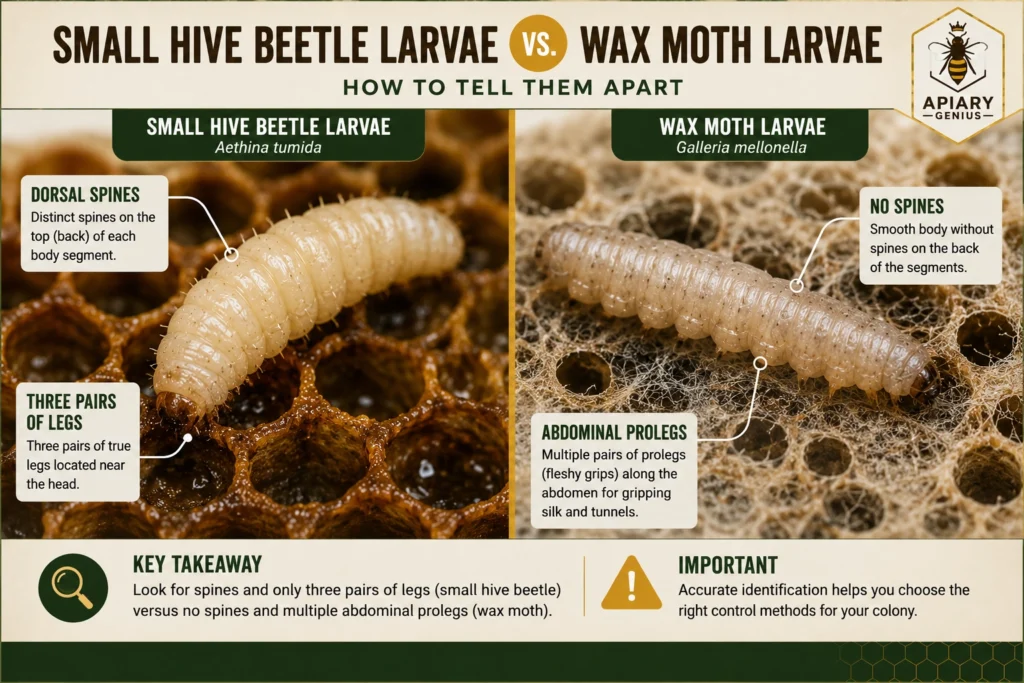
The larvae are pale or off-white and may grow to approximately 10–12 millimeters in length. They have three pairs of well-developed legs near the front of the body and distinctive spines along the back.
Identification becomes especially important once pale larvae appear because small hive beetle larvae can be confused with wax moth larvae.
Small Hive Beetle Larvae vs. Wax Moth Larvae
Small hive beetle larvae and wax moth larvae may appear superficially similar, but several characteristics help distinguish them.
Look at the body
Small hive beetle larvae have three pairs of developed legs near the head and characteristic spines running along the body.
Wax moth larvae have additional abdominal prolegs farther down the body.
This makes close examination of the larvae more reliable than simply judging size or color.
Look at the damaged comb
The surrounding damage often provides an even clearer clue.
Small hive beetle larval activity is commonly associated with:
- wet or greasy-looking comb;
- slimed surfaces;
- damaged pollen and honey;
- fermentation;
- leaking honey;
- unpleasant odors during serious infestations.
Wax moth larvae, by contrast, are strongly associated with silk.
Their damage often includes:
- obvious webbing;
- silken tunnels;
- web-covered comb;
- debris associated with tunneling.
Oregon State University Extension specifically distinguishes small hive beetle larvae by their dorsal spines and lack of the abdominal prolegs seen in wax moth larvae. It also notes that wax moth damage is characterized by webbing.
If pale larvae are present and you are not certain which pest you are seeing, inspect both the larvae and the comb before deciding what action to take.
How Small Hive Beetles Damage a Bee Colony
Adult beetles may live inside a colony without immediately causing serious visible damage.
The destructive situation begins when beetles reproduce and large numbers of larvae begin feeding.
Larvae may consume or damage hive resources that include:
- stored honey;
- pollen;
- brood-associated material;
- comb.
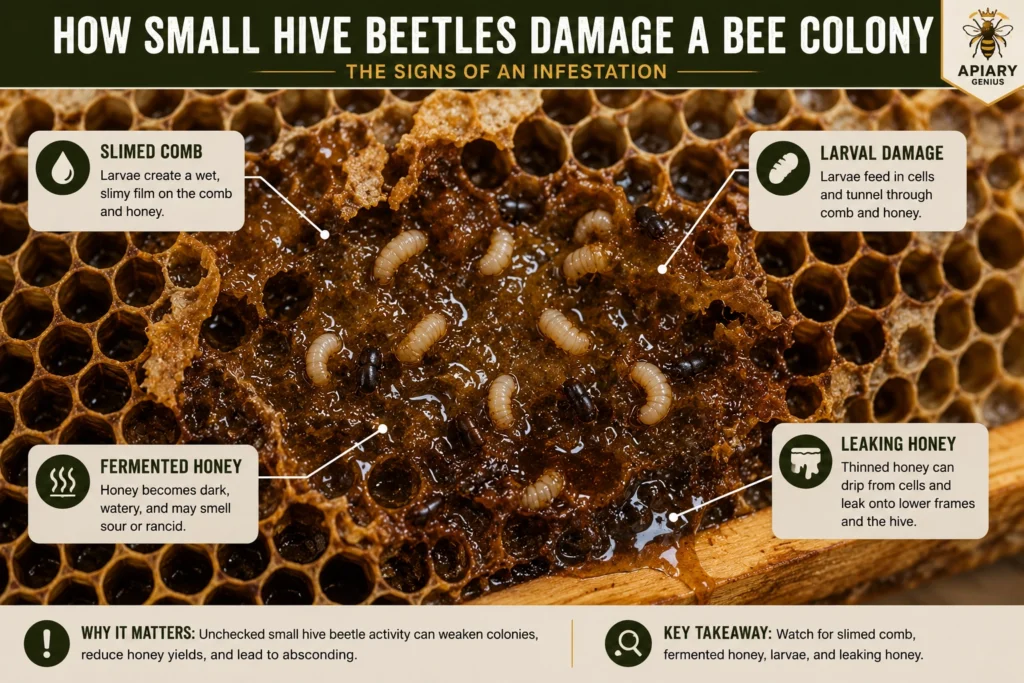
One of the most recognizable signs of a serious infestation is fermented or “slimed” honey.
The USDA Agricultural Research Service explains that larval feeding can cause honey to ferment and run from the comb.
Affected comb may appear wet, slick, discolored, or foul-smelling.
This is much more than an appearance problem.
Honey contaminated by beetle larvae and their waste should not be regarded as normal harvestable honey. Oregon State University Extension states that honey contaminated by small hive beetle excrement is not fit for human consumption.
As an infestation worsens, bees may retreat from affected areas.
In severe cases:
- brood rearing may be disrupted;
- the queen may stop laying;
- stored food can be heavily damaged;
- comb may become unusable;
- the colony may eventually abandon the hive.
The level of damage therefore matters far more than the simple number of adult beetles you happen to see during one inspection.
Why Some Colonies Develop Serious Beetle Infestations
Small hive beetles do not affect every colony equally.
One of the most important factors is colony strength relative to the amount of space the bees must defend.
A populous colony can patrol comb, harass beetles, and restrict their movement. A weak colony has fewer workers protecting the same hive area.
Colonies may be more vulnerable when they are:
- weak or declining;
- newly established;
- recently split;
- small nucleus colonies;
- recovering after swarming;
- experiencing queen problems;
- affected by disease or another major pest;
- occupying more space than their population can effectively protect.
Oregon State University Extension notes that splits, nucs, newly hived packages, and post-swarm colonies can be particularly vulnerable because their smaller populations may be unable to keep beetle numbers under control.
Excess hive space creates a related problem.
If a beekeeper gives a modest colony several largely unoccupied boxes, beetles gain additional hiding and egg-laying opportunities away from dense concentrations of worker bees.
This is one reason supers should be added according to actual colony strength and nectar-storage demand rather than automatically. For guidance on matching additional space to colony development, see When to Add a Honey Super.
Colony health matters too
An increasing beetle population may sometimes be a symptom of a broader colony problem rather than an isolated pest issue.
A colony weakened by high mite pressure, poor queen performance, disease, or nutritional stress may be less able to control opportunistic pests.
For example, if Varroa pressure is contributing to colony decline, controlling beetles alone will not restore colony strength. Our guide to Varroa mite control explains how to assess and manage that separate threat.
Likewise, an obviously failing queen should be investigated rather than assuming beetles are the only cause of poor colony performance. If queen replacement is genuinely warranted, see How to Requeen a Beehive.
The useful diagnostic question is not simply:
“How do I kill these beetles?”
It is:
“What is allowing these beetles to reproduce successfully in this colony?”
How to Check a Hive for Small Hive Beetles
Regular inspection can reveal increasing beetle pressure before larvae damage substantial amounts of comb.
Choose suitable inspection conditions and work efficiently. If you are unsure when opening a colony is least disruptive, review our guide to the best time to inspect a beehive.
Watch as soon as you open the hive
Adult small hive beetles tend to move rapidly toward darker, protected areas.
As hive components are removed, watch:
- top bars;
- frame rests;
- box corners;
- cracks between equipment;
- areas around the inner cover;
- protected spaces near the bottom of the hive.
You may see beetles run quickly away from the newly exposed light.
Do not spend the entire inspection chasing individual adults. The objective is to assess the colony, not merely count every beetle.
Examine the comb
Look for evidence that beetles are reproducing.
More serious signs include:
- small pale larvae;
- wet or slimed comb;
- damaged pollen stores;
- fermenting honey;
- honey running from cells;
- abnormal odors;
- sections of comb the bees have abandoned.
Finding larvae changes the situation because it confirms that beetles have completed the early stages of reproduction inside the colony.
Evaluate the bees at the same time
Ask:
- Are adult bees densely covering the comb?
- Is brood production appropriate?
- Is the brood pattern broadly normal?
- Does the hive contain unnecessary boxes?
- Are large areas of comb poorly defended?
- Is there evidence of queen failure?
- Are other pests or diseases weakening the colony?
Small hive beetle monitoring should be part of a full colony assessment rather than a separate inspection disconnected from overall bee health.
What to Do When You Find Small Hive Beetles
The correct response depends on the severity of what you find.
If you find only a few adults
Do not panic.
NC State Extension notes that adult beetles may occur in colonies without causing obvious damage.
Instead:
- Check carefully for larvae.
- Inspect the comb for slime or fermentation.
- Assess colony strength.
- Check whether the hive contains excessive unoccupied space.
- Consider installing an appropriate mechanical trap.
- Monitor the colony during future inspections.
A few adults in a strong colony call for attention and monitoring—not automatic chemical treatment.
If beetle numbers seem to be rising
Investigate why.
Look for:
- declining bee population;
- a failing or missing queen;
- excessive hive space;
- another pest or disease problem;
- abandoned or poorly protected comb.
Mechanical trapping becomes particularly useful at this stage because reducing adult numbers may reduce reproductive pressure while you address the underlying colony condition.
If you find larvae
Act more quickly.
Larvae indicate successful reproduction.
Remove or contain heavily infested material so larvae cannot simply crawl away from the hive and enter the soil.
NC State Extension warns against brushing larvae onto the ground because mature larvae can pupate in soil and later emerge as adults.
Salvageable frames can be treated by freezing when appropriate, following evidence-based Extension guidance and considering the equipment and material involved.
Heavily fermented or contaminated comb may require more aggressive removal and cleanup.
How to Control Small Hive Beetles
There is no single universal small hive beetle treatment that solves every infestation.
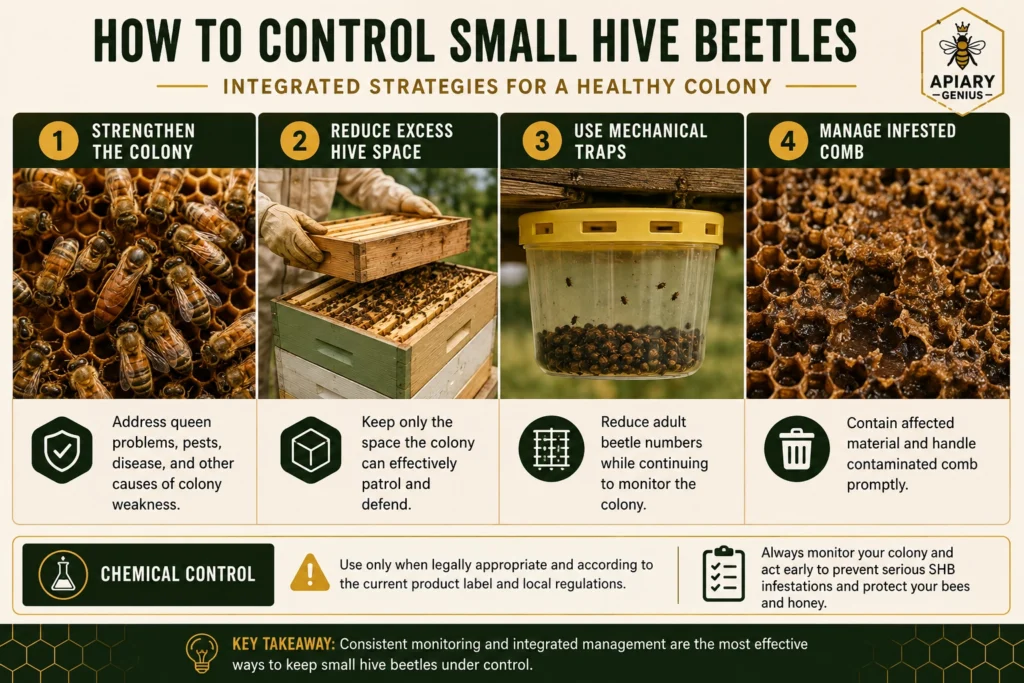
Effective control combines several methods.
Strengthen the colony
A strong, healthy colony is one of the best defenses against small hive beetles.
NC State Extension emphasizes maintaining colony strength as a central part of management.
If the colony is weak, determine why.
Possible areas to investigate include:
- queen performance;
- brood production;
- food availability;
- mite pressure;
- disease;
- recent swarming;
- population loss.
Correct the actual problem rather than treating beetles as the sole cause of every weakness.
Reduce excess hive space
Match hive volume to the population.
If a colony occupies only part of a large stack of boxes, remove genuinely unnecessary space while still allowing enough room for brood development and appropriate nectar storage.
The objective is not to crowd the bees.
It is to avoid maintaining large areas of comb that the colony cannot effectively patrol.
Use mechanical traps
Mechanical traps can help reduce the adult beetle population without making pesticides the default response.
Different designs exploit the beetles’ tendency to seek narrow hiding places that worker bees cannot readily enter.
Traps are most effective when combined with good colony management rather than used as a substitute for it.
Manage contaminated comb promptly
Do not leave infested frames sitting exposed in the apiary or honey house.
Contain them.
Extension recommendations support freezing infested frames as one sanitation method. Exact protocols can vary by source and circumstance. Oregon State University Extension, for example, recommends freezing frames containing beetle larvae or eggs for at least 48 hours.
Follow the recommendation appropriate to your situation rather than assuming that one freezing period applies universally to every storage or treatment scenario.
Chemical control considerations
Pesticides should not be the automatic first response to small hive beetles, and they should not be used prophylactically simply because beetles might appear.
Current NC State Extension guidance specifically advises against using chemical controls as a preventive measure.
Chemical-control options are also particularly sensitive to location and date.
A pesticide or active ingredient mentioned in an older Extension publication may:
- no longer be registered;
- have a different label;
- be restricted to particular uses;
- be unavailable in your jurisdiction;
- be prohibited around honey intended for human consumption.
This is especially important for an international Apiary Genius audience.
Never assume that a product approved somewhere in the United States is approved throughout the United States, Europe, or another country.
Before using any pesticide:
- verify its current registration for small hive beetle control in your jurisdiction;
- read the current label;
- follow the label exactly;
- observe restrictions involving honey supers and food products;
- follow application and personal-protection requirements;
- comply with applicable national, state, provincial, or local regulations.
An old forum post, video, or archived Extension publication should never override a current pesticide label or local law.
Chemical intervention, where legal and genuinely necessary, should remain one component of an integrated management program rather than a replacement for colony strength, sanitation, monitoring, and mechanical control.
Using Small Hive Beetle Traps
Small hive beetle traps are designed mainly to reduce the number of adult beetles living inside the colony.
Many trap designs use the beetles’ tendency to seek narrow protected areas when worker bees pursue them.
Depending on the design, a trap may:
- provide a confined hiding space;
- contain oil or another killing medium;
- fit between frames;
- sit on or near the bottom of the hive.
The exact design matters, so follow the manufacturer’s instructions rather than improvising placement.
For traps to remain useful:
- inspect them regularly;
- replace or clean them when required;
- prevent trap contents from spilling into the hive;
- continue checking the colony for larvae and comb damage;
- keep evaluating colony strength.
NC State Extension recognizes mechanical trapping as a useful component of small hive beetle management, but no trap should be expected to capture every adult.
A rising trap count can also function as a warning.
If significantly more beetles are appearing in traps, investigate whether colony strength has declined or environmental pressure has increased.
The trap is a control tool—not the diagnosis.
How to Prevent Small Hive Beetle Infestations
Good small hive beetle prevention focuses on making the colony and its surroundings less favorable for successful beetle reproduction.
Maintain strong colonies
Monitor colony condition throughout the active season.
A healthy population that adequately covers its comb is better positioned to harass and confine beetles than a weak population spread across too much equipment.
Match hive space to bee population
Add boxes when colony growth and storage requirements justify them.
Remove genuinely unnecessary space when the population contracts.
Avoid leaving large volumes of comb poorly covered by bees.
Keep the apiary clean
Do not leave:
- burr comb;
- discarded pollen-rich comb;
- honey spills;
- dead-out equipment;
- damaged frames;
- exposed wax and hive debris
around the apiary unnecessarily.
NC State Extension recommends collecting excess wax rather than throwing burr comb onto the ground.
Monitor small colonies more closely
Extra attention may be appropriate for:
- nucs;
- new packages;
- recent splits;
- post-swarm colonies;
- colonies recovering from queen problems.
Their smaller worker populations make it easier for beetles to gain protected access to hive resources.
Be cautious when splitting heavily infested colonies
Splitting an already beetle-stressed colony can reduce the bee-to-comb ratio in the resulting units.
Oregon State University Extension specifically advises against making weak splits from heavily infested colonies because the reduced worker populations may be unable to keep beetles under control.
Keep honey-processing areas sanitary
Small hive beetle management extends beyond the hive.
Supers, cappings, honey residue, and pollen-bearing material left in a warm honey house can become resources for beetle reproduction.
Cleaning processing equipment and handling harvested comb promptly are therefore part of prevention.
Managing Frames, Supers, and Extracted Honey
Harvested equipment becomes more vulnerable once it is removed from the protective worker population.
Do not leave full honey supers sitting unnecessarily for long periods, especially in warm environments where small hive beetles are active.
USDA ARS guidance emphasizes prompt extraction of harvested honey, while NC State Extension likewise stresses proper honey-house sanitation.
Pay particular attention to:
- unextracted supers;
- wet supers;
- wax cappings;
- pollen-rich frames;
- damaged comb;
- honey spills;
- dead-out equipment.
Extract promptly
When practical, move harvested supers through extraction without unnecessary delay.
Comb sitting outside a colony gives beetles access without the same level of worker-bee defense.
Handle infested frames separately
If larvae or eggs are found, isolate affected frames rather than storing them with clean equipment.
Freezing is an established sanitation method for infested comb.
Oregon State University Extension recommends freezing frames containing small hive beetle eggs or larvae for at least 48 hours.
Other Extension recommendations may use different time-and-temperature protocols, so follow a reliable local or institutional recommendation for your situation rather than treating a single duration as universal.
Do not salvage contaminated honey for human consumption
If honey has been seriously slimed, fermented, or contaminated by beetle larval activity, do not attempt to turn it into a normal food product.
Oregon State University Extension states that honey contaminated with small hive beetle excrement is not fit for human consumption.
Good harvest management protects both food quality and reusable comb.
What to Do During a Severe Small Hive Beetle Infestation
A severe infestation requires a different response from finding a few adults.
Warning signs include:
- masses of larvae;
- extensive slimed comb;
- fermented or leaking honey;
- heavily damaged pollen stores;
- large areas abandoned by adult bees;
- larvae moving through or out of the hive;
- a colony no longer able to defend much of its comb.
At this point, the priority is containment.
Contain infested material
Do not brush larvae onto the ground around the hive.
Remove badly affected frames and place them in containers or bags that prevent larvae from escaping.
This matters because mature larvae leave the hive and seek soil in which to pupate.
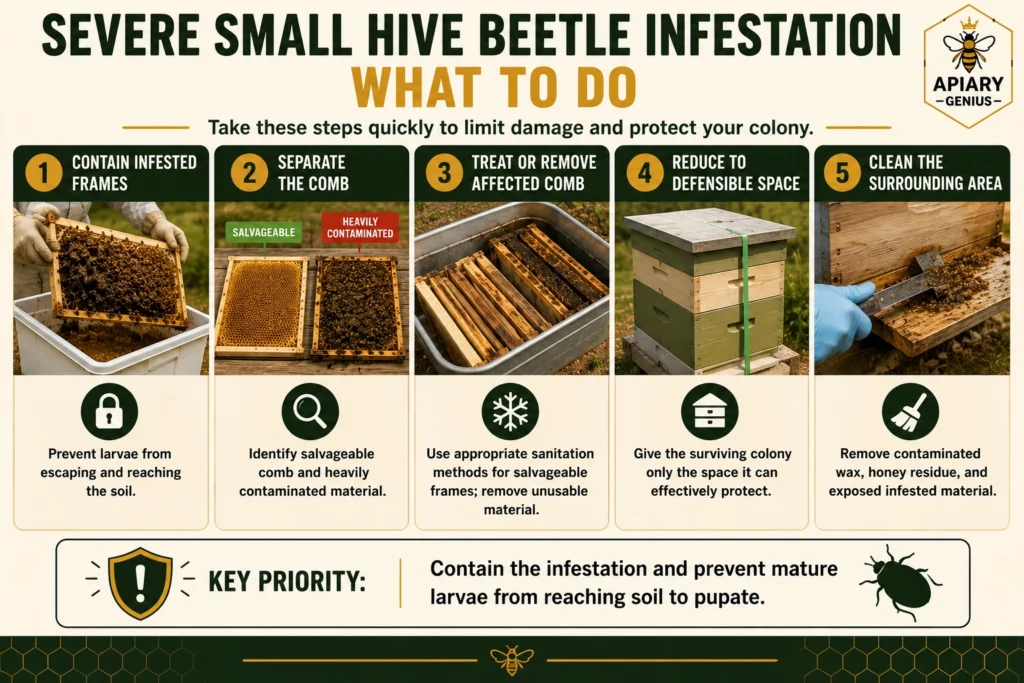
Separate salvageable and unsalvageable comb
Frames with manageable contamination may sometimes be sanitized by freezing.
Comb that is extensively fermented, slimed, structurally damaged, or otherwise unsuitable may need to be removed from service.
Reduce the surviving colony to defensible space
If a viable bee population remains, give it only the hive space it can reasonably protect while maintaining adequate brood and food capacity.
Then address the cause of weakness.
Clean the surrounding area
Remove exposed contaminated material from:
- the apiary;
- storage areas;
- extraction rooms;
- equipment stacks.
Do not leave piles of infested wax or honey residue accessible.
Seek regional guidance when appropriate
If small hive beetles are unusual, newly detected, reportable, or regulated where you live, contact the relevant agricultural authority, apiary inspector, or Extension service.
If chemical intervention is being considered during a severe infestation, verify the current legally permitted options locally before purchasing or applying anything.
Common Small Hive Beetle Control Mistakes
Treating every adult beetle as an emergency
A few adults do not prove that the colony is collapsing.
Look for larvae, contamination, colony weakness, and an increasing population before judging severity.
Focusing on beetles but ignoring colony health
A declining colony may have queen, mite, disease, or nutrition problems in addition to beetles.
Address the underlying weakness.
Giving weak colonies excessive space
More hive boxes can create more unprotected comb.
Match space to actual colony strength and seasonal needs.
Depending entirely on traps
Mechanical traps can reduce adult numbers, but they cannot restore a failing queen, correct disease, or make an undersized colony suddenly capable of protecting a large hive.
Allowing larvae to reach the ground
Mature larvae pupate in soil.
Contain heavily infested material rather than brushing larvae outside the hive.
Leaving harvested supers unattended
Harvested comb no longer benefits from a dense population of worker bees patrolling it.
Extract and store supers promptly.
Neglecting honey-house sanitation
Cappings, honey spills, wax, and pollen-rich comb can provide resources for beetles.
Clean processing and storage areas.
Using pesticides automatically
Chemical control should not be a routine preventive response.
Integrated management comes first.
Following outdated pesticide advice
Registration and label status can change.
Always verify current legal use in your jurisdiction.
Expecting complete eradication
Where small hive beetles are established, the practical objective is usually control rather than a promise that every beetle will disappear.
Frequently Asked Questions About Small Hive Beetles
How do I get rid of small hive beetles?
Start by assessing colony strength and the severity of the infestation.
Maintain a strong colony, remove unnecessary unprotected hive space, use appropriate mechanical traps, maintain sanitation, and handle infested comb promptly.
If larvae are present, contain the affected material before larvae can reach soil and pupate.
In regions where the pest is established, management is generally a more realistic objective than guaranteed eradication.
Are a few small hive beetles a serious problem?
Not necessarily.
A small number of adult beetles can occur in otherwise functional colonies.
Larvae, slimed comb, fermented honey, a rapidly increasing adult population, or a colony too weak to protect its comb are more important warning signs.
What do small hive beetle larvae look like?
They are pale to off-white larvae with three pairs of developed legs near the front of the body and distinctive spines along the back.
Mature larvae may reach roughly 10–12 millimeters in length.
How can I tell small hive beetle larvae from wax moth larvae?
Small hive beetle larvae have dorsal spines and lack the abdominal prolegs found on wax moth larvae.
Damage patterns also differ.
Small hive beetles are commonly associated with wet, slimed, fermenting comb, while wax moth larvae characteristically produce silk and webbing.
Do small hive beetles ruin honey?
A serious larval infestation can contaminate honey and cause fermentation.
Honey heavily contaminated by small hive beetle larval activity or excrement should not be used for human consumption.
Do small hive beetles live in the soil?
Part of their life cycle occurs there.
Mature larvae leave the hive and enter suitable soil to pupate. Adult beetles later emerge and can enter honey bee colonies.
What is the best small hive beetle treatment?
There is no single best treatment for every situation.
The strongest approach is integrated management:
- strong colonies;
- appropriate hive space;
- regular monitoring;
- mechanical trapping;
- sanitation;
- prompt comb and honey handling.
Chemical controls, where currently registered and legally appropriate, are a secondary consideration rather than the automatic first step.
Do small hive beetle traps work?
Mechanical traps can reduce adult beetle numbers and are a useful management tool.
They do not capture every beetle and work best when combined with healthy-colony management and sanitation.
Should I remove supers if I find small hive beetles?
Not automatically.
If the colony is strong and bees are densely occupying and protecting the supers, their presence may still be appropriate.
Remove genuinely excessive space when large areas are poorly occupied and cannot be effectively defended.
Can small hive beetles kill a colony?
A severe infestation can cause major damage to comb and stored honey and may contribute to colony abandonment.
That does not mean every colony containing adult beetles is in danger of collapse.
Should I use pesticides to prevent small hive beetles?
No pesticide should be applied automatically as routine prevention.
NC State Extension advises against prophylactic chemical control.
Prioritize colony strength, sanitation, monitoring, appropriate hive space, and mechanical traps.
If chemical treatment becomes necessary, use only a product currently registered for that use in your location and follow its current label exactly.
Final Thoughts
Successful small hive beetle control begins by distinguishing beetle presence from beetle reproduction.
A few adults in a strong colony usually call for monitoring and sensible management.
Larvae, slimed comb, fermented honey, and a declining colony demand faster action.
The most reliable approach is integrated management: maintain strong colonies, avoid excessive unprotected hive space, inspect regularly, use mechanical traps where appropriate, keep the apiary and honey-processing area clean, and handle harvested or infested comb promptly.
Most importantly, do not view an increasing beetle population in isolation.
Ask what has changed inside the colony.
A falling bee population, queen problem, disease pressure, excessive space, delayed honey processing, or poor sanitation can shift conditions in the beetles’ favor.
Correcting those conditions is usually more valuable than searching for a single product that promises to eliminate every beetle.
Sources
- NC State Extension — The Small Hive Beetle: A Pest of Honey Bee Colonies
- USDA Agricultural Research Service — Small Hive Beetles
- USDA Agricultural Research Service, Bee Research Laboratory — Small Hive Beetle
- Oregon State University Extension — The Small Hive Beetle: A Potential Pest in Honey Bee Colonies