
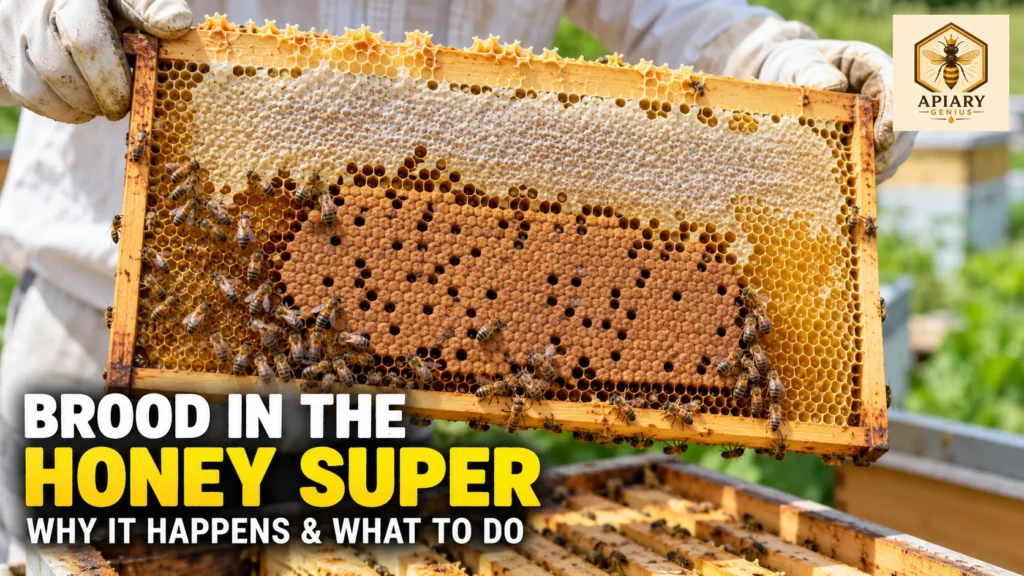
Finding brood in honey super frames can be confusing, especially when you expected the box to contain only nectar and honey. You may find eggs, open larvae, capped worker brood, drone brood, or even the queen herself in a box you intended primarily for honey storage.
The important point is that brood in a honey super does not automatically mean the queen excluder failed. The queen may have had access to the super before the excluder was installed, the hive may have been rearranged, brood frames may have been moved upward intentionally, or no queen excluder may have been used at all.
Before moving frames or changing the hive configuration, determine what kind of brood you are seeing and, most importantly, where the queen is now.
Quick Answer
If you find brood in honey super frames, it usually means the queen had access to that box at some point or brood frames were deliberately moved there.
Start by confirming that the cells really contain brood. Determine whether you are seeing eggs, larvae, capped worker brood, or drone brood. Then locate the queen—or use fresh eggs and young brood as evidence of where she has been laying recently.
Review when the queen excluder was installed, whether boxes were rearranged, and whether brood frames were moved upward.
Do not extract frames containing live brood, and do not install or reposition a queen excluder until you know where the queen is.
Brood above a queen excluder is a management clue—not automatic proof that the excluder failed.
Table of Contents
Is It Really Brood in the Honey Super?
Before changing anything, make sure the cells actually contain brood.
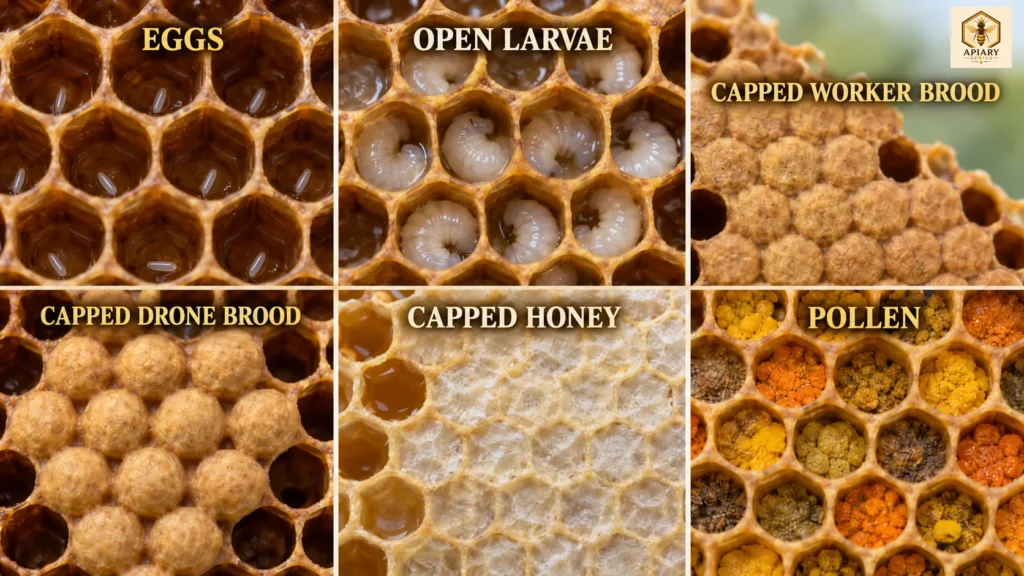
A honey-super frame can hold several materials at the same time, including nectar, capped honey, pollen, eggs, larvae, and capped brood.
Eggs
Honey bee eggs are tiny, white, and elongated. A normally laying queen generally places one egg near the bottom of a cell.
The egg stage lasts about three days, so finding eggs in honey super comb tells you that laying occurred there recently. It does not prove that the queen is still in the super at the moment you inspect it.
Open larvae
After the egg hatches, the developing bee enters the larval stage. Young larvae appear as small white grubs in open cells.
Fresh eggs or very young larvae above the brood chamber provide stronger evidence of recent queen access than older capped brood.
Capped worker brood
Worker brood becomes sealed while the developing bee completes its later stages. A worker develops from egg to adult in about 21 days under normal conditions.
Capped worker brood often forms tan-to-brown patches and should not be confused with capped honey simply because both are covered with wax.
Capped drone brood
Drone cells are larger than worker cells, and capped drone brood commonly has noticeably raised, dome-shaped cappings.
Drone development takes longer than worker development. Finding drone brood alone, however, does not diagnose laying workers or a failing queen.
Capped honey
Capped honey contains stored, ripened honey rather than a developing bee.
A frame may contain both brood and honey, so seeing capped honey on part of a frame does not make the entire frame suitable for extraction while live brood remains elsewhere on it.
Pollen
Pollen is packed into open cells and can appear yellow, orange, tan, brown, or other colors depending on its floral source.
If you are unsure what a frame contains, identify it before making a harvest or brood-management decision.
Why Is There Brood in Honey Super Frames?
There are several ways brood can appear where the beekeeper intended to store surplus honey.
1. No queen excluder was being used
Without a queen excluder, the queen can move upward when suitable comb is available.
Queen excluders are commonly used to keep queens out of honey supers, but they are not mandatory in every beekeeping system. Mississippi State Extension notes that some smaller-scale beekeepers manage honey production without them.
In that situation, brood in the first honey super does not necessarily mean that anything has malfunctioned.
2. The queen was already above the excluder when it was installed
A queen excluder has openings that allow worker bees to pass while restricting the larger queen. Its usual position is between the brood area and honey supers when the beekeeper wants to prevent brood production above it.
But placing an excluder into the hive does not establish where the queen was immediately beforehand.
If she was already in the super when the excluder was placed underneath her, she could simply have been confined above it.
That means brood above the excluder does not, by itself, prove that the queen later passed through the excluder.
3. The excluder was removed or boxes were rearranged
Hive configurations change during inspections.
The excluder may have been temporarily removed, brood boxes and supers may have been reordered, or the queen may have gained access to the super during another management procedure.
Even if the hive has since been returned to its usual configuration, eggs and developing brood can remain as evidence of that earlier access.
4. Brood frames were intentionally moved above the excluder
Not all brood above an excluder is accidental.
Brood can be deliberately moved upward during legitimate management procedures.
The Demaree method, for example, can separate the queen from young brood by keeping the queen below an excluder while brood is placed higher in the hive. Mississippi State Extension documents this type of arrangement.
Penn State also describes moving brood above an excluder as part of specialized queen-management preparation.
So before deciding that something went wrong, review what was deliberately done during previous inspections.
For broader swarm-management strategies, see How to Prevent Bee Swarming: 9 Proven Methods for Beekeepers.
5. The hive or excluder configuration deserves inspection
If recent hive history does not explain the brood placement, inspect the physical setup carefully.
Check whether the excluder is in the expected position, whether the boxes are stacked as intended, whether equipment has shifted, and whether there is obvious damage or another route that could affect the intended separation.
Inspecting the excluder is reasonable.
Declaring it defective merely because brood is above it is not.
First Find Out Where the Queen Is Now
Before installing, removing, or repositioning a queen excluder, determine where the queen is.
Try to locate her directly.
If you cannot find her, examine the brood.
Look above the excluder for:
- eggs;
- very young larvae;
- recently expanding brood.
Then inspect below it for the same evidence.
Because the egg stage lasts only about three days, fresh eggs provide a much narrower indication of recent laying than older capped brood.
Also review your inspection history.
Where was the queen last seen?
Was an excluder installed afterward?
Were frames or boxes moved?
Finding fresh eggs below the excluder supports recent laying below. Finding fresh eggs above it means laying occurred above recently.
Neither observation should be interpreted without considering the hive’s recent configuration.
This step matters because installing an excluder while the queen remains above it can trap her in the very part of the colony you are trying to clear of brood.
The Age of the Brood Tells You What Happened
Brood stage can help reconstruct when the queen had access to a super.
Fresh eggs or very young larvae above
Fresh eggs mean laying occurred recently.
Honey bee eggs normally remain in the egg stage for about three days. Larvae then develop in open cells before the cells are capped.
Eggs or very young larvae above the brood chamber therefore deserve careful investigation.
They do not prove that the queen is still above, but they tell you that her access—or movement of the brood frame—was recent.
Only older capped brood above
A super containing capped brood but no eggs or young larvae tells a different story.
Worker brood normally emerges around day 21. If you see only older capped brood above while new eggs are appearing normally below, the queen may already be below and the upper brood may simply be completing development.
Brood age should be treated as evidence rather than absolute proof of the queen’s location.
What If There Is No Queen Excluder?
Some beekeepers intentionally manage colonies without queen excluders.
University of Alaska Fairbanks Extension describes queen-excluder use as a management choice rather than a universal requirement.
Without one, the queen may move upward into suitable comb.
Finding brood in the first honey super therefore does not automatically mean something is wrong.
The practical question becomes:
Do you want the box to remain available for brood production, or do you want to return it to honey-only use?
If you want to restore honey-only use, first determine the queen’s current location. Then allow for the developing brood and decide how to restore the separation without unnecessarily disrupting the colony.
If the broader question is whether the colony was ready for another honey super, see When to Add a Honey Super: Timing, Signs, and the 7/10 Rule.
What If Brood Is Above a Queen Excluder?
Do not begin with the assumption that the excluder failed.
Work backward through the colony’s recent management.
Ask:
- When was the excluder installed?
- Where was the queen at that time?
- Were brood frames moved upward?
- Were boxes rearranged?
- Was the excluder temporarily removed?
- Are fresh eggs still appearing above?
- Are fresh eggs present below?
- Are queen cells present above?
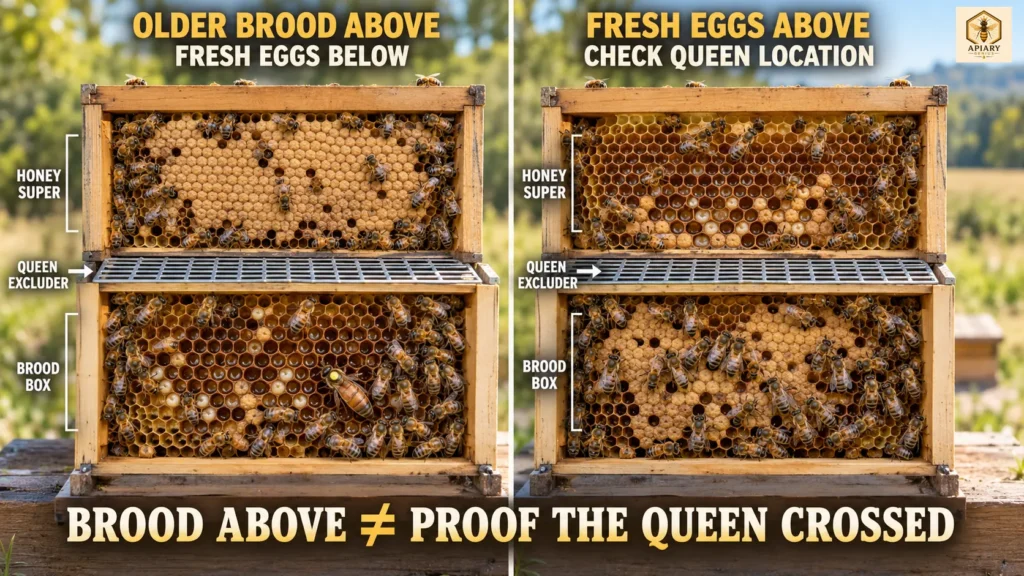
If only older capped brood remains above and fresh eggs are appearing normally below, the brood may reflect earlier queen access or deliberate brood movement.
If eggs continue appearing above, investigate the queen’s location and hive configuration before making additional changes.
The core point is simple:
Brood above a queen excluder does not prove that the queen crossed the excluder.
Could the Brood Have Been Moved Above the Excluder on Purpose?
Yes.
Some hive-management systems intentionally place brood above a queen excluder.
The Demaree method is one example. In the Mississippi State description, the queen remains in the lower brood chamber while young brood is placed higher in the hive and separated by an excluder.
Penn State documents another specialized management procedure in which brood frames are moved above an excluder before queen introduction.
These examples are important because they show why brood above an excluder is not automatically evidence of equipment failure.
They do not mean that every beekeeper finding brood upstairs should perform one of these procedures.
First determine what happened in your own hive.
What to Do With Brood in Honey Super Frames
The main rule is straightforward:
Do not extract frames containing live brood.
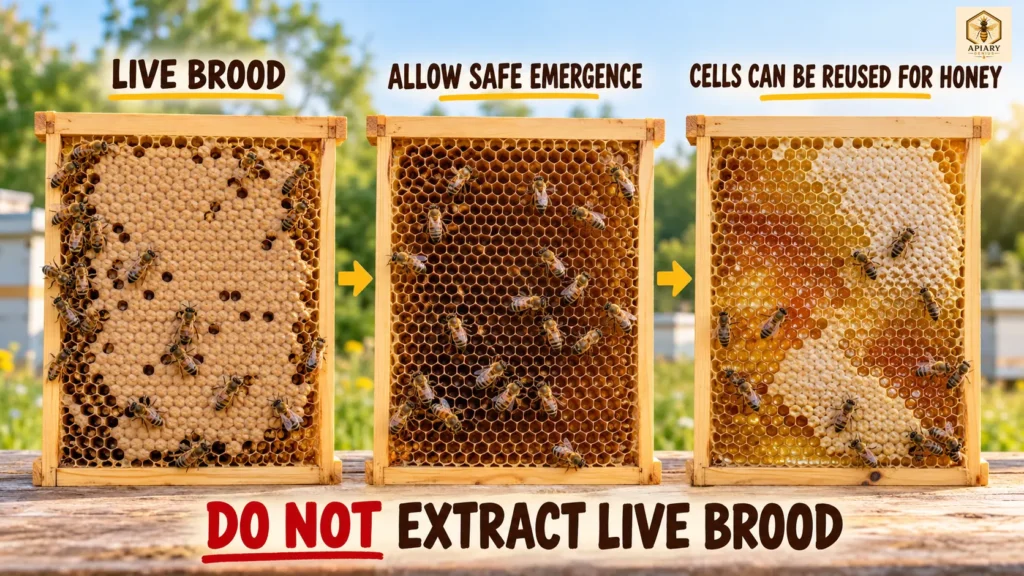
Developing bees should remain in colony conditions where workers can feed, cover, and regulate them properly.
What happens next depends on the hive.
One option is to allow the brood to finish developing where it is after you have confirmed the queen’s position and prevented additional unwanted laying in that box.
Mississippi State Extension describes upper brood emerging and the resulting empty cells later being used for honey storage during favorable conditions.
Another option may be to reorganize the frames, but only after evaluating the brood chamber and the colony as a whole.
There is no universal rule requiring every brood frame in a honey super to be moved down immediately.
Once the developing bees have emerged, workers can clean and reuse those cells. During a suitable nectar flow, the cells may later be used for nectar and honey storage.
Should You Move the Brood Back Into the Brood Box?
Not automatically.
Before moving anything, evaluate:
- available brood space below;
- brood stage;
- colony strength;
- season;
- nectar flow;
- queen location;
- continuity of the brood nest;
- whether the brood was intentionally moved upward.
A frame is not automatically in the wrong place simply because it contains brood above the beekeeper’s preferred honey-storage area.
If the brood is healthy, well covered, and close to emergence, allowing it to finish developing may be less disruptive than immediately rearranging the colony.
On the other hand, a different arrangement may make sense when the colony has suitable space below and the move fits a clear management objective.
Avoid heavily disrupting a compact brood nest without a reason.
Should You Install a Queen Excluder Now?
Only after determining where the queen is.
Queen excluders allow workers to move through while restricting the queen from entering the honey-storage area above.
If you choose to use one, make sure the queen is on the side where you want normal brood production to continue.
Do not place an excluder underneath a queen who is still in the honey super.
Also remember that using an excluder is a management choice. It is not mandatory for every hive or every beekeeping system.
Seasonal configuration matters as well. In situations where a winter cluster must move upward through stored food, an excluder can separate the queen from the cluster. UF/IFAS therefore advises removing queen excluders in relevant winter configurations.
Check for Queen Cells Above the Excluder
Young brood above an excluder deserves another inspection for queen cells.
When brood is deliberately separated from the queen, workers in the upper part of the colony may sometimes begin queen-cell construction.
This is documented in management procedures that intentionally move brood above the queen. Mississippi State’s Demaree guidance specifically calls for checking the upper area for newly developed queen cells, while Penn State advises checking brood moved above an excluder for queen cells during queen-management preparation.
That does not mean queen cells will always appear.
If you find them, interpret the cells in the context of the colony rather than destroying them automatically.
For help distinguishing swarm, supersedure, and emergency queen cells, see Queen Cells in a Beehive: Swarm, Supersedure, or Emergency?.
What About Drone Brood Above a Queen Excluder?
Drone brood requires a little extra attention.
Standard queen excluders are designed so worker bees can pass through while larger bees are restricted. University of Alaska Fairbanks Extension notes that standard excluders also prevent drones from passing through.
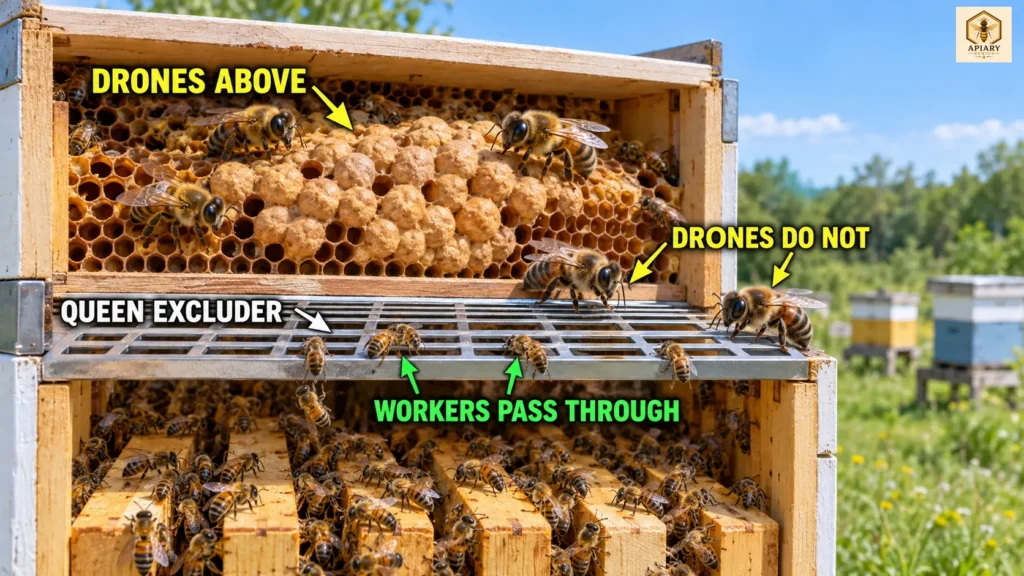
That means drones emerging above an excluder may create a practical management complication because they cannot simply move through the excluder like workers.
Review the configuration rather than ignoring a large amount of emerging drone brood above the barrier.
However, drone brood in a honey super does not automatically mean laying workers are present.
A normally mated queen produces drones from unfertilized eggs. If she previously had access to suitable drone cells in the super, drone brood can be a normal consequence of that access.
Only when drone brood occurs alongside other reproductive abnormalities—such as multiple eggs in cells, unusually positioned eggs, extensive drone brood in worker-sized cells, or evidence that a normal queen is missing—should you investigate laying workers or a drone-laying queen.
For that differential diagnosis, see Laying Worker Bees vs. a Drone-Laying Queen: How to Tell the Difference.
Can You Harvest a Super That Has Brood in It?
Separate the super as a box from the individual brood-containing frame.
Finding one frame of brood does not automatically make every other frame in that super unsuitable for harvest.
But a frame that currently contains live developing brood should not be treated as an ordinary harvest-ready honey frame.
Protect the brood and allow the situation to resolve first.
After the brood emerges, workers may clean the cells and later fill them with nectar and honey. Mississippi State describes this reuse of cells after brood emerges in upper boxes.
If those cells later contain mature honey, judge harvest readiness using your normal honey-harvest criteria rather than rejecting the frame permanently because it once contained brood.
For harvest guidance, see How to Harvest Honey: A Complete Beginner’s Guide.
If the brood issue has been resolved but the colony later fails to occupy, draw, or fill the super, troubleshoot that as a separate problem with Why Aren’t My Bees Using the Honey Super? Causes and What to Check.
Does Brood in the Super Mean You Have a Bad Queen?
No.
Brood in honey super frames is not, by itself, evidence of a poor queen.
The location of otherwise normal brood can reflect:
- hive configuration;
- queen access;
- operating without an excluder;
- temporary equipment changes;
- box rearrangement;
- intentional brood movement.
Do not replace or kill a queen solely because she laid eggs in a honey super.
Queen problems require broader evidence from the colony.
If the brood itself appears unusually scattered or abnormal rather than simply being located in the wrong box, investigate that separately with Spotty Brood Pattern in Honey Bees: Causes, What It Means, and What to Check.
What to Check Before You Change Anything
Use this sequence at the hive:
- Confirm that the cells really contain brood. Do not confuse brood with capped honey or stored pollen.
- Identify the brood type and stage. Look for eggs, larvae, capped worker brood, and drone brood.
- Determine where the queen is now. Locate her directly when possible.
- Look for fresh eggs below the super. They provide useful evidence of recent laying.
- Check whether a queen excluder is present.
- Review when the excluder was installed. Determine whether the queen’s location was known at that time.
- Check whether brood frames were intentionally moved upward.
- Review recent box rearrangements or temporary equipment removal.
- Inspect the excluder and hive alignment. Look for an actual configuration problem rather than assuming one.
- Check for queen cells above.
- Assess available brood space below.
- Decide whether the brood can safely emerge before restoring honey-only use.
The purpose of this sequence is to diagnose before intervening.
What Not to Do
- Do not extract frames containing live brood.
- Do not install or reposition an excluder before determining where the queen is.
- Do not assume the queen excluder failed simply because brood is above it.
- Do not replace or kill the queen merely because she laid eggs in a super.
- Do not move brood into another colony casually. Brood transferred between colonies should come from healthy colonies, and queen location must be checked carefully. Penn State specifically advises using brood from healthy queenright colonies in its brood-transfer procedures.
- Do not heavily rearrange the brood nest without a clear management reason.
- Do not destroy healthy open brood simply to make the super “clean.”
- Do not diagnose laying workers from drone brood alone.
- Do not ignore queen cells that develop above an excluder after young brood has been moved upward.
- Do not leave a queen excluder in an inappropriate winter configuration without considering how the cluster and queen need to move through stored food.
A Practical Brood-in-the-Super Checklist
- Verify that the cells contain brood.
- Identify brood type and approximate age.
- Find the queen or strong evidence of her recent location.
- Confirm which side of the queen excluder she is on.
- Review recent hive manipulations.
- Inspect the excluder and hive configuration.
- Check available brood space below.
- Look for queen cells above.
- Protect developing brood until emergence.
- Restore the brood/honey separation your management system requires.
- Recheck the affected super before harvesting.
The goal is not simply to remove brood from the super as quickly as possible.
The goal is to understand how the brood got there, where the queen is now, and how to restore the intended hive configuration without destroying brood or trapping the queen on the wrong side of an excluder.
FAQ
Why is there brood in my honey super?
Brood in honey super frames usually means the queen had access to the comb when the eggs were laid or brood frames were moved there.
Possible explanations include operating without a queen excluder, installing an excluder while the queen was already above it, temporarily removing the excluder, rearranging boxes, or deliberately moving brood during hive management.
Can a queen lay eggs in a honey super?
Yes.
If a queen can reach suitable empty comb, she can lay eggs in a honey super.
The term “honey super” describes the beekeeper’s intended use of the box. The box itself does not prevent brood production.
How did brood get above the queen excluder?
Several explanations are possible.
The queen may already have been above the excluder when it was installed. The excluder may have been temporarily removed. Boxes may have been rearranged. Brood frames may also have been moved above it deliberately.
Review those possibilities before assuming equipment failure.
Does brood above a queen excluder mean the excluder failed?
No.
Brood above the excluder tells you where the brood is, but it does not prove how it got there.
Check when the excluder was installed, where the queen was at that time, whether frames were moved, and whether fresh eggs are currently appearing above or below.
What should I do with brood frames in a honey super?
First determine the brood stage and locate the queen.
Depending on the hive, it may be reasonable to let the brood emerge where it is and later restore honey-only use of those frames.
In other cases, reorganizing frames may be appropriate after confirming available space and queen location.
There is no single frame-moving rule for every colony.
Can I extract honey from a frame that has brood?
Do not ordinarily extract a frame while it contains live developing brood.
Once the brood emerges, the cells can be reused. If the frame is later filled with mature honey, assess it according to normal honey-harvest criteria.
Should I move brood from the honey super back into the brood box?
Not automatically.
Consider brood age, queen location, available brood space, colony strength, season, nectar flow, and whether the brood was deliberately moved.
Moving the frames simply because they are in a super can sometimes create more disruption than allowing older brood to emerge where it is.
Should I add a queen excluder if there is already brood in the super?
First determine where the queen is.
Installing an excluder while she remains above it can confine her to the super.
Once her location is confirmed, decide whether using an excluder fits your management system and position it so the queen remains in the intended brood area.
What does drone brood in a honey super mean?
It means drone-producing eggs were laid in that comb.
A normal queen can produce drone brood, so drone brood in the super does not diagnose laying workers.
If the brood occurs with multiple eggs, abnormal egg placement, drone brood in worker cells, or other reproductive abnormalities, investigate the colony more broadly.
Will bees fill brood cells with honey after the brood emerges?
They can.
After an adult bee emerges, workers clean the cell and it becomes available for reuse. Under suitable nectar-flow conditions, cells that previously contained brood may later be used for nectar and honey storage.
Sources
- University of Georgia Cooperative Extension — Honey Bees and Beekeeping
- Mississippi State University Extension — Colony Growth and Seasonal Management of Honey Bees
- Penn State Extension — Honey Bee Insemination: Pre-laying II Queen Introduction
- Utah State University Extension — What Is Bee Brood?
- University of Alaska Fairbanks Cooperative Extension — Beekeeping in Alaska
- University of Florida IFAS Extension — Welcome to the Apiary! Honey Bee 4-H Project Book
- University of Florida IFAS Extension — Keeping Bees in Florida