
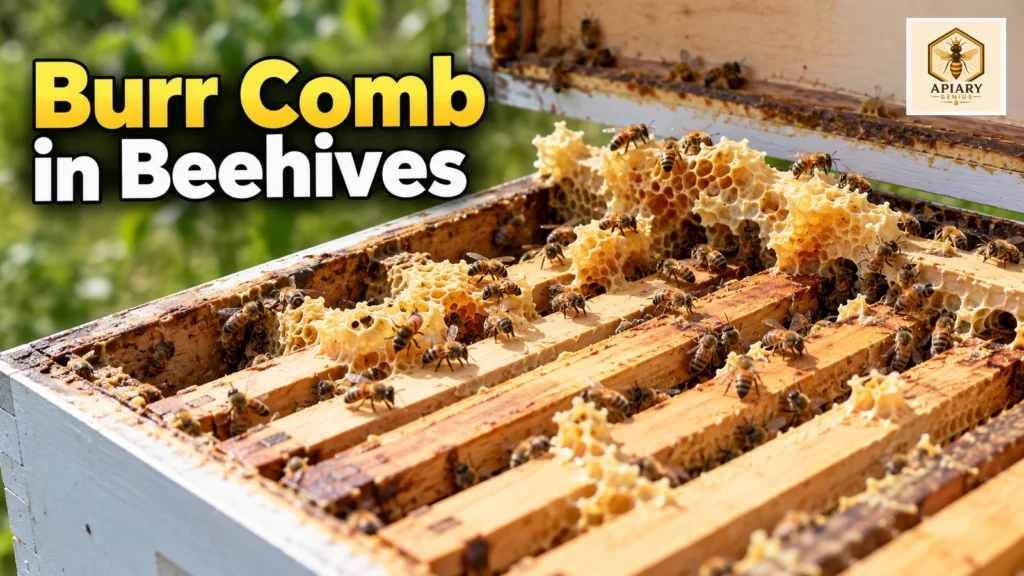
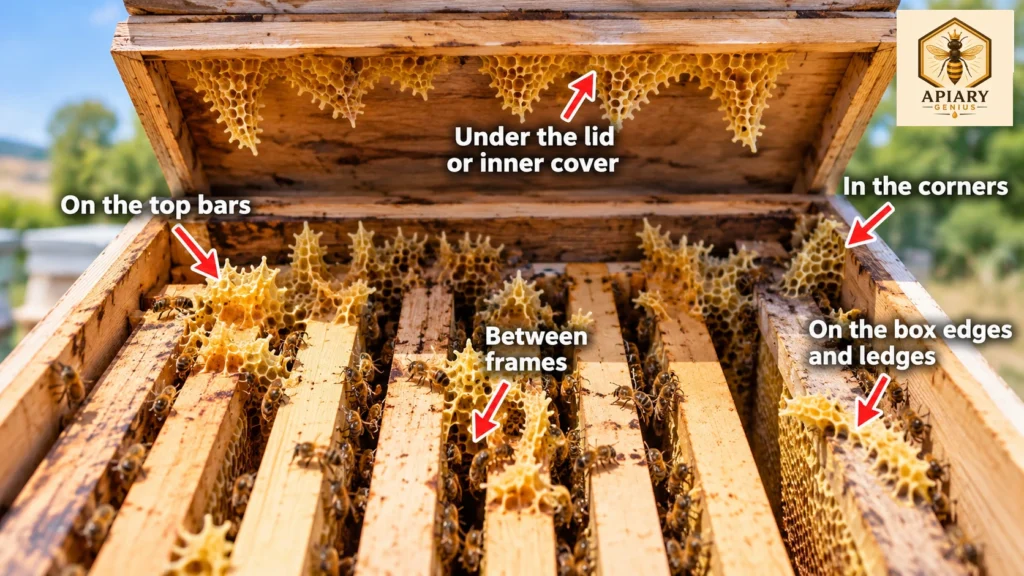
Burr comb is extra comb that bees build outside the intended frame area. You may find it above top bars, hanging beneath frames, connecting hive boxes, attached to an inner cover, under a queen excluder, around a feeder, or filling another unintended gap inside the hive.
Finding burr comb does not usually mean something is wrong with the health of the colony. More often, it is a clue that the hive contains usable space where the bees can build wax.
The important question is therefore not only, “How do I remove this comb?” It is also, “Why was there enough space for the bees to build it here?”
In movable-frame Langstroth equipment, oversized gaps, missing or poorly positioned frames, mismatched frame and box depths, feeder cavities, temporary spacers, distorted comb, or poorly fitting components can all create opportunities for unwanted comb construction.
Before removing anything, inspect the comb carefully. It may contain honey, nectar, worker brood, drone brood, many adult bees, or potentially the queen.
Quick Answer
Burr comb is unwanted or extra comb built outside the intended frame area. Bees commonly build it when the hive provides a larger-than-intended gap where wax can be constructed.
Small, empty burr comb can often be removed carefully with a hive tool. But do not scrape blindly. First check whether the comb contains brood, honey, many adult bees, or the queen.
Most importantly, correct the physical cause afterward.
Removing the wax fixes the immediate obstruction. Correcting the extra space helps prevent the problem from coming back.
Table of Contents
What Is Burr Comb?
Burr comb is comb built where the beekeeper did not intend normal comb to be constructed.
Common locations include:
- above frame top bars;
- below frame bottom bars;
- between neighboring frames;
- between stacked hive boxes;
- on an inner cover;
- around feeder equipment;
- beneath a queen excluder;
- inside unused spaces or cavities.
The University of Florida/IFAS discussion of honey bee nest components shows burr comb associated with spaces outside the intended frame area and notes that sufficiently large pieces may be used for food storage or brood rearing.
Beekeepers sometimes use the terms burr comb, brace comb, and cross comb somewhat differently. Rather than forcing every irregular piece of wax into a rigid category, focus on what the comb is physically doing.
Is it:
- filling an unintended gap?
- joining two hive components?
- crossing the normal frame orientation?
- interfering with frame removal?
Those questions are usually more useful than the label itself.
Burr comb is not a bee disease.
Why Do Bees Build Burr Comb?
Bees build comb where suitable building space is available.
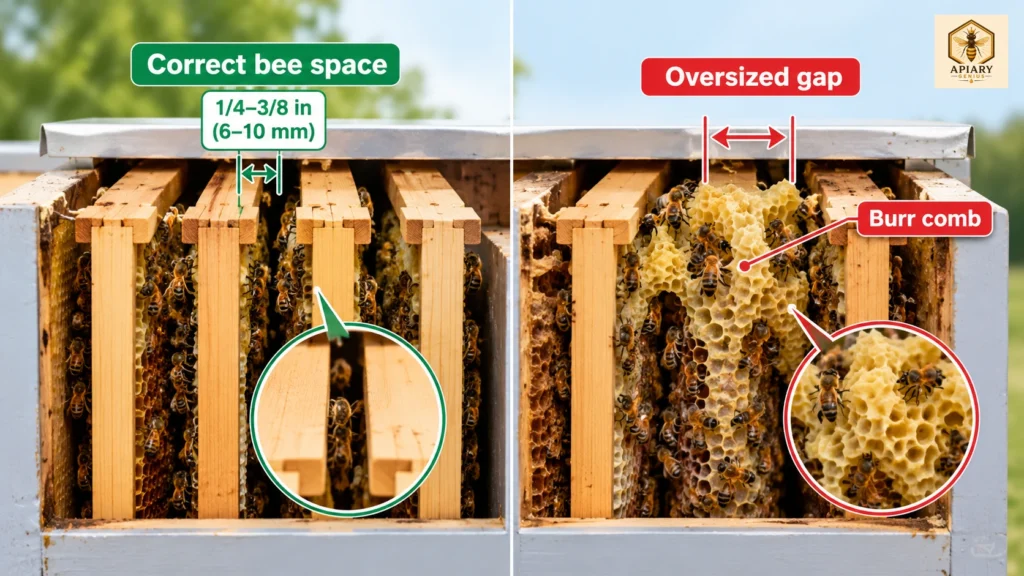
The principle is simple: properly designed movable-frame equipment tries to maintain passages that bees can move through without filling them with comb.
When a gap becomes substantially larger than the intended spacing, bees may use that area for additional comb construction.
Mississippi State University Extension explains that gaps much larger than normal bee space may be filled with additional comb, while spaces that are too narrow may be heavily propolized.
Common reasons for burr comb include:
- a frame is missing;
- frames are not positioned correctly;
- one frame is substantially shorter than the box;
- drawn comb has become badly distorted;
- feeder equipment creates an oversized cavity;
- a temporary spacer remains in place;
- hive components fit poorly;
- excessive space exists above or below the frames.
The bees are not necessarily behaving abnormally.
They are responding to the geometry available inside the hive.
What Is Bee Space and Why Does It Matter?
Bee space is one of the principles that makes movable-frame hive management possible.
In Langstroth-style equipment, a commonly cited approximate bee-space range is:
1/4 to 3/8 inch
or approximately:
6 to 10 mm
Mississippi State University Extension discusses this spacing in the context of movable-frame equipment and explains how maintaining appropriate space helps keep hive parts and frames usable.
This range should not be treated as a universal biological measurement that applies identically to every component of every hive design.
Its importance here is practical.
When movable-frame equipment maintains suitable spacing:
- bees can move between surfaces;
- frames remain easier to remove;
- excessive wax connections are reduced;
- excessive propolizing of very narrow gaps is reduced.
When spacing is badly disrupted, the bees may begin modifying the area themselves.
A large void may be filled with comb.
A very narrow space may be filled or sealed with propolis.
For a broader explanation of different hive systems and how Langstroth equipment is organized, see Types of Beehives Compared: The Complete Guide for Beekeepers.
Where Burr Comb Usually Appears
Where the burr comb appears can help you identify what caused it.
Above the Tops of Frames
Comb can form between top bars and the component above them when excessive clearance exists.
A small amount may simply connect nearby surfaces, while a larger cavity can allow much more extensive construction.
Beneath Frames
Comb hanging from the bottoms of frames often indicates there is usable space beneath them.
One important cause is using frames that are too shallow for the hive body.
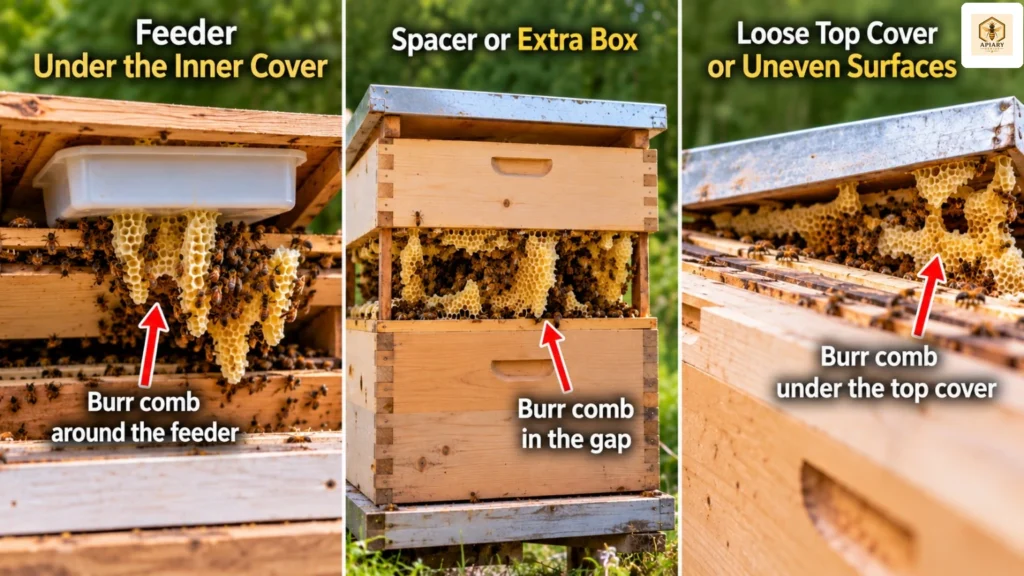
Between Hive Boxes
Bees may build wax connections between the upper parts of frames in one box and the lower portions of frames in the box above.
This can make separating the boxes difficult and may tear comb when the hive is opened.
Under an Inner Cover
Too much empty space above the frames can encourage construction attached directly to the inner cover.
Mississippi State University Extension describes situations in which bees constructed extensive comb in open space above the colony. Large hanging comb can become particularly troublesome if it collapses or tears when the cover is lifted.
Around Feeders and Spacers
Some feeder arrangements require temporary extra hive space.
Examples include:
- feeding rims;
- sugar-cake spacers;
- empty supers used to cover feeders;
- gaps around internal feeder equipment.
If those spaces remain available under active wax-building conditions, the bees may begin using them.
Under Queen Excluders
Burr comb may also appear beneath or around queen excluders where clearance permits additional wax construction. The University of Florida/IFAS guide includes this as a documented location for burr comb.
Beside Incorrectly Positioned Frames
If frames are not grouped and positioned as intended, an oversized opening may appear between them.
The colony may fill the opening with new comb.
Where a Frame Is Missing
A missing frame creates much more than bee space.
It creates a large construction area.
If the colony is actively drawing wax, the bees may build substantial unsupported or irregular comb into that opening.
Are Your Frames Spaced Correctly?
When you find burr comb, inspect the surrounding frames before removing the wax.
Check:
- Are all the intended frames in the box?
- Are the frames pushed together correctly?
- Is one gap noticeably wider than the others?
- Is drawn comb bulging into the neighboring frame space?
- Is irregular comb forcing nearby frames out of position?
- Are the frame end bars sitting normally?
- Has cross comb begun to change the orientation of neighboring comb?
Do not solve poor spacing by simply spreading random oversized gaps throughout the hive.
In standard equipment with self-spacing frames, the frames should be positioned according to the design of the box and frame system.
Drawn comb can also develop irregular contours. One comb may bulge outward while the neighboring comb develops a corresponding depression.
Mississippi State University Extension warns that careless rotation of irregular drawn comb can cause raised areas to collide with neighboring comb, potentially crushing bees or damaging honey and brood.
Newly established colonies are particularly worth watching while their comb structure is developing.
If you are setting up a package or nuc, see How to Install Package Bees or a Nuc: A Step-by-Step Guide.
Using the Wrong Frame Size Can Create Burr Comb
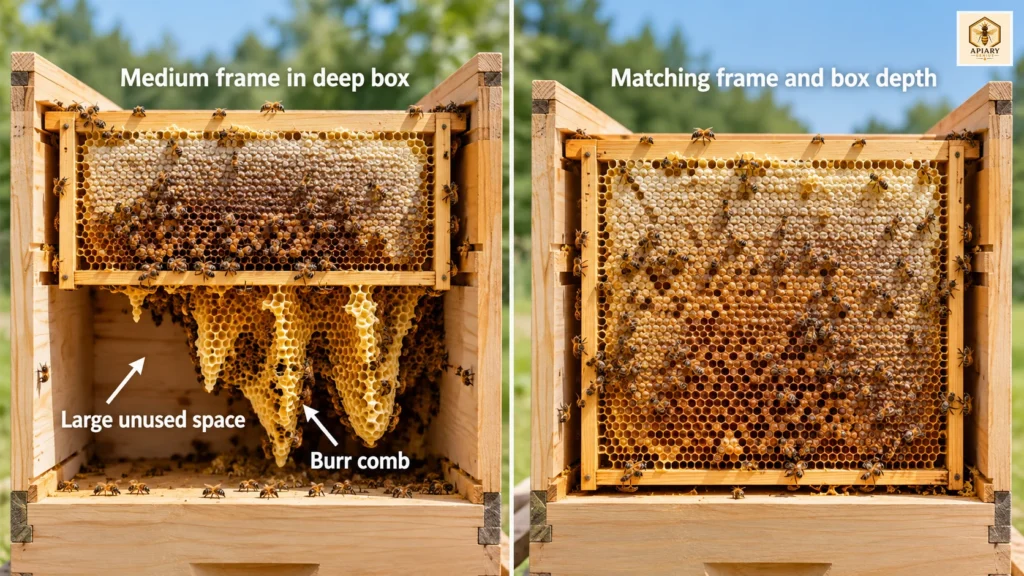
Frame depth should normally match box depth.
For example, placing a medium frame inside a deep hive body leaves a substantial open area beneath the frame.
The bees do not recognize that space as an area that must remain empty.
Under suitable comb-building conditions, they may extend wax downward and create extensive burr comb.
Mississippi State University Extension specifically advises matching frame depth to box depth and notes the burr-comb problem that can result from placing frames that are too short into deeper equipment.
Texas A&M AgriLife Extension likewise describes deep, medium, and shallow boxes with corresponding frame sizes.
As a practical rule:
Match frame depth to box depth unless you are intentionally using a management system designed for another configuration.
Do not routinely mix mismatched frame and box depths and expect the unused space to remain empty.
Feeders, Spacers, and Empty Boxes Can Cause Burr Comb
Feeding equipment does not automatically cause burr comb.
The issue is the extra cavity that some feeding arrangements create.
Examples include:
- an empty box placed around a feeder;
- a feeding rim;
- a sugar-cake spacer;
- an open cavity beside feeder equipment;
- temporary equipment that remains after feeding has ended.
Penn State Extension discusses managing temporary feeding space when installing package bees and removing unnecessary extra equipment after its purpose has been served.
That principle applies here:
If temporary equipment creates extra building space, manage that space intentionally and remove the equipment when it is no longer needed.
For broader information about when and how supplemental feeding is appropriate, see Feeding Bees: The Complete Guide for Every Season.
Burr Comb vs. Cross Comb: What Is the Difference?
These terms are not used identically by every beekeeper, but the following distinctions are useful.
Burr comb generally refers to extra comb built outside the intended comb area.
Brace comb is often used for wax that connects two hive components or surfaces.
Cross comb grows across the intended frame orientation or connects frames in a way that interferes with normal frame removal.
The University of Nebraska–Lincoln Extension discusses unwanted comb in open spaces and comb that bridges or interferes with the normal frame arrangement.
Instead of worrying too much about terminology, ask:
- Is the comb blocking frame removal?
- Is it joining two pieces of equipment?
- Is it crossing the intended comb path?
- Can the beekeeper still inspect the colony without tearing comb apart?
The management consequence matters more than the name.
Should You Remove Burr Comb?
Usually, burr comb should be removed when it interferes with normal hive management.
Examples include comb that prevents:
- frames from being removed normally;
- boxes from sitting together correctly;
- a queen excluder from operating as intended;
- an inspection from being completed safely;
- equipment from being separated without tearing wax;
- frames from being returned without crushing bees.
But do not automatically scrape every piece of burr comb you see.
Inspect it first.
Ask:
- Is it empty?
- Does it contain nectar?
- Does it contain honey?
- Does it contain worker brood?
- Does it contain drone brood?
- Are many adult bees covering it?
- Could the queen be on it?
That inspection matters because removing occupied burr comb can be very different from removing a small empty ridge of wax.
Large pieces of irregular comb can tear suddenly. Honey may spill, brood may be damaged, adult bees may be crushed, and the queen can be put at risk.
How to Remove Simple Burr Comb Safely
For small, accessible, unoccupied burr comb, removal is usually straightforward.
- Work the colony calmly.
- Inspect the comb for bees and the queen.
- Move bees away from the immediate working area where practical.
- Use a hive tool carefully to separate the unwanted wax.
- Avoid scraping directly through clusters of bees.
- Remove loose comb from the hive.
- Reassemble the hive carefully.
- Correct the spacing or equipment problem that created the comb.
Texas A&M AgriLife Extension includes removing unwanted burr comb among the normal uses of the hive tool.
The final step is essential.
If the same large gap remains after the wax is removed, the bees still have the same building opportunity.
What If the Burr Comb Contains Honey?
Honey-filled burr comb requires more care than empty wax.
Breaking it open can release honey across:
- frames;
- bees;
- hive boxes;
- the stand;
- the surrounding apiary.
Try to avoid tearing open honey-filled comb unnecessarily while it is directly over the colony.
If it must be removed:
- contain the honey as much as practical;
- avoid allowing large amounts to spill through the hive;
- do not throw honey-filled wax beside the colony;
- do not leave exposed wet comb around the apiary.
The University of Florida/IFAS guide to robbing behavior recommends preventing bees from gaining easy access to exposed honey or syrup because exposed sugary resources can encourage robbing behavior.
The Mississippi State University Beekeeping Calendar similarly warns against leaving honey-containing burr comb and similar material exposed around colonies.
If exposed honey is followed by frantic searching, fighting, or unusually intense hive traffic, see Robbing Bees: How to Tell If Your Hive Is Being Robbed and How to Stop It.
What If Burr Comb Contains Brood?
Brood changes the decision.
Do not automatically tear brood-filled burr comb apart simply because it is inconvenient.
First evaluate the situation.
Consider:
- How much brood is present?
- Is it worker brood or drone brood?
- Is the brood capped or still developing?
- What season is it?
- What are the weather conditions?
- Is the colony strong enough to cover the brood?
- Where is the queen?
- Can the hive be reassembled safely without crushing the comb?
- Is immediate removal actually necessary?
The University of Florida/IFAS guide notes that sufficiently large areas of burr comb may be used for brood rearing.
Brood needs adequate bee coverage and suitable colony conditions, so any decision to remove occupied burr comb should take weather, colony strength, and the bees’ ability to continue covering the brood into account.
In some situations, it may be practical to allow brood to emerge before removing the comb, provided the hive can still be assembled safely and the brood remains properly covered.
In another situation, the burr comb may interfere so badly with frames or box closure that earlier correction is necessary.
There is no single rule that applies to every case.
Also distinguish brood in burr comb from brood located inside normal framed comb in a honey super.
If the brood is inside the intended frame system of a honey super, see Brood in the Honey Super: Why It Happens and What to Do.
Do not casually move brood-filled burr comb from one colony to another. Before transferring brood between colonies, disease status, queen location, and the receiving colony’s ability to care for the brood must all be considered.
Is That Burr Comb or a Queen Cell?
Irregular comb can sometimes confuse new beekeepers, especially when drone comb or isolated wax structures are present.
Do not identify something as a queen cell based on size alone.
A true queen cell has a specialized structure and should be inspected in context.
Irregular drone comb, damaged wax, and burr comb can all create shapes that initially look unusual.
Before removing anything that might be a queen cell, inspect it carefully.
If you suspect that you have found a real queen cell, use Queen Cells in a Beehive: Swarm, Supersedure, or Emergency? to determine what the colony may be doing before you act.
Why Does Burr Comb Keep Coming Back?
If burr comb repeatedly returns in the same area, the physical cause probably remains.
Possible reasons include:
- the comb was removed but the oversized gap was not corrected;
- one frame is missing;
- the frames remain incorrectly positioned;
- a frame is too short for the hive body;
- feeder equipment still creates a cavity;
- a spacer or feeding rim remains in place;
- two hive components do not fit correctly;
- drawn comb is badly distorted;
- boxes are not aligned properly;
- developing cross comb is changing normal frame geometry.
The problem is not that the bees “refuse” to stop making burr comb.
The colony is simply continuing to use available construction space.
When burr comb keeps returning, ask:
What space are the bees repeatedly filling?
Correct that space instead of repeatedly treating only the wax.
Does Feeding Cause Burr Comb?
Feeding itself does not create burr comb.
A feeder does not automatically cause unwanted wax construction, and sugar syrup should not be described as the direct cause of burr comb.
However, colonies with access to carbohydrates and favorable wax-building conditions may draw comb rapidly.
Mississippi State University Extension discusses syrup feeding in the context of helping newly established colonies build comb.
If the hive also contains an unintended cavity, active comb-building bees may use that space.
The more accurate explanation is:
Feeding may support wax-building conditions, but the underlying physical opportunity is usable extra space.
Without that spacing problem, syrup alone does not explain why comb appeared in a specific unintended location.
Can Burr Comb Harm the Colony?
Burr comb is not usually a disease or a direct colony-health diagnosis.
Its problems are mainly mechanical.
Extensive burr comb can:
- make inspections more difficult;
- connect boxes together;
- make frames difficult to remove;
- rupture honey cells;
- damage brood;
- crush adult bees;
- increase the risk of injuring the queen;
- interfere with normal equipment operation;
- make hive reassembly more disruptive.
The risk often appears when the beekeeper attempts to separate components that have been connected by wax.
A piece of comb can tear unexpectedly. Bees may be trapped between surfaces, honey may leak, and occupied brood may be damaged.
So the presence of burr comb matters even though it does not mean the bees are sick.
How to Prevent Burr Comb From Coming Back
Preventing burr comb is mainly a matter of restoring proper hive geometry.
1. Match Frame Size to Box Size
Use the frame depth designed for the hive body whenever practical.
Do not routinely place substantially shorter frames into deeper boxes and assume the empty area will remain unused.
2. Keep the Intended Frames in Place
A missing frame can create a large construction cavity.
Make sure the box contains the correct number of frames for the equipment and management system being used.
3. Maintain Correct Frame Spacing
Position the frames according to the design of the equipment.
Do not create random oversized gaps throughout the box.
4. Avoid Unintended Large Cavities
Look above, below, and beside the frame system.
Any large unused cavity should have a deliberate purpose.
5. Remove Temporary Feeding Equipment When It Is No Longer Needed
Spacers, feeding rims, and empty boxes used around feeders should not remain indefinitely without a management reason.
6. Check Equipment Fit
Make sure:
- boxes sit properly together;
- frame rests are sound;
- covers fit correctly;
- queen excluders are positioned normally;
- components from different equipment systems are not creating unusual gaps.
7. Correct Severely Distorted Comb Where Appropriate
Badly bulging or misdirected comb can gradually disrupt the geometry of neighboring frames.
8. Keep Hive Components Aligned
Misaligned boxes and components can change the spaces between frames and surfaces.
9. Correct Developing Cross Comb Early
A small comb-orientation problem is easier to manage before several frames become joined together.
The objective is not to stop bees from producing wax.
The objective is to guide comb construction into the intended movable-frame system.
What Not to Do
- Do not scrape comb blindly before checking what it contains.
- Do not crush comb heavily covered with bees.
- Do not treat burr comb as a bee disease.
- Do not throw honey-filled burr comb onto the ground near colonies.
- Do not leave a missing frame in a standard framed box without a deliberate management reason.
- Do not routinely use frames that are too short for the box and expect the unused space to remain empty.
- Do not leave temporary feeder cavities or spacers indefinitely.
- Do not rely on scraping alone if the spacing problem remains.
- Do not rotate irregular drawn comb carelessly if it will collide with neighboring comb or crush bees.
- Do not identify queen cells from irregular comb shape alone.
- Do not move brood-filled burr comb between colonies casually.
Burr Comb Troubleshooting Checklist
When you find burr comb in a beehive, work through these questions in order:
- Where exactly is the burr comb?
- Is the space larger than intended?
- Are all intended frames present?
- Are the frames correctly positioned?
- Do the frame depth and box depth match?
- Is a feeder, rim, spacer, or empty box creating the gap?
- Is the comb bridging hive components?
- Does it contain honey or nectar?
- Does it contain brood?
- Could the queen be on it?
- Can the comb be removed safely now?
- What physical spacing or equipment change will prevent rebuilding?
The last question is the most important.
Scraping removes the immediate obstruction.
Correcting the geometry addresses the reason it formed.
FAQ
What is burr comb in a beehive?
Burr comb is extra or unwanted comb built outside the intended frame area. It may appear above frames, below frames, between boxes, under covers, around feeders, beneath queen excluders, or inside other unintended cavities.
Why do bees build burr comb?
Bees build burr comb when usable space is available for comb construction. In movable-frame equipment, oversized gaps caused by spacing, missing frames, mismatched equipment, feeders, spacers, or distorted comb are common reasons.
Should I remove burr comb?
Usually, burr comb should be removed when it interferes with inspections, movable frames, box alignment, or normal equipment operation. However, inspect it first for brood, honey, adult bees, and the queen.
Will bees rebuild burr comb after I remove it?
They may. If the oversized gap or equipment problem remains, the bees still have the same building opportunity and may construct comb there again.
Can burr comb contain brood?
Yes. Large enough areas of burr comb can contain worker or drone brood. Do not automatically tear brood-filled comb apart without considering colony strength, weather, brood coverage, and queen safety.
What should I do with burr comb full of honey?
Handle it in a way that keeps the honey contained. Avoid tearing it open unnecessarily over the colony, and do not leave honey-filled wax exposed around the apiary because exposed honey can contribute to robbing pressure.
What is the difference between burr comb and cross comb?
Burr comb generally refers to extra comb outside the intended comb area. Cross comb grows across the intended frame orientation or connects frames in a way that interferes with removal. Terminology can vary among beekeepers.
Does burr comb mean my frames are spaced incorrectly?
It can, but incorrect frame spacing is only one possible cause. Burr comb can also result from missing frames, mismatched frame and box depths, feeder cavities, temporary spacers, distorted comb, or poorly fitting hive components.
Can the wrong frame size cause burr comb?
Yes. A frame that is substantially too short for its hive body leaves an open area beneath it, and bees may fill that unused space with burr comb.
Can removing burr comb kill the queen?
It can if the queen is on the comb or nearby when the comb is crushed, torn, or collapsed. Always inspect occupied burr comb carefully before scraping or cutting it.
Sources
- Mississippi State University Extension — Beginning Beekeeping in Mississippi
- Mississippi State University Extension — Mississippi Beekeeping Calendar
- University of Florida / IFAS — Components of the Honey Bee Nest
- University of Florida / IFAS — Robbing Behavior in Honey Bees
- Penn State Extension — Installing Packaged Bees
- Texas A&M AgriLife Extension — Beekeeping Equipment: Hive Boxes
- Texas A&M AgriLife Extension — Beekeeping Equipment: Tools
- University of Nebraska–Lincoln Extension — Beekeepers’ Guide to Comb Honey Production