
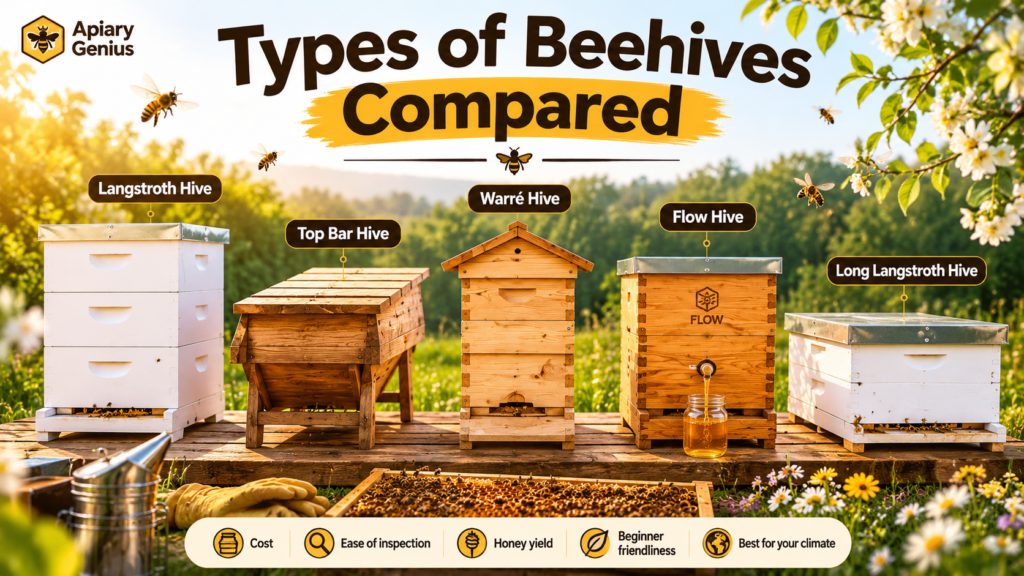
One of the very first decisions any new beekeeper faces — often before a single bee has even arrived — is which hive to use. It’s a decision that shapes almost everything that follows: how you inspect your colony, how much honey you can realistically expect, how much the setup costs, and even how your bees behave. Understanding the different types of beehives available, and the real trade-offs between them, is essential before you commit time and money to a particular system.
This guide walks through the major types of beehives in detail — how each one works, who it suits best, and the honest pros and cons of each — so you can choose with confidence rather than by guesswork.
Table of Contents
Why the Type of Beehive You Choose Matters So Much
New beekeepers sometimes assume a hive is just a box, and that the differences between types of beehives are mostly cosmetic. In reality, hive design affects the biology and management of the colony in meaningful ways. Some designs make inspections faster and less disruptive; others prioritize a more “natural” comb-building process. Some are optimized for maximum honey yield; others are built around minimal intervention. Cost, weight, mobility, and even how well a design suits your local climate all vary significantly between the different types of beehives on the market.
Because switching hive types later means starting over — new equipment, new comb, often a new colony — it’s worth taking the time up front to understand your options properly.
The Main Types of Beehives at a Glance
Before diving into details, it helps to know the landscape. The types of beehives most commonly used by hobbyist and commercial beekeepers today include:
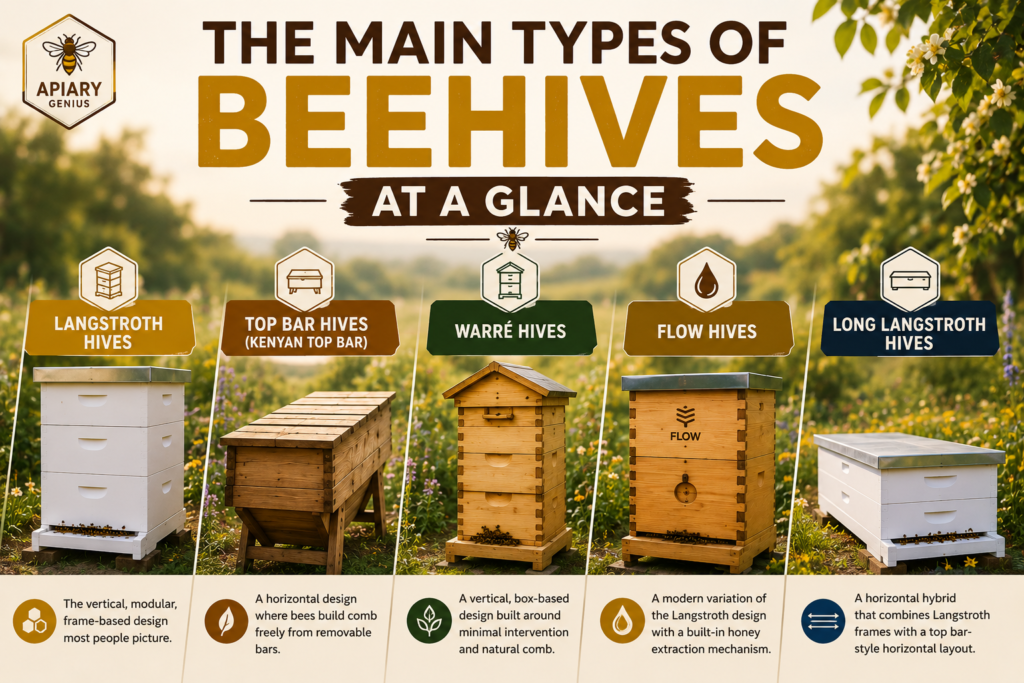
Langstroth hives — the vertical, modular, frame-based design most people picture when they think of a beehive
Top bar hives (often called Kenyan top bar hives) — a horizontal design where bees build comb freely from removable bars
Warre hives — a vertical, box-based design built around minimal intervention and natural comb
Flow hives — a modern variation of the Langstroth design with a built-in honey extraction mechanism
Long Langstroth hives — a horizontal hybrid that combines Langstroth frames with a top bar-style horizontal layout
Each of these types of beehives has a genuinely different philosophy behind it, and understanding that philosophy is often more useful than comparing specifications line by line.
Langstroth Hives: The Industry Standard
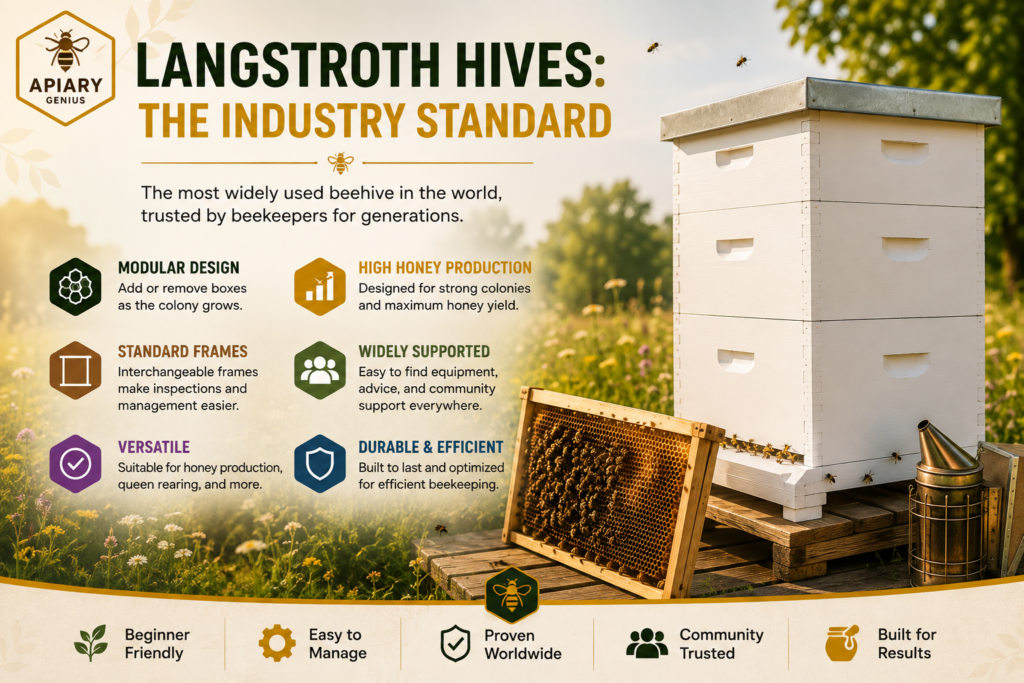
The Langstroth hive is, by a wide margin, the most widely used of all types of beehives worldwide, and for good reason. Invented in the 1850s, it introduced the concept of “bee space” — a precise gap that prevents bees from gluing comb to the hive walls or to each other — which made it possible to remove and inspect individual frames without destroying comb.
How it works:
The hive consists of stacked rectangular boxes (called supers or brood boxes), each holding a set number of removable frames. Bees build comb within these frames, and beekeepers can lift out individual frames to inspect brood, check for pests, or harvest honey.
Advantages:
- Extremely well-supported, with equipment, replacement parts, and community knowledge readily available almost everywhere
- Modular design makes it easy to add space as the colony grows, simply by adding more boxes
- Frames can be moved between hives, which is useful for combining weak colonies or splitting strong ones
- Compatible with mechanical honey extractors, making large-scale honey harvesting efficient
Disadvantages:
- Boxes can become quite heavy, especially when full of honey, which can be physically demanding
- The vertical stacking design means lifting heavy boxes off one another during inspections
- Some beekeepers feel this design encourages more human intervention than bees would experience in the wild
Among all the types of beehives, the Langstroth remains the default recommendation for most beginners simply because of how much support and standardization exists around it.
Top Bar Hives: A Horizontal, Low-Intervention Approach
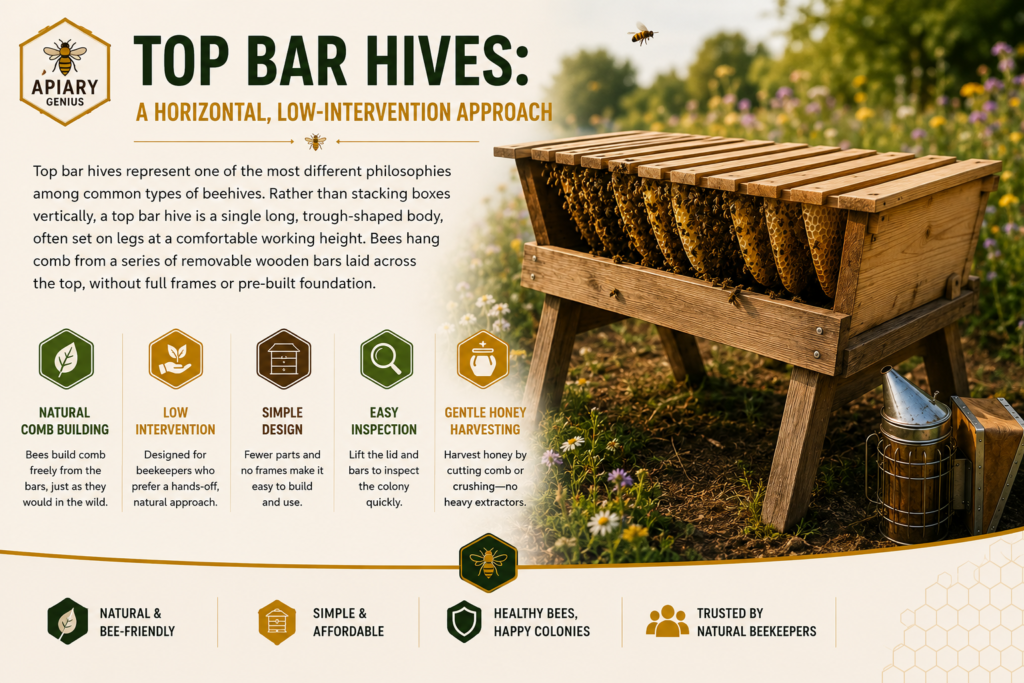
Top bar hives represent one of the most different philosophies among common types of beehives. Rather than stacking boxes vertically, a top bar hive is a single long, trough-shaped body, often set on legs at a comfortable working height. Bees hang comb from a series of removable wooden bars laid across the top, without full frames or pre-built foundation.
How it works:
Bees build their own comb naturally downward from each bar, guided by a starter strip. Because there’s no frame supporting the comb from all sides, the wax structure is more fragile than in a Langstroth hive and must be handled with care.
Advantages:
- Bees build natural comb at their own preferred cell size, which some beekeepers believe supports healthier colonies
- No heavy lifting of stacked boxes — inspection happens by lifting individual bars, which are much lighter
- Lower upfront cost in many cases, since no foundation or frames are required and simple designs can even be built at home
- The horizontal layout can be more comfortable for beekeepers with mobility limitations, since there’s no need to lift boxes overhead
Disadvantages:
- Comb is fragile and can break if mishandled, particularly in hot weather when wax softens
- Honey harvesting typically means crushing and straining comb rather than using an extractor, which destroys the comb and requires bees to rebuild it each time
- Generally produces less honey per colony compared to a well-managed Langstroth setup
- Less standardized than Langstroth equipment, meaning fewer off-the-shelf accessories and less community troubleshooting support in some regions
Of all the types of beehives covered here, the top bar hive tends to appeal most to beekeepers prioritizing a natural, low-intervention approach over maximum honey production.
Warre Hives: Built Around Minimal Intervention
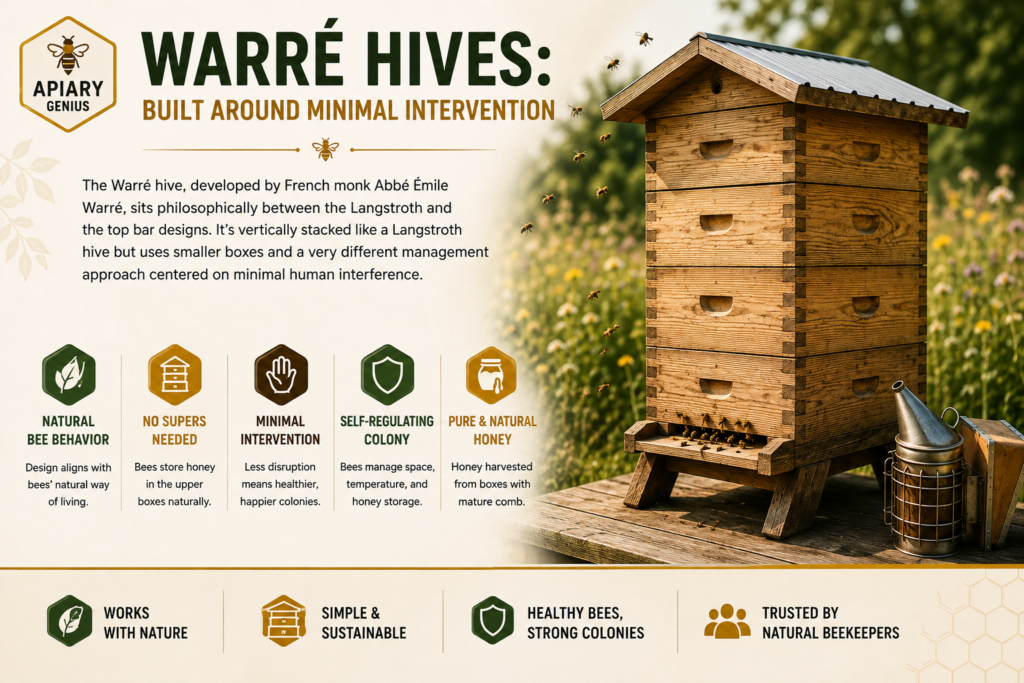
The Warre hive, developed by French monk Abbé Émile Warré, sits philosophically between the Langstroth and the top bar designs. It’s vertical like a Langstroth hive but uses smaller boxes and a very different management approach centered on minimal human interference.
How it works:
Bees build comb on simple top bars (rather than full frames) within stacked boxes. Crucially, new boxes are typically added underneath the existing ones — called “nadiring” — mimicking how a wild colony naturally expands downward as it grows, rather than upward.
Advantages:
- Designed explicitly around minimal intervention, appealing to beekeepers who want a more hands-off, natural approach
- Smaller boxes than Langstroth supers, making individual components lighter to handle
- The quilt box commonly used on top of a Warre hive provides excellent natural moisture management, which is particularly useful in cold climates
- Compact footprint compared to some other types of beehives
Disadvantages:
- Nadiring (adding boxes underneath) requires temporarily lifting the entire existing hive stack, which can be physically awkward
- Comb inspection is more limited than Langstroth, since bars aren’t as easy to fully remove and examine as full frames
- Less common than Langstroth, meaning less local community support and fewer commercially available accessories in many regions
- Honey harvesting is generally lower-yield and more similar to the crush-and-strain method used with top bar hives
Beekeepers drawn to the Warre hive among the various types of beehives tend to be those who value working with the colony’s natural tendencies over maximizing honey output or ease of inspection.
Flow Hives: A Modern Take on Langstroth
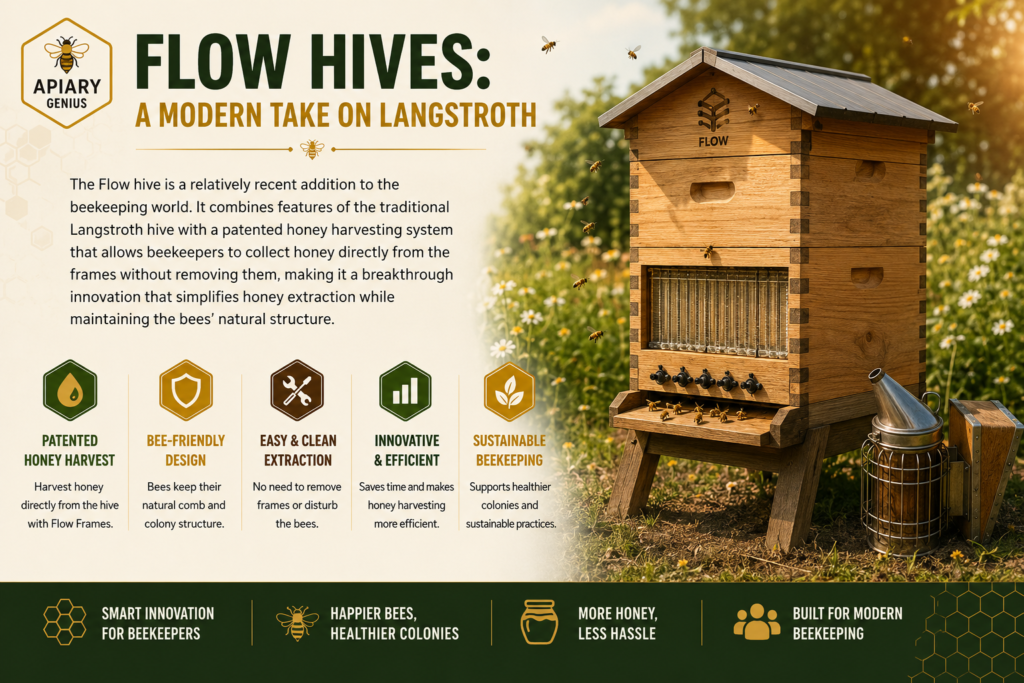
The Flow hive is a relatively recent addition to the landscape of types of beehives, gaining significant popularity after a highly publicized crowdfunding launch. At its core, it’s a Langstroth-style hive with specially designed frames that allow honey to be extracted directly from the hive via a tap, without opening the hive or removing frames at all.
How it works:
Flow frames contain partially formed cells that bees complete with wax and fill with honey as normal. When ready to harvest, the beekeeper turns a key (or lever, depending on the model), which splits the cells internally, allowing honey to flow down through channels and out a spout at the base of the frame into a jar, without disturbing the bees.
Advantages:
- Dramatically simplifies honey harvesting, removing the need for extractors, straining equipment, or a dedicated honey house
- Reduces stress on the colony during harvest, since the hive doesn’t need to be fully opened
- Compatible with standard Langstroth boxes for the brood chamber, so beekeepers can combine Flow supers with familiar equipment
- Appeals strongly to hobbyist beekeepers primarily interested in home honey production with minimal hassle
Disadvantages:
- Significantly more expensive upfront than standard Langstroth equipment
- Some experienced beekeepers argue the design can encourage neglecting regular hive inspections, since harvesting no longer requires opening the hive
- Bees still need to build wax cappings over the plastic cells, and results can vary depending on how readily a particular colony accepts the frames
- Not intended for large-scale commercial honey production, where traditional extraction remains far more efficient at scale
Among modern types of beehives, the Flow hive occupies a unique niche: it doesn’t fundamentally change how bees are managed, but it transforms one specific task — harvesting — dramatically.
Long Langstroth Hives: A Horizontal Hybrid
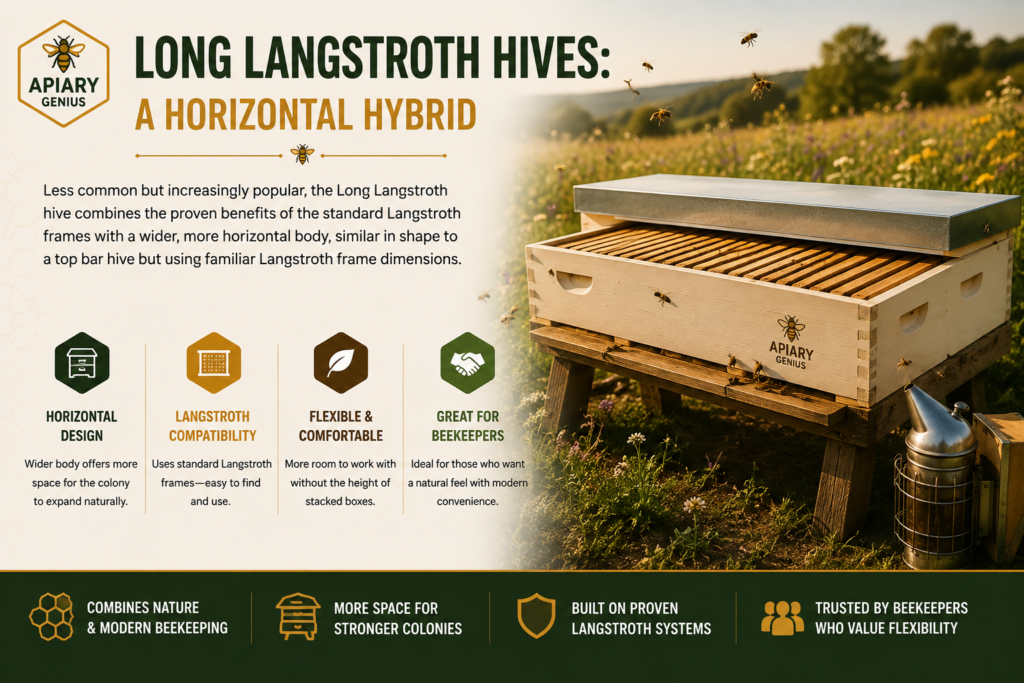
Less common but increasingly popular, the long Langstroth hive combines standard Langstroth frames with a single-story horizontal body, similar in shape to a top bar hive but using familiar Langstroth frame dimensions.
How it works:
Instead of stacking boxes vertically as the colony grows, the hive simply expands horizontally, with the beekeeper adding frames along the length of the box rather than adding boxes on top.
Advantages:
- No heavy lifting of stacked boxes, similar to a top bar hive, while still using standard Langstroth frames compatible with extractors
- Comfortable working height without bending or lifting overhead
- Good option for beekeepers with physical limitations who still want compatibility with standard Langstroth equipment and accessories
Disadvantages:
- Less common, meaning fewer commercially available options and higher likelihood of needing custom or self-built equipment
- Large footprint compared to vertical types of beehives, which matters in space-constrained settings like small urban yards
- Limited established community knowledge compared to standard Langstroth setups
This design illustrates that the different types of beehives aren’t always mutually exclusive categories — hybrid approaches exist for beekeepers with specific needs that standard designs don’t fully address.
Comparing Types of Beehives by Key Criteria
Rather than viewing these designs purely as separate categories, it’s often more useful to compare types of beehives directly across the factors that matter most to your specific situation.
Cost:
Top bar and simple Warre hives are typically the least expensive to set up, especially if built at home. Standard Langstroth equipment sits in the middle. Flow hives carry the highest upfront cost by a significant margin.
Ease of inspection:
Langstroth frames, with their sturdy wooden sides, are generally the easiest and safest to fully remove, examine, and return without damage. Top bar and Warre comb is more fragile and requires more careful handling.
Honey yield:
Langstroth hives, particularly when paired with a mechanical extractor, generally produce the highest honey yields per colony among common types of beehives. Top bar and Warre hives typically yield less, partly because crush-and-strain harvesting destroys comb that bees must then rebuild from scratch.
Physical demands:
Top bar and long Langstroth hives avoid the heavy lifting associated with stacked boxes, making them notably more accessible for beekeepers with back or mobility concerns. Standard Langstroth and Warre hives both involve lifting boxes, though Warre boxes tend to be smaller and lighter.
Beginner friendliness:
Langstroth hives benefit enormously from widespread availability of equipment, local mentorship, and troubleshooting resources, which matters a great deal for a first-time beekeeper working through inevitable early mistakes.
Philosophy and intervention level:
Warre and top bar designs are generally favored by beekeepers prioritizing minimal intervention and natural comb-building, while Langstroth and Flow hives suit those focused on efficient management and honey production.
Which Type of Beehive Should You Choose?
There’s no single “best” answer among the various types of beehives — the right choice depends heavily on your specific goals.
If you’re a complete beginner wanting the most support, the most available beekeeping equipment, and the clearest path to learning through mentorship and community resources, a standard Langstroth hive remains the most commonly recommended starting point.
If minimal intervention and natural comb-building matter most to you, and you’re comfortable with somewhat lower honey yields and more delicate comb handling, a top bar or Warre hive may align better with your goals.
If home honey harvesting convenience is your top priority and budget isn’t a major constraint, a Flow hive can dramatically simplify that specific part of the process, while still functioning as a standard Langstroth-compatible system otherwise.
If physical limitations make lifting heavy boxes difficult, a top bar hive or long Langstroth design avoids that problem entirely, at the cost of somewhat reduced honey yield potential and, in the case of long Langstroth, less commercial equipment availability.
Climate and Regional Considerations
The types of beehives that work best can also shift somewhat depending on your local climate. In regions with long, harsh winters, the compact footprint and strong moisture management associated with Warre hives (via the quilt box) can be genuinely advantageous. In hot climates, the more fragile comb in top bar hives can soften and even collapse if not managed carefully during peak heat, requiring extra attention to hive placement and shade.

Langstroth hives, being the most widely used, tend to have well-established regional guidance no matter where you’re located, since so many other local beekeepers are likely using the same system and can offer climate-specific advice.
Common Mistakes When Choosing a Hive Type
A few recurring mistakes show up across all types of beehives when beekeepers choose without fully thinking through their situation:
- Choosing based on aesthetics alone. A hive style might look appealing in photos without matching your actual goals or physical capabilities.
- Underestimating the learning curve of less common designs. Top bar and Warre hives have less standardized troubleshooting support in many regions, which can leave a struggling beginner without easy answers.
- Ignoring physical demands until it’s too late. Standard Langstroth boxes, when full, can weigh 40 pounds or more — a real consideration for anyone with back issues.
- Mixing incompatible equipment. Frames, boxes, and accessories aren’t interchangeable between the different types of beehives, so partial setups often lead to frustrating gaps in equipment.
- Switching hive types too early. Every switch essentially means starting a colony over in a new system; it’s worth giving your first choice a genuinely fair trial before assuming a different type would solve underlying management issues.
Frequently Asked Questions
Can I mix different types of beehives in the same apiary?
Yes, many beekeepers run multiple types of beehives side by side, often to compare management styles or because they started with one system and later added another for specific goals like natural beekeeping or easier honey harvesting. Just be aware that equipment generally isn’t interchangeable between types.
Which type of beehive is cheapest to start with?
A simple top bar hive is usually the least expensive option, particularly if built from basic materials rather than purchased pre-made. Warre hives are similarly affordable in simple configurations. Flow hives are consistently the most expensive due to their specialized frame technology.
Do bees produce different amounts of honey depending on the hive type?
Generally, yes. Langstroth hives, especially with mechanical extraction, tend to produce the highest yields among common types of beehives, since comb is reused rather than destroyed at each harvest. Crush-and-strain methods used with top bar and Warre hives require bees to rebuild comb after every harvest, which uses colony resources that would otherwise go toward more honey production.
Is one type of beehive better for organic or natural beekeeping?
Top bar and Warre hives are often favored by beekeepers pursuing a more natural, low-intervention approach, partly because bees build comb at their own preferred cell size rather than on pre-formed foundation. That said, “natural” beekeeping practices can be applied to some degree within any of the types of beehives discussed here.
Can beginners successfully use a top bar or Warre hive as their first setup?
Yes, though it typically comes with a steeper learning curve due to less standardized community support and the added skill required to handle fragile comb properly. Many experienced top bar and Warre beekeepers still recommend that first-time beekeepers spend at least a season with a mentor experienced in that specific system, given how different the management style is from the more heavily documented Langstroth approach.
How much space do I need for different types of beehives?
Vertical designs like Langstroth and Warre hives have a relatively small footprint since they expand upward. Horizontal designs like top bar and long Langstroth hives require considerably more ground space, which matters in smaller urban or suburban yards where space is limited.
For deeper guidance on managing your colony year-round, see our complete guide on how to prepare your beehive for winter . For broader technical reference, the Cornell University College of Agriculture and Life Sciences beekeeping program is also a valuable resource.
Final Thoughts
Comparing the different types of beehives ultimately comes down to matching a design’s underlying philosophy and practical trade-offs to your own goals, physical capabilities, and local support network. Langstroth hives remain the most broadly recommended choice for most beginners thanks to their standardization and community support. Top bar and Warre hives suit beekeepers prioritizing natural comb-building and minimal intervention over maximum honey yield. Flow hives offer a modern convenience for hobbyists focused on simplified home harvesting. And hybrid designs like the long Langstroth hive show that these categories aren’t rigid — practical solutions exist for beekeepers whose needs don’t fit neatly into any single traditional model.
Whichever you choose among the various types of beehives, the fundamentals of good beekeeping — regular inspection, attentive colony management, and a willingness to keep learning — matter more than the specific box your bees happen to call home.
Happy beekeeping!