
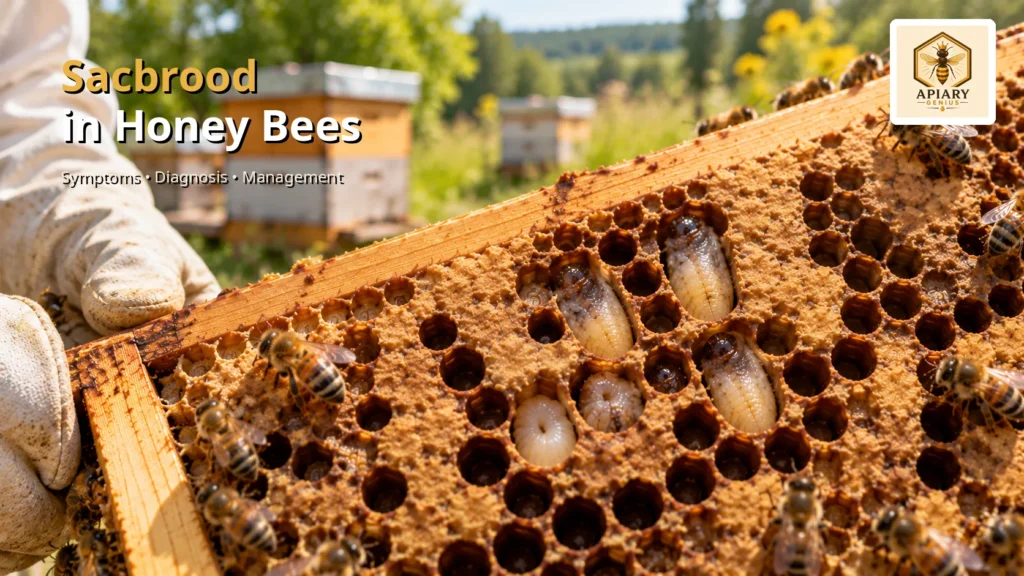
Finding dead, discolored, or strangely positioned larvae in a brood nest can be alarming. One possible cause is sacbrood, a viral disease of honey bee brood that can produce a distinctive change in affected larvae: the larval skin remains intact around fluid, creating a sac-like appearance.
That appearance is an important clue, but it should not be used alone to make a diagnosis. Several brood diseases and other colony problems can cause dead larvae, irregular brood patterns, discoloration, or abnormal cappings. The goal is to recognize the combination of signs that makes sacbrood likely, distinguish it from more serious brood diseases such as American foulbrood, assess how extensive the problem is, and respond proportionately.
Sacbrood is caused by Sacbrood virus (SBV). Importantly, detecting or carrying the virus is not the same as seeing obvious clinical sacbrood. Honey bee viruses can occur without visible disease, and affected brood may sometimes be limited enough that worker bees remove diseased larvae before the beekeeper notices a major problem.
Table of Contents
What Is Sacbrood in Honey Bees?
Sacbrood is a viral brood disease caused by Sacbrood virus (SBV). The familiar signs develop when infected larvae fail to complete normal development and die before pupation is completed.
The disease gets its name from one of its most characteristic signs. Fluid accumulates while the outer larval skin remains intact. When an affected larva is carefully removed from its cell, the skin may hold the contents together like a small fluid-filled bag or sac.
Clinical sacbrood should be taken seriously, but finding a few affected larvae does not automatically mean the colony is in danger of collapse. Penn State Extension’s honey bee disease reference notes that sacbrood often affects only a small percentage of brood and may go unnoticed because workers remove affected larvae.
The situation deserves closer attention when abnormal brood is widespread, persists across inspections, or appears alongside poor brood production, a declining adult population, inadequate food stores, or other signs of colony stress.
What Causes Sacbrood?
Sacbrood is caused by Sacbrood virus, commonly abbreviated SBV. It is an RNA virus that can infect honey bees, although the familiar clinical signs of sacbrood are associated primarily with developing brood.
The USDA Agricultural Research Service’s overview of honey bee viruses identifies SBV as one of the viruses affecting honey bees and notes that sacbrood can produce recognizable symptoms in brood.
An important distinction is:
SBV infection does not necessarily mean that a colony will show visible sacbrood disease.
Adult bees may carry the virus without displaying the dramatic brood symptoms associated with clinical sacbrood. Modern molecular tests can also detect viral material in bees even when obvious disease signs are absent.
This is a broader feature of honey bee virology. Penn State Extension’s guidance on honey bee viruses explains that bees can carry viral infections without obvious symptoms.
Detecting SBV is therefore not, by itself, proof that visible brood damage is clinical sacbrood. Diagnosis still requires interpretation of the colony’s signs and, when necessary, appropriate diagnostic testing.
Sacbrood Symptoms and Warning Signs
Sacbrood symptoms change as affected larvae deteriorate, and not every larva will display every possible sign.
Look for a combination of abnormalities, which may include:
- An irregular or spotty brood pattern
- Scattered uncapped or partially uncapped cells
- Dead or dying larvae in abnormal positions
- Larvae stretched lengthwise in their cells
- A raised or darkened head
- Loss of the normal pearly-white larval color
- Yellow, gray, brown, or progressively darker discoloration
- Clearly visible body segmentation
- Fluid accumulating inside the larval skin
- A toughened skin forming a characteristic sac
- Dried, dark remains that are generally easier to remove than American foulbrood scales
NC State Extension’s honey bee disease guidance describes sacbrood larvae as watery and granular, with a thickened skin that forms a sac. The head may be raised toward the cell opening, producing a characteristic canoe-like appearance.
A spotty brood pattern alone does not diagnose sacbrood. Neither does one discolored larva or one abnormal capping. The diagnostic value comes from recognizing several compatible signs together.
What Do Sacbrood-Infected Larvae Look Like?
Healthy honey bee larvae are normally pearly white. Larvae affected by sacbrood progressively lose that healthy appearance and may become yellowish, gray, brown, or darker as they deteriorate.
Posture can provide another useful clue. An affected larva may lie stretched along the lower part of the cell rather than maintaining its normal appearance. Its head may become raised and darkened, producing the characteristic canoe-like or slipper-like shape described in diagnostic references.
Body segmentation can remain unusually visible.
The most distinctive change occurs when fluid accumulates while the larval skin remains intact. If the larva is carefully lifted from the cell, that skin may hold the fluid and deteriorating tissues together like a small sac.
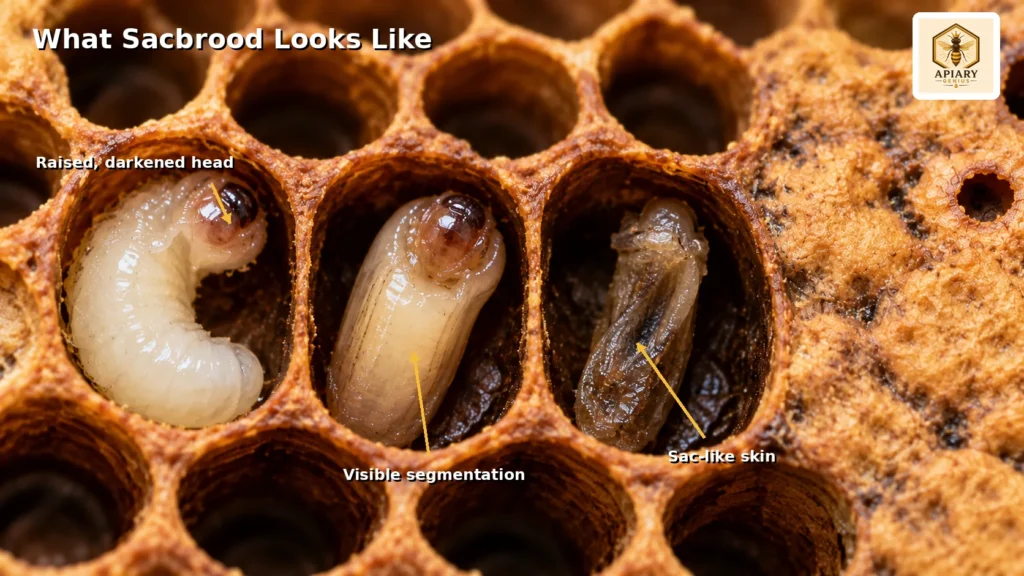
Primary Industries and Regions South Australia (PIRSA) describes characteristic signs that include a raised head, progressive discoloration, visible body segmentation, and a plastic-like sac formed by the dead larval skin.
As the remains dry, they darken and form a brittle scale-like remnant that is generally easier to remove from the cell than the tightly adherent scale associated with American foulbrood.
Not every affected larva will look identical, and not every possible sign is required. Worker bees may also remove diseased larvae before later stages become visible.
For that reason, a photograph or single visual feature should be treated as a diagnostic clue—not definitive proof.
How Sacbrood Virus Affects Developing Brood
Sacbrood virus interferes with normal larval development.
University of Florida IFAS Extension explains that affected larvae die before completing their final molt. Viral replication disrupts normal development, while fluid accumulates within the larval covering.
The larva consequently fails to complete its normal transformation into a pupa, and the characteristic fluid-filled sac can develop.
This timing helps explain why beekeepers may find affected brood associated with cells that were capped and later uncapped by workers.
Worker bees can detect and remove diseased brood. Their removal behavior may prevent some affected larvae from reaching the later, more visually obvious stages of sacbrood.
As a result, the beekeeper may see only scattered abnormal cells rather than large areas filled with obvious sac-like larvae.
How Sacbrood Spreads in a Honey Bee Colony
An important route of Sacbrood virus transmission involves feeding.
Infected adult bees, including nurse bees, can carry SBV and transmit virus to susceptible developing larvae through brood food. PIRSA describes transmission from infected nurse bees to larvae through food.
Honey bee viruses can have complex transmission routes, and research continues to examine how individual viruses persist and circulate within colonies.
For practical hive management, the important point is that disease is not confined to the visibly abnormal larva. Adult bees and colony food interactions can be involved in maintaining viral circulation.
When sacbrood or another brood disease is suspected, avoid unnecessarily transferring suspicious brood or comb into healthy colonies. This is a sensible biosecurity precaution while the cause of the abnormal brood is being evaluated.
Do not assume, however, that every piece of equipment associated with a colony showing sacbrood must automatically be destroyed. Management should reflect the diagnosis and severity of the problem.
Why Some Colonies Develop More Serious Sacbrood
The presence of SBV alone does not predict how much visible disease a colony will develop.
Colony condition matters.
A strong colony with enough workers to care for brood and remove diseased larvae may show relatively little obvious sacbrood. In some cases, workers remove affected larvae quickly enough that the beekeeper sees few clinical signs.
Colony stress may be associated with more visible disease, although the contribution of individual factors can vary.
This distinction is important:
Stress does not cause Sacbrood virus. SBV causes sacbrood.
Instead, colony condition can influence how well the colony copes with disease and how apparent the clinical signs become.
When evaluating an affected colony, look beyond the diseased larvae. Check adult population strength, queen performance, brood production, food reserves, and other obvious health problems.
If stores are genuinely inadequate, correcting the shortage can support the colony. The Apiary Genius guide to feeding bees explains when supplemental feeding may be appropriate.
Feeding should support an actual nutritional need; it should not be presented as a direct treatment for SBV.
How to Diagnose Sacbrood
Field diagnosis starts with both the brood pattern and the appearance of individual larvae.
Sacbrood becomes more likely when several characteristic signs occur together, particularly the intact sac-like larval skin combined with abnormal larval posture, discoloration, a raised or darkened head, and retained segmentation.
During a beehive inspection, check more than one suspicious cell. Examine different areas of brood and determine whether the problem appears isolated, localized, or widespread.
Useful observations include:
- Scattered abnormal or uncapped cells.
- Stretched larvae or prepupae.
- A raised or darkened head.
- Progressive discoloration.
- Clearly retained body segmentation.
- Fluid contained within an intact sac-like skin.
- Dried remains that are comparatively easy to remove.
Do not diagnose sacbrood solely because you see a spotty brood pattern, perforated capping, or discolored larva. Those abnormalities can occur with other brood problems.
Field signs are presumptive, not infallible
Differential diagnosis matters because several brood diseases can overlap visually.
When signs are ambiguous, unusually extensive, persistent, or potentially compatible with American foulbrood, seek professional confirmation rather than guessing.
Depending on your location, assistance may be available through an apiary inspector, government agriculture agency, university Extension program, or specialized diagnostic laboratory.
Molecular methods such as reverse transcription PCR can detect SBV. Peer-reviewed research on RT-PCR detection of Sacbrood virus demonstrates the use of molecular testing for identifying the virus.
Laboratory detection must still be interpreted in context. Detecting SBV does not automatically prove that every visible brood abnormality in the colony was caused by clinical sacbrood.
Sacbrood vs. American Foulbrood
Sacbrood and American foulbrood can both produce irregular brood patterns, abnormal cappings, discoloration, and dead brood. Distinguishing them matters because American foulbrood is a much more consequential bacterial disease and may be subject to specific regulatory requirements depending on jurisdiction.
For a complete guide to AFB, see Apiary Genius’s article on American foulbrood in honey bees.
The fundamental difference is biological.
Sacbrood is caused by a virus.
American foulbrood is caused by the spore-forming bacterium Paenibacillus larvae.
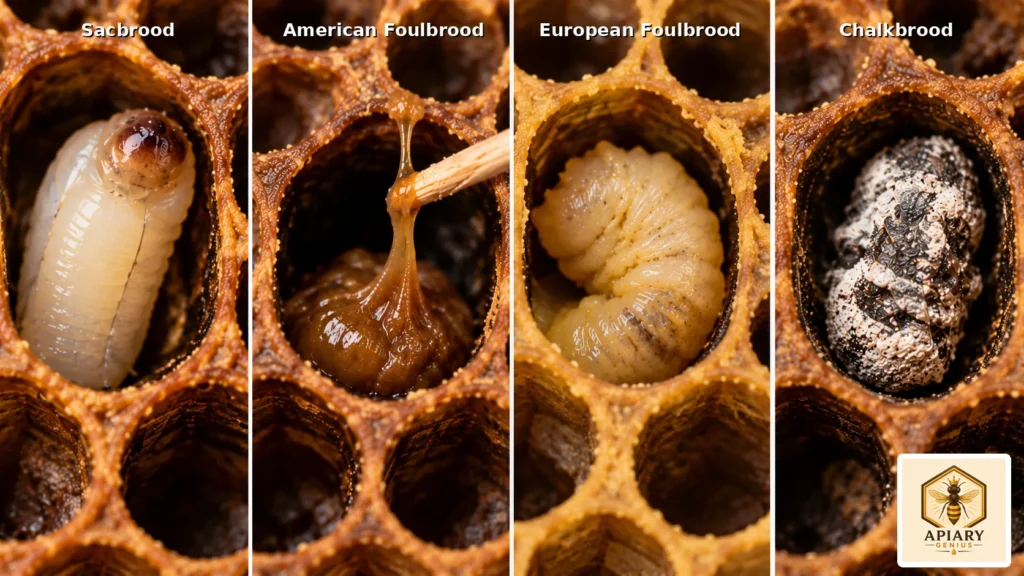
With sacbrood, the affected larva or prepupa may retain a recognizable elongated shape and visible segmentation. A raised, darkened head and the characteristic fluid-filled sac can provide important clues. Dried remains are generally comparatively easy to remove.
American foulbrood has a different classic progression. Affected capped brood may have sunken or perforated cappings. Decomposing brood can develop a brown, sticky or ropy consistency. Later, dark scales form and adhere tightly to the cell wall.
Penn State Extension’s American foulbrood guidance describes ropy remains and tightly adhering scales among important signs of AFB.
These distinctions are useful, but do not use the absence of one textbook sign to rule out American foulbrood.
If AFB is a realistic possibility, especially when brood remains are suspicious or the diagnosis is unclear, contact the appropriate apiary inspector, diagnostic laboratory, or local bee-health authority rather than assuming the colony has sacbrood.
Sacbrood vs. European Foulbrood and Chalkbrood
European foulbrood and chalkbrood are two other important conditions to consider when brood looks abnormal.
European foulbrood is a bacterial brood disease caused primarily by Melissococcus plutonius. It typically affects younger larvae before cells are capped, although presentation can vary. Affected larvae may become discolored, twisted, displaced, or melted-looking. They do not characteristically form the fluid-filled sac associated with sacbrood.
Chalkbrood is caused by the fungus Ascosphaera apis. Its most distinctive field sign is the development of firm, chalk-like larval mummies, which can appear white, gray, or darker.
A practical comparison is:
- Sacbrood: elongated larva or prepupa, raised or darkened head, retained segmentation, and sac-like skin containing fluid.
- American foulbrood: decomposing brood may become sticky or ropy, followed by dark scales that adhere tightly to the cell wall.
- European foulbrood: commonly affects younger, uncapped larvae that may appear twisted, discolored, or melted, without the characteristic sac.
- Chalkbrood: produces firm, chalk-like mummies.
These distinctions help narrow the possibilities, but they do not cover every cause of abnormal brood.
If the signs do not fit cleanly, broaden the investigation rather than forcing the colony into one of these diagnoses.
What to Do If You Find Sacbrood in Your Hive
Start by determining how extensive the problem is.
A few suspicious larvae in an otherwise strong colony are different from multiple frames containing obvious diseased brood combined with declining colony strength.
Check:
- How much brood appears affected?
- Is healthy brood also present?
- Is the queen laying adequately?
- Is the adult population strong enough to care for the brood?
- Are food stores adequate?
- Are workers removing affected brood?
- Are signs of other brood diseases present?
- Does the condition improve or worsen on subsequent inspections?
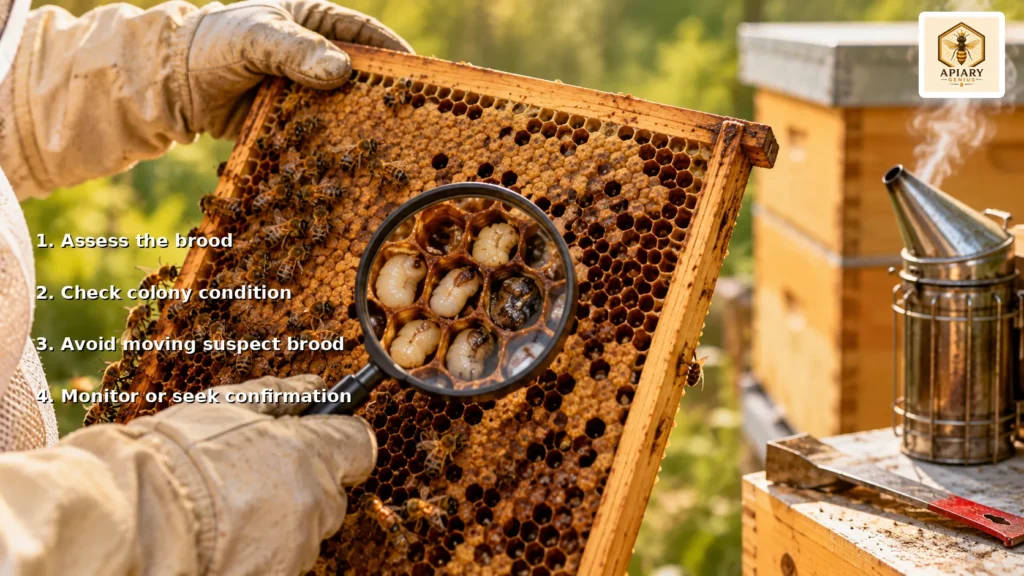
Avoid immediately moving suspicious brood or comb into another colony.
If only a small amount of brood appears affected and the colony is otherwise strong, monitoring and supportive colony management may be appropriate.
If clinical disease is extensive, persists, or the diagnosis is uncertain, seek qualified assistance.
Most importantly, if the signs could indicate American foulbrood, do not proceed as though you are dealing with an ordinary viral brood problem. Confirm the diagnosis and follow applicable local requirements.
Is There a Treatment for Sacbrood?
There is no established antiviral treatment that reliably eliminates SBV from a honey bee colony.
NC State Extension states that there are no chemotherapies for sacbrood and instead emphasizes maintaining colony strength, with requeening potentially beneficial in some cases.
This creates an important management distinction:
Directly eliminating the virus is not the same as helping an affected colony recover.
Supportive management may include correcting genuine nutritional shortages, maintaining adequate colony strength, reducing avoidable stress, monitoring disease progression, avoiding unnecessary movement of suspicious brood, considering comb management where appropriate, and evaluating whether requeening is justified in persistent cases.
Antibiotics are not a treatment for Sacbrood virus. Antibiotics target bacteria, while sacbrood is viral.
Essential oils, homemade mixtures, supplements, or commercial products should likewise not be described as proven sacbrood cures without strong evidence demonstrating that effect.
The goal is to help the colony function and recover—not to promise elimination of the virus with an unproven product.
Should You Requeen a Colony With Sacbrood?
Requeening can be considered in some cases, but it should not be an automatic response every time sacbrood is observed.
Both Extension and government guidance include requeening among possible management measures for affected colonies, particularly when the problem is persistent.
A new queen also gradually changes the worker population as her offspring replace older workers. However, the reason requeening may improve a particular case should not be reduced to a single mechanism, and it should not be presented as a guaranteed cure for SBV.
A colony with only a few affected larvae, a productive queen, and otherwise healthy brood may improve without queen replacement.
Requeening deserves more serious consideration when clinical disease persists, brood production remains poor, the colony repeatedly performs badly, or the queen is already unsatisfactory for other reasons.
If queen replacement is justified, use sound introduction practices rather than treating requeening as an emergency reaction to a few suspicious cells. See the Apiary Genius guide on how to requeen a beehive for the practical process.
How to Manage Comb and Colony Conditions
Management should be proportional to the severity of the problem.
Finding a few affected cells in an otherwise healthy colony does not automatically justify destroying comb or equipment.
Start with colony function.
Check whether the adult population is adequate for the amount of brood being raised. Evaluate food stores, queen performance, and the extent of abnormal brood. Correct real shortages where necessary and avoid repeatedly disturbing the brood nest without a clear reason.
For persistent cases, comb replacement may form part of a broader management strategy. PIRSA’s sacbrood guidance includes comb replacement among possible measures to help affected colonies recover.
That does not mean every frame containing an affected larva must be discarded.
Likewise, do not assume that routine cleaning guarantees complete elimination of SBV from equipment, and do not invent arbitrary rules requiring a fixed percentage of comb to be replaced.
The appropriate response depends on the extent of clinical disease, colony condition, and confidence in the diagnosis.
The guiding principle is simple:
A few affected cells do not require the same response as persistent, widespread disease.
How to Prevent Sacbrood
No management practice can guarantee that a colony will never encounter Sacbrood virus or develop clinical sacbrood.
Prevention therefore focuses on good colony management, early recognition of abnormal brood, sensible biosecurity, and reducing avoidable colony stress.
Useful practices include:
- Inspect brood regularly enough to notice meaningful changes.
- Maintain colonies with adequate adult populations.
- Ensure adequate nutrition and correct genuine food shortages.
- Avoid transferring visibly diseased or suspicious brood into healthy colonies.
- Use sensible apiary hygiene when moving between colonies.
- Evaluate poorly performing queens when colony problems persist.
- Favor healthy, well-performing stock and follow locally supported breeding recommendations.
- Avoid unnecessary disruption of the brood nest.
- Monitor other major colony-health problems.
Varroa control remains an essential part of overall honey bee health because the mite is strongly associated with several important viral diseases. However, the relationship between Varroa and individual honey bee viruses is not identical, and the SBV–Varroa relationship should not be treated as equivalent to the well-established relationship between Varroa and Deformed wing virus.
For a broader colony-health strategy, see the Apiary Genius guide to controlling Varroa mites.
Think of prevention as risk reduction, not a guarantee that sacbrood will never appear.
Can Sacbrood Come Back?
Yes. Clinical signs can disappear and later appear again.
That does not necessarily mean an earlier management decision failed.
A colony can carry viral infection without continuously displaying obvious disease, and colony conditions can change over time. Worker populations, brood production, food availability, queen performance, and other health pressures are not static.
After visible sacbrood subsides, continue normal brood inspections rather than assuming the colony can never show the disease again.
If clinical signs repeatedly return, investigate the broader colony situation and reconsider whether the original diagnosis is correct.
Persistent recurrence gives you more reason to evaluate colony strength, queen performance, nutrition, comb condition, and other possible brood problems than a single mild episode does.
Common Sacbrood Management Mistakes
One of the biggest mistakes is diagnosing sacbrood from a single sign.
A spotty brood pattern is not specific to sacbrood. Neither is a discolored larva or perforated capping.
Avoid these additional mistakes:
- Assuming every SBV-positive colony has clinical sacbrood.
- Treating one abnormal larva as definitive proof.
- Assuming every brood abnormality belongs to one of the major brood diseases.
- Using antibiotics for a viral disease.
- Applying unverified “virus cures.”
- Requeening automatically after a minor finding.
- Moving suspicious brood into healthy colonies.
- Destroying equipment unnecessarily without a sound diagnosis.
- Ignoring extensive disease simply because sacbrood is often limited.
- Treating feeding as a direct cure rather than correcting a genuine nutritional need.
- Assuming improvement means recurrence is impossible.
Another serious mistake is confusing sacbrood with American foulbrood and responding to both as though they were equivalent conditions.
They are not.
The best management decision follows three questions:
What am I seeing? How extensive is it? How confident am I in the diagnosis?
Frequently Asked Questions About Sacbrood
Is sacbrood a virus or a bacterial disease?
Sacbrood is a viral disease caused by Sacbrood virus (SBV). This distinguishes it from American foulbrood and European foulbrood, which are bacterial diseases, and chalkbrood, which is fungal.
What is the most characteristic sacbrood symptom?
One of the most characteristic signs is a dead larva or prepupa whose skin remains intact around accumulated fluid, creating a sac-like appearance when carefully removed from the cell.
A raised or darkened head, elongated posture, retained body segmentation, and progressive discoloration provide additional clues.
No single feature should be interpreted without considering the rest of the brood.
Does every colony carrying Sacbrood virus show symptoms?
No.
Detecting SBV does not automatically mean a colony has obvious clinical sacbrood. Honey bees can carry viral infections without visible symptoms, so laboratory detection of the virus must be interpreted alongside clinical signs.
Is sacbrood usually fatal to the colony?
Sacbrood often affects only a limited proportion of brood, and workers may remove diseased larvae before a beekeeper notices extensive disease.
That does not mean widespread or persistent sacbrood should be ignored. Significant clinical disease can interfere with brood production and deserves closer evaluation.
Can worker bees remove sacbrood-infected larvae?
Yes. Worker bees can detect and remove diseased brood. This behavior is one reason mild cases may be difficult for beekeepers to notice.
Can sacbrood be confused with American foulbrood?
Yes.
Both diseases can produce abnormal brood patterns, discolored brood, and unusual cappings.
The sac-like larval skin, retained segmentation, and comparatively removable remains favor sacbrood, while ropy decomposition and tightly adherent scales are classic warning signs for AFB.
Do not rely on one sign alone to rule out American foulbrood.
Is there a medicine for sacbrood?
There is no established antiviral treatment that reliably eliminates SBV from a honey bee colony.
Management focuses on supporting colony health, assessing severity, correcting genuine management problems, and considering measures such as requeening or comb replacement when justified.
Should I requeen immediately if I see sacbrood?
No.
A few affected larvae in an otherwise strong colony do not automatically justify queen replacement. Requeening may be considered when clinical disease persists, colony performance remains poor, or the queen needs replacement for other reasons.
Should I remove every comb that contains sacbrood?
No universal rule requires removing every comb containing affected brood.
Comb management should reflect the severity and persistence of the problem. Avoid transferring suspicious brood or comb into healthy colonies while disease is being evaluated.
When should I ask for professional help?
Seek professional help when the diagnosis is uncertain, abnormal brood is extensive or persistent, the colony is declining, or the signs could indicate American foulbrood or another important brood disease.
Depending on where you live, assistance may be available from an apiary inspector, government agriculture department, university Extension program, beekeeping authority, or diagnostic laboratory.
Final Thoughts
Sacbrood has several recognizable characteristics, but responsible diagnosis requires more than finding one unusual larva.
Look for a combination of signs: an abnormally elongated larva or prepupa, raised or darkened head, retained segmentation, progressive discoloration, and especially the characteristic intact skin forming a fluid-filled sac.
Then assess the scale of the problem.
A few affected larvae in an otherwise strong colony may disappear as workers remove diseased brood. Persistent or widespread clinical sacbrood deserves closer investigation and proportionate management, including evaluation of colony strength, nutrition, queen performance, comb condition, and other possible brood diseases.
There is no established antiviral treatment that simply eliminates SBV from a colony, so avoid unproven cures and unnecessary aggressive interventions.
Most importantly, do not confuse detection of Sacbrood virus with inevitable clinical disease, and do not assume suspected sacbrood is automatically different from American foulbrood without examining the evidence.
Accurate identification, assessment of severity, and proportionate management are the foundation of a sensible response.
Sources
- USDA Agricultural Research Service — Honey Bee Viruses
- Penn State Extension — Viruses in Honey Bees
- Penn State Extension — A Quick Reference Guide to Honey Bee Parasites, Pests, Predators, and Diseases
- Penn State Extension — Honey Bee Diseases: American Foulbrood
- Primary Industries and Regions South Australia — Sacbrood
- NC State Extension — Disease Management and Guidelines for the Honey Bee
- University of Florida IFAS Extension — Common Viruses of Florida Honey Bees: Diagnosis and Management
- Grabensteiner et al. — Sacbrood Virus of the Honeybee: Rapid Identification and Phylogenetic Analysis Using Reverse Transcription-PCR