
Knowing when to add a honey super helps a strong colony store incoming nectar before its working space becomes crowded. Add it too late, and the bees may run short of storage space during a valuable nectar flow. Add it too early, and a smaller colony may be left with more comb than it can effectively occupy and protect.
The best decision is not based on a date alone. It comes from reading three things together: how much of the current hive is in active use, whether the colony is strong enough to cover more space, and whether a real nectar flow is beginning or already underway.
This guide explains when to add the first honey super, when to add another one, how to apply the 7/10 rule, and what to check before you place the box on the hive.
Table of Contents
Quick Answer
Add the first honey super when the brood chamber is substantially drawn and occupied, the colony is strong and healthy, and a meaningful nectar flow is starting or expected soon. In a 10-frame hive, the common 7/10 rule means adding space when about seven frames in the current upper box are being actively used. In an 8-frame hive, the comparable point is about six frames.
For a second or later honey super, do not wait until every frame below is completely capped. A practical trigger is when roughly 60 to 75 percent of the current super is drawn and being filled, adjusted for the strength of the colony and the expected pace of the nectar flow.
The frame count is a guideline, not an automatic decision. Add a super only after confirming that the colony can use the space and that incoming nectar is likely to justify it.
When to Add a Honey Super: Why Timing Matters
A honey super is a hive box placed above the brood chamber to hold surplus honey intended for harvest. It may contain shallow, medium, or deep frames, although many beekeepers favor medium or shallow supers because a full box is easier to lift. If you are still deciding how the boxes in a Langstroth hive fit together, this comparison of the main types of beehives explains the basic equipment and configurations.
During a nectar flow, foragers bring thin nectar into the hive faster than the finished honey alone would suggest. House bees need open cells in which to place that nectar, add enzymes, move it, and evaporate water before capping it. The colony therefore needs working storage space before the existing box looks completely finished.
Well-timed supering helps the colony receive and ripen incoming nectar while reducing storage congestion. Mississippi State University Extension notes that supers provide room for nectar during major bloom periods and that keeping ahead of storage needs is important for honey production. The same guidance also warns that excessive space near the end of a flow can leave more comb than a shrinking colony can patrol against small hive beetles and wax moths (MSU Extension: Maximizing Honey Production).
Adding a super is also part of swarm-season space management, but it is not a complete swarm-control method by itself. If the colony already has swarm cells or other advanced preparations, simply placing an empty box on top may not stop the process. Mississippi State University Extension notes that cutting out queen cells often only delays swarming and that stronger intervention is needed once a colony is committed (MSU Extension: Colony Growth and Seasonal Management). Use the broader checks and interventions in this guide to preventing bee swarming.
What Is the 7/10 Rule for Adding a Honey Super?
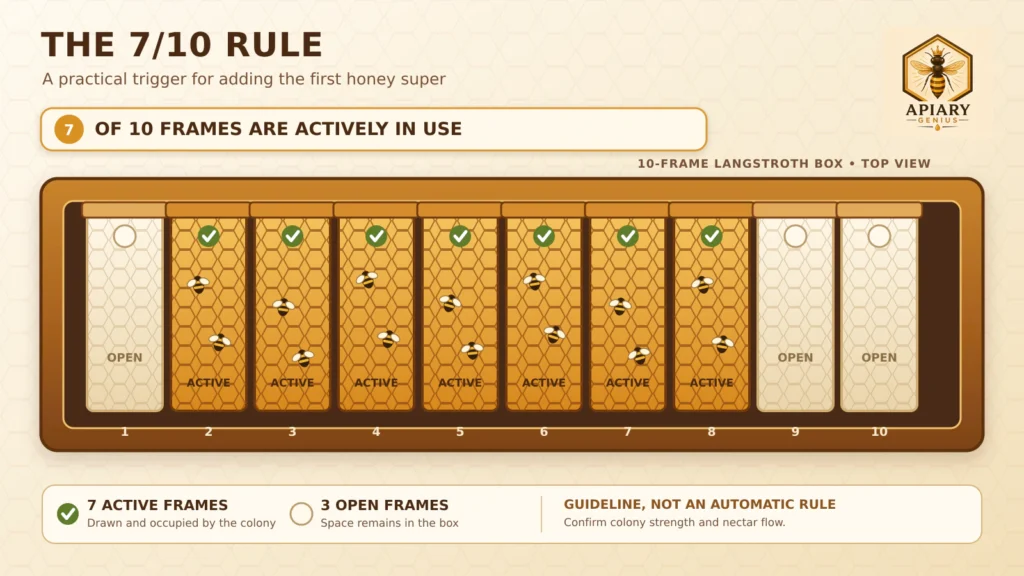
The 7/10 rule is a practical way to judge when a colony is ready for more space. In a standard 10-frame box, add the next box when about seven frames are being actively used by the bees. Dadant describes the rule in those terms: seven of the 10 frames contain drawn comb, brood, honey, or other clear signs of active use (Dadant: What Is the 7/10 Rule in Beekeeping?). Utah State University Extension similarly advises adding a honey super when seven frames in the top box are full, showing that the seven-frame threshold is a recognized field guideline (Utah State University Extension Beekeeping Calendar).
The rule prevents two opposite mistakes. You do not wait until the box is completely packed, but you also do not expand a colony that is using only a small part of its present space.
What Does “In Use” Mean?
“In use” does not always mean seven frames of fully capped honey.
Before the first honey super, examine the upper brood box. A frame may count toward readiness when it is substantially drawn and covered by bees and contains brood, nectar, pollen, or stores appropriate to the colony’s current development. The purpose is to determine whether the bees have established and occupied the brood chamber, not to demand seven harvest-ready frames below it.
For a honey super that is already on the hive, active use means the bees are drawing foundation, polishing cells, depositing nectar, ripening honey, or capping a meaningful area of comb. A frame with only a few visiting bees and no comb work or nectar should not carry the same weight as a frame that is clearly being worked.
Count frames by looking across the box, not by examining only the center frame. Bees often work the central combs first, leaving the outer frames behind. If five central frames are busy but the remaining five are untouched, the box is closer to half used than fully ready for another super.
How Does the Rule Work in an 8-Frame Hive?
Treat 7/10 as an approximate 70 percent occupancy rule. In an 8-frame box, the comparable trigger is about six frames in active use. The calculation is simple: 70 percent of eight frames is 5.6, which rounds to six.
Do not force the arithmetic when the field evidence points another way. Five heavily used frames in an exceptionally strong colony at the start of a major flow may justify early preparation, especially if you have drawn comb. Six lightly covered frames during weak forage may not.
Why the 7/10 Rule Is a Guideline, Not a Law
Authoritative recommendations are not identical in every region. Mississippi State University Extension uses a two-thirds-full rule for additional supers: when about six combs in a 10-frame honey super are full or nearly full, another super may be needed. Oregon State University Extension likewise recommends creating more honey-storage space before existing supers are approximately two-thirds full (OSU Extension residential beekeeping guidelines).
These recommendations are not truly contradictory. Six of 10, seven of 10, and a 60-to-75-percent working range all express the same management principle: give a productive colony more storage before its current space becomes completely filled. Local bloom intensity, weather, colony strength, comb condition, and the time until your next inspection determine where within that range you should act.
Signs Your Colony Is Ready for a Honey Super
No single sign is reliable in every apiary. The strongest decision comes from several signs appearing together.
The Upper Brood Box Is Mostly Drawn and Occupied
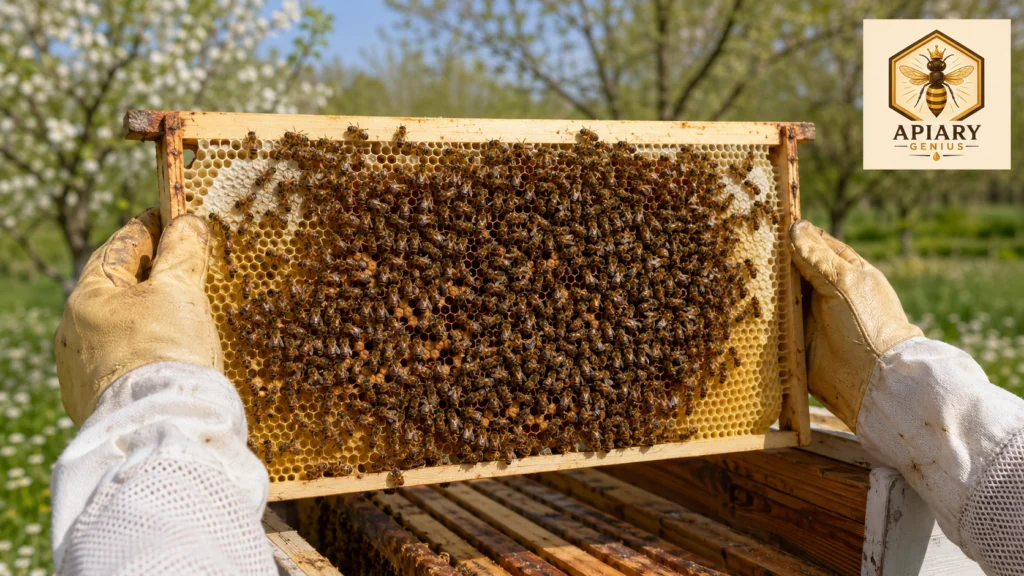
The colony should be using most of the comb available in its established brood chamber. In a 10-frame setup, about seven substantially occupied frames is a useful starting point; in an 8-frame setup, look for about six.
Also check distribution. A box with bees and brood spread across most frames is more ready than one with a small cluster concentrated on a few central combs. If the outer frames remain bare foundation and the bee population is modest, the colony may need more time.
A Nectar Flow Is Beginning or Underway
Calendar dates can help you prepare equipment, but flowers and weather decide when nectar actually reaches the hive. Look for sustained forager traffic, nectar glistening in recently filled cells, increasing hive weight, fresh stores appearing between inspections, and major local nectar plants blooming under suitable flight conditions.
MSU Extension emphasizes that supering schedules vary by geography because bloom periods and nectar-producing plants differ by location. Its guidance recommends basing the number and timing of supers on the expected incoming nectar during the next few weeks, not on a universal month (MSU Extension: Maximizing Honey Production).
The Colony Has a Strong Adult-Bee Population
A new super is useful only if enough bees are available to occupy it, build or work the comb, process nectar, and patrol the added space. During a suitable inspection, look for bees covering the brood combs well, a healthy brood pattern, brood in multiple stages, and a population that is expanding rather than contracting.
You do not have to find the queen at every inspection, but you should see convincing evidence that the colony is queenright and developing normally. A weak, queenless, diseased, or seriously mite-stressed colony needs the underlying problem addressed before honey production becomes the priority.
Bees Are Running Short of Open Storage Space
Fresh nectar around the brood nest, rapid filling of open comb, and a top box that has changed noticeably since the last inspection all suggest that storage demand is rising. Do not wait for every cell to be capped. Nectar requires more cell space while it is being ripened than it will occupy as finished honey.
At the same time, distinguish storage congestion from a brood nest that is simply poorly arranged or honey-bound. Supers create harvest space above the brood chamber, but the queen still needs usable laying space below. A super cannot correct every brood-nest problem.
Fresh White Wax Shows Active Comb Building
New white wax on frame edges, top bars, or freshly extended comb can signal that the colony has abundant incoming resources and wax-producing bees. It is supportive evidence, especially when accompanied by stored nectar and a strong population.
Do not use burr comb alone as the deciding test. Irregular comb may also result from excess bee space or equipment alignment. Read it together with frame occupancy and nectar conditions.
Bearding Is Not Enough by Itself
Bees gathered outside the entrance may be responding to heat, humidity, or limited ventilation rather than a lack of honey-storage space. Utah State University Extension notes that bearding can be a normal cooling response in hot weather (Utah State University Extension Beekeeping Calendar). Inspect the combs before treating bearding as proof that another super is needed.
When to Add the First Honey Super
The first honey super should go on when the colony has established the brood area it needs, is strong enough to work another box, and is approaching a nectar flow capable of producing surplus.
Make Sure the Brood Chamber Is Ready
Follow the brood-chamber configuration used in your local management system. Some beekeepers run one deep brood box, others use two deeps, and others use all-medium equipment. The important question is not whether the hive has reached a predetermined height. It is whether the intended brood chamber is sufficiently drawn, occupied, healthy, and supplied before you dedicate new space to harvestable honey.
Check the upper brood box using the 7/10 principle, assess the laying pattern and colony health, and confirm that the bees are expanding. If you are unsure how to inspect without overlooking these signals, use the preparation and weather guidance in the best time to inspect a beehive.
Do not confuse a honey super with the next brood box. A brood box expands the colony’s living and brood-rearing area. A honey super is intended mainly for surplus stores above that established area. In practice the equipment may be physically similar, but its management purpose is different.
First-Year Colonies May Need More Time
A package or small nucleus colony must build population, draw comb, establish brood, and store enough food for periods of dearth and winter. Many first-year colonies, especially those started on foundation, will not produce a harvestable surplus beyond the stores they need for dearth and winter. Utah State University Extension advises treating harvest from a first-year hive as a bonus rather than an expectation (Utah State University Extension Beekeeping Calendar).
That does not mean a first-year colony can never receive a honey super. A strong nuc started early, placed in excellent forage, and given drawn comb may develop quickly enough to need one. Judge the actual colony. If it is still building its brood boxes or depends on supplemental feed, focus on establishment rather than forcing honey production. New beekeepers can review the seasonal priorities in How to Start Beekeeping.
Drawn Comb Changes the Timing
Drawn comb gives bees immediate cells for incoming nectar. Foundation requires them to secrete wax and build those cells before much nectar can be stored. MSU Extension notes that colonies can store nectar faster in drawn comb because they do not first have to construct the comb (MSU Extension: Maximizing Honey Production).
If your super contains drawn comb, you can stay slightly ahead of a strong, rising flow because the storage space is immediately usable. If it contains only foundation, the colony must be populous and actively building wax. Adding foundation to a weak colony or during marginal forage may result in a box that remains untouched.
When to Add a Second or Additional Honey Super
Once the first honey super is being worked, the decision changes. You are no longer asking whether the colony has established its brood chamber. You are estimating how quickly the remaining storage space will disappear.
Use a 60-to-75-Percent Working Range
Add the next super when roughly 60 to 75 percent of the current honey super is drawn and actively filling. In a 10-frame box, that is approximately six or seven frames. In an 8-frame box, it is about five or six.
Use the earlier end of the range when the colony is strong, the flow is accelerating, the current super is gaining weight quickly, or your next inspection will be delayed. Use the later end when the flow is weak or declining, the colony is covering the box only lightly, or much of the existing super remains untouched.
Do not wait for all frames to be capped. Capping usually indicates that honey has ripened, but it is not the only signal that storage capacity is nearly committed. A box holding large areas of uncapped nectar may already need relief.
Match the Decision to the Strength of the Nectar Flow
Before the peak of a major flow, a strong colony can need space rapidly. At peak bloom, one extra super may be appropriate. After the peak, the colony may need only one or no additional boxes, even if the current super looks fairly full, because incoming nectar is slowing.
MSU Extension specifically recommends adjusting the number of supers to the colony’s position relative to peak bloom. It notes that multiple supers can be added before the peak when strong nectar production is expected, while more caution is appropriate at or after the peak (MSU Extension: Maximizing Honey Production).
Can You Add More Than One Super at a Time?
Yes, but only when the colony and flow justify it. Multiple supers are most defensible on a powerful colony, ahead of an intense and predictable nectar flow, especially when the boxes contain drawn comb or the beekeeper cannot return soon.
For an average backyard colony, adding one box and checking progress is usually easier to manage. Placing several boxes of undrawn foundation on a moderate colony does not create usable comb instantly. Near a dearth, excessive drawn comb can also become difficult for a shrinking population to protect from comb pests.
Should the New Super Go Above or Below the Partly Filled One?
Top-supering places the empty box above the partly filled super. Bottom-supering places it directly above the brood chamber and below the filling super. Both methods are used.
MSU Extension reports little published evidence that one method produces more honey than the other. Top-supering requires less lifting because you do not have to move a heavy, partly filled box to insert the new one beneath it (MSU Extension: Maximizing Honey Production). For most beginners, placing the new super on top is the simpler default unless a local management system calls for a different approach.
What Happens If You Add a Honey Super Too Early?
An early super does not automatically ruin a colony, but it can create avoidable problems.
- The bees may ignore the new box because the population is too small or the nectar flow is too weak.
- Undrawn foundation may remain untouched because the colony lacks the resources or wax-producing workforce to build it.
- A smaller colony may have more comb than it can patrol effectively.
- Drawn comb left poorly guarded can become more vulnerable to small hive beetles or wax moths, especially as forage and colony population decline.
- The added box can make inspections heavier and more complicated without providing a real benefit.
MSU Extension cautions that too many supers, particularly near the end of a flow or during a dearth, can leave comb insufficiently protected by the bees (MSU Extension: Maximizing Honey Production).
If you added a super early and the bees are not using it, reassess rather than reacting automatically. Check colony health, population, forage, and the amount of unused space below. If conditions are poor and the colony cannot guard the box, removing it temporarily may be appropriate. If a strong flow is days away and the colony is expanding, leaving it may be reasonable.
What Happens If You Add a Honey Super Too Late?
Late supering can cost the colony working space at the exact time foragers need it most. Incoming nectar may crowd the available combs, and bees may begin storing nectar in cells that would otherwise remain available for brood rearing. That can restrict the queen’s laying area and intensify congestion.
Storage congestion can also contribute to swarm pressure. Oregon State University Extension recommends adding honey-storage space before existing supers are about two-thirds full as part of spring swarm prevention (OSU Extension residential beekeeping guidelines).
However, adding a late super is not a reliable cure once a colony has committed to swarm preparations. Inspect the brood chamber for queen cells and other signs, then apply an appropriate swarm-management response rather than assuming the empty box has solved the problem.
Late timing is especially costly when the beekeeper has only foundation. The bees must build comb before it becomes storage space, so a box added after the flow has peaked may never be fully used. Drawn comb gives more flexibility, but it cannot replace regular inspection during rapid buildup.
How to Add a Honey Super Step by Step
1. Choose a Suitable Inspection Window
Work in safe, workable weather when you can examine the colony without unnecessarily chilling brood or fighting poor conditions. Prepare the super, frames, protective equipment, smoker, and hive tool before opening the hive.
2. Confirm Colony Readiness
Inspect the intended brood chamber and upper box. Verify that the colony is queenright, healthy, populous, and using roughly 70 percent of its available space. Look for a coherent brood pattern, adequate bee coverage, active comb use, and evidence of incoming nectar.
If the colony is weak or unhealthy, fix the cause rather than covering it with more equipment. This includes monitoring mite pressure and following an effective plan for controlling Varroa mites.
3. Check the Nectar Flow and Your Return Schedule
Confirm that meaningful forage is available or expected soon. Consider how much filling has occurred since the previous inspection and when you can return. A super that is filling rapidly, combined with a strong expected nectar flow, calls for more lead time than a slowly changing box near the end of bloom.
4. Remove Feeders From Honey-Production Colonies
Do not feed sugar syrup while collecting honey that you intend to harvest, because bees may store the syrup in the super. North Carolina’s central beekeeping calendar advises removing feeders during the main nectar flow except where new or weak colonies still require support (North Carolina beekeeping calendar).
If a colony genuinely needs feed, its survival and development come first. Continue appropriate feeding, but do not treat syrup-stored comb as a harvestable floral honey crop. For seasonal feeding decisions, see Feeding Bees: The Complete Guide for Every Season.
5. Verify All Treatment Restrictions
Check every in-hive treatment before adding a super whose honey will be harvested for human consumption. Some products permit use with honey supers present; others do not. Follow the current product label exactly, including temperature limits, dose, treatment duration, super restrictions, and any required waiting period.
The U.S. Environmental Protection Agency states that registered pesticides must be used according to their labeling and that residues in honey must comply with applicable federal tolerances. State requirements may be more restrictive (EPA advisory on Varroa-control substances). The Honey Bee Health Coalition’s Varroa resources provide current management guidance, but the label for the exact product in your hand remains controlling.
Outside the United States, follow the product authorization, treatment restrictions, and residue rules established by the relevant national regulator. Beekeepers in the EU and European Economic Area can consult official authorization and availability information through the European Medicines Agency’s Veterinary Medicines Information website.
6. Decide Whether to Use a Queen Excluder
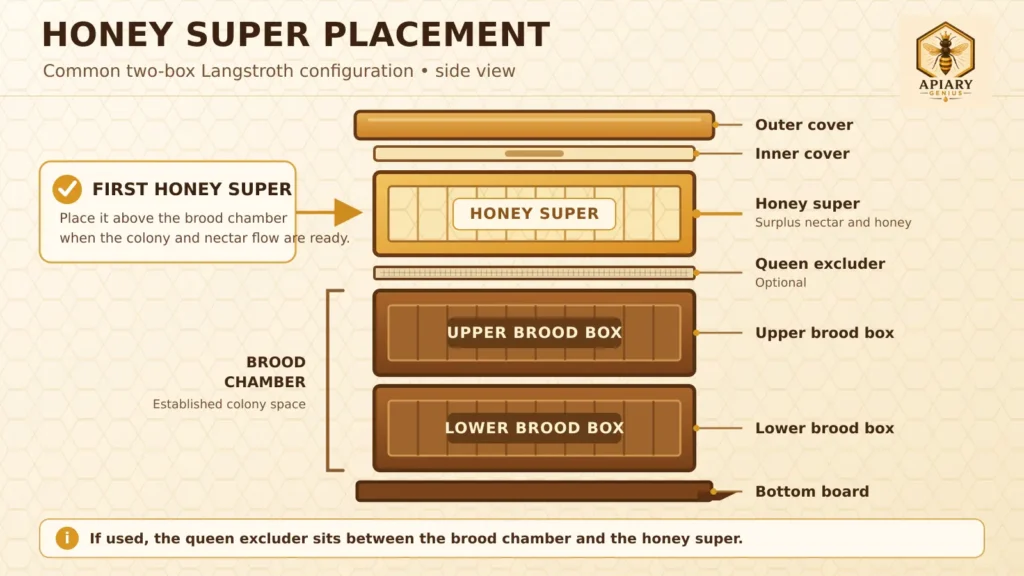
A queen excluder is placed between the brood chamber and honey supers to restrict the queen’s movement into harvest comb while allowing workers through. It is optional: many beekeepers use one, while others manage without it.
If you use an excluder, install it flat above the established brood chamber and below the first honey super. Make sure the queen is below it. Do not treat the excluder as a substitute for colony strength, good timing, or adequate comb. Also remember to manage or remove it when the honey supers come off; it should not be forgotten in the hive through winter.
7. Place the Super Squarely on the Hive
Keep all frames correctly spaced and pressed together according to the equipment design. Set the super on the hive without crushing bees, confirm that the box sits flat with no unintended gaps, and replace the inner and outer covers.
For the first super, the stack is normally brood chamber, optional queen excluder, honey super, inner cover, and outer cover. For an additional super, place it according to your chosen top- or bottom-supering method.
8. Record the Condition and Recheck Progress
Write down the number of frames drawn, the number actively receiving nectar, the amount capped, the condition of the flow, and when you expect to inspect again. During a heavy flow, conditions can change quickly, so do not rely on memory or a fixed monthly schedule.
At the next inspection, compare actual progress with your notes. If the super is approaching the 60-to-75-percent range and the flow remains strong, prepare the next box. If the bees have not entered it, investigate population, comb, forage, queen status, and the possible effect of an excluder before adding still more space.
Frequently Asked Questions
What Month Should I Add a Honey Super?
There is no universal month. In many temperate areas, the first super goes on in spring as the colony expands and the main nectar flow approaches. In warmer or forage-rich regions, the timing can be earlier; at higher latitudes or elevations, it can be later. Use local bloom information, current weather, colony strength, and frame occupancy rather than copying a distant calendar date.
Should I Add a Honey Super Before the Nectar Flow Starts?
You can add it shortly before an expected flow if the colony is already strong and the brood chamber is ready. This gives bees immediate access to storage when nectar begins. Do not add it weeks early to a small colony simply because a calendar says the season is near.
Do I Need Seven Fully Capped Frames Before Adding a Super?
No. The 7/10 rule is commonly based on active frame use, and the correct interpretation depends on whether you are evaluating a brood box before the first super or a honey super before adding another. For later supers, substantial uncapped nectar and active comb work can justify more space before seven frames are fully capped.
Can I Add a Super With Undrawn Foundation?
Yes, but the colony must build the comb before it becomes useful storage. Undrawn foundation works best with a strong population and a good nectar flow. Drawn comb can receive nectar immediately and therefore gives the beekeeper more flexibility during rapid flows.
Can I Add a Honey Super Without a Queen Excluder?
Yes. A queen excluder is a management choice, not a requirement for supering. Without one, monitor the first super for brood. With one, confirm that workers are moving through and working the comb, and make sure the queen remains below.
How Long Does It Take Bees to Fill a Honey Super?
There is no dependable fixed time. A powerful colony on drawn comb during an exceptional flow may make dramatic progress in days, while a smaller colony on foundation may take weeks or may not fill the box that season. Colony population, comb condition, forage, weather, and the stage of the flow all matter.
Can I Put Too Many Honey Supers on a Hive?
Yes. Strong colonies ahead of a major flow can use multiple supers, but a weak or declining colony may not occupy or protect excessive space. The risk is greater near a dearth, when drawn comb may be vulnerable to pests. Add space in proportion to the colony and the nectar expected before your next inspection.
When Should I Add the Second Honey Super?
Add it when about 60 to 75 percent of the first super is drawn and being filled and the flow is likely to continue. In a 10-frame box, that is usually six or seven frames; in an 8-frame box, about five or six. Act earlier within the range during a fast flow and later when incoming nectar is slowing.
Final Thoughts
The right time to add a honey super is just before the colony runs out of useful storage space, not after every frame is finished and not simply on a predetermined date.
Use the 7/10 rule as a practical inspection trigger: about seven active frames in a 10-frame box or six in an 8-frame box. Then confirm the rest of the picture—colony strength, brood-chamber readiness, available comb, incoming nectar, local bloom stage, feeding status, and treatment restrictions.
For additional supers, a 60-to-75-percent working range keeps you ahead of the bees without giving them more space than they can use. Stay observant during the flow, keep clear records, and adjust to what the colony and landscape are showing you. When the crop is ready, follow a careful step-by-step honey harvesting process that leaves the colony with the stores it needs.
Sources
- Mississippi State University Extension — Maximizing Honey Production: https://extension.msstate.edu/publications/maximizing-honey-production
- Mississippi State University Extension — Colony Growth and Seasonal Management of Honey Bees: https://extension.msstate.edu/publications/colony-growth-and-seasonal-management-honey-bees
- Utah State University Extension — Beekeeping Annual Calendar: https://extension.usu.edu/beekeeping/learn/calendar
- Oregon State University Extension — Residential Beekeeping: Best-Practice Guidelines for Nuisance-Free Beekeeping in Oregon: https://extension.oregonstate.edu/catalog/em-9186-residential-beekeeping-best-practice-guidelines-nuisance-free-beekeeping-oregon
- North Carolina Cooperative Extension / NCDA&CS — Calendar for Beekeeping in Central North Carolina: https://growingsmallfarms.ces.ncsu.edu/wp-content/uploads/2023/01/CALENDAR-FOR-BEEKEEPING-IN-CENTRAL-NORTH-CAROLINA2020-Copy.pdf
- U.S. Environmental Protection Agency — Advisory on the Applicability of FIFRA and FFDCA for Substances Used to Control Varroa Mites in Beehives: https://www.epa.gov/pollinator-protection/advisory-applicability-fifra-and-ffdca-substances-used-control-varroa-mites
- Honey Bee Health Coalition — Varroa Management Resources: https://honeybeehealthcoalition.org/resources/varroa-management/
- Dadant & Sons — What Is the 7/10 Rule in Beekeeping, and Why Is It Important?: https://www.dadant.com/what-is-the-7-10-rule-in-beekeeping-and-why-is-it-important/
- European Medicines Agency — Veterinary Medicines Information Website: https://medicines.health.europa.eu/veterinary/en/about-website