
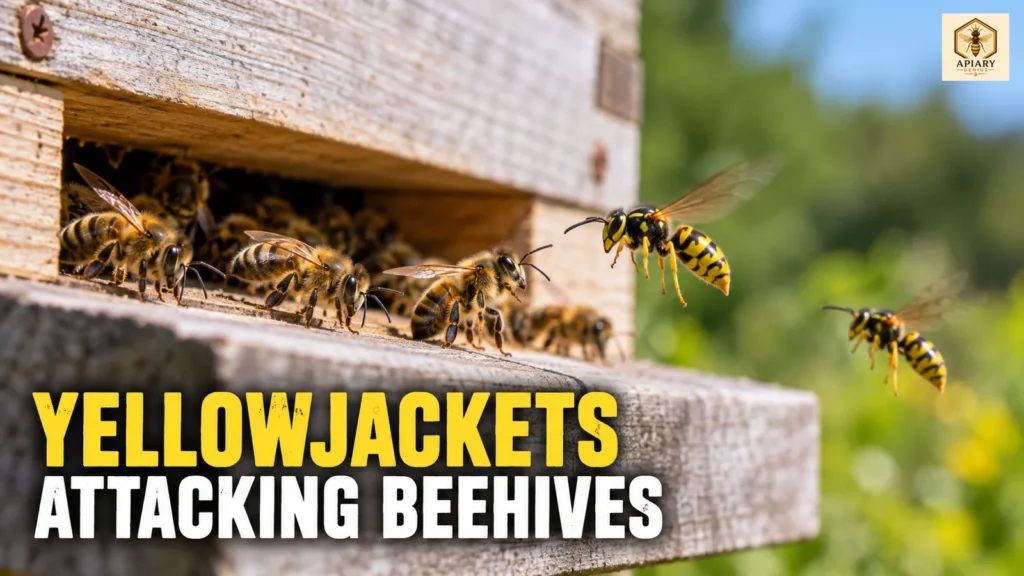
Seeing yellow-and-black wasps circling a hive entrance can be alarming, especially when guard bees are fighting them. But yellowjackets attacking beehives should not be diagnosed from a few wasps around the apiary or from chaotic entrance activity alone.
Yellowjackets are predators and scavengers. They may visit an apiary for dead insects, spilled syrup, exposed honey, fruit, or other food without seriously threatening a colony. The situation becomes more concerning when they repeatedly test the entrance, fight guard bees, enter successfully, kill or carry away bees, or remove hive resources.
The first job is not to kill every wasp you see. It is to identify the insect, determine what it is doing, assess how well the colony is defending itself, and then respond in proportion to the pressure. Oregon State University Extension notes that yellowjackets can prey on adult honey bees and take colony resources, while also emphasizing their ecological roles as predators and scavengers. Oregon State University Extension
Quick Answer
A few yellow jackets around a beehive do not automatically mean the colony is under serious attack.
The clearest signs of yellowjackets attacking beehives are repeated entrance attempts, successful entry, fighting with guard bees, predation, and removal of colony resources—not simply the presence of a few wasps.
If yellowjackets are only passing through the apiary, scavenging occasionally, or being consistently driven away, monitoring and good apiary sanitation may be enough.
If pressure is persistent, first confirm that the insects really are yellowjackets. Then make the hive easier to defend, consider a robbing screen, close unintended gaps, remove exposed food sources, minimize unnecessary hive opening, and investigate why the colony may be struggling to defend itself.
Trapping, nest management, professional pest control, or relocation are escalation options—not automatic first steps. Oregon State University Extension
Table of Contents
Are Yellowjackets Actually Attacking Your Hive?
The word “attack” should describe what the insects are doing, not simply their presence near a hive.
A yellowjacket flying past a colony or collecting a dead bee from the ground is different from a wasp repeatedly hovering at the entrance, confronting guard bees, slipping inside, and returning again.
Occasional presence may look like:
- One or a few yellowjackets moving through the apiary.
- Brief scavenging around dead bees or debris.
- Little or no persistent attention to one hive entrance.
- Guard bees confronting and driving away intruders normally.
- No clear pattern of repeated successful entry or predation.
More serious predation or entrance pressure may include:
- Repeated hovering directly in front of the entrance.
- Repeated attempts to get past guard bees.
- Fighting between yellowjackets and honey bees.
- Yellowjackets successfully entering the hive.
- Increasing numbers of injured or dead bees associated with entrance fighting.
- Yellowjackets carrying adult bees or pieces of bees away.
- Continued exploitation of honey, brood, or other colony resources.
- Persistent pressure concentrated on a small or weakened colony.
If you see yellowjackets killing bees or repeatedly carrying bee parts away, the situation has moved beyond occasional scavenging.
However, dead bees near the entrance alone do not identify the cause. Increased mortality can accompany heavy fighting, but disease, pesticides, starvation, robbing, Varroa-related decline, and other problems can also produce dead bees outside a hive.
If mortality itself is the main unexplained symptom, see Why Are There Dead Bees in Front of My Hive? Normal vs. Warning Signs.
There is no useful universal rule such as “five yellowjackets means an attack.” Colony strength, entrance configuration, species, weather, forage conditions, and whether intruders are actually succeeding matter more than a simple count.
How to Identify a Yellowjacket
Correct identification comes before control.
Yellowjacket (or yellow jacket) is a common name for wasps in the genera Vespula and Dolichovespula. Many yellowjackets have sharply defined yellow-and-black markings, a relatively smooth or shiny appearance, relatively few body hairs, and a narrow wasp-like waist.
University of Minnesota Extension describes yellowjackets as hard, shiny-bodied insects with relatively few hairs and distinctive yellow-and-black markings. University of Minnesota Extension
Honey bees look different when viewed carefully. Worker honey bees are visibly hairier and generally have a softer brown or golden-brown appearance. Their abdominal markings also look different from the sharply defined patterns common on yellowjackets.
Returning honey bee foragers may also carry visible pollen loads on their hind legs.
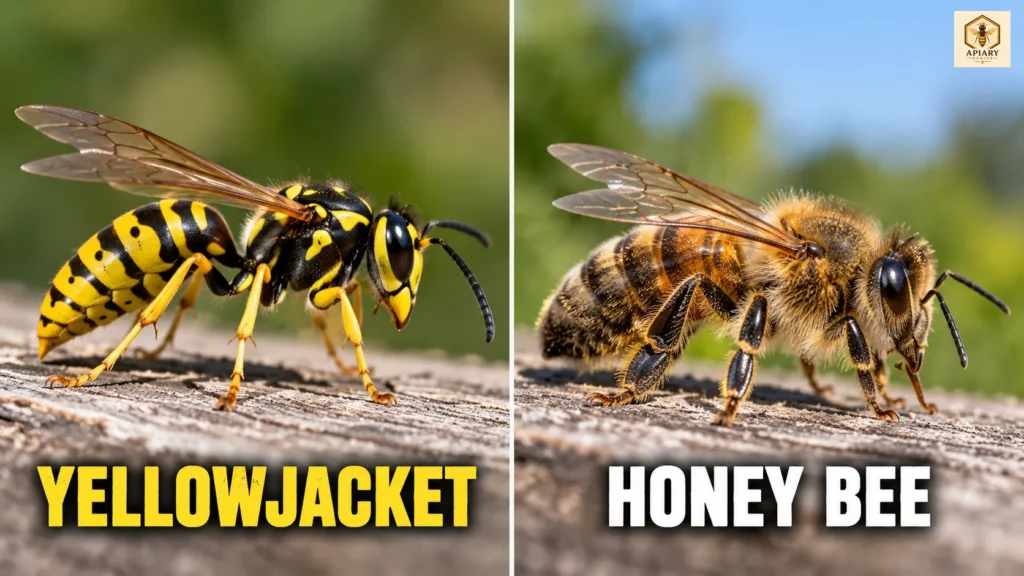
Do not identify an insect from color alone. Bees, wasps, flies, and hornets can share yellow-and-black coloration.
If practical, observe the insect from a safe position or take a clear photograph before deciding what you are dealing with.
Why Do Yellowjackets Target Beehives?
A honey bee colony concentrates several valuable food resources in one place.
Adult bees provide animal protein. Dead bees around the entrance can be scavenged. Some yellowjacket species may also exploit brood and other protein-rich hive material when they gain access to a colony.
Honey and exposed syrup provide carbohydrate resources.
Oregon State University Extension describes yellowjackets as predators and scavengers that may prey on adult honey bees and rob colony resources. Mississippi State University Extension also notes that some yellowjackets may enter honey bee colonies to take honey or consume brood. Oregon State University Extension
That does not make yellowjackets specialized honey-bee enemies throughout the year.
They use many food sources and also prey on other insects. Their ecological roles include predation and scavenging.
A beehive becomes particularly attractive when other food sources are limited or when the colony presents an unusually easy opportunity.
Why Yellowjacket Pressure Often Gets Worse in Late Summer and Fall
Yellowjacket colonies generally begin relatively small and build their worker populations as the season progresses.
As a result, many areas have larger populations of foraging yellowjackets later in the season.
At the same time, food conditions can change. Insect prey may become less available, nectar flows may decline, and a dearth can concentrate competition around remaining food sources.
Oregon State University Extension notes that yellowjackets can become increasingly troublesome to honey bee colonies in late summer and fall as prey insects and nectar resources decline. Dry conditions that shorten nectar flows may also increase pressure in some years. Oregon State University Extension
This is a seasonal tendency—not a universal calendar rule.
Timing varies with:
- Region.
- Climate.
- Weather.
- Forage availability.
- Drought.
- Yellowjacket species.
- Yellowjacket colony development.
A beekeeper in one region may therefore see serious pressure much earlier or later than someone elsewhere.
Yellowjacket Attack vs. Robbing Bees: How to Tell the Difference
This distinction matters because both problems can produce frantic activity, fighting, and dead bees around a hive entrance.
The most useful first question is:
Who are the intruders?
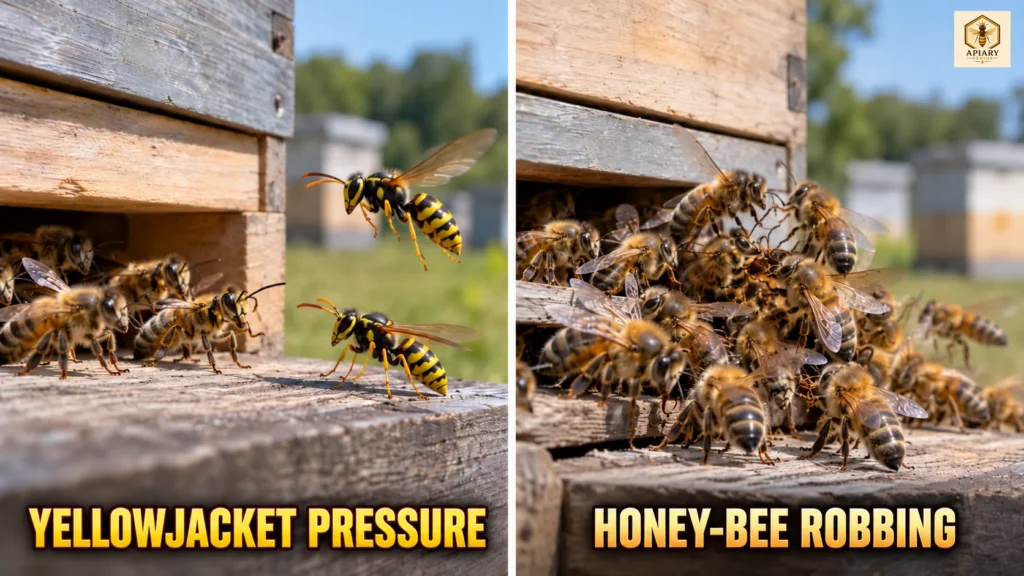
| What you see | Yellowjacket predation | Honey-bee robbing |
|---|---|---|
| Main intruders | Wasps/yellowjackets | Honey bees from another colony |
| Attacks on adult bees | May occur | Not the primary objective |
| Scavenging dead bees | May occur | Not the main behavior |
| Main target | Bees and/or hive resources | Primarily stored honey |
| Entrance fighting | May occur | May occur |
| Weak colonies targeted | Common | Common |
| Exposed honey can worsen activity | Yes | Yes |
| Capping debris | Not a reliable yellowjacket diagnostic sign | Can be an important clue when robbers are opening stored honey |
Both situations can appear chaotic from several feet away.
Do not diagnose honey-bee robbing simply because you see fighting, and do not diagnose yellowjacket predation merely because yellow-and-black insects are nearby.
Identify the intruders.
Yellowjackets may also arrive after another disturbance has begun. For example, dead or injured bees associated with robbing can create scavenging opportunities.
If the intruders are honey bees rather than wasps, use Robbing Bees: How to Tell If Your Hive Is Being Robbed and How to Stop It for the full diagnosis and response.
Which Colonies Are Most Vulnerable?
Yellowjackets are opportunistic.
A populous colony with many effective guard bees may repel pressure that a much smaller colony cannot.
Oregon State University Extension identifies smaller colonies and colonies weakened by problems such as mites, disease, or inadequate food as especially vulnerable to yellowjacket predation. Oregon State University Extension
Higher-risk situations may include:
- Weak colonies.
- Nucs.
- Late splits.
- Newly established colonies.
- Colonies with relatively small adult populations.
- Colonies experiencing high Varroa pressure.
- Colonies with queen problems.
- Colonies with poor brood production.
- Starving or poorly provisioned colonies.
- Colonies weakened by disease.
- Colonies that recently swarmed and temporarily have fewer adult bees.
- Hives with entrances that are large relative to the defending population.
A newly installed nuc, for example, may have far fewer defenders than a full-sized established colony. See How to Install Package Bees or a Nuc: A Step-by-Step Guide for the broader needs of newly established colonies.
Most importantly, vulnerability does not prove causation.
Yellowjackets may exploit a colony that was already weakening for another reason.
If Varroa pressure may be contributing to the decline, review How to Control Varroa Mites: The Complete 2026 Guide.
If brood and queen evidence are abnormal, How to Tell If a Beehive Is Queenless: Signs, Diagnosis, and What to Do Next may help identify a different underlying problem.
What to Do About Yellowjackets Attacking Beehives
Once you have confirmed repeated predation or successful intrusion, work from the hive outward.
1. Confirm That the Insects Are Yellowjackets
Do not respond to a suspected yellowjacket problem until you know that the intruders are wasps rather than robbing honey bees or another look-alike.
2. Watch Whether They Are Successfully Entering the Hive
Hovering outside is one level of pressure.
Repeatedly getting past the guard bees and entering the colony is more concerning.
Watch whether defenders consistently stop the intruders or whether yellowjackets are regularly crossing the defensive line.
3. Assess Fighting and Predation
Look for:
- Persistent confrontation with guard bees.
- Attacks on adult bees.
- Yellowjackets carrying bees or bee parts away.
- Increasing entrance mortality associated with the fighting.
- Repeated entry for hive resources.
Remember that dead bees alone do not establish yellowjacket predation as the cause.
4. Reduce the Defendable Entrance Area When Appropriate
A smaller entrance can concentrate guard bees and reduce the area they must defend.
Do not use one entrance dimension as a universal rule.
The appropriate opening depends on:
- Colony population.
- Temperature.
- Ventilation requirements.
- Weather.
- Season.
5. Consider a Robbing Screen
A robbing screen changes the direct route into the colony.
Resident bees can learn the modified pathway, while intruders repeatedly approaching the most obvious entrance location may have more difficulty gaining access.
Oregon State University Extension includes robbing screens among the physical tools that can help colonies resist yellowjacket pressure. Oregon State University Extension
6. Seal Unintended Gaps
Inspect the hive for:
- Gaps between boxes.
- Poorly fitting covers.
- Damaged corners.
- Cracks or openings around components.
The colony should not have to defend several accidental entrances.
7. Remove Attractants
Clean up exposed:
- Syrup.
- Honey.
- Wet comb.
- Wax scraps.
- Brood remains.
- Dead bees.
- Discarded feed.
8. Avoid Unnecessary Hive Opening
Opening a struggling colony releases attractive odors and can temporarily expose food resources.
During heavy pressure, inspections should have a clear purpose.
Do not leave honey, supers, frames, or feeding materials exposed longer than necessary.
9. Investigate Why the Colony Is Vulnerable
Check:
- Adult bee population.
- Brood production.
- Queen evidence.
- Food stores.
- Varroa status.
- Disease signs.
- Recent swarming.
- Recent splits or installation.
- Other colony-health problems.
Do not let the visible predators distract you from a more important underlying problem.
10. Continue Monitoring
After improving defenses and sanitation, observe the entrance again.
You are looking for reduced successful entry, predation, and fighting—not necessarily the complete disappearance of every yellowjacket.
11. Escalate Only When the Situation Justifies It
Persistent severe pressure may justify additional measures such as:
- Trapping.
- Nest management.
- Professional pest management.
- Relocation in selected situations.
Moving the hive should not be the automatic first response.
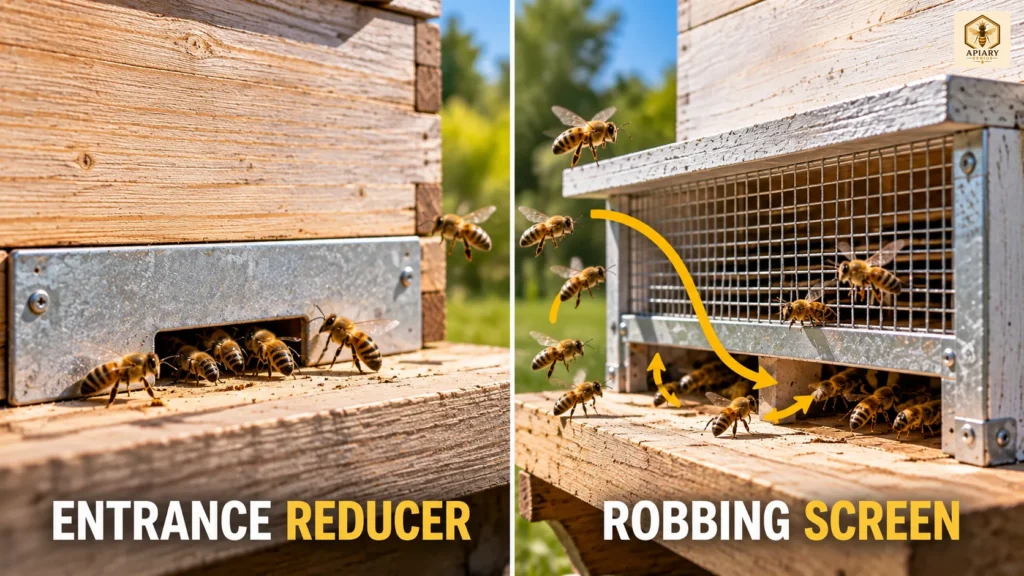
How Entrance Reducers and Robbing Screens Help
Entrance reducers and robbing screens address related but different problems.
An entrance reducer decreases the area guard bees need to defend.
Instead of spreading a limited defensive population across a wide opening, the colony can concentrate guards at a smaller access point.
A robbing screen changes the pathway into the hive. Resident bees can adapt to the altered entrance while intruders that repeatedly approach the obvious original entry point encounter a barrier.
Oregon State University Extension recommends reduced entrances and robbing screens as physical defenses against yellowjacket predation. It also notes the need to maintain adequate ventilation when entrances are reduced during hot weather. Oregon State University Extension
Neither device has one universal configuration appropriate for every hive.
A small nuc in hot weather and a strong colony in cool conditions have different ventilation and defensive requirements.
Adjust the setup to the colony and conditions rather than relying on an arbitrary opening size.
Keep the Apiary From Attracting More Yellowjackets
A vulnerable colony is already difficult to defend. Avoid making the surrounding apiary more attractive.
Yellowjackets search for both protein and carbohydrate sources, so apiary debris and poorly managed feeding can provide additional food cues.
Promptly clean up:
- Spilled sugar syrup.
- Exposed honey.
- Wet or leaking supers.
- Uncapped honey left open.
- Wax scrapings containing honey or brood.
- Brood scraps.
- Dead bees.
- Discarded protein feed.
- Rotting fruit.
- Human food and garbage near the apiary.
Be especially careful with feeding during nectar dearth.
Do not allow feeders to leak outside the hive, and promptly clean spilled syrup.
Oregon State University Extension recommends maintaining a tidy apiary and minimizing exposed food sources that can attract yellowjackets. Oregon State University Extension
For broader feeding decisions, see Feeding Bees: The Complete Guide for Every Season.
Do Yellowjacket Traps Work?
Yes. Yellowjacket traps can catch yellowjackets.
That does not automatically mean they will protect a hive.
The important distinction is between capturing individual wasps and reducing predation enough to change what is happening at the colony entrance.
Oregon State University Extension reports that traps can capture yellowjacket queens or workers but cautions that casual trapping may not reduce local populations enough to substantially relieve pressure on honey bee colonies. Oregon State University Extension
Bait attractiveness and trap performance can also vary with species, season, and available food.
If you use trapping:
- Continue strengthening the hive itself.
- Continue removing attractants.
- Monitor whether successful intrusion actually decreases.
- Follow the trap manufacturer’s directions.
- Do not assume a trap full of wasps proves that the colony is protected.
- Do not treat trap placement directly beside a vulnerable hive as a universal rule.
There is no justified universal trap density or spacing rule for every apiary.
Trapping should supplement colony defense—not replace it.
Should You Find and Destroy the Yellowjacket Nest?
Not automatically.
Yellowjackets have useful ecological roles, and a nest that is not creating a significant stinging hazard or severe apiary problem may not need to be destroyed.
Nest control may become reasonable when:
- Predation on the apiary is severe.
- A nest creates a significant human safety hazard.
- Other practical measures are insufficient.
But yellowjacket colonies can defend their nests aggressively.
Oregon State University Extension recommends considering professional assistance when dealing with an active nest or chemical control. Oregon State University Extension
Professional pest management may be especially appropriate when:
- The nest is in a dangerous location.
- The colony is highly defensive.
- Pesticide treatment is required.
- Safe access is difficult.
- The beekeeper has a severe sting allergy.
- The beekeeper lacks the equipment or experience to manage the risk safely.
Do not improvise dangerous nest-destruction procedures.
What About Pesticides Around the Apiary?
The key rule is simple:
The label is the law.
EPA explains that pesticide labeling is legally enforceable and that federal law prohibits using a pesticide in a manner inconsistent with its labeling. The label specifies where and how the product may be used and includes relevant precautions. U.S. Environmental Protection Agency
Products capable of killing wasps may also harm honey bees.
Therefore:
- Do not improvise pesticide baits.
- Do not invent pesticide mixtures.
- Do not use a pesticide off-label.
- Do not spray honey bees.
- Do not spray the hive entrance or landing board in a way that exposes honey bees unless the specific registered label permits that use.
- Avoid contaminating surfaces where honey bees are likely to contact residues.
- Follow current federal and state requirements.
Don’t Confuse Yellowjackets With the Yellow-Legged Hornet
Ordinary yellowjackets are not the same insect as the yellow-legged hornet, Vespa velutina.
The yellow-legged hornet is an invasive wasp that preys on insects, including honey bees.
According to USDA APHIS information last modified August 21, 2026, yellow-legged hornets have been detected in Georgia, South Carolina, and North Carolina, and federal and state partners continue surveillance, trapping, and nest-removal efforts in affected and neighboring areas. USDA APHIS
Do not identify Vespa velutina merely from yellow coloration.
USDA APHIS notes that it can be confused with other common wasps and hornets. USDA APHIS
If you suspect a yellow-legged hornet:
- Do not approach or disturb a suspected nest.
- Photograph the insect safely if possible.
- Record the location.
- Follow current state or USDA reporting instructions.
- Check the current official distribution before relying on older maps or articles.
Use the current official information here:
USDA APHIS — Yellow-Legged Hornet
What to Check If One Hive Is Being Targeted More Than the Others
If several colonies occupy the same apiary but one receives most of the pressure, ask what is different about that hive.
Check:
- Is the colony smaller?
- Is the entrance larger relative to its population?
- Is brood production normal?
- Is the queen functioning normally?
- Did the colony recently swarm?
- Are Varroa levels concerning?
- Are food stores low?
- Is it a nuc or recent split?
- Are there gaps between boxes?
- Has syrup or honey been spilled nearby?
- Are neighboring colonies experiencing similar pressure?
The answer may reveal that the yellowjackets are exploiting a problem rather than creating it.
For example, a colony already losing population because of high Varroa pressure may become progressively less capable of guarding its entrance. Queen failure, poor brood production, starvation, or disease can create similar vulnerability.
Do not control yellowjackets while ignoring the reason one colony cannot defend itself.
If the colony is already nearly empty or abandoned, the primary problem is no longer simply active yellowjacket pressure. See Why Did My Bees Leave the Hive? Absconding vs. Swarming and Colony Loss for that differential diagnosis.
What Not to Do
- Do not treat every yellowjacket sighting as an attack.
- Do not diagnose the problem from chaotic entrance activity alone.
- Do not confuse yellowjacket predation with robbing honey bees.
- Do not leave syrup, honey, brood, comb, or food waste exposed.
- Do not repeatedly open a weak colony during severe pressure.
- Do not rely on one trap as a complete solution.
- Do not use homemade poisoned bait.
- Do not invent pesticide mixtures or doses.
- Do not use pesticides off-label.
- Do not spray the hive, landing board, entrance, bees, or bee-contact surfaces with insecticide unless the registered label specifically permits that use.
- Do not attempt unsafe nest destruction.
- Do not combine a weak colony with another colony until important disease, parasite, and colony-health risks have been considered.
- Do not assume yellowjackets caused the original colony weakness simply because they are exploiting it now.
- Do not assume a strong colony can never be damaged by sustained heavy predation.
A Practical Yellowjacket Attack Checklist
- Identify the insect. Confirm that the intruders are yellowjackets rather than robbing honey bees or another look-alike.
- Determine whether they are entering successfully. Wasps outside the hive are less significant than repeated successful intrusion.
- Watch for fighting and predation. Look for attacks on adult bees, persistent conflict with guards, and yellowjackets carrying prey away.
- Compare colony strength. Determine whether the targeted colony is smaller or weaker than neighboring colonies.
- Reduce the defendable entrance area if warranted. Match the opening to colony strength, weather, and ventilation needs.
- Consider a robbing screen. Make direct entry more difficult while allowing resident bees to adapt.
- Seal unintended hive gaps. Do not allow attackers to bypass the guarded entrance.
- Remove food attractants. Clean up syrup, honey, brood scraps, wax debris, dead bees, fruit, and food waste.
- Review feeding practices. Stop leaks and spills and avoid unnecessarily exposing syrup or honey.
- Investigate colony weakness when safe. Check brood, queen evidence, food stores, Varroa pressure, disease signs, and recent colony history.
- Monitor whether the pressure decreases. Focus on successful entry and predation rather than expecting every yellowjacket to disappear.
- Escalate only when justified. Consider trapping, nest management, professional pest management, or relocation when the severity of the situation warrants it.
The goal is not to eliminate every wasp from the environment.
The goal is to keep an occupied honey bee colony capable of defending itself while identifying and correcting the conditions that make it unusually vulnerable.
FAQ
Are yellowjackets dangerous to honey bee colonies?
They can be.
Occasional yellowjacket activity may have little effect, but sustained predation and repeated successful entry can reduce adult bee populations and allow yellowjackets to exploit colony resources. Small or already weakened colonies are particularly vulnerable. Severe sustained predation can contribute to colony decline or death. Oregon State University Extension
Why do yellowjackets attack beehives in late summer?
Yellowjacket colonies often have larger worker populations later in the season, while natural prey and nectar availability may decline. Nectar dearth and dry conditions can increase pressure in some areas.
The timing varies by region, weather, forage availability, species, and yellowjacket colony development. Oregon State University Extension
How can I tell yellowjackets from robbing honey bees?
Identify the intruders.
Yellowjackets have relatively smooth, shiny bodies, relatively few hairs, a narrow waist, and clearly defined markings. Honey bees are visibly hairier and generally browner.
If the intruders are honey bees from another colony primarily trying to steal stored honey, the event is honey-bee robbing rather than yellowjacket predation. University of Minnesota Extension
Can yellowjackets kill a whole beehive?
Severe and sustained yellowjacket predation can contribute to serious colony decline and may ultimately contribute to colony death, especially when the honey bee colony is already small or compromised.
That does not prove yellowjackets caused the colony’s original weakness. Oregon State University Extension
Will an entrance reducer help stop yellowjackets?
It can help by decreasing the area guard bees need to defend.
The appropriate entrance opening depends on colony population, temperature, ventilation, and other environmental conditions, so there is no single size appropriate for every hive. Oregon State University Extension
Do robbing screens work against yellowjackets?
They can help.
A robbing screen changes the direct entry pathway, allowing resident bees to adapt while making entry more difficult for intruders approaching the obvious entrance.
It should be considered part of broader colony defense rather than a stand-alone cure. Oregon State University Extension
Do yellowjacket traps actually protect beehives?
Traps can capture yellowjackets, but capturing many wasps does not guarantee that predation pressure will fall enough to protect a colony.
Use trapping as a possible supplemental measure rather than a replacement for physical hive defense, colony-health management, and apiary sanitation. Oregon State University Extension
Should I kill a yellowjacket nest near my apiary?
Not automatically.
Consider the severity of predation, the risk the nest poses to people, and whether other measures are controlling the problem.
Yellowjacket nests can be dangerous to approach, and professional pest management may be safer when nest control is necessary. Oregon State University Extension
Can I spray wasp killer around my beehive?
Do not use insecticide in a way that exposes honey bees unless the exact registered product label permits that use.
Never improvise pesticide baits or use a pesticide off-label. The label is the law. U.S. Environmental Protection Agency
What should I do if I see a yellow-legged hornet near my bees?
Do not treat a suspected Vespa velutina sighting as an ordinary yellowjacket problem.
Photograph it safely if possible, avoid disturbing a suspected nest, and follow current USDA APHIS or state reporting instructions.
As of USDA APHIS information last modified August 21, 2026, detections have occurred in Georgia, South Carolina, and North Carolina. USDA APHIS
Sources
Oregon State University Extension — Protecting Honey Bees from Yellowjacket Wasps
University of Minnesota Extension — Wasps and Bees
Mississippi State University Extension — Hornet Species That Threaten Honey Bees
USDA APHIS — Yellow-Legged Hornet
U.S. Environmental Protection Agency — Introduction to Pesticide Labels