
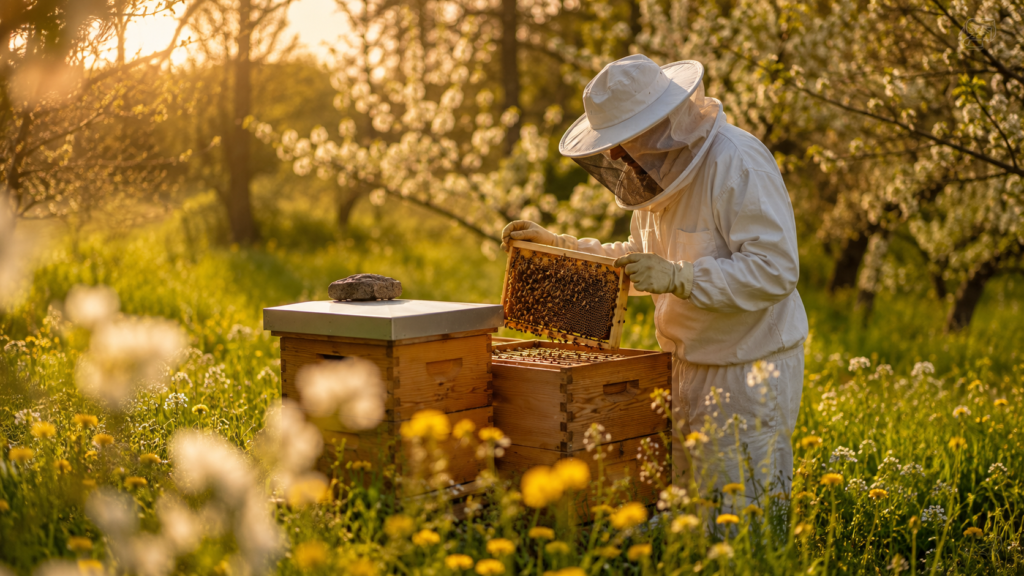
If you’ve been dreaming about keeping bees, one of the first questions you’ll run into is timing. Beekeeping isn’t something you can start on a random Tuesday in November and expect to succeed at — bees follow the rhythm of the seasons, and so should you. Getting your timing right in your first year can be the difference between a thriving colony that builds up quickly and a struggling one that never quite catches up.
In this guide, we’ll walk through exactly when the best season to start beekeeping actually is, why timing matters so much, and what to do if your local calendar doesn’t line up perfectly with the “ideal” window.
Table of Contents
Why Timing Matters More Than You Think
New beekeepers often assume that as long as they have a hive, some bees, and basic protective gear, they’re ready to go whenever it’s convenient for them. In reality, a honeybee colony’s entire yearly cycle is built around one goal: surviving winter. Everything a colony does in spring and summer — foraging, building comb, raising brood, storing honey — is preparation for the months when there’s little to no food available and temperatures drop too low for bees to fly.
When you introduce a new colony to a hive, you’re essentially asking it to start that entire preparation cycle from scratch. A colony started too late in the year simply won’t have enough time to build up its population, draw out comb, and store enough honey to survive winter. A colony started too early, before there’s enough forage available, may struggle to feed itself and can even starve.
This is why “when should I start beekeeping” isn’t a minor logistical question — it’s one of the most important decisions you’ll make as a new beekeeper.
The Short Answer: Spring Is (Almost) Always Best
For the vast majority of climates, spring is the best season to start beekeeping. More specifically, most experienced beekeepers recommend starting in early to mid-spring, once the danger of hard frosts has mostly passed but before the main nectar flow begins.
Here’s why spring works so well:
- Maximum growing season ahead. A colony started in spring has the entire spring and summer to build up its population, draw comb, and store food before autumn arrives.
- Natural alignment with nectar flows. Most regions experience their heaviest nectar flow in late spring and early summer. A colony that’s already established by then can take full advantage of it.
- Better survival odds. Bees started in spring have the best chance of building a strong enough colony to survive their first winter — historically the most dangerous period for a new hive.
- Availability of bees. Package bees, nucleus colonies (nucs), and swarms are all most readily available in spring, which is also when most bee suppliers schedule their deliveries.
Understanding Your Local Nectar Flow
While “spring” is a useful general guideline, the single most important factor in choosing your start date isn’t the calendar — it’s your local nectar flow. Nectar flow refers to the period when flowering plants in your area are producing the most nectar, giving bees abundant food to forage.
Nectar flow timing varies dramatically depending on where you live:
- Warm, southern climates may see nectar flow begin as early as February or March.
- Temperate regions typically see nectar flow ramp up in April and May.
- Cooler, northern climates may not see a strong nectar flow until late May or even June.
The goal is to have your colony established before the main nectar flow begins, so the bees are ready to capitalize on it the moment it starts. Starting a colony even a few weeks too late means missing a significant portion of the flow — and that lost time is very hard to make up.
How to find your local nectar flow window:
- Talk to a local beekeeping association or club — they almost always track flow timing for your specific region.
- Ask local beekeepers directly; this is one of the most valuable pieces of hyper-local knowledge you can get.
- Watch what’s blooming — fruit trees, clover, dandelions, and other early-season flowers are strong indicators that flow is beginning.
Starting with Package Bees vs. Nucs vs. Swarms
The method you use to start your colony also affects the ideal timing.
Package Bees
A package is a screened box containing worker bees and a caged queen, but no comb or brood. Because the colony has to start completely from scratch — drawing comb, the queen beginning to lay, and the workforce building up — packages need the most lead time before nectar flow. Installing packages in early spring gives them the best shot at being fully established before the flow peaks.
Nucleus Colonies (Nucs)
A nuc is a small, already-established colony with drawn comb, brood in various stages, and a laying queen. Because a nuc is essentially a colony that’s already a few weeks ahead of a package, it can be installed slightly later than a package and still catch up in time for the nectar flow. Nucs are often considered the best option for beginners because they’re more forgiving of timing and give you a head start.
Swarms
Capturing a swarm can happen at almost any point during swarm season (typically spring into early summer), and swarms often build up remarkably fast because they arrive with a mature, mated queen and a strong workforce instinct to build comb quickly. However, swarm timing isn’t something you can fully control — you take what nature gives you, when it gives it to you.
What Happens If You Start Too Early?
Starting too early — say, installing a package in late winter before there’s reliable forage — comes with real risks:
- Starvation risk: If there isn’t yet enough nectar or pollen available, the colony may need to be fed continuously just to survive, which is stressful for both the bees and the beekeeper.
- Cold stress: A small, newly established colony doesn’t yet have the population needed to effectively regulate hive temperature. A late cold snap can kill brood or even the whole colony.
- Slow buildup: Without adequate forage, the queen may reduce her laying rate, which slows the colony’s growth right when it needs to be accelerating.
What Happens If You Start Too Late?
Starting too late carries its own set of problems:
- Missed nectar flow: This is the big one. A colony established after the main flow has already passed misses its best (and sometimes only) opportunity to build significant honey stores.
- Insufficient population for winter: Colonies need a strong population of workers to form a winter cluster and keep the hive warm. A late start often means entering autumn with too few bees.
- Not enough stored honey: Without a strong flow to draw from, the colony may not store enough honey to survive winter, and you as the beekeeper will likely need to feed heavily going into fall — which is far less effective than the bees storing their own natural reserves.
A General Seasonal Timeline for New Beekeepers
Once you’ve identified the best season to start beekeeping in your area, it helps to have a clear timeline to work from. While exact dates depend entirely on your region, here’s a general framework most new beekeepers can adapt:
Late Winter (6–8 weeks before your local nectar flow begins)
- Finalize your hive equipment and location.
- Order package bees or reserve a nuc from a local supplier.
- Complete any beginner beekeeping courses or mentor arrangements.
Early Spring (as danger of hard frost passes)
- Install package bees or nucs.
- Begin regular hive inspections (roughly every 1–2 weeks).
- Monitor for adequate stores; feed if natural forage is still limited.
Mid-to-Late Spring (nectar flow begins)
- Reduce or stop supplemental feeding as natural forage becomes abundant.
- Add additional supers as the colony grows and needs more space.
- Watch closely for swarm signals as the colony expands rapidly.
Summer
- Continue regular inspections.
- Monitor for pests and diseases, particularly varroa mites.
- Depending on your region and colony strength, you may see your first honey harvest.
Early Autumn
- Assess winter readiness: population size, stored honey, and overall colony health.
- Treat for pests if needed, following your local guidelines.
- Reduce hive entrances to help the colony defend against robbing and pests as forage declines.
Winter
- Minimize hive disturbances.
- Check periodically (without opening the hive unnecessarily) for signs of activity.
- Plan and prepare for the following spring.
Special Considerations for Different Climates
The best season to start beekeeping isn’t a single fixed date — it shifts depending on where you live. Here’s how it plays out across different climate types.
Warm Climates (Little to No Winter)
In regions with mild winters, the “best season” window is often wider and can begin earlier — sometimes as early as late winter. Nectar flows may also occur more than once per year. Local beekeeping clubs are especially valuable here, as timing can vary significantly even within the same general climate zone.
Cold Climates (Long, Harsh Winters)
In colder regions, timing becomes even more critical because the growing season is shorter. Starting as early as safely possible — right as the danger of hard frost passes — gives the colony the maximum amount of time to build up before the short window closes again in autumn. Beekeepers in these climates often lean toward nucs over packages, since nucs offer a head start that’s especially valuable when the season is compressed.
Arid or Drought-Prone Regions
Nectar flow can be less predictable in these areas, sometimes tied closely to rainfall rather than a fixed calendar date. Beekeepers in these regions often watch rainfall patterns as closely as the calendar itself.
Should You Ever Start in Summer or Fall?
While spring is ideal, it isn’t the only time you can start beekeeping — it’s simply the option with the highest odds of success for a first-year beekeeper. Starting in summer or fall isn’t impossible, but it comes with real trade-offs:
- Summer starts may still work if you’re installing a strong nuc with plenty of remaining growing season ahead, but package bees started in summer often struggle to build up enough before autumn.
- Fall starts are generally discouraged for beginners. A colony started in fall has very little time to build population and stores before winter, and will likely need significant feeding support just to survive its first winter — with no guarantee of success.
If you find yourself with the opportunity to start outside the ideal spring window, it’s worth talking to an experienced local beekeeper about whether it’s realistic in your specific climate, and what extra support the colony might need.
Frequently Asked Questions
Can I start beekeeping in my first year with just one hive?
Yes, and many beekeepers recommend starting with just one hive so you can focus your attention and learning on a single colony. That said, some experienced mentors suggest starting with two hives if your budget and space allow, since it gives you a direct comparison point — if one colony is behaving unusually, having a second “normal” colony nearby makes it much easier to tell whether something is actually wrong.
How do I know if it’s too late in the season to start this year?
Since the best season to start beekeeping is closely tied to your local nectar flow, a good rule of thumb is to ask local beekeepers or your local club whether there’s still enough of the growing season left for a new colony to build up sufficient population and stores before your region’s first hard frost. If the honest answer is “probably not,” it’s often better to spend the rest of the year preparing — building or buying equipment, taking a course, lining up a mentor — so you’re fully ready to start strong the following spring.
Do I need to feed my bees when I first install them, even in spring?
Often, yes — at least for a short period. Even in spring, a newly installed package or nuc may need supplemental sugar syrup while the colony gets established and before natural forage is fully abundant. This is especially true for packages, since they have no stored resources of their own yet. Feeding is usually reduced or stopped once you see the bees consistently bringing in their own nectar and pollen.
What if the weather in my area is unpredictable in spring?
Unpredictable spring weather is common in many regions, and it’s one of the reasons new beekeepers are encouraged to stay flexible rather than fixate on an exact date. If a late cold snap hits after you’ve already installed your bees, you can help the colony by reducing the hive entrance to make it easier to defend and regulate temperature, and by ensuring they have adequate food stores until the weather stabilizes.
Is it better to buy bees locally or order them from farther away?
Sourcing bees locally, or at least regionally, is generally considered the better choice whenever it’s an option. Local bees are already adapted to your regional climate and nectar flow timing, and local suppliers can often give you more accurate guidance on when to expect and install your bees relative to your specific area’s conditions.
Can I start beekeeping with a swarm instead of buying bees?
Yes, and many beekeepers do exactly this, especially once they have some experience. Swarms typically appear during swarm season, which usually overlaps with spring and early summer, and a captured swarm often builds up comb impressively quickly since it arrives with a mature queen and a strong, motivated workforce. The trade-off is that you can’t schedule a swarm the way you can order a package or reserve a nuc — you have to be ready to respond when one becomes available.
Final Thoughts
Choosing the best season to start beekeeping isn’t about rigidly following a calendar date — it’s about understanding your local climate, your local nectar flow, and giving your bees the best possible foundation to grow strong. For most new beekeepers, that means starting in early to mid-spring, timed just ahead of the main nectar flow in your area.
Getting this timing right won’t guarantee a perfect first year — beekeeping always comes with its share of surprises — but it stacks the odds firmly in your favor. Combine good timing with steady learning, regular hive inspections, and support from your local beekeeping community, and you’ll be giving your first colony everything it needs to thrive.
Happy beekeeping!
If you’re just getting started, our complete guide on how to start beekeeping walks through equipment, setup, and your first inspection in detail. For broader guidance on regional bee health and seasonal patterns, the University of Georgia’s Honey Bee Program is also a trusted external resource.