
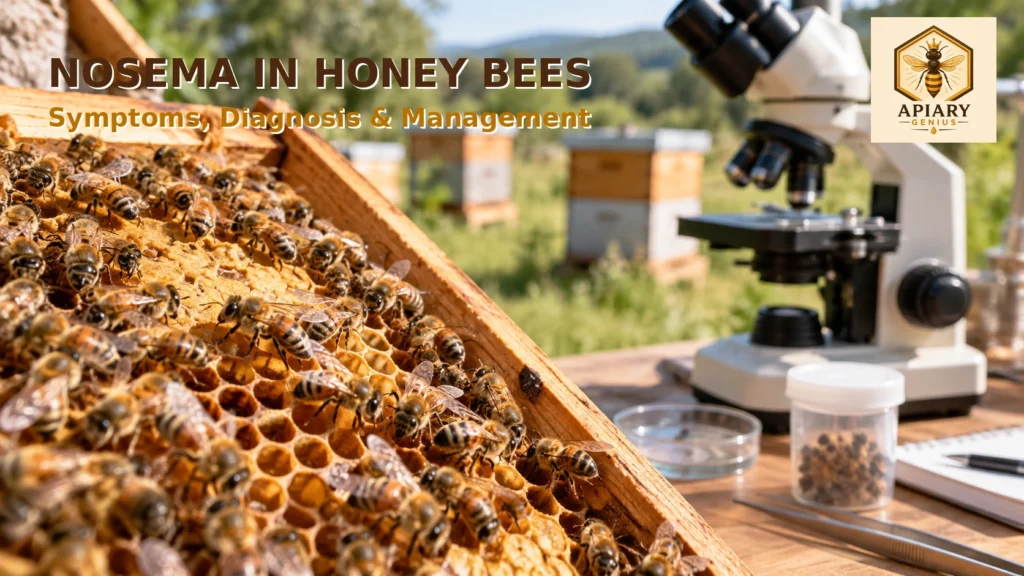
Nosema in honey bees can be difficult to recognize because the signs you see at the hive rarely provide a definite diagnosis. A colony may dwindle, develop fecal staining, build up slowly, or simply seem less productive—but none of those observations proves that Nosema is the cause.
Nosema disease is primarily a microscopic infection of adult honey bees. Reliable management therefore starts by separating what you can observe from what testing can confirm. The practical sequence is:
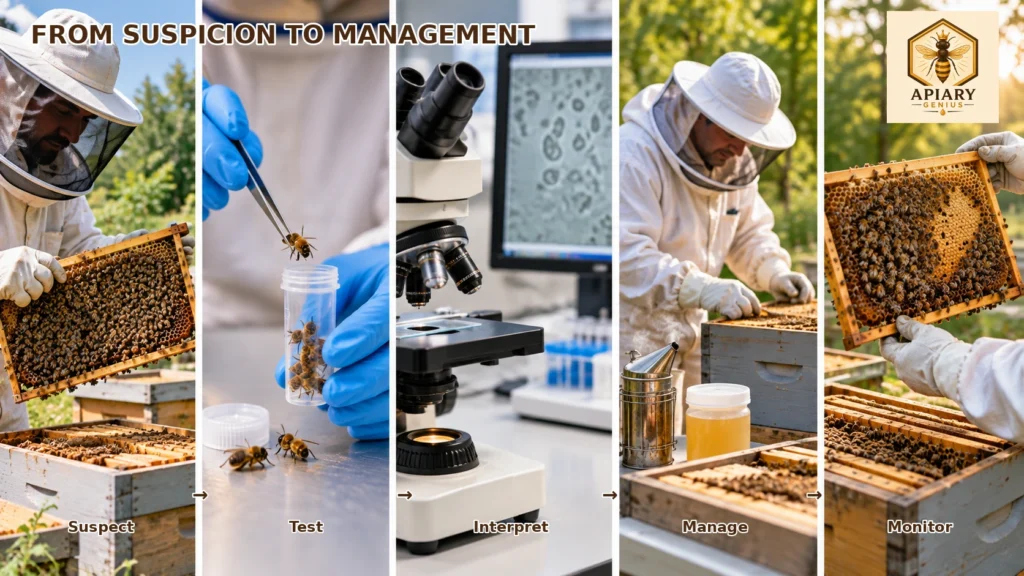
Observe → Suspect → Rule out other explanations → Test → Interpret the result → Decide whether action is warranted → Manage the colony → Reduce future risk
Quick Answer: Nosema in honey bees is caused mainly by the microsporidian parasites Nosema apis and Nosema ceranae. Infection may shorten adult-bee lifespan, alter physiology, and contribute to poor colony performance under some conditions. However, visible signs—including dysentery—cannot reliably diagnose Nosema. Microscopy can detect and estimate Nosema spores, while molecular methods such as PCR can help identify the species. A positive result should be interpreted alongside colony condition, sampling method, season, and other stressors rather than treated as an automatic reason to medicate.
Table of Contents
What Is Nosema in Honey Bees?
Nosema disease, also called nosemosis, is an infection caused by microscopic, spore-forming microsporidian parasites. The two species of greatest importance in the western honey bee, Apis mellifera, are Nosema apis and Nosema ceranae.
Unlike American foulbrood, European foulbrood, chalkbrood, or sacbrood, Nosema is primarily an adult-bee infection rather than a brood disease. The parasites develop mainly in the digestive system of adult bees and can interfere with normal physiology and reduce the lifespan of infected workers.
The organisms traditionally known as Nosema apis and Nosema ceranae have been proposed for reclassification as Vairimorpha apis and Vairimorpha ceranae. That terminology has been adopted in some scientific literature but is not universally used. “Nosema” remains the term most familiar to beekeepers and continues to appear widely in extension and diagnostic material, so this guide uses the traditional names.
The most important practical point is that you usually cannot confirm Nosema by looking at the colony. Suspicion begins at the hive, but reliable diagnosis requires examining bees or appropriate samples for evidence of infection.
What Causes Nosema Disease?
Nosema disease begins when an adult honey bee ingests viable spores.
After reaching the digestive tract, the spores germinate and infect epithelial cells of the midgut. The parasite develops inside these host cells and produces additional spores. Spores can then enter the digestive tract and eventually be shed in fecal material.
The basic transmission cycle is:
Infected adult bee → spores → contamination → ingestion by another adult bee → infection in the digestive tract → production of additional spores → further shedding
This cycle helps explain how infection can persist and spread within a colony.
However, finding Nosema does not automatically mean a colony is experiencing serious disease. Infection can occur without obvious colony-level signs.
The practical question is therefore not simply:
“Is Nosema present?”
It is also:
“Is the infection significant in the context of what is happening to this colony?”
The USDA Agricultural Research Service describes Nosema as an intestinal infection of adult honey bees and emphasizes that no single visible symptom is specifically diagnostic of the disease.
Nosema apis vs. Nosema ceranae
Both Nosema apis and Nosema ceranae infect adult honey bees. They share enough biological and diagnostic characteristics that beekeepers should not attempt to identify the species from colony appearance alone.
Nosema apis
Nosema apis has been recognized as a parasite of Apis mellifera for more than a century.
Heavy infections have historically been associated with reduced worker longevity, digestive disturbance, poor colony development, reduced productivity, and sometimes crawling or weakened adult bees.
Seasonal patterns have also been reported, including stronger spring peaks in some climates.
However, these patterns should not be treated as universal diagnostic rules.
Climate, latitude, season, colony management, sampling method, and local conditions can all influence what researchers and beekeepers observe.
Nosema ceranae
Nosema ceranae was originally described in the Asian honey bee, Apis cerana, and was later found infecting Apis mellifera. It is now widely distributed and has become commonly detected in western honey bees in many regions.
Research has associated N. ceranae infection with energetic stress, altered physiology and behavior, reduced worker longevity, and impaired colony performance under some conditions.
But these effects do not provide a unique field diagnosis.
A colony without fecal streaking can still contain N. ceranae, and a colony with fecal streaking cannot be assumed to have N. apis.
The spores of the two species also overlap enough in morphology that routine light microscopy should not be considered a reliable method for species identification.
When knowing whether a sample contains N. apis, N. ceranae, or both is important, an appropriate molecular test such as species-specific PCR is more useful.
Nosema Symptoms and Warning Signs
Possible nosema symptoms can include:
- gradual loss of adult bees;
- poor or delayed colony buildup;
- reduced productivity;
- crawling or weak bees near the hive;
- unusual numbers of dead or dying adult bees;
- fecal staining on hive components;
- poor performance following periods of stress or confinement.
The problem is that none of these signs is unique to Nosema.
A weak colony may instead—or additionally—be dealing with poor nutrition, queen problems, adverse weather, pesticide exposure, other pathogens, or parasitic mites.
Varroa deserves particular attention because uncontrolled mite pressure and viruses associated with it, including Deformed Wing Virus (DWV), can seriously weaken colonies.
If a colony is declining, Nosema should therefore be one item on a broader diagnostic list rather than the automatic explanation. Apiary Genius’s guide to How to Control Varroa Mites explains how to assess and manage another major threat to colony health.
Agriculture Victoria also notes that infected colonies may show no obvious signs and that signs associated with Nosema can occur with other diseases or abnormal colony conditions.
Does Dysentery Mean Your Bees Have Nosema?
No. Dysentery is not a diagnosis of Nosema.
Fecal streaking on the hive, frames, or entrance can make Nosema worth investigating, particularly when it occurs alongside colony decline. But dysentery and fecal staining can occur for reasons other than Nosema, including prolonged confinement and other abnormal colony or dietary conditions.
The reverse is equally important:
No visible dysentery does not mean no Nosema.
A colony can carry Nosema without obvious fecal staining.
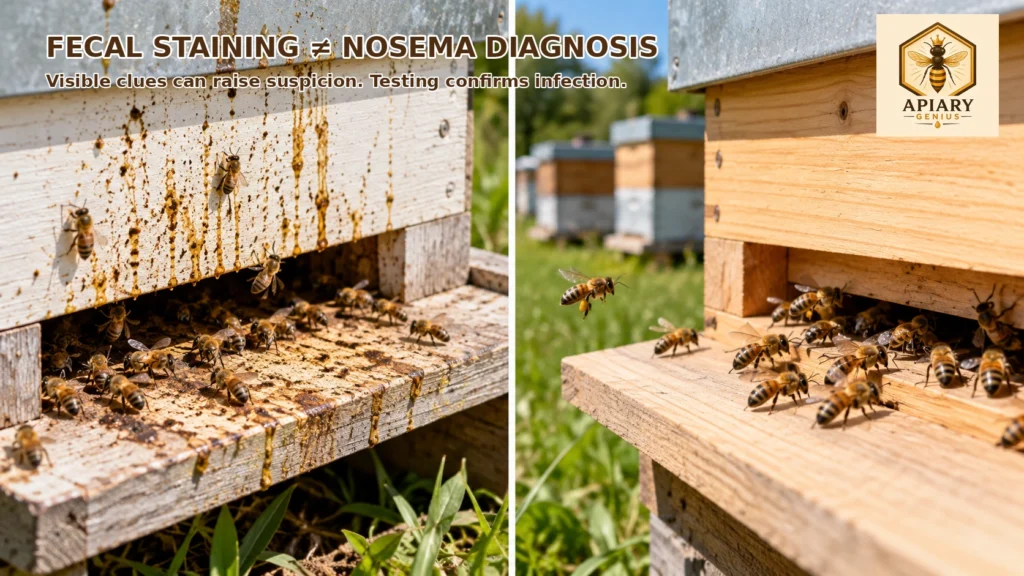
This distinction prevents one of the most common diagnostic mistakes in beekeeping:
Visible clue ≠ confirmed diagnosis.
Treat fecal staining as evidence that something deserves investigation—not as proof that you already know the cause.
How Nosema Affects Adult Honey Bees
Nosema parasites infect tissues involved in digestion and nutrient processing. Research has associated infection with changes in energy balance, feeding behavior, physiology, immune-related functions, and adult-bee longevity.
At the colony level, those individual effects may contribute to:
- reduced adult-bee lifespan;
- fewer effective workers;
- altered worker performance;
- reduced productivity;
- slower colony development;
- difficulty maintaining population strength.
The severity varies.
A laboratory study showing that Nosema can shorten worker lifespan does not mean every naturally infected colony will visibly decline.
Colony nutrition, parasite burden, weather, queen performance, other pathogens, Varroa pressure, environmental conditions, and overall colony strength can modify the outcome.
Nosema has also been investigated in relation to major colony losses and Colony Collapse Disorder. However, detecting Nosema in a weak, collapsing, or dead colony does not establish Nosema as the sole cause of the loss.
Nosema should therefore be considered within the wider health condition of the colony rather than automatically blamed whenever an infected colony performs poorly.
How Nosema Spreads Through a Colony
Transmission occurs when viable spores reach and are ingested by another adult bee.
An infected bee can shed spores in fecal material. Those spores may contaminate comb, hive surfaces, food, and other material contacted by bees.
When another adult bee ingests viable spores, the infection cycle can begin again.
Cleaning behavior may therefore contribute to transmission when workers encounter contaminated material.
Periods of prolonged confinement may also create conditions in which contamination inside the colony becomes more important because bees have fewer opportunities to make normal cleansing flights away from the hive.
Movement between colonies can matter as well.
Drifting, robbing, and management practices that transfer potentially contaminated comb, food, or equipment may contribute to pathogen movement.
This is why Nosema management is not simply about reducing infection inside individual bees. It also involves reducing opportunities for repeated exposure and transmission.
Why Some Colonies Are More Affected Than Others
Nosema exists within a much larger colony-health system.
Two colonies can test positive for Nosema yet perform very differently because infection interacts with biological and environmental pressures.
Relevant factors may include:
- quality and availability of nutrition;
- prolonged weather-related confinement;
- colony population strength;
- season and local climate;
- other pathogens;
- Varroa infestation and associated viral pressure;
- environmental stress;
- management history.
Nutrition deserves particular attention because infected bees already face physiological demands.
Ensuring that colonies have adequate food resources is part of supporting general colony health, although feeding is not a treatment for Nosema and does not replace diagnosis.
See Apiary Genius’s guide to Feeding Bees when evaluating a colony’s nutritional situation.
Likewise, colonies entering extended cold-weather confinement with multiple health problems may be less resilient. Good winter hive preparation should address colony strength, food resources, and other major health pressures rather than focusing on Nosema alone.
How to Diagnose Nosema
Diagnosing nosema in honey bees should move from observation to testing rather than from observation directly to treatment.
Start by documenting what is actually happening.
Is the colony losing adult bees? Is buildup slow? Are bees crawling? Is there fecal staining? When did the problem begin? Are nearby colonies affected? What is the colony’s food situation, queen status, and Varroa condition?
Then consider testing if Nosema remains a reasonable possibility.
Which Bees Should Be Sampled?
Sampling strategy matters because Nosema infection is not necessarily distributed evenly among all bees in a colony.
Older adult workers may be more informative for some monitoring purposes than very young bees, but the correct sampling method depends on the purpose of the test and the diagnostic service being used.
Do not assume that one universal number of bees, collection location, or preservation method applies to every Nosema test.
For example, the USDA Bee Disease Diagnosis Service has specific submission requirements for samples sent to that service.
Those instructions are USDA-specific requirements, not universal sampling rules.
If you use a university laboratory, state or provincial diagnostic service, apiary program, or other bee-health laboratory, follow that service’s current collection, preservation, and submission instructions.
What Can Microscopy Confirm?
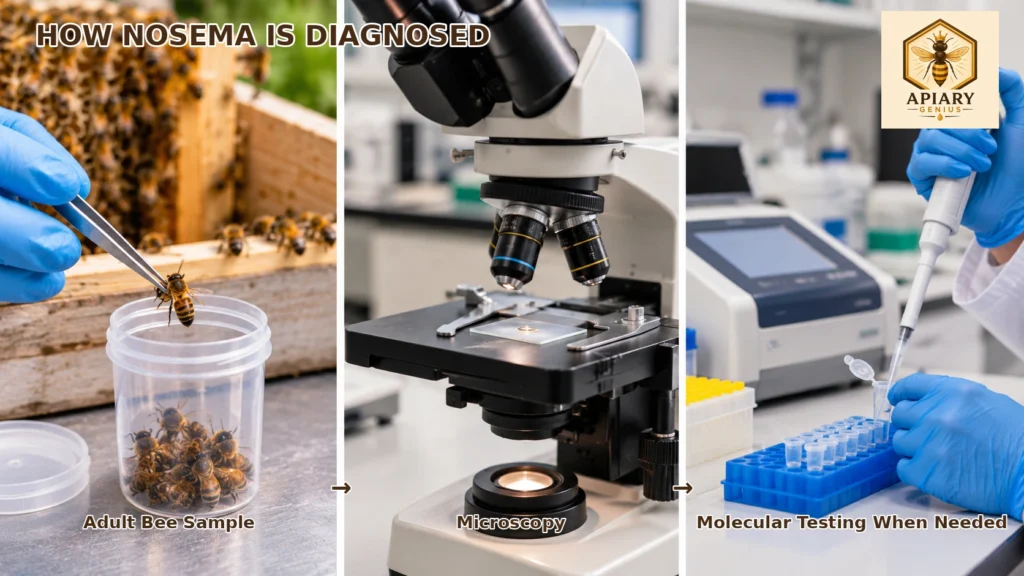
A prepared sample of adult bees can be examined under a light microscope for Nosema spores.
Microscopy can answer an important question:
Are recognizable Nosema-type spores present in the tested sample?
When standardized preparation and an appropriate counting chamber are used, microscopy can also provide an estimate of spore burden.
However, routine light microscopy generally should not be expected to reliably distinguish N. apis from N. ceranae.
Their spores overlap enough in appearance and size that species identification based only on ordinary light microscopy is unreliable.
When Is PCR Useful?
Polymerase chain reaction, or PCR, detects genetic material from the organism.
Appropriate species-specific molecular assays can distinguish N. apis from N. ceranae and may detect infections that are difficult to identify with routine microscopy.
PCR can therefore be useful when species identification matters for surveillance, research, epidemiology, or a more detailed diagnostic investigation.
However, not every diagnostic laboratory offers species-level testing.
For example, the USDA ARS Bee Disease Diagnosis Service currently examines adult-bee samples for microsporidian disease, but when Nosema is detected, the service does not determine whether N. apis or N. ceranae is present.
If species-level identification matters, confirm that the laboratory you choose actually provides an appropriate molecular assay.
And remember that sensitive molecular detection does not automatically prove that Nosema is responsible for the colony’s current condition.
Microscopy vs. Laboratory Testing
Microscopy is useful because it can provide direct evidence of Nosema-type spores and, when performed correctly, an estimate of spore burden.
A trained beekeeper with appropriate equipment and technique may be able to perform this examination.
However, microscopy has limitations.
Results can be affected by:
- sampling method;
- sample preparation;
- observer experience;
- infection intensity;
- counting technique;
- the bees selected for the sample.
Routine microscopy is also not a dependable method for determining whether the infection is caused by N. apis or N. ceranae.
Laboratory testing may provide standardized examination and, depending on the laboratory, molecular species identification.
But the services offered vary.
The USDA ARS Bee Disease Diagnosis Service, for example, can examine adult bees for microsporidian disease but currently states that it does not determine which Nosema species is present when Nosema is detected.
Therefore, before submitting samples, ask what the laboratory’s test actually reports.
If you need species-level identification, verify that the laboratory offers an appropriate molecular test rather than assuming that all Nosema testing includes species identification.
How to Interpret a Nosema Spore Count
A Nosema spore count is a measurement—not a verdict.
Spore counts can help estimate infection burden in the sampled bees. They can also be useful when comparing colonies or monitoring changes over time if sampling and counting methods are standardized.
But one number should not be turned into a universal rule for every apiary.
You may encounter recommendations stating that a particular number of spores per bee automatically requires treatment.
The often-repeated figure of one million spores per bee, for example, should not be treated as a universal biological treatment threshold.
Interpretation can depend on:
- which bees were sampled;
- how the bees were collected;
- how many bees were pooled;
- sample preparation;
- season;
- geography;
- Nosema species;
- colony condition;
- other health problems;
- the purpose of the test.
Research and extension literature have questioned the scientific basis for using a single spore-count threshold as an automatic treatment decision.
The Canadian national honey-bee biosecurity guidance also emphasizes that pest-management thresholds can depend on sampling method, timing, geography, and other parasites or stressors.
The safest interpretation is therefore:
Detection ≠ serious disease.
A higher spore count ≠ proof that Nosema caused every observed problem.
One spore count ≠ an automatic treatment decision.
Use the count as one piece of evidence within the larger diagnostic picture.
What to Do If You Suspect Nosema
If you suspect nosema in bees, resist the temptation to jump directly to treatment.
Instead, work through a diagnostic sequence.
- Record the visible problem. Note population changes, fecal staining, crawling bees, unusual adult mortality, food stores, brood pattern, queen performance, and unusual behavior.
- Look for competing explanations. Check major colony-health factors, including Varroa pressure, nutrition, queen status, weather-related stress, and signs of other diseases.
- Compare colonies. Differences between the suspect colony and nearby colonies can provide useful context.
- Test adult bees when Nosema remains a reasonable possibility. Choose microscopy or an appropriate diagnostic laboratory according to the information you need.
- Interpret the result with the colony—not separately from it. A positive sample from an apparently strong, productive colony does not necessarily have the same significance as a substantial infection found repeatedly in a colony that is progressively dwindling.
- Decide whether intervention is justified. Consider colony condition, other health problems, current evidence, local recommendations, and the regulatory status of any product being considered.
A careful hive inspection can help document the broader picture. Apiary Genius’s guide to the Best Time to Inspect a Beehive can help you choose conditions that allow a useful inspection without unnecessary disruption.
Is There a Treatment for Nosema?
There is no responsible one-line treatment recommendation that applies to every beekeeper and every jurisdiction.
Fumagillin has a long history of use against Nosema and has been extensively studied. However, historical use, scientific evidence, product availability, regulatory approval, and legal use are separate issues.
What Fumagillin Can and Cannot Do
Fumagillin has biological activity against actively developing stages of Nosema and has historically been used to suppress Nosema infections.
However, it does not simply sterilize a colony or eliminate all dormant spores from contaminated equipment.
Scientific evidence that a substance can suppress an organism also does not automatically mean that every product containing that substance is currently approved or legally authorized in every country.
That distinction is critical:
Evidence of biological activity ≠ current regulatory approval everywhere.
Why Local Regulations Matter
Beekeepers should not rely on old books, outdated labels, forum advice, or another country’s regulations when deciding whether fumagillin can be legally used.
The United States provides a good example of why current verification matters.
FDA records show that approval of the historical FUMIDIL B application, NADA 009-252, was withdrawn in 2013.
At the same time, current U.S. drug listings may still include fumagillin products. A product’s appearance in an NDC or DailyMed listing does not by itself establish FDA approval.
Current DailyMed information for fumagillin bee products includes an FDA disclaimer stating that the drugs have not been found by FDA to be safe and effective and that their labeling has not been FDA-approved.
That means U.S. beekeepers should verify current federal and state requirements rather than assuming that historical use means a particular product is currently FDA-approved or legally appropriate for their situation.
Regulatory systems differ in other countries as well.
Before considering any medication:
- verify the current regulatory status where your colonies are located;
- verify the status of the specific product, not just the active ingredient;
- read the current product label;
- follow applicable honey-harvest or withdrawal restrictions;
- consult relevant veterinary, agricultural, or apiary authorities where appropriate;
- never invent or adapt a dosage from another product;
- do not assume historical recommendations remain current;
- do not use a product off-label unless that use is explicitly lawful under the applicable regulatory framework.
What About Natural or Alternative Products?
Essential oils, plant extracts, probiotics, supplements, herbal preparations, and other experimental compounds have been investigated for Nosema.
That does not automatically make them proven treatments.
A laboratory experiment, small field trial, reduction in a measured spore count, or commercial claim does not by itself establish that a product reliably improves colony health under normal beekeeping conditions.
Keep these three questions separate:
Has it been studied?
Has it been shown reliably effective?
Is it approved or legally authorized for this use?
These questions are not interchangeable.
Until strong evidence and appropriate regulatory guidance support a product, it should not be presented to beekeepers as a proven Nosema treatment.
How to Manage an Affected Colony
Management should address the colony as a whole rather than focusing exclusively on a Nosema test result.
Start with confirmation and assessment.
Determine whether Nosema is actually present, evaluate how the colony is performing, and check whether other significant problems are occurring at the same time.
Then address relevant colony stress where practical.
Make sure the colony has appropriate food resources, evaluate queen performance and population strength, and address major parasite problems such as Varroa using evidence-based methods.
Reduce unnecessary movement of potentially contaminated material between colonies. Avoid casually transferring comb or food from a suspect colony into healthy colonies.
Continue monitoring after management changes.
Repeating an appropriate Nosema test may sometimes help determine whether measured infection burden is changing, particularly when comparable sampling methods are used.
But the laboratory number is not the only outcome that matters.
Colony strength, adult population, productivity, food resources, queen performance, and other health indicators also matter.
The goal is not simply to produce a lower spore count.
The goal is to maintain a functioning, resilient colony while reducing relevant disease and stress pressure.
What to Do With Contaminated Comb and Equipment
A Nosema diagnosis does not automatically mean that all comb and equipment must be destroyed.
Nosema spores can remain a potential source of reinfection outside infected adult bees. That makes contaminated material relevant, but it does not justify arbitrary rules such as destroying every frame or replacing a fixed percentage of comb.
Avoid unnecessarily transferring suspect comb, food frames, or other potentially contaminated material from an affected colony into healthy colonies.
Use good apiary sanitation and biosecurity practices, and follow current regional or national guidance when specific decontamination procedures are warranted.
It is also important to understand the difference between suppressing active infection in adult bees and reducing environmental contamination.
A treatment that affects developing Nosema inside infected bees does not automatically sterilize comb or equipment or eliminate every viable spore from the colony environment.
Some decontamination methods have been investigated or used historically, but their effectiveness, practicality, safety, and effect on beekeeping materials vary.
For that reason, do not improvise chemical treatments, heat procedures, or other disinfection methods from incomplete online instructions.
The practical principle is:
Reduce unnecessary infection pressure without creating a new equipment, residue, or safety problem.
How to Prevent Nosema
There is no single management practice that guarantees nosema prevention.
A stronger strategy is to reduce opportunities for pathogen transmission while maintaining colonies that are better able to withstand stress.
Useful practices include:
- maintain adequate colony nutrition;
- monitor colony strength and health regularly;
- monitor and control Varroa using evidence-based methods;
- avoid unnecessary movement of suspect comb and equipment between colonies;
- reduce robbing and excessive drifting where practical;
- maintain sensible equipment sanitation and apiary biosecurity;
- investigate persistent adult-bee decline rather than guessing at the cause;
- obtain bees and equipment from sources with known health histories when possible;
- keep useful records of colony observations, disease findings, and test results.
Prevention should be viewed as a system rather than a single intervention.
The Canadian Food Inspection Agency’s honey-bee biosecurity guidance emphasizes reducing susceptibility and exposure, monitoring colony health, obtaining accurate diagnoses, responding appropriately to disease, and maintaining sanitation and biosecurity.
Those principles apply well to Nosema management.
Can Nosema Come Back?
Yes.
A colony that improves can later test positive again.
Nosema is not necessarily a one-time visible outbreak that permanently disappears when the bees begin to look healthy.
Viable spores can remain potential sources of exposure, infected bees can contribute to continuing transmission, and new exposure may occur.
Colony conditions also change over time.
A strong colony during one part of the year may later face different nutritional, environmental, parasite, or seasonal pressures.
Successful management therefore should not be defined as:
“I treated once, so Nosema is gone forever.”
A better long-term approach is:
Monitor → Manage relevant stressors → Reduce transmission opportunities → Retest when justified → Reassess
The possibility of recurrence also reinforces why medication—where an appropriate medication is legally available and justified—should not replace broader colony-health management.
Common Nosema Management Mistakes
One of the biggest mistakes is diagnosing Nosema from fecal streaking alone.
Dysentery is a clue, not confirmation.
Another mistake is assuming that a hive without dysentery cannot have Nosema. Infection can occur without obvious fecal staining.
A third mistake is treating every positive test as proof of clinically important disease.
Detection tells you that evidence of the organism was found in the tested sample. It does not automatically establish that Nosema is the main cause of colony weakness.
Avoid using a single universal spore-count threshold as an automatic treatment trigger regardless of sampling method, season, species, geography, and colony condition.
Do not assume ordinary light microscopy reliably distinguishes N. apis from N. ceranae.
Do not blame Nosema for every dwindling colony without assessing other important possibilities, including Varroa, nutrition, queen performance, environmental stress, other pathogens, and pesticide exposure where relevant.
Do not assume that because fumagillin was historically used, a particular product is currently approved, available, or legally appropriate in your location.
And do not turn preliminary research on essential oils, probiotics, herbal products, supplements, or experimental compounds into proven treatment recommendations.
The common thread behind these mistakes is simple:
Observation, detection, clinical importance, and causation are different things.
Frequently Asked Questions About Nosema
What is Nosema in honey bees?
Nosema in honey bees is a microscopic infection of adult bees caused mainly by Nosema apis and Nosema ceranae. These microsporidian parasites infect the digestive system and may affect adult-bee physiology, longevity, and colony performance. Visible signs alone cannot reliably confirm the infection.
What are the most common Nosema symptoms?
Possible signs include poor colony buildup, declining adult populations, weak or crawling bees, reduced productivity, and fecal staining. However, none of these signs is specific enough to diagnose Nosema.
Is bee dysentery the same as Nosema?
No. Dysentery can occur in colonies with Nosema, but it can also occur for other reasons. Fecal staining should raise a diagnostic question rather than provide the diagnosis.
Can bees have Nosema without dysentery?
Yes. The absence of visible fecal streaking does not rule out Nosema infection.
How do you test bees for Nosema?
If you are wondering how to test bees for Nosema, the main approaches are microscopic examination of an adult-bee sample and laboratory testing. Microscopy can detect Nosema-type spores and estimate spore burden, while appropriate molecular tests such as species-specific PCR can help distinguish N. apis from N. ceranae. Follow the sampling instructions of the specific laboratory or diagnostic service you use.
Can a microscope tell whether I have Nosema apis or Nosema ceranae?
Routine light microscopy can detect Nosema-type spores but generally should not be relied on for definitive species identification. Appropriate molecular testing is more useful when species-level identification is needed.
Does a high spore count mean Nosema is killing the colony?
Not necessarily.
A higher count indicates a greater measured spore burden in the sample, but it does not by itself prove that Nosema is responsible for the colony’s condition.
Interpret the result alongside sampling method, colony condition, season, other parasites and pathogens, nutrition, and environmental factors.
Is one million Nosema spores per bee a treatment threshold?
It should not be treated as a universal treatment threshold.
The significance of a spore count depends on sampling method, timing, geography, species, colony condition, and other factors.
Does Nosema infect brood?
Nosema disease in Apis mellifera is primarily an infection of adult honey bees.
It should not be confused with brood diseases such as American foulbrood, European foulbrood, chalkbrood, or sacbrood.
Does Nosema cause Colony Collapse Disorder?
Nosema has been investigated in relation to colony health and colony losses, but detecting Nosema does not prove that it caused a colony’s collapse.
Colony losses can involve multiple interacting pathogens, parasites, nutritional conditions, environmental pressures, and other stressors.
Should I treat every colony that tests positive?
No.
A positive Nosema result should be interpreted in context. Consider infection burden, colony condition, other health problems, local guidance, and whether any appropriate treatment is currently legally authorized where you keep bees.
Is fumagillin a Nosema treatment?
Fumagillin has historically been used and scientifically studied against Nosema.
However, historical use and biological efficacy are different from current regulatory approval and legal use.
Product authorization and availability vary by country and may change over time. Always verify current regulations and the status and label of the specific product in your jurisdiction.
Can essential oils or probiotics cure Nosema?
Research has investigated various alternative products, but studied does not mean proven effective or approved.
Experimental findings should not automatically be converted into practical treatment recommendations.
Final Thoughts
Nosema in honey bees is a good example of why responsible disease management begins with diagnosis rather than appearance.
Fecal streaking, crawling bees, poor buildup, reduced productivity, or declining adult populations can justify further investigation, but none of those signs confirms Nosema.
Likewise, finding Nosema spores or detecting Nosema genetic material does not automatically prove that the infection is responsible for the colony’s current problems.
The most useful approach remains:
Observe → Suspect → Rule out other explanations → Test → Interpret the result → Decide whether action is warranted → Manage the colony → Reduce future risk
Use microscopy or appropriate laboratory testing when confirmation is needed.
Interpret spore counts in context instead of relying on a universal treatment threshold.
Evaluate other major colony-health factors, especially nutrition, Varroa pressure, queen performance, colony strength, other pathogens, and environmental conditions.
And when treatment is being considered, separate historical use and experimental evidence from current regulatory authorization.
Regulations and product availability can change, so verify the current rules and product labeling where you keep bees.
That approach may be less convenient than diagnosing a colony from one visible sign, but it is far more likely to lead to sound, evidence-based beekeeping decisions.
Sources
- Penn State Extension — Nosema Disease of Honey Bees
- USDA Agricultural Research Service — Nosema Disease
- USDA Agricultural Research Service — Bee Disease Diagnosis Service
- USDA Agricultural Research Service — How to Submit Samples
- Agriculture Victoria — Nosema Disease of Honey Bees
- Canadian Food Inspection Agency — Honey Bee Producer Guide to the National Bee Farm-Level Biosecurity Standard
- FDA — How Can I Tell if a Drug Is Legally Marketed for Animals?
- Federal Register — Withdrawal of Approval of New Animal Drug Applications
- DailyMed — Fumagillin Drug Information
- PubMed — Fumagillin Treatment and Nosema Infection Research