
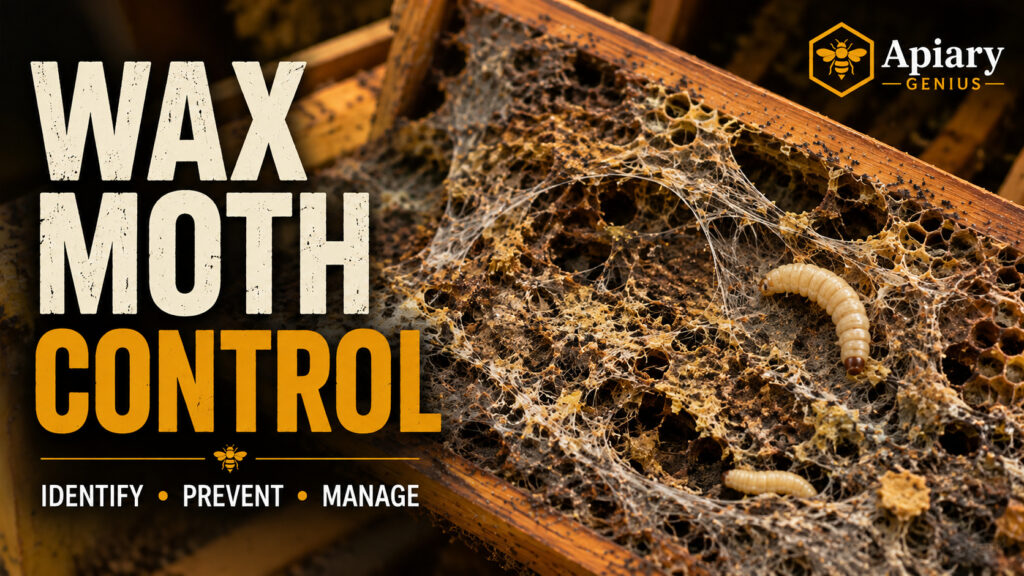
Finding webbing, tunnels, damaged comb, or pale caterpillar-like larvae inside a hive can be alarming. Wax moths can destroy valuable drawn comb and, in severe cases, damage wooden frames and hive equipment. But seeing wax moths does not automatically mean they caused a colony to fail.
In an active beehive, serious wax moth problems are usually associated with a colony that is already weak, stressed, queenless, declining, or unable to defend all of its comb. Stored comb is different: once frames are removed from the protection of a strong bee population, they can become highly vulnerable to wax moth infestation.
Effective wax moth control therefore starts with identifying what you are dealing with and determining whether the problem is occurring in a living colony or in stored equipment. From there, you can address the underlying colony problem, salvage usable comb, protect stored frames, and reduce the chance of another infestation.
Table of Contents
What Are Wax Moths?
Wax moths are opportunistic pests associated with honey bee colonies and stored beekeeping equipment. The two species beekeepers most commonly encounter are the greater wax moth (Galleria mellonella) and the lesser wax moth (Achroia grisella).
The greater wax moth is generally the more important pest of stored comb. Lesser wax moths can cause similar damage but are smaller. According to the University of Florida IFAS Extension, both species can occur around honey bee colonies, while serious problems are much more likely when a colony is weakened or comb is stored without bees to protect it.
Adult moths themselves are not responsible for the characteristic destruction of comb. The damaging stage is the larva.
Female moths seek protected locations where they can lay eggs, including cracks and crevices associated with hive equipment. Once the eggs hatch, the larvae move through the comb and feed on material associated with it.
Older, darker brood comb is particularly vulnerable because it contains pollen residues, discarded larval and pupal skins, and other organic material. Although they are commonly called “wax moths,” their relationship with comb involves more than simply eating pure beeswax.
As larvae grow, they produce silk webbing and leave behind frass. Mature larvae eventually seek protected places in which to pupate, sometimes chewing depressions or grooves into wooden frames and hive bodies before forming their cocoons.
This life cycle explains why an infestation can become so destructive in stored equipment. Without a large population of worker bees constantly policing the comb, larvae can move and feed relatively undisturbed.
How to Identify Wax Moths in a Beehive
Correct identification matters because not every pale larva found in a hive is a wax moth larva.
Adult Wax Moths
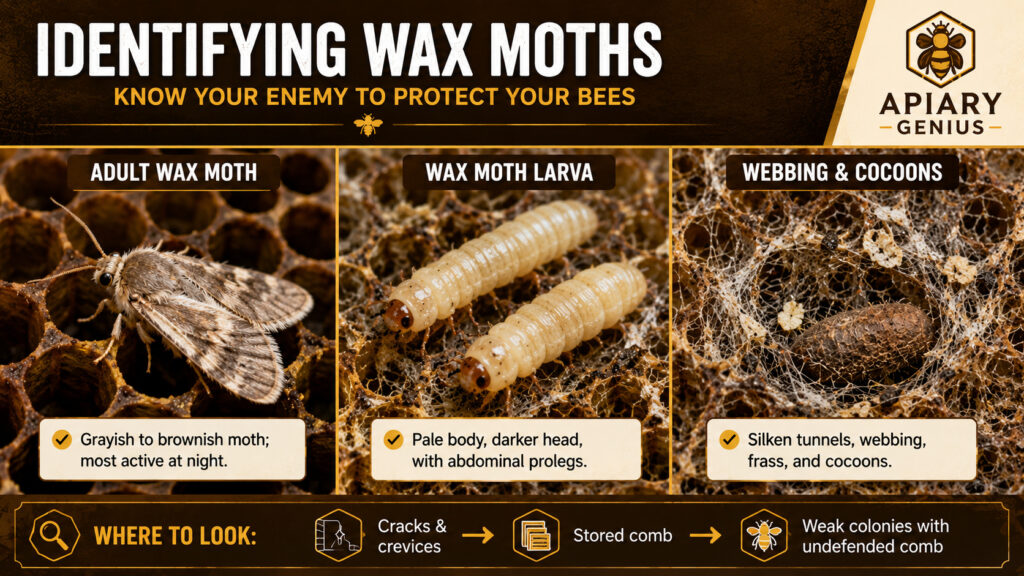
Adult greater wax moths are grayish to brownish moths with relatively narrow wings. Their coloration and resting posture can make them inconspicuous against wooden hive equipment.
Lesser wax moth adults are smaller and more slender. UF/IFAS Extension’s lesser wax moth profile describes adults as ranging from silver-gray to beige, with a prominent yellowish head.
Adult moths are primarily nocturnal, so beekeepers may never see many of them during routine daytime inspections. Finding larvae, webbing, cocoons, or damaged comb is generally more useful diagnostically than relying on adult moth sightings alone.
Wax Moth Larvae
Wax moth larvae are caterpillar-like rather than maggot-like.
They are generally pale cream, whitish, or grayish, with a noticeably darker head. As they mature, greater wax moth larvae can become substantially larger than small hive beetle larvae.
A useful identifying feature is the presence of abdominal prolegs in addition to the three pairs of true legs near the front of the body.
The larvae frequently occur within silken tunnels running through comb. This webbing is one of the strongest practical clues that wax moth larvae are responsible for the damage.
Eggs, Cocoons, and Pupae
Wax moth eggs are tiny and may be deposited in protected cracks where worker bees have difficulty reaching them. For most beekeepers, locating individual eggs is less practical than identifying later signs of infestation.
Mature larvae leave the feeding area and look for protected places to pupate. They spin tough silken cocoons, which may be found on frames, boxes, corners, or other protected surfaces.
These cocoons can become covered with frass and debris, making them less obvious than clean white silk would suggest.
Signs of a Wax Moth Infestation
Wax moth damage tends to become increasingly obvious as larval numbers increase.
One of the most recognizable signs is silk webbing running across or through the comb. Heavy infestations can produce thick mats of webbing that bind sections of comb together and make frames difficult to separate.
Other signs include:
- Pale or grayish caterpillar-like larvae
- Tunnels through the comb
- Frass and granular debris
- Damaged or chewed comb
- Silken cocoons attached to frames or hive surfaces
- Grooves or depressions chewed into wooden equipment
- Large areas of collapsed or unusable comb in advanced infestations
Dark brood comb often shows damage more readily than clean, newly drawn honey comb.
Wax moth larvae moving beneath capped brood can also contribute to a condition known as bald brood. Worker bees detect the disturbance and remove portions of the cappings, sometimes leaving lines of exposed pupae that correspond to the larva’s path through the comb.
However, bald brood should not be treated as proof of a major wax moth infestation by itself. The beekeeper should inspect the surrounding comb for larvae, silk, tunnels, and other supporting evidence.
During regular inspections, look beyond individual pests and evaluate the condition of the colony as a whole. If you are unsure how often or under what conditions to open a hive, see our guide to the best time to inspect a beehive.
Wax Moth Larvae vs. Small Hive Beetle Larvae
Wax moth larvae and small hive beetle larvae can both appear pale and can both be found in damaged hive material, which makes misidentification possible.
Fortunately, several practical differences can help.
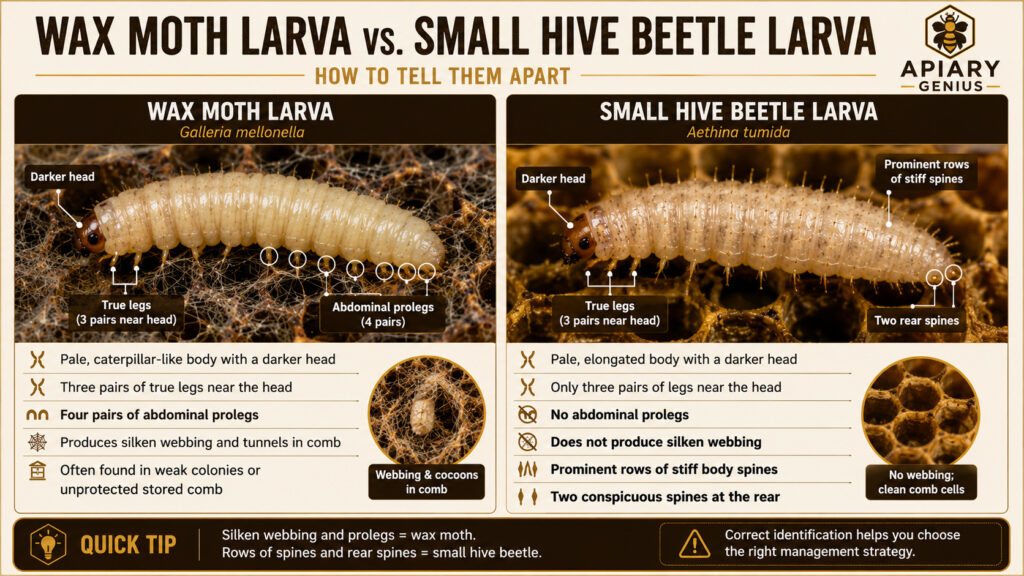
Wax moth larvae typically:
- Have three pairs of true legs near the head plus additional abdominal prolegs
- Lack the prominent rows of stiff body spines characteristic of small hive beetle larvae
- Lack the two conspicuous rear spines seen on small hive beetle larvae
- Can grow larger than small hive beetle larvae
- Produce obvious silk webbing and tunnels through comb
Small hive beetle larvae typically:
- Have only three pairs of legs near the head
- Have distinctive body spines
- Have two relatively prominent spines projecting from the rear
- Do not produce the characteristic silk webbing associated with wax moths
- May occur in groups in corners or areas containing damaged honey and pollen
Utah State University Extension provides a particularly useful visual comparison of small hive beetle and wax moth larvae, including the differences in legs and body spines.
The surrounding damage also provides clues. Heavy small hive beetle activity may be associated with slimy, fermenting comb and damaged honey, while extensive silken galleries and webbing point much more strongly toward wax moths.
If your larvae look more like small hive beetles, read our complete guide to Small Hive Beetle Control: How to Identify, Prevent, and Manage an Infestation rather than applying wax moth management methods to the wrong pest.
How Wax Moths Damage Comb and Hive Equipment
Wax moth damage can range from a few localized tunnels to the destruction of entire boxes of drawn comb.
Young larvae enter and move through comb while feeding on material associated with the wax. As they develop, they create silk-lined tunnels. Webbing accumulates as the infestation progresses, while frass and debris become mixed into the damaged comb.
Brood comb is particularly attractive because it contains accumulated organic material from repeated brood cycles. Older, darker comb therefore tends to be at greater risk than clean foundation or relatively new comb used primarily for honey storage.
Severe infestations can leave comb shredded, webbed together, contaminated with debris, and structurally unusable.
The damage does not necessarily stop at the wax.
Mature greater wax moth larvae can chew into woodenware while searching for places to pupate. Grooves and shallow cavities may appear in frame parts or the inside surfaces of hive boxes. Heavy damage can weaken equipment enough that replacement becomes more practical than repair.
This is one reason drawn comb should be treated as valuable equipment rather than simply being stacked in an unprotected shed after harvest.
A strong colony can defend comb continuously. Stored frames cannot.
Why Wax Moths Infest Some Bee Colonies
Finding wax moths in an active hive should prompt an important question:
Why was the colony unable to control them?
Wax moths are generally considered secondary or opportunistic pests in living honey bee colonies.
UF/IFAS Extension notes that worker bees in healthy colonies routinely eliminate wax moth eggs and larvae and keep their populations under control. Large wax moth populations inside living colonies usually become possible after the bee population has declined for another reason.
Potential underlying problems include:
- A failing or missing queen
- Disease
- Heavy parasite pressure
- Starvation or inadequate nutrition
- Pesticide exposure
- Excessive space relative to the number of bees
- Recent colony decline or major population loss
- Other stresses that leave too few bees to defend the available comb
The University of Arkansas Cooperative Extension Service similarly describes the greater wax moth as an opportunistic hive pest and emphasizes maintaining strong, healthy colonies as the best defense.
This distinction is essential.
If a weak hive contains wax moth larvae, simply killing the larvae without addressing the colony’s weakness is not an adequate solution.
For example, if the colony is queenless or has a failing queen, queen status needs attention. Our guide on how to requeen a beehive explains the broader requeening process.
Likewise, a declining colony should be evaluated for other major health pressures. Varroa remains one of the most important threats to honey bee health, so unexplained colony weakness may justify reviewing your monitoring and management approach in our guide to controlling Varroa mites.
The presence of wax moth damage can therefore be a symptom of a larger colony-management problem rather than the original cause.
What to Do If You Find Wax Moths in an Active Hive
The first response should not be to reach automatically for a pesticide.
Instead, determine the severity of the infestation and the condition of the bees.
1. Confirm That Wax Moths Are Actually Present
Look for larvae, silk webbing, tunnels, frass, cocoons, and characteristic comb damage.
If the larvae have prominent body spines and no webbing is present, reconsider whether you may be dealing with small hive beetles.
2. Evaluate Colony Strength
Look at how many frames are actually covered and defended by bees.
A colony occupying only a small portion of a large hive may have more comb than its workforce can patrol effectively.
Evaluate brood, food stores, adult population, and general activity rather than judging strength from the number of boxes alone.
3. Check Queen Status
Look for evidence of a functioning queen, including eggs and an appropriate brood pattern for the season and colony condition.
If the colony appears queenless or the queen is failing, the wax moths may be taking advantage of a decline that began for another reason.
4. Look for Other Health Problems
Assess the colony for Varroa pressure, signs of disease, nutritional stress, and other factors that may have reduced its population.
Treating the visible wax moth problem while ignoring a severe underlying stressor is unlikely to produce a lasting recovery.
5. Remove Comb the Colony Cannot Defend
If the bee population is too small to occupy all of the available equipment, reducing excessive empty space may help the bees defend the remaining comb.
Do not leave badly infested frames beside the hive or exposed in the apiary. Larvae and moths can continue developing in abandoned comb.
6. Decide Whether the Colony Can Recover
A mildly affected but viable colony may recover if the underlying problem is corrected and the bees are given an appropriately sized space to defend.
A severely declining colony requires a broader management decision based on queen status, disease risk, population, season, food stores, and local conditions.
Wax moth removal alone cannot rebuild a failing colony.
How to Control Wax Moths in a Beehive
For an active colony, the foundation of wax moth control is colony management, not routine chemical treatment.
UF/IFAS Extension specifically states that chemical control options are not available for controlling wax moths in living bee colonies in its guidance and emphasizes keeping colonies strong, healthy, and queenright instead.
That principle is more useful than trying to find a product to kill every moth larva you see.
Strengthen or Correct the Colony
If the colony has enough bees and is otherwise recoverable, address the factor allowing the infestation to develop.
That may mean correcting queen problems, addressing excessive hive space, improving nutrition where appropriate, or managing another pest or disease.
Reduce Unprotected Comb
A small population should not be expected to patrol an unnecessarily large volume of comb.
Removing empty boxes or frames that the colony cannot defend can concentrate the bees in a more manageable space. Any removed comb must then be protected as stored equipment rather than left exposed.
Physically Remove Heavy Infestations
Badly webbed comb, dense accumulations of larvae, cocoons, and debris should be removed from the active hive.
Frames and boxes should be assessed individually rather than assuming that everything must either be saved or discarded.
Avoid Unverified In-Hive Treatments
Do not place mothballs, household insecticides, fumigants, or other unapproved chemicals inside an occupied beehive.
Pesticide registrations and permitted uses differ among countries and can change over time. A product that has a legal stored-equipment use in one jurisdiction may not be approved in another, and that does not mean it can be used around live bees or honey intended for human consumption.
Always follow the current product label and applicable national or local regulations.
How to Deal With Wax-Moth-Damaged Comb
Not every frame touched by wax moth larvae needs to be discarded.
The appropriate response depends on the extent of the damage.
Lightly Damaged Comb
If damage is limited and the comb remains structurally sound, it may be possible to save the frame.
First, make sure the moth life stages are eliminated. Freezing is a practical nonchemical option for equipment that fits in an appropriate freezer.
After treatment, remove loose webbing, cocoons, and debris and inspect the frame carefully.
Usable comb can sometimes be returned to a strong colony, where the bees may clean and repair moderate damage.
Heavily Damaged Comb
Comb that has been extensively tunneled, webbed, distorted, contaminated with debris, or structurally weakened may not be worth saving.
Remove severely destroyed wax and assess the underlying frame and foundation.
Plastic foundation may sometimes survive an infestation even when the drawn wax has been destroyed, provided the foundation itself remains intact and can be appropriately cleaned.
Damaged Woodenware
Inspect frame top bars, side bars, bottom bars, box walls, and corners for cocoon sites and chewing damage.
Minor surface damage does not automatically make a box unusable, but badly weakened or deeply damaged components should be replaced.
Cleaning equipment is also an opportunity to inspect for unrelated problems. Freezing can kill wax moth life stages, but it should not be confused with sterilization against every honey bee pathogen.
Utah State University Extension’s guidance on cleaning and sterilizing beekeeping equipment specifically notes that freezing equipment does not kill bacteria, viruses, or harmful spores.
If a colony died for an unknown reason and disease is suspected, do not assume that killing the wax moths makes its comb automatically safe to reuse.
How to Protect Stored Comb From Wax Moths
Stored comb requires a different strategy from an active bee colony.
Once supers and frames are removed from the hive, they lose the protection provided by thousands of worker bees. Dark brood comb is especially vulnerable.
Freeze Comb Before Storage
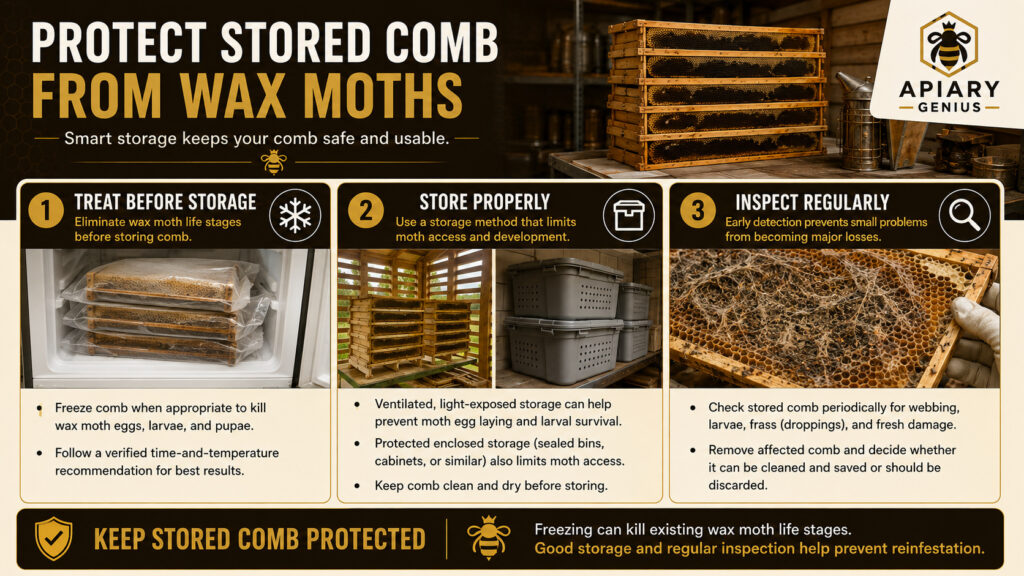
Freezing can kill wax moth life stages already present in the equipment.
After freezing, however, the frames still need to be stored in a way that prevents adult moths from reaching them and laying new eggs.
Freezing is a treatment, not a permanent protective barrier.
Use Secure Storage
For smaller quantities of valuable drawn comb, sealed or otherwise moth-excluding storage can reduce the chance of reinfestation after the comb has been treated.
Inspect containers and stacks for openings through which adult moths could enter.
Consider Light and Ventilation Where Appropriate
UF/IFAS Extension describes increased light and airflow as a nonchemical method for protecting light comb. Supers can be arranged to maximize ventilation and light penetration in a covered, open-sided location.
This approach is not equally practical in every climate, storage building, or operation, and dark brood comb remains more attractive to wax moths.
Inspect Stored Comb Regularly
Do not assume that stored supers are safe because they looked clean when stacked.
Periodically check for:
- New webbing
- Larvae
- Frass
- Cocoons
- Tunnels through comb
- Adult moth activity
- New damage to frames or boxes
Early detection can turn a manageable problem into a few treated frames instead of a stack of destroyed supers.
Be Cautious With Chemical Fumigation
Chemical control of stored comb is highly dependent on jurisdiction, current pesticide registration, equipment type, and label instructions.
UF/IFAS notes that the availability and suitability of fumigants change and emphasizes that pesticides used on stored comb must be specifically labeled for that use.
For readers in the United States or Europe, the safest general rule is simple:
Do not assume that a chemical mentioned in an old book, forum, video, or another country’s Extension publication is currently legal for your stored comb.
Check current national and local regulations and the exact product label before use. Never improvise a fumigation treatment around equipment that will later hold bees or food.
Can Freezing Kill Wax Moths and Their Eggs?
Yes. Proper freezing can kill wax moth life stages and is one of the most useful nonchemical tools available to small-scale beekeepers.
However, exact temperature-and-time recommendations vary among Extension publications.
For example, Utah State University Extension recommends freezing disassembled equipment at 20°F (-6.7°C) or lower for at least 24 hours as part of its cleaning procedure and states that this kills all stages of wax moths.
UF/IFAS Extension’s wax moth control guidance provides a more conservative procedure for infested honeycomb and equipment: placing it in a freezer for at least 72 hours.
Rather than treating these recommendations as contradictory universal rules, follow a validated procedure appropriate to your equipment, freezer temperature, and local Extension guidance.
For a home beekeeper using a conventional freezer, allowing adequate time for the entire mass of frames and comb to reach the target temperature is important. A tightly packed box of warm supers does not become uniformly frozen the instant it enters the freezer.
Frozen beeswax can also be brittle, so handle frames carefully while they are still very cold.
Most importantly, remember what happens after the frames come out.
If treated comb is returned to an accessible storage area, adult moths can lay new eggs on it. Freeze the comb and then protect it from reinfestation.
How to Prevent Wax Moth Infestations
Effective wax moth control and prevention have two distinct parts: maintaining strong, defensible colonies and protecting comb once it leaves those colonies.
Keep Colonies Strong
A populous, healthy colony is the primary biological defense against wax moth establishment inside an active hive.
Monitor queen performance, food availability, brood condition, colony population, and major pests rather than focusing on wax moths in isolation.
Keep Hive Space Appropriate to Colony Strength
Adding more boxes is not always beneficial.
If a colony has far more comb than its population can patrol, pests gain access to poorly defended areas.
Give colonies the space they need, but avoid leaving weak colonies with large volumes of unused comb.
Address Queen Problems Promptly
A failing or missing queen can lead to a declining worker population and eventually leave comb undefended.
Regular inspections can help detect changes in brood pattern and queen status before colony strength falls dramatically.
Manage Other Colony Stressors
Wax moths often take advantage of problems rather than create them.
Varroa, disease, inadequate nutrition, queen problems, pesticide exposure, and other stresses can reduce the number of bees available to defend the hive.
Integrated colony health management is therefore part of wax moth prevention.
Protect Dead-Out Equipment Quickly
Once a colony dies or abandons equipment, the comb loses its bee defense immediately.
Do not leave valuable drawn comb sitting unprotected while deciding what to do with it.
First determine whether disease could affect its safe reuse. Then protect appropriate equipment from wax moths and other pests.
Protect Supers After Harvest
Once supers are removed from colonies, move them promptly into your chosen protection system rather than leaving stacks exposed for moths to enter.
If you store equipment for winter, incorporate pest protection into your broader seasonal preparations. Our guide on how to prepare your beehive for winter covers the colony-management side of winter preparation.
Keep Storage Areas Clean
Remove loose wax, cappings, comb scraps, and other hive debris from storage and extraction areas.
Good sanitation does not replace freezing or exclusion, but it reduces pest-friendly material and makes new activity easier to detect.
Check Equipment Throughout Storage
Wax moth prevention is not a one-time event.
A few minutes spent periodically checking stored comb can prevent extensive losses, particularly during warm periods when moth development is favored.
Common Wax Moth Control Mistakes
Mistake 1: Assuming Wax Moths Killed the Colony
A hive full of webbing can make wax moths look like the obvious cause of failure.
But serious wax moth activity often develops after the colony has already become weak or died.
Look for the underlying reason the bees stopped defending their comb.
Mistake 2: Treating Active Hives and Stored Comb the Same Way
The management strategies are fundamentally different.
Inside a living colony, focus on colony strength, queen status, other health problems, appropriate hive space, and removal of heavily damaged material.
Stored comb has no bee population to defend it, so physical protection, freezing, suitable storage, inspection, and—in jurisdictions where appropriate—properly labeled treatments become relevant.
Mistake 3: Confusing Small Hive Beetle Larvae With Wax Moth Larvae
This can lead to the wrong response.
Look for silk webbing, abdominal prolegs, body spines, rear spines, and the pattern of damage before deciding which pest you have.
Mistake 4: Freezing Comb and Then Leaving It Exposed
Freezing can kill the wax moth stages already present.
It does not prevent another adult moth from laying eggs on the comb afterward.
Protect treated frames from reinfestation.
Mistake 5: Saving Comb That Is Beyond Practical Repair
Drawn comb is valuable, but severely destroyed comb may require more labor to clean than it is worth.
Save structurally sound equipment when practical, but replace material that is badly compromised.
Mistake 6: Using Household Moth-Control Products in Beekeeping Equipment
A household product being labeled for clothes moths does not mean it is approved for beekeeping equipment.
Never put household insecticides or unverified moth-control chemicals into a hive or stored comb intended for future bee or honey use.
Mistake 7: Ignoring the Rest of the Colony
Removing larvae while overlooking a failing queen, severe Varroa problem, starvation, disease, or a critically low adult population treats the symptom rather than the cause.
Effective wax moth control starts with the bees.
Frequently Asked Questions About Wax Moths
Are wax moths dangerous to a healthy beehive?
Wax moth eggs or larvae may occur around colonies without causing serious damage. A strong, populous colony normally keeps wax moth populations under control by removing intruders and defending its comb.
A substantial infestation inside an active colony should therefore trigger an assessment of why that colony is weak or unable to defend its hive.
Do wax moths kill bee colonies?
They can seriously damage comb in weakened colonies, but heavy wax moth infestation is often a consequence of colony decline rather than its original cause.
UF/IFAS Extension notes that wax moths usually are not the direct cause of the demise of colonies in which large moth populations become established.
How do I know if I have wax moth larvae?
Look for pale caterpillar-like larvae with darker heads, along with silk webbing, tunnels through comb, frass, and cocoons.
The webbing is particularly useful because small hive beetle larvae do not produce the same silken tunnels.
How do I get rid of wax moths in beehives?
In an active hive, first determine why the colony cannot control them. Evaluate colony population, queen status, available space, nutrition, Varroa, and other health issues. Remove heavily damaged comb and correct the underlying colony problem when possible.
Do not automatically apply chemicals inside an occupied hive.
Can a strong colony clean wax-moth-damaged comb?
Strong colonies may clean and repair comb with limited damage once the moths have been controlled.
Comb that is heavily tunneled, webbed, structurally destroyed, or contaminated with extensive debris may be better removed and replaced.
Should I throw away every frame that has wax moths?
No.
Lightly damaged, structurally sound frames may be salvageable after the infestation has been eliminated and the equipment has been cleaned appropriately.
Evaluate each frame individually.
Can wax moths damage wooden hive boxes?
Yes.
Mature greater wax moth larvae may chew grooves or cavities into wooden frames and hive bodies while seeking protected places to pupate.
Severe damage can make some wooden components unsuitable for reuse.
Does freezing kill wax moth eggs?
Extension guidance supports freezing as a method for killing wax moth life stages, including eggs. The exact temperature and duration recommendations vary, so use a validated procedure appropriate to your freezer and local guidance.
After freezing, protect the comb from new moths.
Is dark comb more vulnerable to wax moths?
Generally, yes.
Older brood comb contains more accumulated organic material such as pollen residues and discarded pupal skins, making it more attractive to wax moth larvae than new foundation or lighter comb.
Can I use mothballs to protect stored comb?
Do not use household mothballs or other household pesticide products unless the exact product is specifically registered and labeled for the intended beekeeping use in your jurisdiction.
Chemical registrations and labels vary by country and can change. A treatment mentioned in older beekeeping literature should not be assumed to be currently permitted.
What is the best way to prevent wax moths?
The best wax moth control strategy depends on where the problem occurs. For active hives, maintain strong, healthy, queenright colonies with an appropriate amount of comb for the bee population.
For stored comb, prevent moth access, use an appropriate validated control method such as freezing when needed, maintain clean storage conditions, and inspect frames regularly.
Final Thoughts
Successful wax moth control begins with understanding that an active colony and stored comb are two different management situations.
Inside a living hive, a major infestation is often telling you something about the colony. Strong honey bee colonies normally defend their comb effectively, so extensive webbing and larval activity should prompt you to investigate queen status, population decline, Varroa, nutrition, disease, excessive hive space, and other possible stressors.
Stored comb has no such protection. Once frames leave a strong colony, they need an intentional storage strategy. Freezing, preventing reinfestation, maintaining appropriate storage conditions, and checking equipment regularly can save valuable drawn comb from extensive damage.
Most importantly, do not treat every wax moth sighting as a reason to apply a pesticide. Identify the pest correctly, determine why it became established, distinguish active-hive management from stored-comb protection, and use chemical controls only when they are specifically legal, labeled, and appropriate for your location and intended use.
That approach protects not only your comb and equipment, but the health of the colonies that will use them next.
Sources
- University of Florida IFAS Extension — Wax Moth Control
- University of Florida IFAS Extension — Lesser Wax Moth, Achroia grisella
- University of Arkansas Cooperative Extension Service — Honey Bee Parasites, Hive Pests, & Bee Diseases
- Utah State University Extension — Small Hive Beetle
- Utah State University Extension — Cleaning and Sterilizing Beekeeping Equipment