
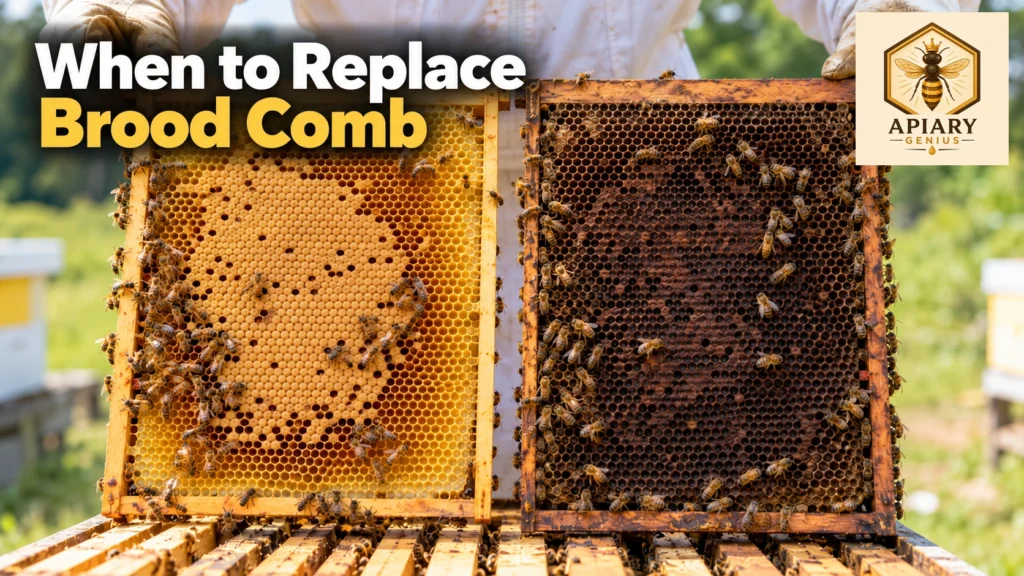
A brood frame that started with pale, freshly drawn wax can become dark brown or nearly black after years of use. That change is normal, but it raises an important management question: When should you replace old brood comb?
Dark color alone does not mean a frame is diseased or unsafe. Repeated brood rearing leaves cocoon material and other residues inside the cells, while beeswax can accumulate certain pesticide residues and retain biological contamination under some circumstances.
These changes make gradual comb renewal a useful part of hive management. However, removing every dark frame immediately can waste valuable drawn comb and unnecessarily disrupt healthy developing brood.
Knowing when to replace brood comb requires looking at the frame’s age, history, structural condition, potential risks, and the colony’s ability to build replacement comb.
This guide explains how to recognize frames that deserve priority, compare replacement schedules, and develop a practical rotation plan without disturbing the brood nest unnecessarily.
Quick Answer
When to replace brood comb depends on frame age, condition, history, and risk—not color alone.
Black brood comb is not automatically bad for bees. Its dark appearance usually reflects repeated brood cycles and the accumulation of cocoon layers and other materials.
There is no universally accepted expiration age for every brood frame.
Some Extension guidance recommends rotating approximately 20% of brood comb annually. Other disease-prevention programs recommend replacing roughly one-third each year, while some Extension specialists suggest approximately four to six years as a practical age guideline.
These recommendations represent different management approaches rather than one universal rule.
For routine brood-comb maintenance:
- Track the year each brood frame enters service.
- Identify the oldest and highest-risk frames.
- Prioritize damaged, contaminated, or unknown-history comb.
- Replace a manageable portion when the colony can build new comb.
- Avoid removing healthy developing brood solely to meet a replacement target.
- Continue rotating older frames over successive seasons.
The goal is to maintain useful brood comb while gradually reducing avoidable risks.
Table of Contents
Why Does Brood Comb Get Darker With Age?
Brood comb darkens mainly because developing bees repeatedly occupy the same wax cells.
Freshly constructed beeswax is usually pale yellow or nearly white. As the colony raises successive generations of workers, the comb gradually changes in appearance and structure.
Before pupation, a honey bee larva spins a silk cocoon inside its cell.
When the adult bee emerges, some cocoon material remains attached to the cell walls. Repeated brood cycles add more layers.
Several materials contribute to comb darkening:
- Cocoon layers from previous brood cycles.
- Propolis deposited by workers.
- Pollen residues and other stored-food materials.
- Brood-associated debris.
- Substances incorporated into or absorbed by the wax.
Over time, accumulated cocoon material can thicken the cell walls and reduce the internal dimensions of brood cells.
Research by Taha and Al-Kahtani, published in the Saudi Journal of Biological Sciences, examined relationships between comb age and colony performance. Under the study conditions, colonies using younger combs performed better on several measured outcomes than colonies using four-year-old comb.
However, this study does not establish a universal age at which all brood comb becomes unusable.
Read the peer-reviewed comb-age study
Darkening is a normal consequence of brood rearing. It is not, by itself, evidence of disease. Understanding when to replace brood comb starts with recognizing that distinction.
Is Black Brood Comb Bad for Bees?
Not automatically.
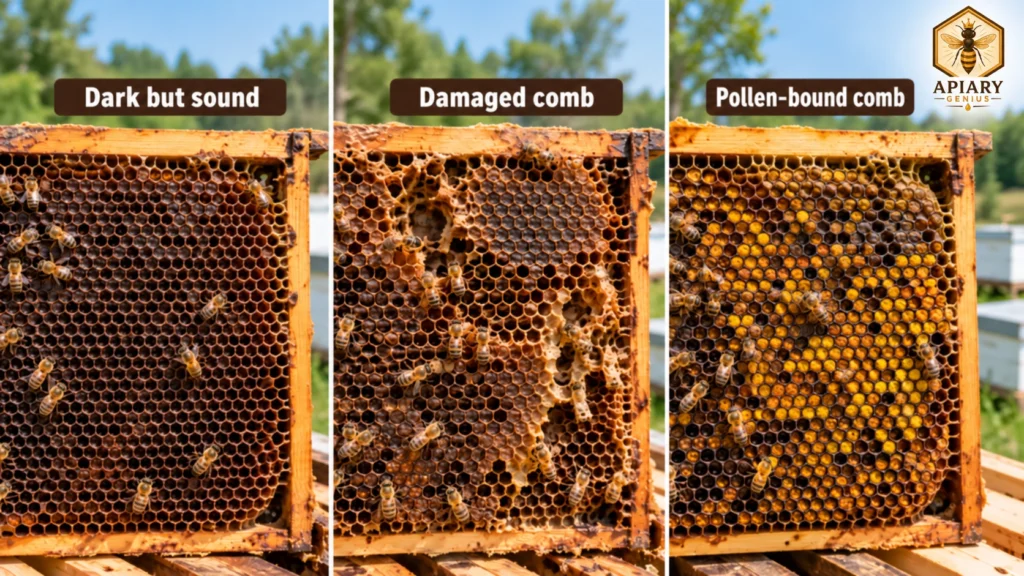
A black brood frame can remain structurally sound and support healthy developing bees.
Its appearance may indicate extensive use, but color cannot reliably reveal pesticide concentrations, disease status, or whether the comb must be removed immediately.
The more useful question is whether the frame has additional characteristics that justify replacement.
Dark but Structurally Usable Comb
A dark frame may remain suitable for continued use when:
- Its age and history are reasonably well understood.
- The frame and foundation remain sound.
- Cells are properly formed and functional.
- The colony is raising healthy brood.
- There is no known serious disease or contamination concern.
Such a frame can remain on a future rotation list without requiring immediate removal.
Comb With Additional Replacement Concerns
Replacement becomes more important when a frame has:
- Excessive age or unknown history.
- Known or suspected chemical contamination.
- Severe structural damage.
- A history of serious brood disease.
- Dead brood of unexplained cause.
- Extensive accumulation of old pollen.
- Badly distorted or damaged cells.
- Broken foundation or deteriorated frame components.
A frame with multiple concerns deserves greater attention than one that is merely dark.
Also distinguish aging brood comb from irregular comb built in unintended hive spaces.
Unwanted comb caused by equipment gaps or improper spacing is a different management issue, explained in our guide to burr comb in beehives.
What Actually Accumulates in Old Brood Comb?
Old brood comb can accumulate several types of material.
Some are normal consequences of brood rearing. Others may become relevant to colony health depending on their identity, concentration, and history.
Cocoon Material
Successive generations of bees leave cocoon layers inside brood cells.
These layers contribute to thicker cell walls and gradually reduced cell dimensions.
Comb-age research has documented changes in brood-cell characteristics and associations between comb age and colony performance.
However, the effects observed under specific research conditions should not be interpreted as proof that every old frame harms a colony.
Pollen, Propolis, and Debris
Stored pollen, propolis, and brood-associated debris can accumulate in older comb.
Some of these materials are normal parts of hive life.
Problems become more relevant when cells are heavily obstructed, damaged, or no longer functioning effectively for brood rearing.
Pesticide Residues
Beeswax can retain certain pesticide residues, particularly compounds that readily associate with wax.
Potential sources include agricultural exposure and some treatments used inside beehives.
A peer-reviewed study by Wu, Anelli, and Sheppard examined the effects of highly contaminated brood comb on developing worker bees.
The researchers observed delayed development and reduced adult longevity under their experimental conditions. They also documented movement of pesticide residues between combs.
Read the pesticide-residue study in PLOS ONE
These findings demonstrate that wax contamination can affect bees.
They do not mean that every old frame contains harmful pesticide concentrations or that black comb is automatically toxic.
Comb color is not a reliable test for chemical contamination.
Persistent Biological Contamination
Some pathogens can persist in contaminated comb and equipment.
American foulbrood is an especially important example because the bacterium responsible for the disease produces highly persistent spores.
Chalkbrood spores can also remain in the hive environment.
However, the presence of old brood comb does not establish that either disease is present.
Disease concerns must be evaluated using relevant symptoms, history, and appropriate diagnostic methods.
How Often Should You Replace Brood Comb?
There is no single scientifically established replacement interval that applies to every brood frame in every apiary.
Extension recommendations differ because they address different management goals, including routine comb renewal, disease prevention, and colony-health management.
When deciding how often to replace brood comb, two practical approaches are particularly useful.
Approach A: Annual Percentage Rotation
This approach replaces a portion of the oldest suitable brood comb each year.
Examples include:
| Management approach | Suggested rotation | Context |
|---|---|---|
| Annual percentage rotation | Approximately 20% annually | Oregon State University Extension advice in a chalkbrood-management context |
| More intensive annual rotation | Approximately 3–4 frames per 10-frame box each year | Penn State Extension AFB-prevention guidance |
| Age-based rotation | Approximately 4–6 years as a practical guideline | Michigan State University Extension frame-culling advice |
The recommendations are not interchangeable scientific requirements.
For example, Penn State Extension describes replacing the oldest three to four frames in each box annually as part of its American foulbrood prevention recommendations.
Oregon State University’s Extension response discusses retiring approximately 20% of brood comb annually as one supporting measure in chalkbrood management.
Penn State Extension: American Foulbrood
Oregon State University Extension guidance
Both approaches encourage ongoing comb renewal, but their different contexts matter.
Approach B: Track Frame Age
Under an age-based system, brood frames are marked when they enter service.
The oldest suitable frames are then selected for gradual replacement.
Michigan State University Extension has recommended rotating brood comb approximately every four to six years as a practical management guideline.
Its advice also identifies frames of unknown age, heavily pollen-filled frames, and frames containing dead brood as situations deserving additional consideration.
Michigan State University Extension: Reusing Wax Foundation From Dead Hives
That recommendation is useful for planning, but it should not be treated as a strict biological deadline.
A healthy frame does not suddenly become unsafe when it reaches a particular birthday.
Which Approach Should You Use?
Both systems can work.
Annual percentage rotation gives the beekeeper a recurring maintenance target.
Age tracking helps identify which frames have been used longest.
Combining the two is often practical.
For example, you can mark frames by year, identify the oldest group each season, and rotate suitable candidates when the colony is capable of drawing replacement comb.
If a selected frame still contains healthy brood, its removal may need to be postponed.
A consistent, documented rotation system is more useful than forcing one exact replacement interval onto every colony.
A Practical Brood-Comb Rotation Plan
Once you understand when to replace brood comb, the next step is creating a repeatable system.
The following plan works as a general framework for routine movable-frame hive management.
1. Mark New Brood Frames With the Year
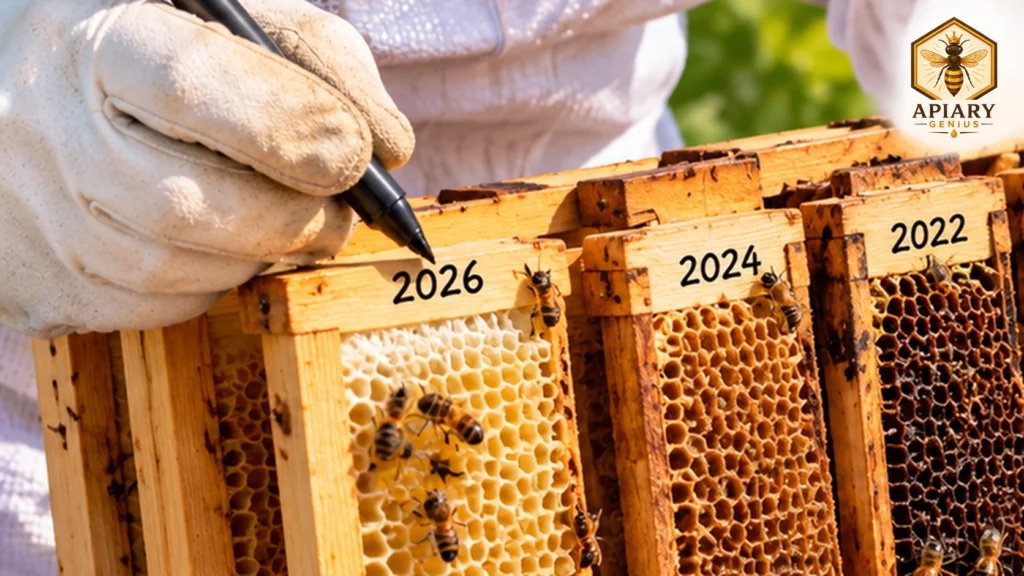
Write the year on the frame’s top bar when it enters brood service.
A simple marking such as 2026 is sufficient.
This helps distinguish newer frames from those that have supported brood for several seasons.
2. Keep a Simple Frame-Age Record
Record the year each group of frames was introduced.
You can use a notebook, hive inspection record, or simple color-marking system.
If a frame’s actual age is unknown, record that uncertainty rather than assigning an invented construction date.
3. Identify the Oldest Group Each Season
During normal inspections, locate the oldest known brood frames.
Also note frames obtained with nucs or used equipment whose histories are incomplete.
These become candidates for closer evaluation.
4. Prioritize Higher-Risk Frames First
Age alone should not control the rotation order.
Frames with serious structural deterioration, concerning histories, or suspected contamination deserve priority over dark but otherwise sound comb.
If serious disease is suspected, follow appropriate diagnostic guidance rather than continuing routine rotation.
5. Replace Only a Manageable Portion at One Time
Avoid removing large amounts of healthy brood comb simply to meet an annual percentage.
Gradual replacement helps preserve brood-nest continuity and limits the immediate demand for new wax construction.
6. Time Replacement for Favorable Conditions
Choose periods when colony strength, temperature, and available resources support comb building.
A strong growing colony during a nectar flow may draw replacement foundation more readily than a weak colony during a shortage.
7. Confirm That New Comb Is Being Used
Installing foundation does not guarantee that the bees will draw it.
During later inspections, check whether the colony is building usable cells and incorporating the new comb into its normal brood or food-storage pattern.
If foundation remains untouched, reconsider colony strength, available resources, season, and frame placement.
Successful comb rotation means replacing aging comb with useful new comb—not merely adding undrawn foundation.
Which Frames Should You Replace First?
The best way to prioritize old brood comb is to evaluate risk and usefulness rather than color alone.
Highest Priority: Significant Risk or Damage
These frames deserve prompt assessment:
- Used brood comb of unknown origin or uncertain history.
- Comb with suspected pesticide or chemical contamination.
- Frames associated with known serious disease concerns.
- Severely damaged or unstable comb.
- Frames containing unexplained dead brood.
- Comb with badly distorted or collapsed cells.
Some of these situations may require diagnosis, isolation, or specialist guidance rather than ordinary frame rotation.
Do not transfer suspect equipment to another colony before resolving serious disease concerns.
Next Priority: Old or Poor-Quality Brood Comb
Suitable planned-replacement candidates include:
- The oldest known brood frames.
- Comb with substantial cocoon accumulation.
- Frames heavily packed with old pollen.
- Poorly formed or irregular comb that no longer serves the brood nest effectively.
These may be removed gradually when doing so will not unnecessarily sacrifice healthy brood or essential stores.
Lower Priority: Dark but Otherwise Sound Frames
A dark frame with a known history, sound structure, and healthy brood is generally a lower immediate priority.
It can remain in service temporarily while awaiting its turn in the rotation program.
Deciding when to replace brood comb requires evaluating each frame’s age, condition, and history—not removing old bee frames as quickly as possible.
The goal is to remove less desirable comb while preserving healthy colony function.
What About Frames From a Purchased Nuc?
Frames supplied with a nucleus colony may already have supported several generations of brood.
Some may be relatively new, while others may have unknown ages.
Unknown age does not automatically mean a nuc frame is unsafe.
However, uncertainty makes those frames reasonable candidates for planned replacement.
When installing a purchased nuc:
- Examine the brood and general colony condition.
- Keep healthy brood frames together.
- Avoid immediately dismantling the brood nest because the comb is dark.
- Mark frames with unknown ages.
- Rotate suitable older frames gradually when conditions permit.
A newly installed nuc depends on its existing brood, adult bees, and food resources while becoming established.
Removing several healthy brood frames immediately could interfere with that development.
For initial colony installation and frame arrangement, see How to Install Package Bees or a Nuc: A Step-by-Step Guide.
What About Used Equipment From Another Beekeeper?
Previously owned brood comb deserves more caution than frames whose history you have tracked yourself.
Before introducing used comb into an occupied hive, consider:
- The previous colony’s disease history.
- Any known or suspected American foulbrood.
- Potential pesticide or chemical exposure.
- The cause of colony death, if applicable.
- Equipment storage conditions.
- Available inspection records.
Penn State Extension specifically recommends checking inspection records when acquiring used equipment and advises caution regarding equipment associated with AFB.
Penn State Extension: Used Equipment and AFB Prevention
A previously used wooden hive box and a frame of old brood comb do not necessarily present the same concerns.
Brood comb has directly supported developing bees and may retain residues or biological contamination associated with its use.
Do not blindly introduce unknown-history brood comb into a healthy colony.
At the same time, do not assume every piece of used equipment must automatically be destroyed.
Its history, condition, possible contamination, and relevant disease-control requirements should guide the decision.
When serious concerns remain unresolved, seek advice from a state apiary inspector or appropriate Extension specialist.
When Is the Best Time to Rotate Old Brood Frames?
Replace old brood frames when the colony can build replacement comb without compromising its developing brood.
The best timing depends on the colony and local conditions.
Relevant factors include:
- Colony population and strength.
- Brood-nest size.
- Temperature and seasonal conditions.
- Nectar availability.
- Existing food stores.
- Supplemental feeding context, when appropriate.
In many areas, spring expansion and periods of strong nectar availability create useful comb-building opportunities.
However, there is no single replacement date suitable for every location in the United States.
Beekeepers in different regions experience different forage patterns, temperatures, and colony-development schedules.
Mississippi State University Extension discusses comb construction during colony growth and emphasizes the importance of adequate resources and appropriate hive management.
Mississippi State University Extension: Beginning Beekeeping in Mississippi
If the colony is weak, cold weather limits brood expansion, or nectar availability is poor, replacement foundation may remain undrawn.
Choosing when to replace brood comb also means waiting until the colony has suitable conditions for drawing replacement comb. A frame selected for routine rotation can remain marked until conditions improve.
Where Should New Foundation Go?
New foundation should be positioned where bees can build it without unnecessarily disrupting the brood nest.
There is no universal placement that works for every colony.
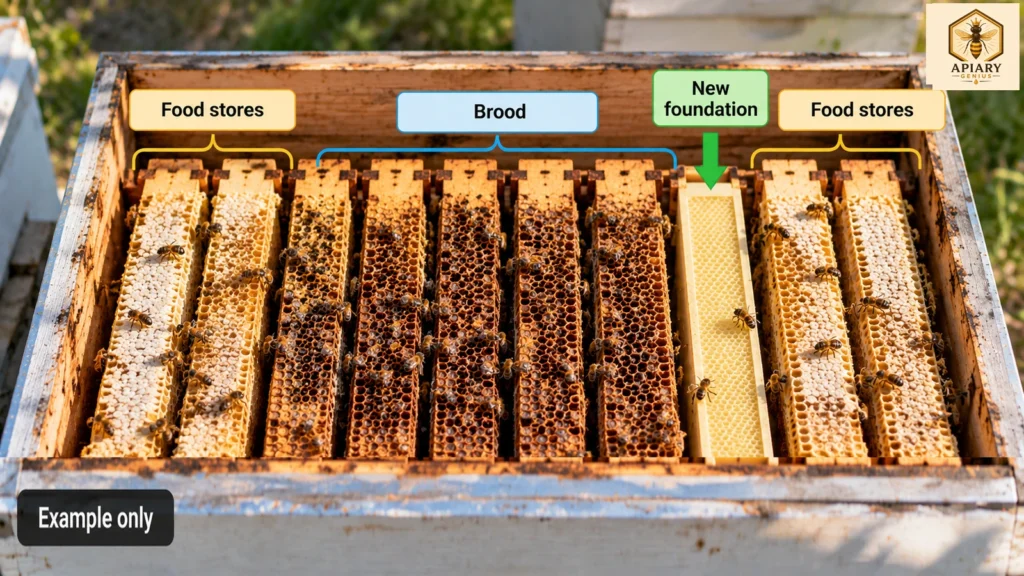
Depending on colony strength, season, and hive configuration, foundation may be introduced near the edge of an expanding brood nest or between brood comb and adjacent food-storage frames.
The important principle is to preserve brood-nest continuity.
Avoid scattering multiple undrawn foundation frames randomly through the center of a healthy brood nest.
A weak colony or one experiencing cool conditions may struggle if its brood area is divided.
Michigan State University Extension has described placing foundation between brood and food frames as one possible way to encourage comb construction while keeping brood frames together.
Michigan State University Extension: Foundation Placement
That arrangement is an example, not a mandatory positioning rule.
Observe the colony’s response and adjust management according to its strength and ability to draw comb.
What If the Old Frame Still Contains Brood?
Do not remove healthy developing brood simply because the frame is old.
A frame scheduled for replacement may still contain eggs, larvae, or capped brood.
If the brood appears healthy and there is no urgent disease, contamination, or structural reason to remove the frame, routine rotation can usually be delayed.
A practical approach is to:
- Mark the frame for future removal.
- Keep the brood nest functional.
- Allow developing brood to emerge when appropriate.
- Manage the frame gradually so it can eventually be removed.
- Confirm that the frame is free of brood before retiring it.
Depending on the hive configuration, repositioning may help prevent additional brood rearing on an old frame.
However, moving frames requires judgment.
An unsuitable arrangement could separate brood, interfere with the cluster, or reduce access to food.
There is no single repositioning recipe that is appropriate for every hive.
If serious disease is suspected, ordinary rotation procedures should not replace disease-specific guidance.
What If the Old Frame Contains Honey or Pollen?
Stored food deserves consideration before removing an old frame.
Old Comb Containing Honey
Dark brood comb does not automatically make the honey stored inside it unusable.
Honey suitability depends on its condition, possible contamination, treatment history, and intended use.
The colony may also need those stores.
Avoid removing essential food simply to meet a brood-comb replacement target.
Old Comb Packed With Pollen
Pollen requires a more nuanced assessment.
Bees store pollen as bee bread, an important source of protein and other nutrients.
Michigan State University Extension identifies heavily pollen-filled old frames as candidates for culling, partly because long-stored pollen may become less useful.
However, the scientific evidence does not support assuming that pollen rapidly loses nutritional value simply because it has been stored for several days.
A 2017 peer-reviewed study found that honey bees preferred recently stored pollen, but the researchers did not detect nutritional differences in the short-term storage treatments they examined.
Read the pollen-storage study in PLOS ONE
This distinction matters.
A frame heavily packed with long-standing pollen may be a reasonable replacement candidate, particularly if it has limited usable brood space.
Nevertheless, pollen-filled comb should not automatically be discarded without considering the colony’s needs and the frame’s overall condition.
Brood Comb vs. Honey-Super Comb
Brood comb and honey-super comb can have different histories and replacement needs.
Brood comb repeatedly supports larvae and pupae.
As a result, it experiences:
- Repeated cocoon accumulation.
- Changes in brood-cell structure.
- Contact with pollen and propolis.
- Exposure to brood-associated biological material.
Honey-super comb used primarily for honey storage does not normally experience the same repeated brood cycles.
Therefore, the same replacement schedule should not automatically be applied to every honey-super frame.
Honey-super comb still requires inspection for:
- Structural deterioration.
- Contamination concerns.
- Inappropriate chemical-treatment exposure.
- Pest damage.
- Previous brood use.
A super frame that has supported brood may require different consideration from one used exclusively for honey.
Sound drawn comb also represents a substantial investment of colony resources.
Mississippi State University Extension explains that producing new comb requires significant energy and that established drawn comb can help colonies use nectar flows more efficiently.
Mississippi State University Extension: Maximizing Honey Production
Avoid discarding usable drawn comb without a clear management reason.
Does Replacing Old Comb Prevent Disease?
Routine brood-comb replacement can support preventive hive management, but it does not guarantee disease prevention.
Removing older comb may reduce some accumulated materials, chemical residues, or biological contamination associated with the removed frames.
However, different diseases have different causes, transmission pathways, and management requirements.
Chalkbrood
Chalkbrood is caused by the fungus Ascosphaera apis.
Its spores can persist in the colony environment.
Comb replacement may be one supporting management measure, but it is not a guaranteed cure.
Colony genetics, hygienic behavior, brood-nest conditions, and other management factors can also influence disease expression.
For disease-specific guidance, see Chalkbrood in Honey Bees: Symptoms, Causes, and Management.
Pesticide Exposure
Removing contaminated wax may reduce some accumulated residues.
However, pesticide exposure can involve more than one brood frame.
Residues may also be associated with other wax comb, stored materials, hive treatments, or environmental exposure.
Replacing one frame does not establish that the remaining hive is free of contamination.
American Foulbrood
American foulbrood requires a different level of caution.
The disease is caused by Paenibacillus larvae, a spore-forming bacterium.
Its spores can persist for many years in contaminated equipment.
Replacing a few old brood frames does not eliminate an active AFB infection.
If symptoms raise an AFB concern, consult American Foulbrood in Honey Bees: Symptoms, Diagnosis, and Management.
Routine comb rotation must not be presented as a substitute for diagnosis or disease-specific management.
When Old Comb Requires More Than Routine Rotation
Certain findings should immediately change the management response.
Stop treating the situation as ordinary comb aging if you find:
- Suspected American foulbrood.
- Unexplained dead or abnormal brood.
- Suspicious brood scales or remains.
- Concerning sunken or perforated brood cappings.
- Equipment associated with serious unresolved disease concerns.
- Severe pest damage affecting comb integrity.
- Known or suspected chemical contamination.
- A deadout with unexplained suspicious symptoms.
These findings do not all indicate the same problem.
They indicate that additional assessment is needed before routine reuse or rotation.
Dark comb alone cannot diagnose AFB, chalkbrood, Nosema, or pesticide contamination.
If American foulbrood is suspected:
- Do not transfer suspect comb into a healthy colony.
- Prevent other bees from accessing or robbing suspect equipment.
- Avoid moving potentially contaminated materials between colonies.
- Contact your state apiary inspector or appropriate diagnostic service.
- Follow applicable state requirements and disease-specific guidance.
Confirmed AFB can require management actions that go well beyond ordinary comb replacement.
The priority is preventing disease spread and obtaining an appropriate diagnosis.
What About Comb From a Dead Colony?
Not all dead colonies leave behind equipment with the same risk profile.
A colony that died from a reasonably established noninfectious cause presents a different situation from one with suspected serious brood disease.
Before reusing old brood comb from a dead hive, evaluate:
- The known or suspected cause of colony death.
- Any previous AFB concerns.
- Abnormal brood or suspicious remains.
- Pest damage.
- Chemical-treatment and contamination history.
- Frame and foundation condition.
- Whether the comb is still useful for the intended purpose.
Michigan State University Extension notes that some comb from dead colonies can be reused when serious disease concerns are absent.
Its guidance also identifies older brood comb, heavily pollen-filled frames, and frames containing dead brood as possible culling candidates.
Michigan State University Extension: Reusing Comb From Dead Hives
If the cause of colony death is uncertain, do not assume the comb is safe merely because it looks normal.
If AFB or another serious transmissible disease is suspected, seek appropriate guidance before reuse.
Conversely, avoid automatically destroying every structurally sound frame from every deadout without considering the circumstances.
Old or stored comb may also be damaged by pests.
When you find wax moth webbing, tunneling, larvae, or extensive damage, consult Wax Moth Control: How to Prevent and Manage Infestations in Beehives.
How to Track Comb Age Without Extra Work
A practical frame-age system does not require detailed spreadsheets or complicated records.
Write the Year on the Top Bar
When a new frame enters brood service, mark its introduction year.
For example:
- 2024
- 2025
- 2026
These simple labels help identify the oldest known frames during later inspections.
Use a Color Code if Preferred
A yearly color-marking system can work as an alternative.
Keep the system consistent and record what each color represents.
Separate Age From Acquisition Date
When acquiring a frame of unknown age, do not label it as newly constructed.
Instead, mark it clearly:
Acquired 2026 — Age Unknown
This records what you know without inventing the frame’s actual age.
Rotate the Oldest Suitable Group First
During regular inspections, compare the oldest known frames with those that have concerning conditions or uncertain histories.
Select suitable replacement candidates and record the year the new frames enter service.
Over several seasons, this creates a continuing comb-renewal system.
What Not to Do
Avoid these common mistakes when managing aging brood comb.
- Do not discard a frame solely because it is black. Dark color is an age clue, not proof of disease.
- Do not diagnose disease from comb color. Examine brood symptoms and colony history.
- Do not wait for a supposed universal expiration date and then replace the entire brood nest. Rotate suitable frames gradually.
- Do not randomly insert multiple foundation frames through the brood nest. Consider colony strength, temperature, and season.
- Do not remove healthy developing brood merely to meet an annual quota. Delay routine replacement when appropriate.
- Do not reuse unknown-history brood comb without considering disease and contamination risks.
- Do not transfer suspect comb into a healthy colony.
- Do not treat ordinary comb rotation as an American foulbrood treatment.
- Do not automatically apply the brood-comb replacement schedule to honey-super comb.
- Do not discard structurally sound drawn comb without a clear management reason.
- Do not present one Extension recommendation as universal scientific consensus. Replacement guidance varies by purpose and context.
Practical Brood-Comb Rotation Checklist
Use these questions during your next hive inspection.
- Do you know the frame’s age? Check its marking or introduction record.
- Was it used mainly for brood? Repeated brood cycles affect comb structure.
- Is it simply dark, or is it also damaged? Inspect cells, foundation, and frame integrity.
- Does it contain healthy developing brood? Avoid unnecessary brood loss.
- Is it heavily pollen-bound? Consider whether old stores occupy substantial usable space.
- Is there a known disease history? Review previous colony problems.
- Did the frame come from a nuc or used equipment? Identify any uncertainty about its history.
- Is there any American foulbrood concern? Stop routine rotation and seek appropriate diagnostic guidance.
- Is the colony strong enough to draw replacement comb? Evaluate its population and growth.
- Are season and forage conditions suitable? Consider temperature, nectar availability, and food reserves.
- Can the frame be marked and removed after brood emerges? Preserve healthy developing bees whenever practical.
- Have you recorded the replacement year? Keep the age-tracking system current.
If a frame is old but presents no urgent problem, mark it for planned rotation.
If serious disease or contamination is suspected, investigate that concern before treating the frame as ordinary aging comb.
FAQ
How often should brood comb be replaced?
There is no universal interval. Some Extension recommendations suggest replacing approximately 20% annually, while certain disease-prevention programs recommend replacing roughly one-third. Michigan State University Extension has also offered a four-to-six-year practical guideline.
The best approach is consistent, risk-based rotation without unnecessarily disturbing healthy brood.
Is black brood comb bad for bees?
Not automatically.
Black brood comb usually reflects repeated brood rearing and accumulated cell materials.
Color alone does not establish disease, dangerous contamination, or an immediate need for replacement.
How old is too old for brood comb?
No single age makes every brood frame automatically unsafe.
Approximately four to six years is one practical guideline found in Extension advice, but frame condition, disease history, contamination concerns, and actual use matter.
Should I replace dark brood frames?
Consider gradual replacement when the frames are old, damaged, heavily obstructed, or have concerning histories.
A dark frame containing healthy brood does not normally require immediate removal simply because of its color.
Why does brood comb turn black?
Brood comb darkens as successive generations of bees leave cocoon layers and other residues inside the cells.
Propolis, pollen residues, and additional accumulated materials also contribute to the change.
Can old brood comb carry diseases?
Yes.
Comb associated with certain infections can retain infectious material.
American foulbrood spores are particularly persistent.
However, old brood comb is not automatically diseased, and color alone cannot establish whether pathogens are present.
Do pesticides build up in beeswax?
Certain pesticide residues can accumulate in beeswax.
Experimental research has documented developmental effects in bees exposed to highly contaminated brood comb.
The contamination level of an individual frame cannot be determined reliably from its color.
Should I replace frames that came with a nuc?
Frames of unknown age are reasonable candidates for planned rotation.
However, avoid immediately dismantling a healthy nuc brood nest simply because its frames are dark.
Mark the frames and replace suitable candidates gradually when colony conditions allow.
Can I reuse old brood comb from a dead hive?
Sometimes.
Reuse depends on the cause of colony death, disease and contamination history, brood condition, and structural quality.
Comb associated with suspected AFB or another serious unresolved disease concern should not be transferred into a healthy colony without appropriate guidance.
What time of year should I replace old brood frames?
Choose a period when the colony is strong and conditions support building replacement comb.
Temperature, nectar availability, population strength, and regional season matter more than a fixed calendar date.
Where should I put new foundation when rotating frames?
Placement depends on colony strength, season, and hive configuration.
Foundation may be introduced near an expanding brood-nest edge or between brood and food-storage areas when appropriate.
Avoid unnecessarily dividing the brood nest with multiple undrawn frames.
Should honey-super comb be replaced as often as brood comb?
Not automatically.
Honey-super comb used primarily for honey storage does not normally experience repeated cocoon accumulation.
Evaluate it according to its use history, structural condition, pest damage, treatment exposure, and contamination concerns.
Sources
The following university Extension resources and peer-reviewed studies support the scientific explanations and practical management recommendations in this article.
1. Michigan State University Extension — Reusing Wax Foundation From Dead Hives
Practical guidance on brood-frame age, approximately four-to-six-year rotation, frames acquired with nucs, heavily pollen-filled comb, and deadout equipment.
Read the Michigan State University Extension guidance
2. Penn State Extension — Honey Bee Diseases: American Foulbrood
Guidance on American foulbrood, disease prevention, used equipment, inspection history, and the recommendation to replace three to four of the oldest frames per box annually within an AFB-prevention program.
Read the Penn State Extension guide
3. Oregon State University Extension — Feeding Bees in the Summertime
An Extension response by a pollinator-health specialist discussing chalkbrood management, including the suggestion to retire approximately 20% of brood comb each year.
Read the Oregon State University Extension response
4. Mississippi State University Extension — Beginning Beekeeping in Mississippi
Practical guidance on colony establishment, brood-nest organization, foundation placement, seasonal growth, and conditions supporting new comb construction.
Read the Mississippi State University Extension publication
5. Michigan State University Extension — Backfilling Nectar
An Extension response explaining how foundation may be positioned between brood and food frames while preserving brood-nest continuity.
Read the Michigan State University foundation-placement guidance
6. Taha, E. K. A., and Al-Kahtani, S. N. (2020) — The Relationship Between Comb Age and Performance of Honey Bee (Apis mellifera) Colonies
Saudi Journal of Biological Sciences, 27(1), 30–34.
Peer-reviewed research examining comb age, brood production, colony population, foraging activity, and honey yield under the conditions studied.
7. Wu, J. Y., Anelli, C. M., and Sheppard, W. S. (2011) — Sub-Lethal Effects of Pesticide Residues in Brood Comb on Worker Honey Bee (Apis mellifera) Development and Longevity
PLOS ONE, 6(2), e14720.
Experimental research investigating pesticide residues in brood comb and their effects on developing workers and adult longevity.
8. Carroll, M. J., et al. (2017) — Honey Bees Preferentially Consume Freshly-Stored Pollen
PLOS ONE, 12(4), e0175933.
Research examining honey bee preferences for recently stored pollen and nutritional measures across short-term pollen-storage treatments.
9. Mississippi State University Extension — Maximizing Honey Production
Extension guidance on the value of drawn comb, the energetic demands of wax production, and the benefits of providing usable comb during honey production.