
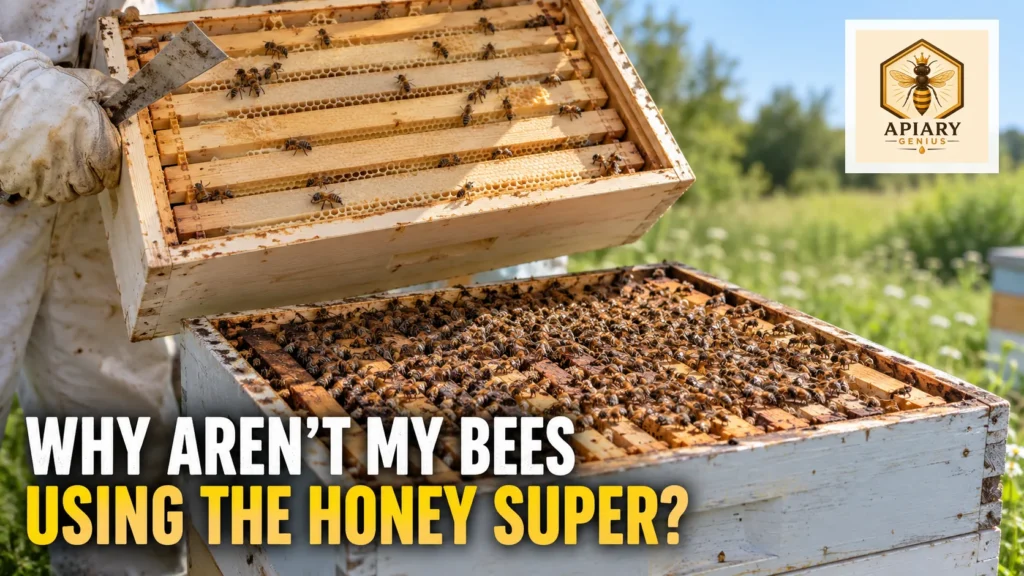
You added a honey super because the colony appeared ready for more storage space. But when you inspect again, the super is still almost empty. Maybe only a few bees are walking across the frames. Maybe the bees enter the box but ignore the foundation. Or perhaps the comb is already drawn, yet little or no nectar is being stored.
When your bees are not using the honey super as expected, the empty box itself does not tell you why. The cause may be a weak or finished nectar flow, insufficient colony strength, unused room below, undrawn foundation, a recent swarm, a queen or brood problem, or—in some situations—the combination of a queen excluder and undrawn foundation.
The useful question is not, “How do I force the bees into the super?” It is, “What condition required for using this super is currently missing?”
Quick Answer
If your bees are not using the honey super, first determine what “not using” actually means.
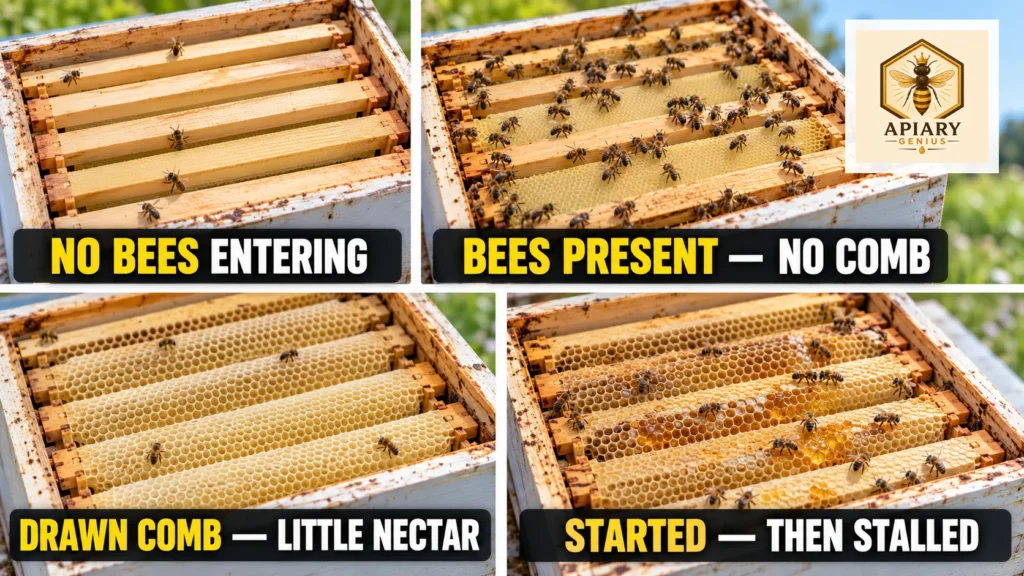
Are there no bees above at all? Are workers entering but not drawing foundation? Is drawn comb available but still empty? Or did the colony begin storing nectar and then stop?
A honey super becomes useful when the colony has enough workers, sufficient incoming nectar, a need for additional storage space, and comb that is accessible and usable. Drawn comb can receive nectar immediately, while foundation must first be built into comb.
If your bees are not filling the honey super, do not automatically blame the queen excluder, begin feeding syrup, rearrange the hive, or add another super. Check nectar flow, colony population, brood production, space below, comb type, recent swarming, queen status, and colony health first.
Bees Not Using Honey Super Space? First Define What “Not Using” Means
An “unused” honey super can describe several different situations. Those situations do not necessarily have the same cause.
No bees are entering the super
If the box is almost completely empty of workers, ask whether the colony currently has a reason to occupy it.
There may still be substantial usable space below. The nectar flow may be weak or absent. The colony may not have enough adult bees to cover additional equipment.
If the super contains only foundation, particularly above a queen excluder, moving into the box may also be slower than when drawn comb is available.
Bees are in the super but not drawing foundation
This is a different observation.
Workers have reached the super, so access alone may not be the main limitation. Instead, the colony may lack the conditions that favor substantial comb construction: enough incoming resources, a growing worker population, suitable seasonal conditions, or a strong enough nectar flow.
The comb is drawn, but little or no nectar is being stored
Now the diagnostic question shifts from comb construction to nectar surplus.
The cells are already available. If they remain empty, ask whether the colony is receiving more nectar than it currently needs for brood rearing, maintenance, and storage elsewhere in the hive.
The bees started using the super and then stopped
Look for something that changed.
The nectar flow may have weakened. Rain, drought, temperatures, or the end of an important bloom may have reduced incoming nectar. The colony may have swarmed. Brood production may have declined. Queen status may have changed. Colony health may also have deteriorated.
The observation should come before the intervention.
Is There Actually a Nectar Flow?
Before changing equipment, determine whether enough nectar is actually entering the colony to create a surplus.
Visible flowers do not automatically mean that a strong nectar flow is occurring.
Nectar production varies with plant species, location, soil conditions, moisture, temperature, weather, and the stage of bloom. Prolonged rain can keep bees from foraging, while drought or unfavorable conditions can reduce nectar availability even when flowers are still visible. Mississippi State University Extension emphasizes that honey production depends heavily on the quality and timing of bloom and that unusual weather can reduce yields.
Look for several clues together:
- fresh nectar appearing in cells elsewhere in the hive;
- increasing stores between inspections;
- sustained foraging activity;
- fresh wax or active comb construction;
- favorable recent weather;
- important local nectar plants in useful bloom;
- increasing hive weight, if you track it;
- other healthy colonies in the same apiary also gaining stores.
Nearby colonies can provide useful context. If several otherwise healthy colonies stop gaining stores at the same time, forage or weather becomes more plausible than a problem unique to one honey super.
Also ask where you are in the local flow.
Is the main flow beginning, active, slowing, or already finished?
Do not apply one national calendar to every apiary. Nectar flows vary substantially by region and year.
Is the Colony Strong Enough to Use the Super?
A honey super creates space.
It does not create the workforce required to use that space.
Penn State Extension lists strong colonies and plentiful forage with a strong nectar flow among the important requirements for successful honey production.
Inspect the colony itself rather than judging strength from entrance traffic alone.
Check:
- the adult bee population;
- how densely bees cover the frames;
- the amount of developing brood;
- whether brood production is expanding, stable, or declining;
- whether the colony appears to be growing;
- general colony health;
- whether the population recently dropped.
A busy entrance does not necessarily mean the colony has enough workers to draw foundation, process a large nectar flow, care for brood, and occupy additional boxes at the same time.
Honey production depends on a colony-level workforce, not just the number of foragers visible at the entrance.
If the colony is weak, changing the super is unlikely to solve the underlying limitation.
Was the Honey Super Added Too Early?
Sometimes nothing is wrong with the bees or the equipment.
The colony may simply not need the additional space yet.
If substantial usable room remains in the boxes below, bees may continue occupying and filling those combs rather than expanding into the super.
This does not mean that an early super automatically causes a colony problem. It means that an empty super may indicate that the colony has not yet reached the conditions that make the additional storage space useful.
Inspect the room below and reassess colony readiness.
For the full readiness criteria rather than repeating them here, see When to Add a Honey Super: Timing, Signs, and the 7/10 Rule.
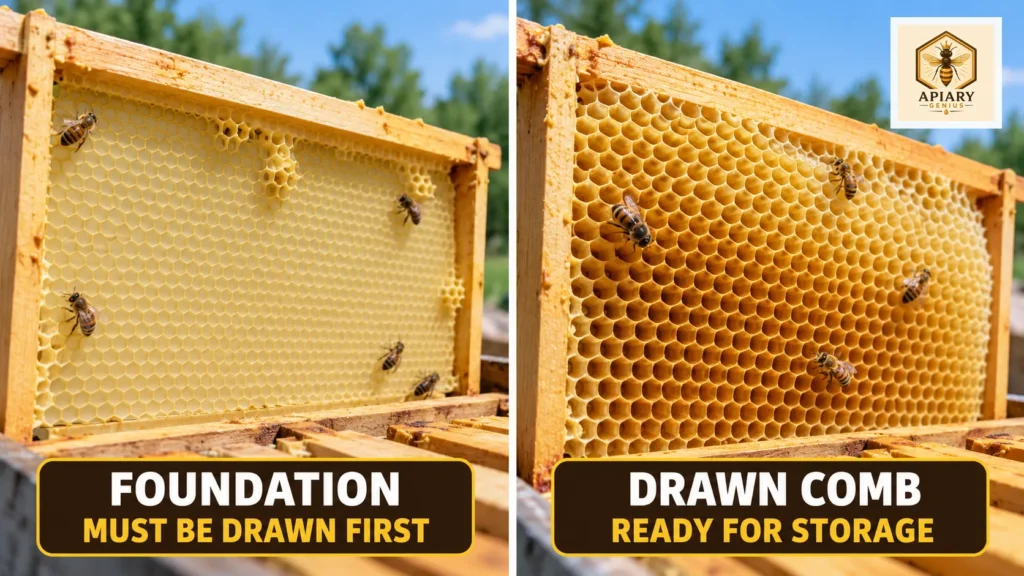
Drawn Comb vs. Foundation: Why It Matters
One of the most important questions when your bees are not using the honey super is whether the box contains drawn comb or foundation.
They are not equivalent.
Drawn comb
Drawn comb already contains completed wax cells.
Workers can place nectar into those cells without first constructing the storage space.
Foundation
Foundation provides a base on which the bees must build full wax cells.
Before large amounts of nectar can be stored, workers must produce wax and construct the comb.
Mississippi State University Extension notes that bees can store nectar more readily when they already have empty drawn comb instead of first having to construct comb from foundation.
The Mid-Atlantic Apiculture Research and Extension Consortium also recommends giving new foundation primarily to rapidly growing colonies or established colonies during a major nectar flow and notes that foundation provided during a nectar dearth may be poorly drawn.
That helps explain why foundation may remain untouched during:
- weak nectar flows;
- dearths;
- declining seasonal forage;
- unfavorable weather;
- periods of slow colony growth;
- weak colony conditions.
Do not assume that foundation should be drawn within a fixed number of days.
The rate depends on the colony and the conditions around it.
Is the Queen Excluder Keeping Bees Out of the Super?
A queen excluder is worth considering, but it should not become the default diagnosis.
Its purpose is to restrict the queen from entering honey supers while allowing worker bees to pass through.
Before blaming it, check:
- whether the super contains drawn comb or foundation;
- whether workers are crossing the excluder;
- whether nectar is already present above it;
- whether the boxes below are heavily occupied;
- colony strength;
- the current nectar flow.
Comb type is particularly important.
MAAREC notes that workers can sometimes be reluctant to pass through a queen excluder to store above and advises particular caution about placing undrawn foundation above an excluder. Drawn comb can make the upper space more immediately useful to the colony.
That does not mean every case of bees not going into a honey super is caused by the queen excluder.
A 2024 field study in Apidologie compared colonies managed with and without queen excluders and found no significant difference in the measured colony-dynamics parameters under the conditions studied. The researchers also noted that effects may interact with other management practices.
So interpret the queen excluder together with:
- comb type;
- available room below;
- nectar flow;
- colony strength;
- management goals.
Do not automatically remove it simply because the super is empty.
What If Bees Are in the Super but Not Building Comb?
If workers are already walking on the foundation, the problem is no longer simply “the bees will not enter the super.”
Now ask whether the colony has the resources and biological incentive to build substantial amounts of wax.
New foundation is best worked under conditions of colony growth and good incoming resources. MAAREC specifically recommends foundation for rapidly growing colonies or established colonies during a major nectar flow.
Check:
- incoming nectar;
- adult bee population;
- colony growth;
- season;
- recent weather;
- condition of the foundation;
- whether drawn comb is available elsewhere.
Bees standing on foundation does not mean they will immediately draw it.
If your bees are not drawing comb in the honey super, the presence of workers above is useful information, but it does not prove that the colony currently has enough resources or need for major comb construction.
What If the Comb Is Drawn but the Bees Are Not Filling It?
Once drawn comb is available, the diagnosis changes.
The bees no longer need to create the storage cells first. If those cells remain largely empty, focus more closely on whether a nectar surplus exists.
Check:
- whether fresh nectar is appearing anywhere in the hive;
- whether the main nectar flow is active;
- whether the flow appears to be ending;
- recent rain, drought, heat, or other weather changes;
- local forage conditions;
- colony population;
- whether brood rearing is consuming much of the incoming food;
- whether nectar is being stored below instead.
If fresh nectar is scarce throughout the colony, rearranging the honey super is unlikely to manufacture a honey crop.
Mississippi State University Extension emphasizes that surplus honey production depends on significant nectar availability and that weather and bloom conditions strongly influence the amount collected.
Drawn comb removes one limitation.
It does not create surplus nectar.
Could a Recent Swarm or Queen Problem Be the Reason?
Yes.
This possibility becomes especially important if the colony had been using the super and then activity dropped sharply.
When a colony swarms, a large group of adult workers leaves with the old queen. The parent colony is left with a smaller workforce and may also experience an interruption while a replacement queen develops, mates, and begins laying.
Mississippi State University Extension notes that swarming can greatly reduce the foraging workforce and honey production. University of Georgia Extension likewise describes swarming as severely reducing colony strength.
If you suspect a recent swarm, inspect the colony rather than diagnosing it from the empty super alone.
Look for:
- a noticeably smaller adult population;
- queen cells or recently emerged queen cells;
- an interruption in egg laying;
- recent colony history consistent with swarm preparation.
For the broader swarm-management topic, see How to Prevent Bee Swarming: 9 Proven Methods for Beekeepers.
If you discover queen cells and need to interpret them, see Queen Cells in a Beehive: Swarm, Supersedure, or Emergency?.
A queen or brood-production problem can also slow population growth enough that the colony no longer has the workforce expected to exploit the super.
If queen status itself becomes uncertain, see How to Tell If a Beehive Is Queenless: Signs, Diagnosis, and What to Do Next.
Could Colony Health Be Limiting Honey Production?
Yes, but an unused honey super alone does not diagnose a health problem.
Health becomes more important when the empty super appears alongside other warning signs, such as:
- declining adult population;
- poor brood production;
- abnormal or irregular brood;
- sick or deformed bees;
- unexplained colony weakness;
- evidence of high Varroa pressure.
Varroa mites and associated viruses can weaken developing bees, shorten adult lifespan, reduce the ability of workers to perform colony tasks, and eventually interfere with both foraging and brood rearing.
But do not diagnose Varroa simply because the honey super is empty.
If the brood pattern itself looks abnormal, compare what you see with Spotty Brood Pattern in Honey Bees: Causes, What It Means, and What to Check.
If monitoring or other evidence points toward a Varroa problem, use How to Control Varroa Mites: The Complete 2026 Guide for the dedicated management discussion.
The unused super may be the symptom that made you inspect more carefully. The actual diagnosis must come from evidence inside the colony.
Should You Feed Bees to Make Them Use a Honey Super?
Not as a universal solution.
And there is an important distinction between feeding a colony for establishment or survival and feeding while collecting a harvestable honey crop.
Supplemental syrup can have a legitimate role when establishing a package or nuc, supporting a colony with inadequate stores, or helping a developing colony build comb under appropriate conditions. Mississippi State University Extension describes syrup feeding as useful for new colonies building foundation and for other specific management needs.
But that is not the same as feeding a colony while harvest supers are collecting honey intended for human consumption.
Michigan State University Extension guidance specifically advises against feeding syrup while honey supers intended for harvest are on because workers may store that syrup in the same comb intended for the honey crop.
Sugar syrup stored in harvest comb is not the same thing as nectar gathered from flowers and converted into honey.
Therefore, do not use syrup simply to make an unused harvest super appear productive.
If the colony genuinely needs supplemental feeding outside the honey-crop context, see Feeding Bees: The Complete Guide for Every Season.
What to Check When Bees Ignore a Honey Super
Use the following sequence before changing equipment:
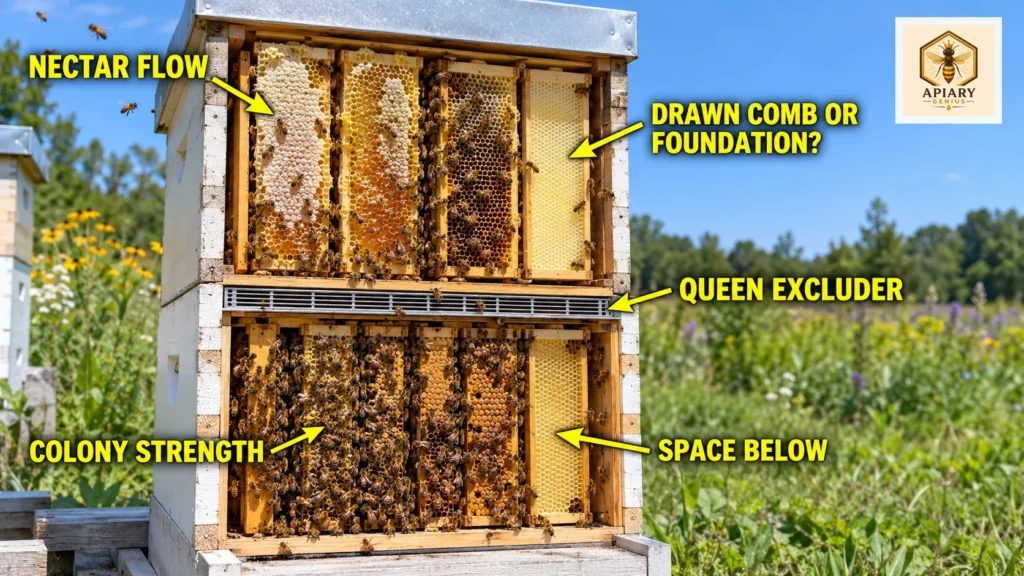
- Is nectar actually coming in?
Look for fresh nectar and increasing stores rather than relying only on flowers outside. - Are the bees still using or filling space below?
Determine whether significant usable comb remains in the brood boxes. - How strong is the adult population?
Judge bees covering frames throughout the colony, not entrance traffic alone. - Is brood production normal?
Look for eggs, larvae, capped brood, and continued replacement of the adult workforce. - Did the colony recently swarm?
A sudden population reduction can completely change how the colony uses additional equipment. - Does the super contain drawn comb or foundation?
Foundation must be constructed before it provides the same immediately usable storage space as drawn comb. - Is a queen excluder installed?
Treat it as one factor, particularly when the super contains undrawn foundation. - Are any workers entering the super?
No workers entering is different from workers walking on the frames but not drawing them. - Is nectar being stored elsewhere?
Fresh nectar below provides a different diagnostic clue from a hive with little fresh nectar anywhere. - What has the recent weather been like?
Rain, drought, temperature, and other conditions can change both bee flight and plant nectar availability. - Is the main nectar flow starting, active, slowing, or ending?
Do not diagnose the colony from the calendar alone. - Are queen, brood, Varroa, disease, or other health problems reducing colony strength?
Follow those paths when additional evidence supports them.
This approach turns the unused super into a diagnostic clue rather than a reason for random equipment changes.
What to Do Based on What You Find
There is no universal fix when bees are not using a honey super.
The next step depends on what the inspection shows.
If there is no meaningful nectar flow
Do not try to force surplus honey production when environmental conditions do not support it.
Instead, monitor colony stores, strength, and health.
If the colony is weak
Investigate why.
Look at queen status, brood production, colony history, forage, Varroa monitoring, disease signs, and recent colony events.
Manipulating the honey super will not replace a missing workforce.
If the super was probably added before the colony needed it
Reassess usable room below and colony readiness.
Use the full criteria in When to Add a Honey Super: Timing, Signs, and the 7/10 Rule rather than adding more equipment to an already unused box.
If the super contains undrawn foundation
Remember that the colony has two separate tasks:
- construct the storage cells;
- fill those cells with nectar.
Conditions adequate for filling existing drawn comb may not produce the same response when the bees must first build the comb.
If the queen excluder may be contributing
Evaluate it together with:
- drawn comb versus foundation;
- whether workers are already crossing;
- usable room below;
- nectar flow;
- colony strength;
- queen location and management goals.
Do not treat removal as an automatic fix.
If the colony recently swarmed
Reassess expectations for the remaining workforce.
Inspect brood production, queen status, and the colony’s post-swarm condition rather than trying to push the reduced population into the super.
If the colony has a health problem
Address the underlying problem.
Moving supers around will not correct serious Varroa pressure, abnormal brood, disease, queen failure, or a declining adult population.
What Not to Do
- Do not add another super because the first one is still empty.
- Do not automatically blame or remove the queen excluder.
- Do not assume flowering plants guarantee a nectar surplus.
- Do not expect a weak colony to draw large amounts of foundation simply because you added it.
- Do not feed sugar syrup into harvest supers and then treat the resulting stores as a natural nectar honey crop.
- Do not judge colony strength from entrance traffic alone.
- Do not repeatedly rearrange equipment without identifying the likely cause.
- Do not use a rule such as “the bees should fill the super within X days.”
- Do not ignore queen, brood, Varroa, disease, or post-swarm problems when colony strength is declining.
An unused honey super is information.
Use that information before making another management change.
When an Empty Super Points to a Bigger Colony Problem
A healthy colony can leave a super unused simply because the nectar flow is weak, the box was added before it was needed, or foundation has not been drawn.
Concern should increase when the unused super occurs alongside signs that the colony itself is declining.
Investigate more deeply if you also find:
- a declining adult population;
- little or no new brood;
- abnormal larvae or capped brood;
- a deteriorating or spotty brood pattern;
- evidence of a recent swarm;
- queen problems;
- high or poorly controlled Varroa pressure;
- unexplained colony weakness;
- declining food stores;
- other abnormal findings.
At that point, the honey super not being used is probably not the primary problem.
It may instead be one visible consequence of a colony that currently lacks the population, health, resources, or nectar surplus required to use it.
FAQ
Why are my bees not going into the honey super?
Common reasons include insufficient nectar flow, substantial unused room below, inadequate colony population, undrawn foundation, or a combination of undrawn foundation and a queen excluder.
First determine whether the colony actually needs additional storage space and whether workers have the population and resources to use it.
Why are bees in the super but not drawing comb?
The fact that workers are present tells you they can access the box, but comb construction requires favorable conditions.
Check nectar availability, colony strength, colony growth, weather, season, and foundation condition. New foundation is more likely to be worked by rapidly growing colonies or during a strong nectar flow.
Why are my bees not filling the honey super with honey?
If the comb is already drawn, lack of surplus nectar becomes an important possibility.
The main nectar flow may be weak or ending, poor weather may be limiting forage, the colony may be using incoming resources for brood and maintenance, or population strength may be insufficient for significant surplus production.
Check whether fresh nectar is accumulating elsewhere in the hive before changing the super.
Does a queen excluder stop bees from using a honey super?
Worker bees can pass through a properly designed queen excluder.
However, workers may sometimes be slower to occupy a super above an excluder, particularly when that super contains undrawn foundation. That makes the excluder one factor to investigate, not proof of the cause.
Will bees draw foundation without a nectar flow?
Comb can be built under different management conditions, including situations where supplemental feed is appropriately provided outside a harvest-honey context.
However, foundation is more likely to be worked when resources are abundant and the colony is growing. During a nectar dearth, foundation may remain largely untouched or be poorly drawn.
Do not assume that simply adding foundation guarantees that bees will build it.
Should I remove the honey super if the bees are not using it?
Not automatically.
First determine why the super is unused.
If the colony is strong and a major flow is developing, the box may soon become useful. If the flow is over and colony population is shrinking, excessive unused equipment may become unnecessary space for the bees to patrol.
Mississippi State University Extension cautions that too much super space, particularly near the end of a honey flow, can increase vulnerability to comb pests such as small hive beetles and wax moths.
Should I feed sugar syrup to make bees draw a honey super?
Not if the super is being used to collect a honey crop intended for human consumption.
Feeding can be appropriate for colony establishment, emergency stores, or comb building in non-harvest situations. But syrup fed while harvest supers are present may be stored in those supers.
Determine why the colony needs feeding separately from why the honey super is unused.
How long should it take bees to start using a honey super?
There is no reliable fixed number of days.
The rate depends on:
- adult bee population;
- nectar flow;
- season;
- weather;
- usable space below;
- drawn comb versus foundation;
- colony health;
- recent swarming;
- queen and brood status;
- local forage conditions.
A strong colony during a major nectar flow with drawn comb available can respond very differently from a weaker colony facing undrawn foundation during a declining flow.
Instead of counting days, ask whether the colony currently has both the capacity and the need to use the super.
Sources
- Mississippi State University Extension — Maximizing Honey Production
- Mississippi State University Extension — Colony Growth and Seasonal Management of Honey Bees
- Penn State Extension — Beekeeping: Honey Bees
- Penn State Extension — Honey Bee Management Throughout the Seasons
- Mid-Atlantic Apiculture Research and Extension Consortium — Beekeeping Equipment
- University of Florida IFAS Extension — Welcome to the Apiary! Honey Bee 4-H Project Book
- University of Georgia Cooperative Extension — Honey Bees and Beekeeping
- Mississippi State University Extension — Managing Varroa Mites in Honey Bee Colonies
- Michigan State University Extension — Feeding Bees
- Apidologie — Effects of Queen Excluders on the Colony Dynamics of Honeybees