
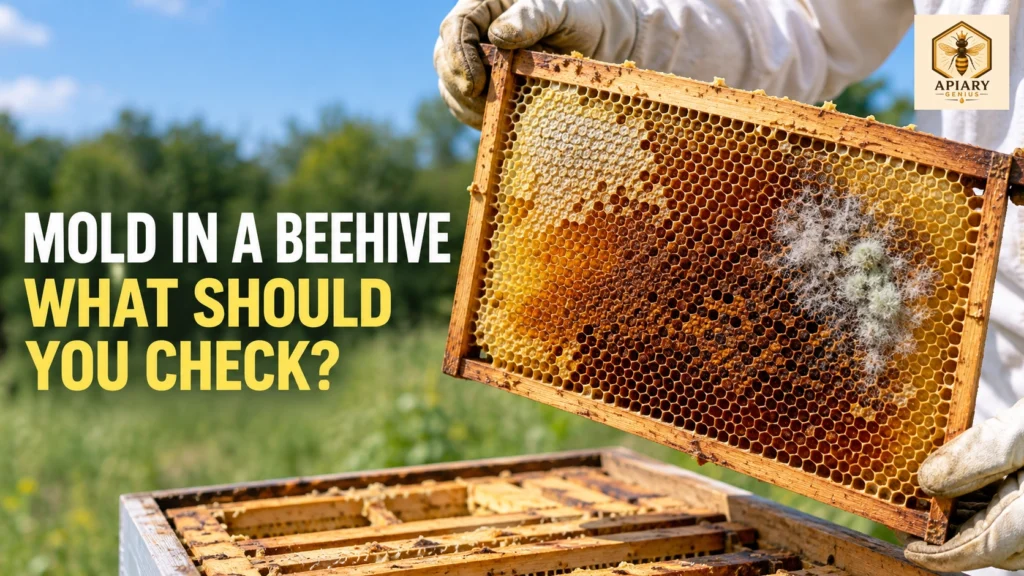
Finding mold in a beehive does not automatically mean the bees are sick or the comb is ruined. It usually indicates that a surface remained damp where bees were not keeping it clean—whether that surface was an outer frame, an inner cover, stored equipment, or comb left behind after colony death.
Whether you find mold on bee frames, an inner cover, or stored comb, assess the colony and equipment history before deciding what to reuse.
Start with colony status, mold extent, brood condition, and possible contamination. Then identify why the equipment stayed wet and decide which frames can be kept, cleaned by bees, rotated, or removed.
Mold is usually a clue—not the diagnosis.
Quick Answer
Mold in beehive equipment is usually a sign of damp conditions and insufficient bee coverage, not proof that mold caused colony failure. A strong, healthy colony can often clean light surface mold. Heavily covered comb, dead brood, deteriorated frames, contamination, or uncertain disease history requires greater caution.
Inspect the colony and affected frames, correct the moisture source, and make reuse decisions individually. Do not transfer disease-suspect deadout comb into a healthy hive or routinely soak drawn comb in bleach. Michigan State University Extension’s frame-reuse guidance explains why mold extent and frame contents matter.
Table of Contents
Is Mold in a Beehive Dangerous?
Usually not by itself. Common surface mold should prompt an inspection rather than an immediate conclusion that the colony has a disease.
Look at the circumstances around it. Is the colony alive? Are bees covering the affected comb? Is the equipment wet? Does the frame also contain abnormal brood or contaminated food?
A small patch on a sound, unused outer frame and extensive growth around decomposing brood require different responses.
Do not assume every moldy frame is harmless. The greater concern may be the damp conditions, the cleaning burden, or a separate problem that makes the comb unsuitable for reuse.
Why Does Mold Grow Inside a Beehive?
Mold can develop when moisture persists on comb or internal equipment. Several contributing conditions may occur together:
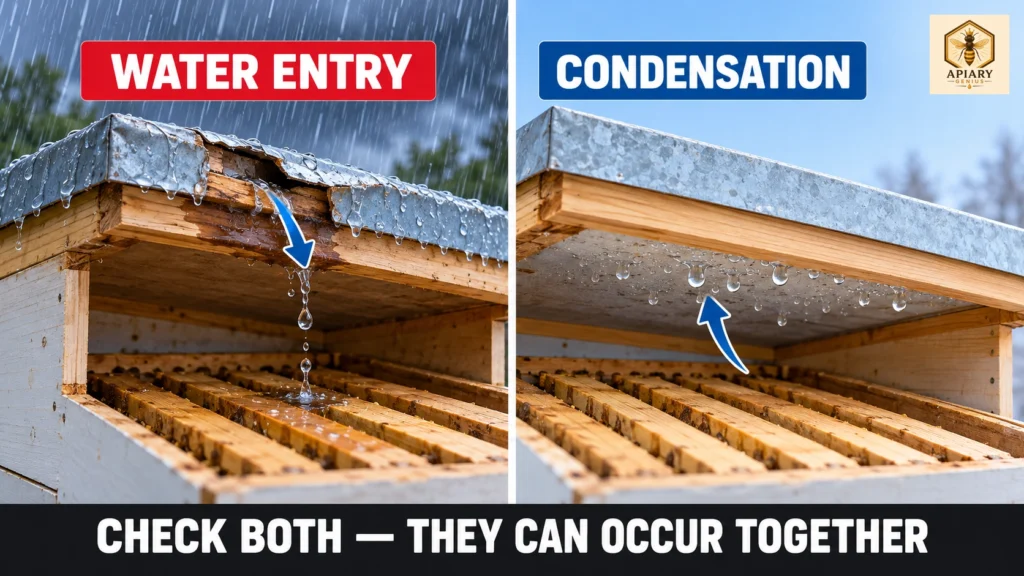
- Condensation: Water collects when moist air contacts a sufficiently cold surface.
- Water intrusion: Rain enters through a damaged cover, cracks, or poorly fitting equipment.
- High environmental humidity: Damp surroundings make drying more difficult.
- Reduced bee coverage: A weak colony or winter cluster leaves some comb unattended.
- Excessive unused space: More equipment is present than the colony can occupy and maintain.
- A deadout: After colony death, comb cleaning stops.
- Poor storage conditions: Unoccupied comb remains damp and inadequately protected.
When investigating mold in beehive equipment, check both water entry and internal condensation rather than assuming they have the same cause.
Illinois Extension’s winter guidance describes how moisture from bee respiration and damp conditions can condense beneath the inner cover. Condensation is worth investigating, but it does not rule out a roof leak or another moisture source.
Does Mold Mean the Colony Is Sick?
Not necessarily. Environmental mold does not establish a diagnosis of American foulbrood, European foulbrood, chalkbrood, Nosema, or Varroa-related collapse.
Inspect the bees and brood separately from the mold. Record unusual larvae, damaged cappings, abnormal brood remains, and any unexplained population decline.
If the brood looks abnormal, move to disease-specific assessment. Cleaning surface growth will not explain why brood is dying.
Likewise, white, gray, green, or dark growth cannot identify a bee disease by color alone.
Mold vs. Chalkbrood: What’s the Difference?
Surface mold grows on materials such as comb, frame surfaces, hive walls, or dead bees. Chalkbrood is a fungal disease affecting developing honey bee larvae.
The important distinction is what is affected:
| Observation | What to investigate |
|---|---|
| Surface growth on wood or comb | Moisture, bee coverage, storage, and frame history |
| Chalky, mummified brood in cells or among removed debris | Chalkbrood |
| Dead or abnormal brood without clear identification | A broader brood-disease assessment |
Chalkbrood produces characteristic larval mummies. Mold on an inner cover is not enough to diagnose it. Penn State’s honey bee disease reference describes chalkbrood among other honey bee maladies.
For identification and management of affected larvae, see Chalkbrood in Honey Bees: Symptoms, Causes, and Management.
Can a Strong Colony Clean Moldy Frames?
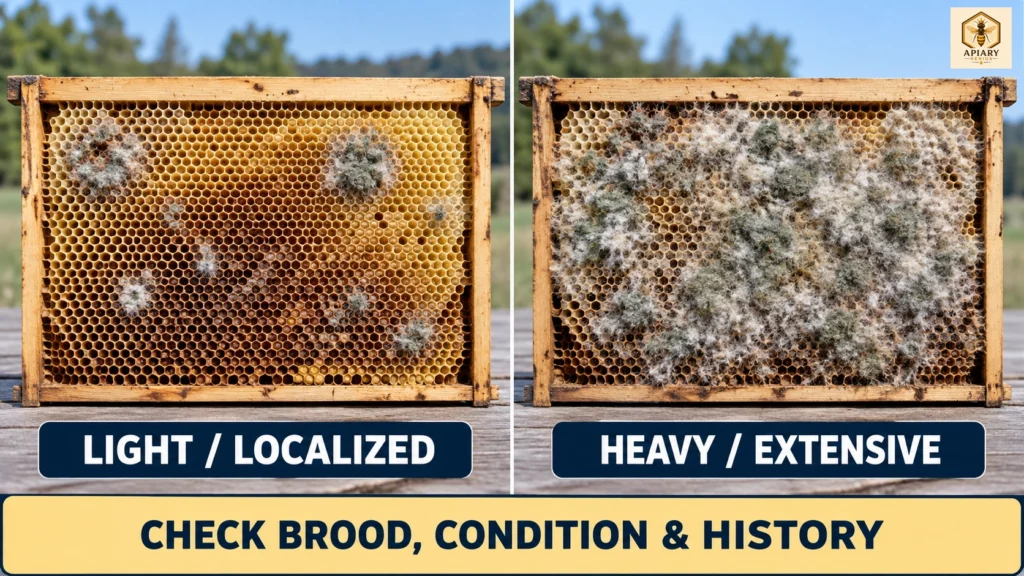
Often, when mold is light or localized and the frame is otherwise suitable.
A strong colony has more workers available to maintain comb. However, cleaning capacity is not unlimited. Removing visible growth also does not establish that a frame has an acceptable disease or contamination history.
Before relying on the bees, consider:
- how much cleaning the frame requires;
- whether usable cells and sound comb remain;
- whether dead brood or deteriorated food is present;
- whether the receiving colony can reasonably handle the task.
For example, a sound outer frame with a small mold patch, known history, and no abnormal brood may be a reasonable candidate for cleaning by a strong colony.
Do not assume bees will restore severely covered comb, and do not make a small package or weak nuc responsible for a major cleanup job.
When Is a Moldy Frame Too Far Gone?
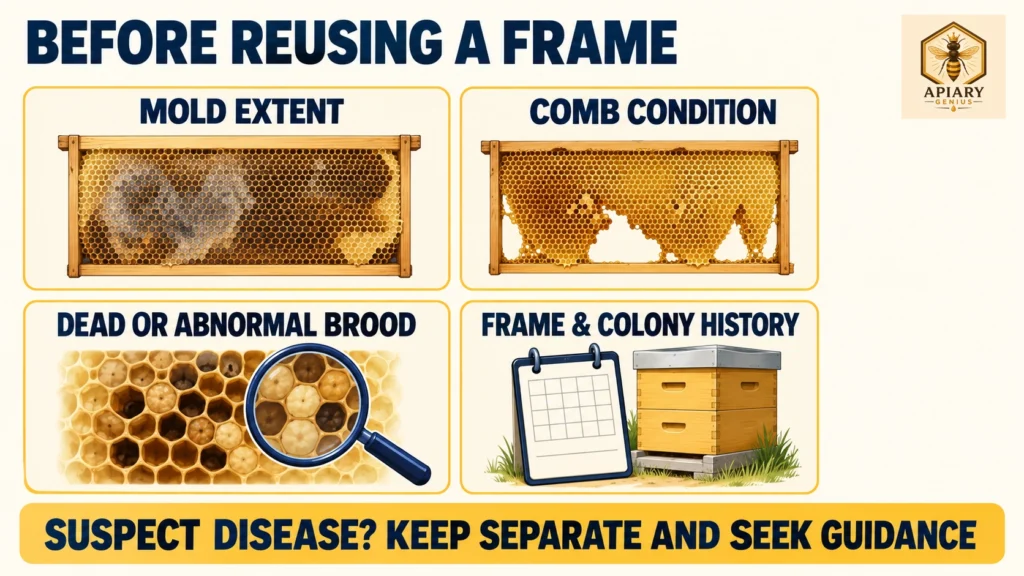
Judge the whole frame rather than applying a mold-color rule or a percentage cutoff.
Mold in honeycomb should be assessed alongside the condition of the cells and their contents—not by surface color alone.
Look for:
- extensive, heavy growth;
- fragile, collapsed, or badly deteriorated comb;
- dead or decomposing brood;
- old pollen occupying much of the usable comb;
- substantial water damage;
- fermented contents;
- advanced comb age;
- chemical, rodent, or other contamination;
- uncertain disease history.
MSU Extension’s deadout advice identifies thick mold and dead brood as reasons to consider culling. It also acknowledges uncertainty about the pathogen risk from dead brood. Precaution should therefore not be presented as proof that every frame containing dead brood is infectious.
Several problems together can make replacement more reasonable than attempting to save the comb.
What Should You Do When You Find Mold in an Occupied Hive?
Work through this sequence during an inspection appropriate for the weather:
- Assess colony strength. Note the adult population and how much comb the bees occupy.
- Check brood and queen context. Look for expected brood stages and abnormalities.
- Inspect food stores. Check their availability and condition.
- Determine mold extent. Identify affected frames and equipment surfaces.
- Look for leaks and condensation. Note droplets, wet wood, and water marks.
- Check equipment fit. Examine the cover, box joints, and damaged components.
- Evaluate unused space. Consider whether the colony has more unoccupied equipment than it needs.
- Correct the moisture source. Match the response to the observed problem.
- Decide frame by frame. Keep suitable comb, allow limited cleaning, plan rotation, or remove unsuitable frames.
- Reinspect later. Check whether conditions and affected surfaces have improved.
Do not unnecessarily dismantle the brood nest or remove useful brood and food simply to make the hive look cleaner. If a frame contains live brood, plan its handling around brood protection unless a disease concern requires a different response.
At the next suitable inspection, look for persistent wetness, new growth, progress in cleaning, and changes in bee coverage. If mold returns or spreads, reconsider the moisture source and colony condition.
What Should You Do With Moldy Frames From a Deadout?
First evaluate why the colony died. A deadout is a colony that has died. Mold found in the remaining hive may have developed after the bees died.
The BeeMD mold reference describes growth on dead bees and unattended comb. Finding mold later does not establish when it appeared or what killed the colony.
Sort frames into practical groups:
| Frame condition | Initial decision |
|---|---|
| Light surface mold on sound comb with known history | Evaluate for reuse |
| Extensive heavy mold | Consider culling rather than imposing a major cleaning burden |
| Apparently clean honey comb | Check disease, food, and treatment history separately |
| Brood comb | Assess age, structure, and previous colony condition |
| Dead brood remaining | Hold for closer assessment; consider precautionary removal |
| Very old or deteriorated comb | Prioritize renewal |
| Unknown-history comb | Keep separate until its suitability is assessed |
| Disease-suspect comb | Stop routine cleanup and seek appropriate guidance |
Do not distribute frames among healthy colonies before assessing suspicious brood and history. If disease cannot reasonably be excluded, keep the comb separate while seeking advice.
When the main question becomes why the colony disappeared or died, use Why Did My Bees Leave the Hive? Absconding vs. Swarming and Colony Loss.
Can You Reuse Moldy Brood Comb?
Sometimes. Reuse is more reasonable when:
- mold is light or localized;
- the comb remains structurally sound;
- frame and colony history are known;
- no serious disease is suspected;
- contamination is not a concern;
- the receiving colony can clean and maintain the comb.
Be more cautious when dead brood remains, the comb is very old, its history is unknown, or it comes from an unexplained deadout.
A cleaner appearance after drying does not resolve disease or contamination concerns. The decision should reflect the frame’s history as well as what you can see.
If age becomes the main reason for replacement, see When to Replace Brood Comb: Signs, Risks, and a Practical Rotation Plan.
Should You Throw Away Moldy Frames?
Not automatically. Removal becomes more reasonable when saving the frame would preserve several problems rather than just a little surface growth.
Prioritize removal when mold accompanies:
- structural failure;
- old, badly deteriorated comb;
- dead or decomposing brood;
- extensive water damage;
- severe contamination;
- serious disease concerns.
A dark or lightly moldy but sound frame is a different situation. Neither darkness nor mold color should decide the outcome alone.
Removing unsuitable comb does not always mean the wooden frame must also be discarded. Equipment condition and disease history determine what can be retained. Meghan Milbrath’s Dealing with Deadouts discusses balancing valuable drawn comb against structural, pathogen, and contamination concerns.
Disease-suspect equipment requires appropriate handling rather than ordinary cleanup or casual disposal.
Should You Clean Moldy Frames With Bleach?
Not as a routine treatment for drawn comb. Surface mold alone is not a reason to soak comb in bleach.
Disease sanitation is a separate decision. A protocol for particular equipment after a diagnosed disease should not be repurposed as a general mold-cleaning recipe.
For example, Penn State’s American foulbrood guidance discusses disinfection within AFB management. That context does not establish that household bleach soaking makes moldy drawn comb suitable for reuse.
If AFB is suspected, keep the equipment separate and contact your state apiary inspector or Extension service. See American Foulbrood in Honey Bees: Symptoms, Diagnosis, and Management for relevant warning signs.
How to Find the Moisture Source
Inspect the path water could take into or through the hive:
- Check the roof and outer cover for damage.
- Examine cracks, gaps, and poorly fitting box joints.
- Look for rain entry and water tracks.
- Note where droplets form beneath the cover.
- Check hive tilt, stand condition, and drainage.
- Consider shade, low-lying ground, and persistent site dampness.
- Compare the colony’s population with its occupied and unused space.
Mold location helps direct the inspection, but it cannot diagnose the source alone. Growth near a cover could accompany condensation, leakage, or both.
Record your observations before making changes. A photograph of the affected area and a note about recent weather can make the follow-up inspection more useful.
Mold After Winter: What Should You Check First?
Determine whether the colony is alive before focusing on cleanup.
If bees are present, assess their condition without unnecessarily breaking apart a cold cluster. When conditions permit, check:
- cluster size and position;
- remaining food and its accessibility;
- brood;
- water marks and inner-cover condensation;
- dead bees;
- possible starvation signs;
- previous Varroa monitoring and treatment;
- suspicious brood remains.
Utah State University Extension emphasizes keeping rain out, managing moisture, and avoiding inspections that chill bees and brood. Mold does not justify a prolonged cold-weather teardown.
For broader seasonal preparation, see How to Prepare Your Beehive for Winter.
Does More Ventilation Always Fix Mold?
No. Ventilation can help in some circumstances, but adding openings does not repair a leaking cover or resolve every moisture problem.
Consider climate, insulation, wind exposure, colony strength, and hive configuration together. Additional openings can increase heat loss in cold or windy conditions, depending on the setup.
For example, if rain is entering through a damaged roof, the first correction is to stop that water entry. More airflow does not repair the roof.
The goal is to control excess moisture while maintaining suitable colony conditions. Do not assume every hive needs an upper entrance, quilt box, or the same vent setting.
Use locally appropriate guidance and check whether the adjustment actually improves conditions.
Can Mold Mean Your Colony Is Too Weak?
It can be a clue, but it is not a diagnosis.
A weak colony may cover, patrol, and clean less comb. However, mold on an outer frame after winter does not by itself establish that the colony is failing.
Assess weakness directly through:
- adult bee population;
- brood quantity and condition;
- queen status;
- food stores;
- Varroa monitoring;
- other pest activity.
For stored or deadout comb, look beyond surface growth. Larvae, webbing, tunnels, or eaten wax require a different investigation. See Wax Moth Control: How to Prevent and Manage Infestations in Beehives when those signs are present.
Can You Use Honey From Moldy Frames?
Visible mold on a frame does not establish whether its honey is suitable for human consumption.
Check deadout history, medications and Varroa treatments, supplemental feeding, fermentation, rodent contamination, and water damage. Reusing a frame for bees and harvesting its contents as food are separate decisions.
MSU Extension’s honey guidance identifies treatment history, syrup feeding, and contamination as reasons for caution with overwintered or deadout honey.
If food suitability remains uncertain, do not harvest it for consumption or sale.
When Mold Requires a Disease Check Instead of Cleanup
Stop treating the situation as routine surface mold when you find:
- dead or discolored brood;
- sunken or perforated cappings;
- scales adhering inside cells;
- ropy or otherwise abnormal brood remains;
- repeated brood abnormalities;
- an unexplained suspicious odor;
- uncertain disease history;
- colony collapse without a clear explanation.
These observations are warning signs, not a complete diagnosis. An odor or damaged capping alone does not confirm AFB.
Keep suspicious frames separate. Do not transfer them to healthy colonies or assume that drying or removing visible growth has resolved the risk. Seek disease-specific assessment before reuse.
What Not to Do
- Do not assume mold killed the colony.
- Do not diagnose chalkbrood from mold on equipment.
- Do not discard every moldy frame automatically.
- Do not reuse every moldy frame automatically.
- Do not give heavily moldy frames to a weak nuc by default.
- Do not soak drawn comb in bleach simply because it is moldy.
- Do not transfer suspicious deadout frames to a healthy colony.
- Do not treat ventilation as a universal cure.
- Do not ignore roof leaks or water entry.
- Do not assume honey is suitable for human consumption based only on mold appearance.
- Do not overlook dead brood or disease signs while focusing on surface mold.
- Do not clean visible mold while leaving the moisture source unresolved.
Mold Troubleshooting Checklist
Use this checklist before deciding what to do with affected equipment:
- Is the colony alive?
- Is it strong or weak?
- Where is the mold located?
- Is it light and localized or extensive?
- Is the comb structurally sound?
- Is live or dead brood present?
- Are there abnormal cappings or brood remains?
- Do you know the frame and colony history?
- Was this equipment from a deadout?
- Is there evidence of roof leakage?
- Is condensation visible?
- Is excessive unused comb present?
- Is the site unusually damp?
- Can a strong colony reasonably clean the frame?
- Is age itself a reason to rotate the brood comb?
- Is disease-specific diagnosis needed?
- Has the underlying moisture source been corrected?
Record each frame decision. At a later suitable inspection, compare wetness, new growth, cleaning progress, and bee coverage with your original observations.
FAQ
Is mold in a beehive harmful to bees?
Common surface mold is usually an environmental clue rather than a disease diagnosis. Limited growth may be manageable, but heavy coverage, damp conditions, abnormal brood, or contamination requires closer assessment.
Why is there mold inside my beehive?
Possible contributors include condensation, rain entry, persistent humidity, reduced bee coverage, and unused comb. In stored equipment or a deadout, there are no bees maintaining the affected surfaces. More than one factor may be present.
Can bees clean mold off frames?
Strong, healthy colonies can often clean light or localized surface mold from otherwise suitable comb. Their cleaning ability is not unlimited, and it does not resolve disease or contamination concerns.
Can I reuse moldy beehive frames?
Sometimes. Reuse is more reasonable when growth is limited, comb is sound, history is known, serious disease is not suspected, and the receiving colony can maintain it. Extensive mold, dead brood, contamination, or uncertain history calls for caution.
Should I throw away moldy comb?
Not solely because a little mold is present. Consider removal when growth is heavy or accompanies deteriorated comb, decomposing brood, major water damage, contamination, or serious disease concerns. Judge the whole frame rather than its color.
Can I put moldy frames into a new package or nuc?
Do not give heavily covered frames to a small colony by default. Start with suitable, clean equipment. Any lightly affected comb considered for reuse still needs an assessment of its history, contents, and cleaning burden.
Is mold a sign of chalkbrood?
Mold on equipment does not establish chalkbrood. Chalkbrood affects developing larvae and produces characteristic mummies. Inspect the brood rather than diagnosing the disease from surface growth.
Did mold kill my colony?
Visible mold cannot establish the cause of death. It may have developed afterward. Investigate the colony’s previous condition, stores, brood, Varroa history, and remaining evidence before drawing a conclusion.
Why do dead hives get moldy?
After colony death, bees no longer clean and maintain comb. Moisture can remain on unattended surfaces, allowing mold to develop on comb, stored materials, or dead bees.
Should I clean moldy frames with bleach?
Do not routinely soak drawn comb in bleach because surface mold is present. Disease-specific sanitation is a separate decision and should follow appropriate guidance for the disease and equipment involved.
How do I stop mold from coming back?
Identify and correct the moisture source, check colony coverage and unused space, and protect stored equipment from damp conditions and pests. Reinspect for persistent wetness or new growth rather than relying on a single cleanup.
Does more ventilation prevent mold?
It may help in some climates and hive configurations, but it is not a universal fix. Consider insulation, water entry, wind exposure, and colony strength before changing airflow.
Can I use honey from moldy frames?
Do not judge food suitability from mold appearance alone. Review treatment and feeding history, fermentation, contamination, water damage, and the circumstances of any deadout. If suitability remains uncertain, do not harvest it for human consumption.
What if moldy frames also contain dead brood?
Assess the brood and colony history before reuse. Dead brood with an uncertain cause deserves a more cautious decision. Keep suspicious frames separate and seek disease-specific advice when abnormal remains or cappings are present.
Sources
- Michigan State University Extension — Reusing wax foundation from dead hives. Frame sorting, mold extent, dead brood, and reuse considerations.
- Michigan State University Extension — Is it safe to reuse?. Deadout frames and disease-history cautions.
- Michigan State University Extension — Honey from winter hives. Colony cleaning capacity, small-package considerations, and honey-use concerns.
- Meghan Milbrath — Dealing with Deadouts. Comb condition, history, and risk-based equipment decisions.
- BeeMD — Mold. Surface mold on unattended comb and deadout equipment.
- Illinois Extension — Prepare your bees for winter. Winter condensation context.
- Utah State University Extension — How Do You Winterize a Beehive?. Water exclusion, moisture management, and inspection precautions.
- Penn State Extension — Honey Bee Diseases: American Foulbrood. Disease-specific sanitation context.
- Penn State Extension — A Quick Reference Guide to Honey Bee Parasites, Pests, Predators, and Diseases. Chalkbrood and other honey bee maladies.