
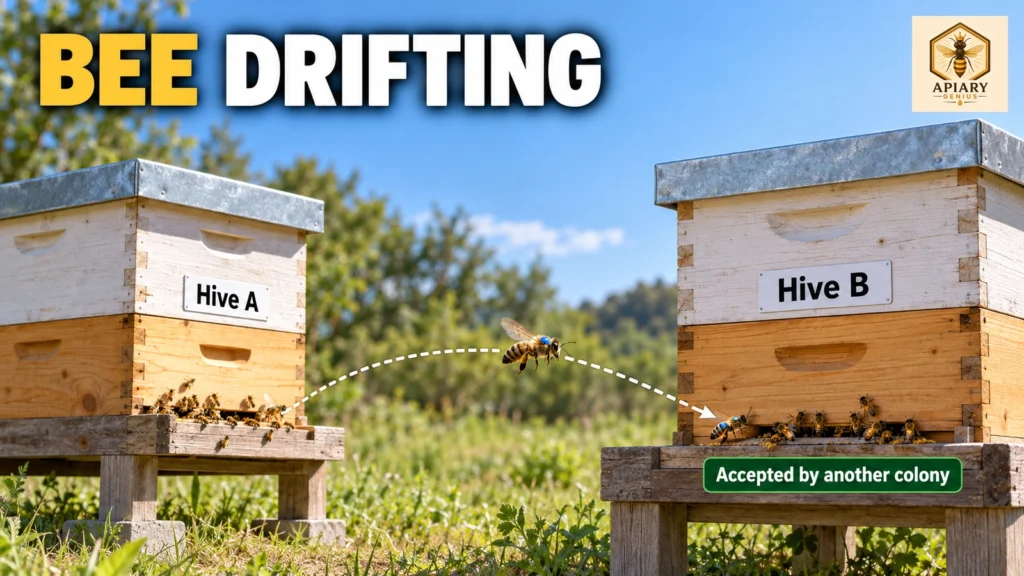
Bee drifting happens when a honey bee returns to and is accepted by a colony other than its own. Some movement between neighboring colonies is normal, but crowded apiaries with nearly identical hives can make orientation mistakes more likely.
If you notice bees going into the wrong hive, first determine whether their origin is actually known and whether the activity could be robbing. Then look for practical ways to make neighboring entrances easier to distinguish. Moving every hive is usually not the first step.
Quick Answer
Bee drifting occurs when a bee returns to and is accepted by a colony other than its original colony. Workers and drones can drift. Close spacing, repetitive layouts, and similar entrances can contribute to cross-colony mixing.
To reduce excessive drifting, improve visual differences between neighboring hive fronts, preserve useful landmarks, and consider varied entrance orientation and additional spacing where practical. These measures cannot eliminate drifting or replace Varroa monitoring and disease management.
Table of Contents
What Is Bee Drifting?
Bee drifting occurs when a bee returns to and is accepted by a colony other than its original colony. Acceptance matters: a bee hovering near another entrance or being turned away has not necessarily joined that colony.
Workers can drift during orientation flights or when returning from foraging. Drones also drift between colonies.
The 2026 scientific review of drifting and inter-colony transmission uses return to a foreign colony followed by acceptance as the defining behavior. It also explains why the methods used to establish a bee’s origin affect research conclusions.
The management concern is excessive or repeated mixing—not an expectation that every colony will remain completely isolated.
Bee Drifting vs. Robbing: What’s the Difference?
Drifting involves entering and being accepted by another colony. Robbing involves entering another colony to take food resources.
| Feature | Drifting | Robbing |
|---|---|---|
| Main behavior | Returning to and being accepted by a foreign colony | Taking honey or other food stores |
| Typical explanation | Orientation or colony-recognition error | Resource acquisition |
| Entrance activity | May look relatively ordinary | May include fighting, persistent intrusion, and intense traffic |
| Evidence needed | Known origin and evidence of acceptance | Multiple signs consistent with stores being stolen |
A drifting bee is not necessarily attempting to steal honey. A robber entering another hive should not automatically be classified as a drifter. Research on Varroa movement treats these as distinct pathways through which colonies can become connected.
Fighting alone does not prove robbing, and quiet entry does not prove drifting.
If foreign bees are persistently challenging guards or taking stores, consult our guide to identifying and stopping robbing bees. Changing hive markings is not an adequate response to active robbing.
Why Do Bees Drift Into the Wrong Hive?
Honey bee drifting can involve two separate steps: a bee approaches the wrong entrance, and the receiving colony accepts it.
Factors worth examining include:
- Identical neighboring hive fronts.
- Repetitive arrangements of boxes.
- Entrances facing the same direction.
- Close spacing and high colony density.
- Few distinguishing landmarks.
- Environmental conditions affecting flight or orientation.
Bees use multiple navigation cues. Color can help with recognition near an entrance, but navigation does not depend on color alone.
Classic drifting research found that bees could enter hives occupying similar positions in repetitive arrangements. It also showed that drift varied considerably between circumstances.
Reaching another entrance does not guarantee admission. Guard-bee recognition and acceptance matter too. Weather, nectar availability, and colony condition can influence movement or acceptance; they do not provide a simple formula for predicting drift in a particular yard.
Is Some Bee Drifting Normal?
Yes. Some drifting occurs between colonies, and complete isolation should not be expected.
The practical question is whether repeated movement is contributing to population redistribution or creating additional opportunities for parasite and pathogen movement.
There is no universal “safe drifting percentage” for a backyard or commercial apiary. Research percentages depend on the bees tracked, observation period, layout, and conditions. A figure measured in one experiment is not a diagnostic threshold for your colonies.
Can You Tell If Bees Are Drifting Just by Watching the Entrance?
Usually not with certainty. Ordinary entrance traffic does not reveal where each bee originated.
More useful evidence includes:
- A bee marked in one colony entering a neighboring hive.
- Repeated observations of known-origin bees using another colony.
- Origin tracking that distinguishes residents from incoming bees.
A uniform layout or unexplained population imbalance can justify investigation, but neither confirms drifting.
Researchers use paint marking, individual tags, genetic comparisons, or distinguishable physical characteristics to establish origin. A peer-reviewed study of parasites, pathogens, and inter-colony movement used genetic identification of returning workers rather than assuming their origin from entrance activity.
A marked bee entering another hive establishes that a known-origin bee reached that entrance. That observation alone does not reveal how long it remained or whether it subsequently used the colony repeatedly.
Record what you actually observe before assigning a cause.
Why Straight Rows of Similar Hives Increase Drift Risk
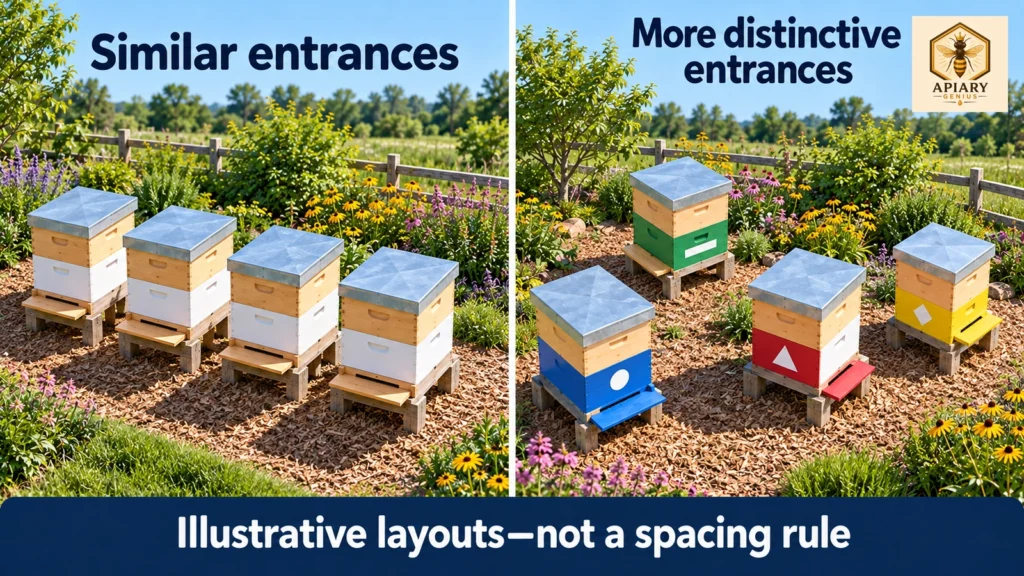
Straight rows can increase drift risk in some apiary layouts, especially when neighboring colonies are difficult to distinguish.
Identical boxes, equal spacing, matching entrance directions, and few landmarks create repeated visual geometry. However, a straight row is not automatically a serious management problem.
In a 2019 apiary-layout experiment, researchers compared a dense, uniform row with a more separated and visually distinctive configuration. The latter had lower observed drifting.
The experiment changed spacing, arrangement, entrance direction, height, colors, and symbols together. It therefore supports the combined configuration, rather than proving the independent effect of any one feature.
Use the findings to support reducing unnecessary sameness—not to declare one layout scientifically ideal.
Does Distance Between Hives Matter?
Increasing spacing generally tends to reduce opportunities for confusion between neighboring entrances, but no universal distance applies.
Available land, visual differences, landmarks, and operational needs all affect the practical choice.
Mississippi State University Extension recommends leaving space between hives in rows and varying entrance direction to help reduce forager drifting. Its guidance also recognizes that arrangement involves practical tradeoffs.
Do not convert a research comparison—such as hives placed 1 meter versus 10 meters apart—into a mandatory spacing rule. Where feasible, avoid crowding visually identical colonies more tightly than your operation requires.
For an established apiary, consider additional spacing during future expansion before deciding to relocate occupied hives.
Does Entrance Direction Matter?
Varied entrance orientation can help neighboring hives become easier to distinguish.
Depending on the site, options include slightly different directions, outward-facing entrances, or a less repetitive arrangement. Research has found reduced drifting when hives faced different directions, but this does not establish one universally best angle.
Before changing an occupied hive’s orientation, consider reorientation and the resulting flight path. Do not direct entrances toward a walkway, work area, neighboring property, or confined animals simply to make the arrangement less uniform.
Do Different Hive Colors and Patterns Reduce Drifting?
Distinctive colors and patterns can help bees recognize neighboring entrances, but they do not guarantee correct homing.
Practical options include:
- Different colors on adjacent hive fronts.
- Simple, contrasting geometric patterns.
- Distinctive entrance-board markings.
Experiments on hive recognition found that workers learned colors near their entrances and distinguished certain nearby symbols. This supports placing useful differences close to the entrance rather than relying entirely on markings high on the hive.
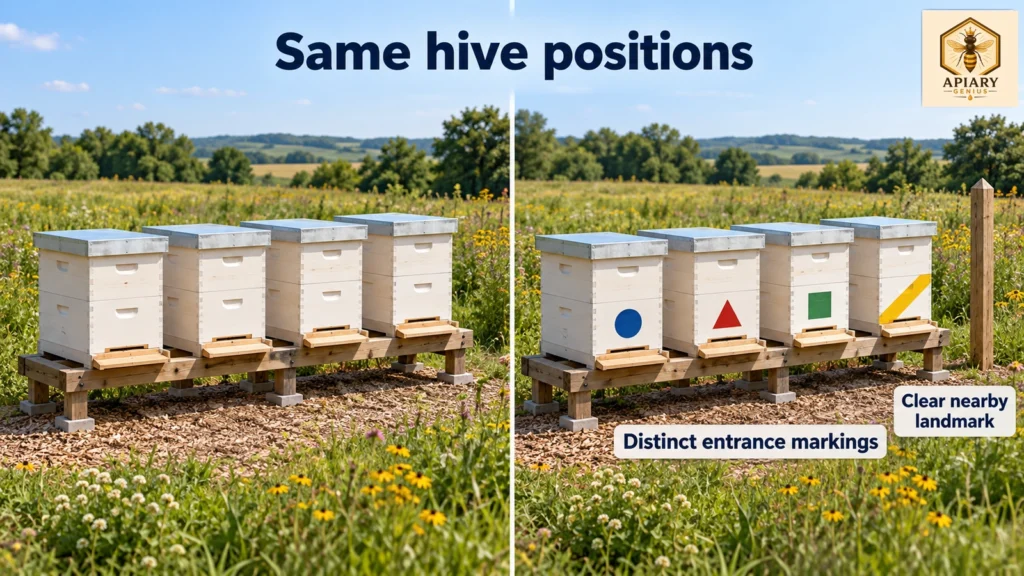
For example, a contrasting circle on one front and a broad diagonal stripe on the next can break visual repetition. These are practical choices, not a scientifically mandatory marking system.
Results depend on context. An indoor flight-room study found that added orientation cues did not reduce drifting under its experimental conditions. That indoor result should not be treated as a direct prediction for an outdoor apiary, but it illustrates why visual markings cannot be promised to work everywhere.
Can Landmarks Help Bees Find the Correct Hive?
Recognizable landmarks may assist orientation by making the area around an entrance more distinctive.
Examples include bushes, posts, rocks, nearby structures, and naturally different background features. Entrance-level markings can complement these larger cues.
The 2026 review discusses nearby landmarks as part of orientation learning and notes that windbreaks can also provide recognizable local features.
Preserve helpful features where possible. If adding a marker, keep it stable and clear of the entrance, flight approach, and inspection access. It should distinguish the location without obstructing it.
Why Bee Drifting Matters for Varroa and Disease Spread
Drifting provides a pathway for Varroa mites and some pathogens to move between colonies. It does not establish that a particular bee or event caused a health problem.
Drifting bees can transport Varroa mites when mites are attached to their bodies, but not every drifter carries mites. The adult-bee transport stage is often called the phoretic or dispersal phase.
A review of Varroa behavior and chemical ecology describes drifting, robbing, and beekeeper-mediated transfers as routes through which mites can reach new colonies.
Cross-colony movement also creates opportunities for pathogen transfer. Penn State Extension’s American foulbrood guidance includes reducing drifting and robbing among disease-prevention practices.
The strength of evidence differs between pathogens. Directly demonstrating transmission through drifting remains incomplete for some viruses. Risk depends on the organism involved, whether bees or mites carry it, and what happens after entry into the receiving colony.
For relevant virus context, see deformed wing virus in honey bees and its relationship with Varroa.
If mite counts increase, assess colony-level conditions and possible incoming mites without assigning the increase to drifting alone. Research on collapsing colonies shows that robbing can also be an important transmission route.
Continue Varroa monitoring and management. Layout improvements cannot establish infestation levels, determine treatment needs, or verify treatment effectiveness.
Can Drifting Make One Colony Look Stronger Than Another?
Persistent drift can redistribute adult bees and contribute to uneven populations.
Some colonies may receive bees while others lose them. Controlled flight-room research has documented population imbalances associated with drift. Its findings illustrate that redistribution can occur, rather than predicting the amount of drift in an outdoor apiary.
However, unequal populations are not a diagnosis. Queen performance, brood production, colony history, swarming, and health problems also need consideration.
Compare inspection records over time. A busy entrance does not establish stronger brood production, and a quieter colony does not establish outward drifting.
Do Drones Drift Too?
Yes. Drone drifting can be substantial, and some studies have found it more frequent than worker drifting. Foundational research documented this difference, but it should not be converted into a fixed rate for every apiary.
Drone entry into neighboring colonies does not establish the amount of worker drift or the colony’s disease status.
How to Reduce Bee Drifting in an Existing Apiary
To reduce bee drifting in an existing apiary, start with changes proportionate to the evidence and the site.
- Make neighboring hive fronts easier to distinguish. Focus on the area bees approach when entering.
- Break visual sameness. Use contrasting colors or simple patterns instead of repeating the same front on every hive.
- Preserve useful landmarks. Keep recognizable features that do not interfere with access.
- Review entrance orientation. Consider variation where safe and practical, while accounting for reorientation.
- Increase spacing when practical. Treat changes to occupied-hive positions as relocation decisions.
- Reduce repetition in future arrangements. Avoid automatically extending a very long, uniform row.
- Plan expansion with drifting in mind. Review how to choose a suitable beehive location before installing additional colonies.
- Continue normal health monitoring. Record populations, brood condition, and Varroa results separately from layout observations.
These steps apply orientation and layout evidence to practical management. They are not a tested package that guarantees a particular reduction.
What If Your Hives Are Already in a Straight Row?
You do not necessarily need to rebuild the apiary.
Assess the evidence first, then consider low-disruption improvements such as different entrance markings, distinctive front colors, and stable visual landmarks.
For example, suppose several identical hives face the same direction, and one appears busier than its neighbors—but you have no known-origin observations. Begin by checking colony records and possible robbing signs. Improve visual distinction without changing hive positions, then continue recording populations and mite levels. Do not treat a change in entrance traffic as proof that drifting has stopped.
Where appropriate, consider whether some entrance directions can be varied safely. During future expansion, additional spacing or separate groups may be more practical than extending the same row.
If several features change together, an improvement will not reveal which feature produced it.
Should You Move Hives Just to Reduce Drifting?
Usually not as the first response.
Moving occupied colonies creates orientation and management issues of its own. A suspicion based only on entrance traffic is a weak reason for a major rearrangement.
If repositioning is justified, follow our guide to short- and long-distance beehive relocation. Use a planned method rather than randomly shifting boxes to make the yard look different.
What Not to Do
- Do not assume every foreign bee is a confirmed drifter.
- Do not diagnose drifting solely from entrance traffic.
- Do not confuse drifting with robbing.
- Do not assume every straight-row apiary has a serious problem.
- Do not apply one universal hive-spacing rule.
- Do not claim paint colors eliminate drifting.
- Do not assume every drifting bee carries Varroa or disease.
- Do not substitute layout changes for Varroa monitoring.
- Do not move occupied hives randomly to “fix” drift.
- Do not create unsafe flight paths when changing entrance direction.
- Do not attribute a study’s results to one factor when several changed together.
- Do not promise complete elimination of drifting.
Bee-Drifting Troubleshooting Checklist
Work through these questions before making major changes:
- Do you actually have evidence that bees are entering the wrong colony?
- Are the hives visually very similar?
- Are they in a dense straight row?
- Do all entrances face the same direction?
- Are there useful visual landmarks?
- Are neighboring colonies spaced more tightly than necessary?
- Could the activity actually be robbing?
- Are appropriately marked bees available to help confirm origin?
- Are some colonies gaining or losing adult populations unexpectedly?
- Are Varroa levels elevated in neighboring colonies?
- Can you improve visual distinction without moving hives?
- Can entrance orientation be varied safely?
- Can future colonies be placed less uniformly?
- If moving a hive is necessary, have you followed proper relocation guidance?
Separate what you know from what you suspect. That distinction helps keep management proportional.
FAQ
What is bee drifting?
Bee drifting occurs when a bee returns to and is accepted by a colony other than its original colony. Hovering near another entrance is not enough to confirm it.
Is bee drifting normal?
Yes. Some cross-colony movement occurs. The concern is excessive or repeated mixing rather than achieving complete isolation.
Why do bees go into the wrong hive?
Similar entrances and repetitive layouts can contribute to orientation mistakes. Environmental conditions and acceptance by the receiving colony also affect the outcome.
How is bee drifting different from robbing?
A drifter returns to and is accepted by another colony. A robber enters to take food resources. Foreign-bee entry alone does not distinguish the two.
Can you tell if bees are drifting by watching the entrance?
Usually not with certainty. Known-origin bees provide better evidence than congestion or ordinary traffic, especially when their use of another colony is observed repeatedly.
Can bee drifting spread Varroa mites?
Yes. A mite attached to a drifting bee can reach another colony. Not every drifter carries mites, and an increase in infestation should not automatically be attributed to drift.
Can bee drifting spread honey bee diseases?
It can provide opportunities for pathogen movement. The risk depends on the pathogen, whether the incoming bee or its mites carry it, and what happens after entry. Evidence is stronger for some transmission pathways than others.
Do straight rows of beehives cause more drifting?
They can, particularly when densely arranged and visually uniform. A straight row alone does not establish excessive drift.
How far apart should beehives be to reduce drifting?
There is no universal distance. Avoid unnecessary crowding and consider spacing together with visual distinction, landmarks, and site constraints.
Do different hive colors help bees find their own hive?
They can help, especially near entrances. Colors and patterns do not guarantee correct homing.
Should hive entrances face different directions?
Variation may help where practical. Safe flight paths and the reorientation of occupied colonies must also be considered.
Do landmarks help reduce drifting?
Recognizable nearby features may assist orientation. Keep them stable and clear of entrances, flight paths, and inspection access.
Do drones drift between hives?
Yes. Drone drifting can be substantial in some conditions, but it does not establish the amount of worker drift.
Can drifting make colony populations uneven?
Yes, persistent drift can contribute to uneven adult populations. Queen performance, brood production, colony history, and health should also be assessed.
Can bee drifting be completely prevented?
No method reliably guarantees complete prevention. The practical goal is to reduce excessive drifting while continuing normal colony health monitoring.
Sources
- Drifting and other inter-colony pathways of pest and pathogen transmission in apiaries — 2026 scientific review.
- Reduced density and visually complex apiaries reduce parasite load and promote honey production and overwintering survival in honey bees — peer-reviewed apiary-layout experiment, 2019.
- Choosing an Apiary Location — Mississippi State University Extension.
- Honey Bee Diseases: American Foulbrood — Penn State Extension.
- The drifting of honey-bees — foundational research, 1958.
- Further experiments on the drifting of honey-bees — entrance recognition and visual-cue research, 1961.
- The influence of hive position and orientation cues on the drifting of honey-bees in a flight and rearing room — controlled indoor study, 1967.
- Parasites and Pathogens of the Honeybee and Their Influence on Inter-Colonial Transmission — peer-reviewed research, 2015.
- Mite bombs or robber lures? The roles of drifting and robbing in Varroa destructor transmission — peer-reviewed research, 2019.
- Understanding the Enemy: A Review of the Genetics, Behavior and Chemical Ecology of Varroa destructor — scientific review, 2022.