
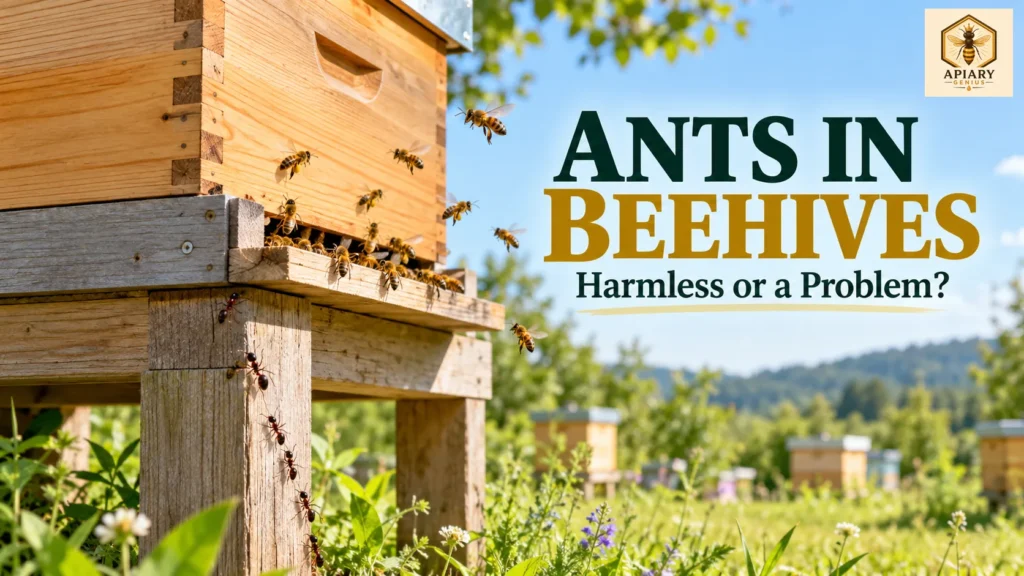
Finding ants in a beehive can be alarming, especially when they appear beneath the lid, gather around a feeder, or form a steady trail toward the entrance. But their presence does not automatically mean your honey bees are under attack.
Many ants visit beehives for sugar, shelter, moisture, or dead insects. Some nest in protected spaces between hive covers without disturbing the colony below. Others can become genuine pests when they gain access to honey, syrup, or developing brood.
The difference matters. A few ants on a hive stand may require little more than observation, while persistent ant activity inside a poorly defended colony deserves closer investigation.
The key is to determine where the ants are going, what they are doing, and whether the colony is actually being harmed.
This guide explains when ants in beehives are mostly harmless, how to recognize warning signs, and how to keep ants out of a beehive using practical prevention and physical barriers before considering chemical control.
Quick Answer
Most ants found around a healthy beehive are a nuisance rather than an emergency. A few ants on the stand or beneath the outer cover usually do not justify treatment.
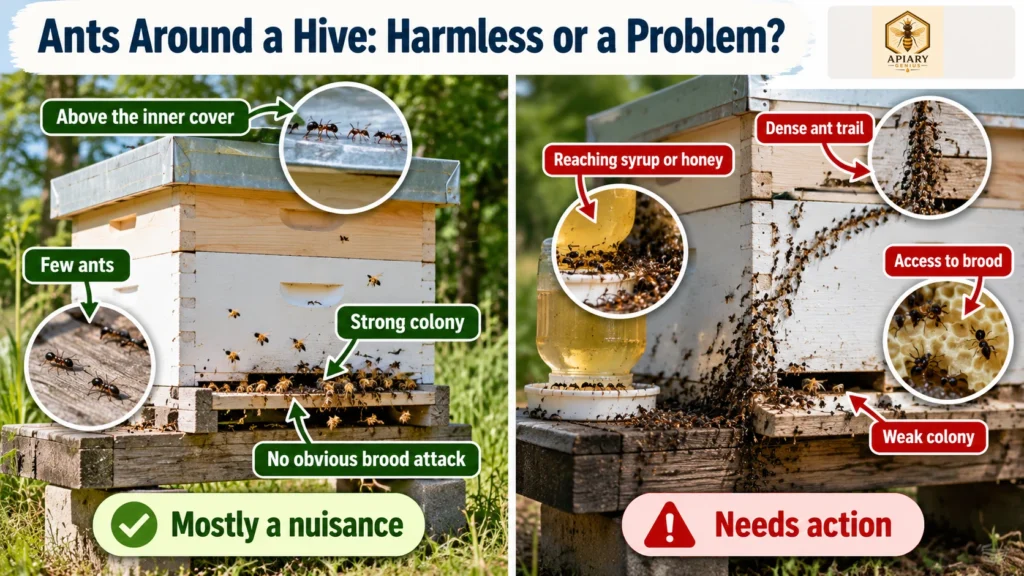
However, continuous trails into the hive, ants feeding on brood or stored food, nesting inside equipment, or heavy activity around a weak colony may signal a more serious problem.
To deal with ants in a beehive:
- Find out where the ants are entering and what they are reaching.
- Look for actual damage to brood, bees, or food stores.
- Check the colony’s population and general health.
- Fix leaking feeders and remove exposed syrup or sugar.
- Eliminate grass, branches, or equipment that provide access bridges.
- Use properly maintained hive-stand barriers when needed.
- Consider carefully contained, label-compliant ant control outside the hive only if simpler methods are insufficient.
Treat the ant problem you actually have—not every ant you see.
Table of Contents
Are Ants in a Beehive Actually a Problem?
Usually, not automatically.
Ants are common visitors to apiaries. Some climb hive stands while foraging, some seek sugary food, and others settle into sheltered spaces that bees cannot easily patrol.
According to Penn State Extension’s guide to honey bee pests, ants are usually not serious pests of honey bee colonies. They are frequently found between the inner and outer covers and seldom disturb the bees.
That general observation does not apply to every ant species or infestation.
Some ants can feed on stored honey, dead bees, or developing brood. Under severe conditions, certain species may place considerable pressure on susceptible colonies.
Five factors help determine the risk:
- Species: Different ants have different feeding and nesting behaviors.
- Numbers: A few occasional visitors differ from a large, persistent infestation.
- Location: Ants above the inner cover are not equivalent to ants reaching the brood nest.
- Colony strength: A well-populated colony generally has more workers available to defend occupied space.
- Actual damage: Direct evidence of food theft, brood predation, or persistent invasion matters more than ant presence alone.
A strong colony is not immune to ants, and a weak colony will not necessarily be overrun.
The important distinction is that finding ants is an observation; determining whether they are causing damage requires additional evidence.
Why Are Ants Attracted to Beehives?
A beehive provides several resources that ants may find attractive. Not every ant enters a hive to attack bees.
Honey and Sugar
Some ants actively forage for sugary foods.
Accessible honey, exposed comb, and sugar residues around hive equipment may attract them. Ants can also exploit honey that becomes accessible in poorly defended spaces.
Ants in Beehive Feeders
Sugar syrup can attract foraging ants when it leaks, spills, overflows, or becomes accessible outside the colony’s defended area.
Feeding bees does not inherently cause an ant infestation. The problem is often the availability of an accessible food source.
Dead Bees and Other Insects
Many ants scavenge dead insects, including dead honey bees.
Finding ants carrying dead bees does not necessarily mean they killed those bees.
Warmth and Shelter
The protected spaces between hive covers, beneath equipment, or within unused cavities can provide shelter.
Some ants occupy these areas without reaching the brood nest.
Moisture
Certain ants seek moist environments or nesting conditions. Damp equipment and sheltered spaces may attract them, depending on the species.
Protected Nesting Areas
Cracks, gaps, cover spaces, and deteriorating wood can provide nesting opportunities.
The UF/IFAS Extension honey bee project guide notes that ants sometimes live in hive equipment and consume honey or supplemental sugar.
The practical lesson is that ants may be looking for food, shelter, moisture, or nesting space—not necessarily brood.
Where Ants Usually Show Up in a Hive
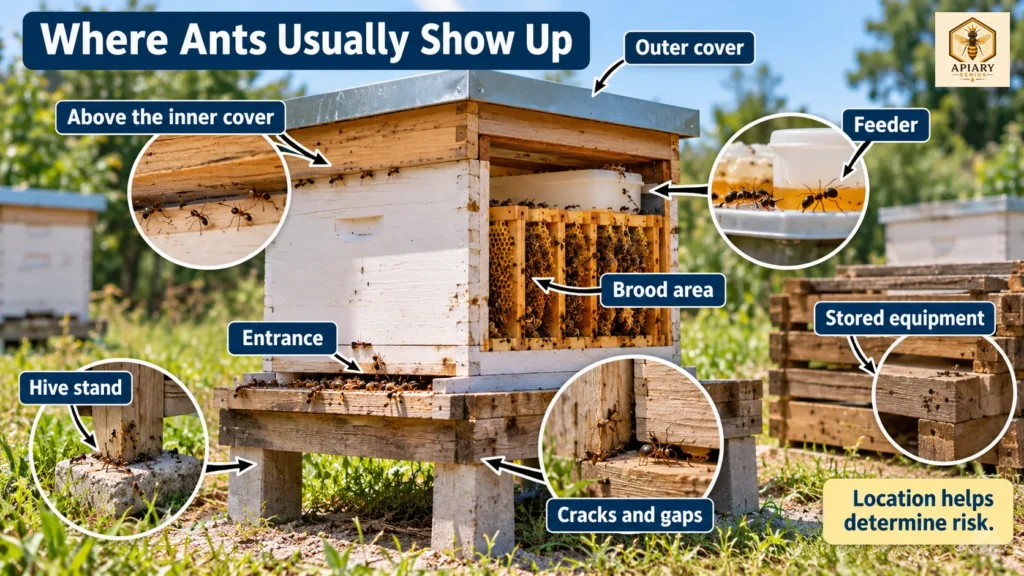
When you find ants in beehive equipment, their location is one of the most useful clues for evaluating a possible infestation.
| Location | Possible explanation | What to investigate |
|---|---|---|
| Hive stand | Ants traveling from the ground | Trails and access routes |
| Beneath the outer cover | Shelter or nesting | Ant numbers and nest material |
| Above the inner cover | Protected space with limited bee access | Whether ants enter lower boxes |
| Feeder equipment | Accessible syrup or sugar residues | Leaks and feeder fit |
| Hive entrance | Foraging or attempts to enter | Bee defense and successful entry |
| Cracks and gaps | Sheltered travel routes | Equipment condition |
| Stored boxes | Nesting or scavenging | Moisture and unused equipment |
| Brood area | Potentially serious intrusion | Direct feeding or damage |
Ants walking across the exterior of a hive are not the same as ants repeatedly entering the brood chamber.
Likewise, an ant nest above the inner cover may be an equipment nuisance without causing damage below.
Use the location to decide what to inspect next.
When Ants Are Mostly Harmless
Ant activity is generally less concerning when it remains limited and the colony appears healthy.
Typical lower-concern signs include:
- Only a few ants are visible.
- Activity is limited to the stand or cover space.
- No dense trail leads into the occupied brood nest.
- Ants are not repeatedly entering feeders.
- No brood predation or attacks on living bees are observed.
- The colony has an adequate working population.
- Brood and food stores appear normal for the colony’s condition.
- Bees are actively controlling their occupied nest space.
For example, several ants sheltering beneath the outer cover of a populous colony do not automatically justify chemical treatment.
Removing accessible nest material, checking for attractants, and monitoring the situation may be enough.
However, do not assume that a minor problem will always remain minor.
If ant numbers increase, established trails develop, or ants begin reaching food or brood, reassess the situation.
Warning Signs Ants Are Actually Hurting the Colony
Ants attacking a beehive can be difficult to distinguish from ants simply using it for shelter or scavenging.
Look for evidence that goes beyond occasional activity.
Dense Trails Entering the Hive
A continuous, heavily traveled route into the hive may indicate that ants have found a dependable resource.
Follow the trail to determine what they are reaching.
Ants Reaching Brood
Ants moving into the occupied brood area deserve closer attention than ants confined above the inner cover.
Direct feeding on developing brood is particularly concerning.
Feeding on Brood or Bees
Some ant species can consume honey bee brood, while others primarily scavenge dead insects.
Distinguish attacks on living bees or brood from removal of bees that have already died.
Persistent Food Access
Repeated access to honey or syrup can become significant, especially in a small colony with limited reserves.
Nesting Inside Equipment
An established ant nest may create persistent access routes or interfere with routine hive management.
Heavy Activity and Colony Disturbance
Large numbers of ants accompanied by unusual bee agitation, declining activity, or disrupted brood development warrant investigation.
However, those signs are not specific to ant damage.
Severe Infestation Pressure
In some circumstances, heavy ant infestations can contribute to colony absconding.
Mississippi State University Extension documents Argentine ants feeding on brood, dead bees, and honey stores. It also reports that severe infestations can cause honey bees to abandon their hives.
The University of Tennessee’s fire ant guidance describes imported fire ants invading hives and feeding on developing larvae, occasionally causing serious damage to weak colonies.
These examples establish that some ant infestations can be harmful. They do not establish that every ant species behaves this way or that every heavy infestation causes absconding.
Do not blame ants for colony decline without investigating other possible causes.
Why Weak Colonies Are More Vulnerable to Ants
Small or declining colonies may have difficulty defending all their equipment.
Several factors can increase vulnerability.
Fewer guard bees
A reduced worker population generally means fewer bees available to defend entrances and other accessible areas.
Less effective patrol coverage
Weak colonies may leave parts of the hive poorly defended, providing opportunities for ants to enter or shelter.
Easier access to food
Exposed honey, dead bees, and supplemental feed may be easier for ants to exploit when fewer workers control access.
Overlapping colony problems
Queen problems, Varroa pressure, food shortages, and other pests may reduce colony strength independently of ant activity.
The relationship can work in either direction.
Ants may contribute to stress in an already vulnerable colony. Alternatively, ants may become more noticeable because the colony was weak before they arrived.
Ants can be a consequence of colony weakness as much as a cause.
Removing the ants will not correct an underlying health problem.
Which Ants Can Cause Problems in Beehives?
Ant species differ considerably in their feeding habits, nesting behavior, and potential impact on honey bees.
A few examples help explain why local identification matters.
Argentine Ants
Argentine ants (Linepithema humile) can establish extensive foraging trails and exploit resources in honey bee colonies.
Mississippi State University Extension documents their feeding on brood, dead bees, and honey stores, with severe infestations posing greater risks to susceptible colonies.
Carpenter Ants
Carpenter ants (Camponotus species) may forage around hives or occupy cavities in wooden structures.
Some excavate wood to establish nests, particularly under suitable nesting conditions. However, ants sheltering around hive equipment should not automatically be identified as carpenter ants or assumed to be damaging wood.
Imported Fire Ants
Imported fire ants can be problematic in regions where they are established.
They may invade susceptible colonies and feed on developing brood. Their stings also pose a hazard to people working around infested apiaries.
Crazy Ants and Other Local Species
Some invasive or regionally troublesome ants can occur in large numbers or occupy protected equipment spaces.
Their importance depends on local distribution, species behavior, and infestation conditions.
These examples are not a nationwide species-identification guide.
Argentine ants, carpenter ants, imported fire ants, and ants commonly called crazy ants are not equally distributed throughout the United States.
If an infestation is persistent or damaging, contact a local Cooperative Extension office or appropriate insect-identification service.
Species identification is most useful when it changes your management decision.
How to Keep Ants Out of a Beehive
The most practical approach to ant control for beehives is usually to remove attractants and block access before considering pesticides.
Start with these measures.
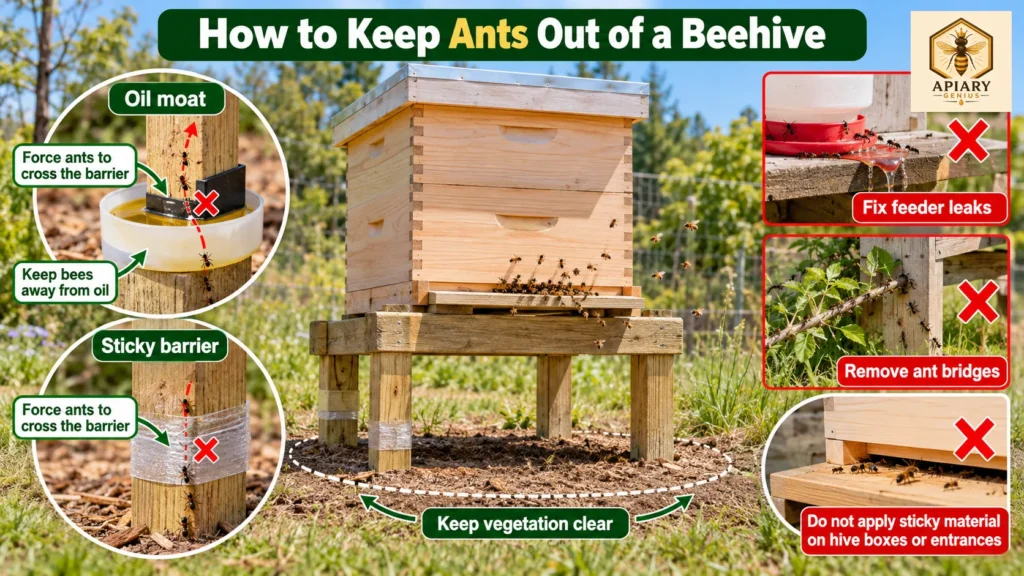
- Identify and reduce access routes. Determine whether ants are climbing stand legs, crossing vegetation, or using nearby equipment.
- Remove attractants. Clean accessible syrup, exposed sugar, and food residues.
- Improve stand isolation. Use a stable, elevated hive stand that allows ground access points to be protected.
- Prevent vegetation contact. Keep grass and branches from touching the stand or hive.
- Repair feeder leaks. Make sure syrup remains properly contained.
- Evaluate colony strength. Investigate whether the colony has enough workers to defend its occupied space.
- Install physical barriers if needed. Use appropriately protected oil moats or sticky barriers where practical.
- Escalate only when justified. Consider additional control when the ants are causing meaningful problems and simpler measures are insufficient.
Physical exclusion works only if ants cannot bypass the protected route.
A perfectly maintained barrier on one stand leg will accomplish little if ants can enter along a branch touching the hive.
Keep Grass and Vegetation From Becoming an Ant Bridge
Grass, weeds, and nearby branches can create alternative paths into a hive.
Check for:
- Tall grass touching hive boxes.
- Weeds leaning against the stand.
- Branches contacting the outer cover.
- Debris accumulated around stand legs.
- Nearby objects or stored equipment touching the hive.
These connections can allow ants to bypass a barrier intended to stop them.
Trim vegetation where necessary and maintain practical clearance around the hive stand.
There is no need to remove all surrounding vegetation or eliminate beneficial flowering plants unnecessarily.
The goal is to interrupt physical contact with the hive.
UF/IFAS Extension identifies elevated stands and trimming vegetation around hives as useful ant-prevention practices.
Recheck contact points regularly, especially during periods of rapid plant growth.
Check Feeders and Spilled Syrup
When ants gather around feeders, investigate the food source before choosing an ant-control product.
Inspect for:
- Leaking seams or containers.
- Loose or poorly fitted feeder components.
- Syrup escaping around lids.
- Residues on exterior surfaces.
- Spills during filling.
- Open sugar syrup accessible outside the colony’s defended area.
Correct leaks promptly.
Clean spilled syrup from accessible equipment surfaces, avoid leaving exposed sugar beside the hive, and make sure the feeder is assembled correctly.
If ants are entering the feeder, identify the access route rather than repeatedly replacing the syrup while leaving the problem unchanged.
A feeder can be functioning well nutritionally while still providing an unintended food source for ants if syrup is exposed.
For more guidance on supplemental feeding methods and equipment, see Feeding Bees: The Complete Guide for Every Season.
How to Use Hive-Stand Barriers
Physical barriers can help prevent ants from climbing hive stands without introducing insecticides into occupied hive equipment.
The most commonly described methods include oil moats and sticky barriers placed on isolated stand legs.
Both Mississippi State University Extension and the University of Tennessee describe these approaches for limiting ant movement into beehives.
Before using any barrier, make sure:
- The stand remains stable and can safely support the hive.
- Every practical ground access route crosses the barrier.
- Honey bees cannot contact hazardous materials.
- Grass, branches, and equipment do not provide alternate routes.
- Maintenance is practical throughout the season.
No physical barrier should be considered permanent or guaranteed.
Oil Moats
An oil moat uses a liquid barrier around a hive-stand leg to interrupt ground-traveling ants.
Some Extension guidance describes placing stand feet in shallow containers holding nontoxic oil.
The arrangement must be designed to avoid creating new hazards.
For safer use:
- Use a stable, load-bearing stand arrangement.
- Select an appropriate nontoxic oil for the barrier setup.
- Keep containers away from normal bee flight and landing areas.
- Prevent bees and other non-target animals from entering the liquid.
- Avoid exposed containers that create drowning hazards.
- Prevent spills, tipping, and overflow.
- Keep oil away from smoker flames and ignition sources.
- Remove leaves, insects, or debris that could form a bridge.
- Check oil levels and container condition regularly.
Avoid improvising an open trap that can contaminate hive equipment or surrounding soil.
Oil barriers are most practical when the stand has a manageable number of protected support points.
Sticky Barriers
Sticky barriers prevent or discourage ants from climbing selected surfaces.
They are typically placed on isolated stand legs, not on hive boxes or entrances.
For practical use:
- Keep sticky material away from areas contacted by honey bees.
- Do not apply it to landing boards or entrances.
- Use a suitable material and follow its instructions.
- Protect stand surfaces when appropriate.
- Remove accumulated dust, debris, and trapped insects.
- Maintain or renew the barrier when effectiveness declines.
- Check for vegetation bypassing the protected area.
Dust and debris can reduce the effectiveness of sticky materials.
Poor placement may also trap non-target insects.
Never place sticky ant-control material where honey bees routinely land, walk, or gather.
What to Do If Ants Are Already Inside the Hive
Finding ants inside hive equipment does not automatically justify dismantling the colony.
Use a focused inspection.
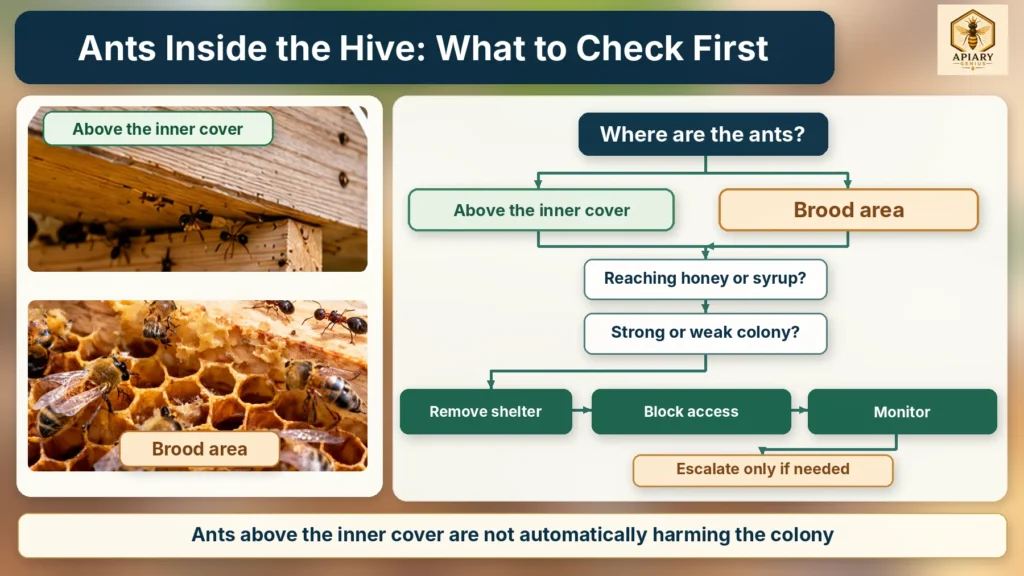
- Locate the ants. Determine whether they are beneath the cover, inside a feeder, along equipment walls, or reaching brood.
- Check for direct damage. Look for feeding on brood, accessible honey, syrup, or dead bees.
- Evaluate colony strength. Determine whether the bees are actively defending their occupied equipment.
- Identify attractants. Check for exposed feed, honey, moisture, or sheltered nesting spaces.
- Remove accessible ant shelter. Clear ant nest material from unoccupied cover spaces when practical.
- Block the entry route. Interrupt stand-leg access and other physical connections.
- Clean or repair equipment. Correct feeder problems and damaged components that maintain the infestation.
- Monitor the result. Recheck ant pressure and colony condition after the intervention.
Ants confined above the inner cover usually do not require a complete brood inspection solely because they are present.
However, ants repeatedly reaching the brood area justify closer examination.
Avoid unnecessary hive disassembly, especially under unsuitable weather conditions.
Ants Nesting Above the Inner Cover
Ants above the inner cover often occupy a sheltered space that is difficult for bees to patrol.
A telescoping outer cover may create a narrow cavity above the inner cover. Depending on the equipment configuration, worker bees may be unable to enter that space easily.
Michigan State University Extension’s guidance on ants in honey bee colonies explains how this limited access can allow ants to remain between covers.
During an inspection, assess:
- The number of ants present.
- Whether ant eggs, larvae, pupae, or nest material are visible.
- Whether activity is confined above the inner cover.
- Whether ants are reaching food or entering lower boxes.
- Whether the bees appear adequately populated and undisturbed.
If ants are only sheltering above the colony, removing accessible nest material and improving exclusion may be sufficient.
Michigan State University also discusses changing the inner-cover orientation and creating additional space so bees can patrol the affected area. Such an adjustment should only be considered when suitable for the equipment and conditions, without compromising cover stability, weather protection, or pest exclusion.
A 2025 Michigan State University Extension response likewise explains that ants above inner covers are commonly sheltering rather than causing meaningful harm in Michigan colonies.
That regional observation should not be generalized to every species or location.
First determine whether ants are simply sheltering above the colony or reaching food and brood.
Should You Use Ant Baits Near Beehives?
Ant baits may be appropriate for some meaningful infestations, but they require special caution around honey bees.
Ant bait combines an attractive food material with an insecticide.
Foraging ants consume or transport the material, potentially exposing other ants within the nest.
Because some baits use sugar-based attractants, exposed products may also attract honey bees.
A product marketed for ant control is not automatically safe near an occupied beehive.
Consider bait-based control only when:
- Ant pressure is substantial or persistent.
- Removing attractants and blocking access have not provided adequate control.
- The product label permits the intended use and location.
- The treatment remains outside occupied hive equipment.
- Honey bees can be reliably excluded from the bait and residues.
- The placement does not threaten honey, comb, drinking water, or bee traffic areas.
Where permitted, a properly contained bait station may reduce exposure compared with open bait.
However, an enclosed station is not necessarily inaccessible to honey bees. The actual design, openings, placement, and product instructions matter.
Do not place exposed sweet bait, poisonous syrup, or loose toxic materials where bees can forage.
General ant-management guidance from UC Integrated Pest Management and NC State Extension explains how baits work, but it does not establish that every household ant bait is safe near beehives.
If the product label or bee-exclusion method is uncertain, seek guidance from your state Cooperative Extension service or pesticide regulatory authority.
Bait should be a carefully evaluated option for a real infestation, not a routine response to a few ants.
Why Spraying Insecticide Around an Active Hive Can Be Risky
Many insecticides that kill ants can also harm honey bees.
Direct spraying is an obvious danger, but exposure can occur in other ways.
Bees may contact insecticide residues on treated surfaces or encounter spray drift near hive entrances, landing boards, vegetation, or nearby flowers.
Treatment around the entrance can expose bees precisely where they repeatedly enter and leave the colony.
The U.S. Environmental Protection Agency’s pollinator-protection guidance explains how pesticide labels, exposure-reduction measures, and application restrictions help protect pollinators.
For ant problems around occupied hives:
- Do not spray insecticide directly into the hive.
- Do not routinely spray entrances or landing boards.
- Avoid broad, exposed treatments that could contaminate bee traffic areas.
- Do not assume an ant-control product is bee-safe.
- Follow the exact product label and applicable restrictions.
- Consult authoritative local guidance when chemical use near an apiary is uncertain.
Product choice, placement, residues, drift, and exposure pathways all matter.
Use nonchemical exclusion whenever it can adequately address the problem.
What About Cinnamon, Diatomaceous Earth, or Essential Oils?
Cinnamon, diatomaceous earth, and essential oils frequently appear in discussions about home remedies for ants.
Some beekeepers report success with these materials, but anecdotal observations are not equivalent to dependable, hive-specific evidence.
Cinnamon
Cinnamon is sometimes used as a supposed ant repellent.
However, reliable evidence is insufficient to recommend it as a primary method for protecting occupied beehives across different ant species and environmental conditions.
Diatomaceous Earth
Diatomaceous earth can affect insects by damaging or absorbing protective surface materials, contributing to desiccation.
Its effectiveness depends on conditions, including moisture.
UC Integrated Pest Management explains that dust-based ant control has limitations in damp conditions and that inhalation can cause serious irritation.
That general information does not establish that spreading diatomaceous earth around hive entrances is an effective or safe practice for honey bees.
Avoid placing uncontrolled dust where bees may contact it.
Essential Oils
Some essential oils demonstrate repellent or insecticidal effects under particular conditions.
Those results do not establish reliable long-term ant exclusion or safety when concentrated oils are applied around occupied hives.
Do not apply concentrated oils directly to bees, combs, entrances, or bee-contact surfaces without adequate evidence and appropriate guidance.
For practical ant control, prioritize correcting attractants, removing access bridges, and maintaining physical barriers.
A temporary repellent effect does not necessarily make a remedy a dependable hive-management method.
Are Ants the Real Reason Honey Is Disappearing?
Not necessarily.
Ants may consume accessible honey, but low food stores alone do not prove that ants are responsible.
Other possible explanations include:
- Normal colony food consumption.
- Brood-rearing demands.
- Honey-bee robbing.
- Yellowjackets or other food-stealing insects.
- Leaking or damaged comb.
- Incorrect earlier estimates of food stores.
Look at what is happening around the hive.
Unusually frantic bee traffic, fighting at entrances, and bees trying to enter through gaps may suggest honey-bee robbing rather than ant damage.
See Robbing Bees: How to Tell If Your Hive Is Being Robbed and How to Stop It for the separate signs and control measures.
If wasps are repeatedly pressuring the entrance or attacking bees, consult Yellowjackets Attacking Beehives: Signs, Risks, and What to Do.
Do not diagnose honey theft from ant presence alone.
A stronger indication would be directly observing ants repeatedly reaching and consuming accessible stores.
When Ants Are a Sign to Check Colony Strength
Heavy ant activity around a small colony can be a reason to investigate overall colony health.
The ants may be exploiting reduced defensive capacity rather than causing the original problem.
Check:
Queen status
Look for evidence of recent egg laying and normal queen function.
Brood pattern
Determine whether brood development appears consistent with the colony’s condition.
Adult population
Assess whether enough workers are present to cover and defend the occupied comb.
Food stores
Check whether the colony has adequate accessible nutrition.
Varroa pressure
Review recent mite-monitoring results and whether management has been appropriate.
Other pest activity
Inspect for evidence of additional pests taking advantage of weakly defended equipment.
For specific beetle problems, see Small Hive Beetle Control: How to Identify, Prevent, and Manage an Infestation.
If webbing, tunneling, or damaged comb indicates a possible wax moth problem, consult Wax Moth Control: How to Prevent and Manage Infestations in Beehives.
These are separate diagnoses, not automatic consequences of ant activity.
Eliminating ants does not resolve queenlessness, excessive Varroa pressure, starvation, or other underlying colony problems.
What Not to Do
Avoid turning a minor ant problem into a greater risk for the colony.
- Do not treat every ant sighting as an emergency. Assess numbers, location, and damage.
- Do not spray insecticide into an occupied hive. Avoid exposing bees and hive products.
- Do not place exposed poison where honey bees can reach it. Sweet bait can attract bees.
- Do not assume an ant-control label guarantees bee safety. Label restrictions and exposure pathways matter.
- Do not allow grass or branches to bypass stand barriers. Check all access routes.
- Do not place sticky substances where bees can contact them. Avoid unnecessary entrapment.
- Do not create unsafe open oil traps. Prevent drowning, leakage, instability, and fire hazards.
- Do not ignore leaking feeders. Correct the food source attracting ants.
- Do not rely on cinnamon or essential oils as proven control methods. Evidence is insufficient for dependable hive protection.
- Do not blame ants automatically for a weak colony. Investigate other causes.
- Do not introduce contaminated ant-control materials into the hive. Keep external pest-control substances away from comb and food-contact equipment.
- Do not assume troublesome ant species occur everywhere. Regional identification matters.
Effective management addresses actual ant pressure without unnecessarily disrupting or exposing the bees.
Ant Troubleshooting Checklist
Use this checklist before deciding whether ant control is necessary.
- ☐ 1. Where are the ants? Stand, cover, feeder, entrance, equipment gaps, or brood area?
- ☐ 2. How many are present? A few individuals or a continuous trail?
- ☐ 3. Are they sheltering or entering the brood area? Follow their movement.
- ☐ 4. Are they reaching honey or syrup? Look for accessible food.
- ☐ 5. Are they attacking brood or adult bees? Distinguish predation from scavenging.
- ☐ 6. Is the colony strong or weak? Evaluate its population and defensive capacity.
- ☐ 7. Is a feeder leaking? Check for exposed syrup or sugar residues.
- ☐ 8. Is vegetation bridging the stand? Inspect grass, branches, and nearby objects.
- ☐ 9. Are the stand legs isolated? Identify ground access routes.
- ☐ 10. Can a physical barrier solve the problem? Assess safe and practical exclusion.
- ☐ 11. Is local ant identification needed? Would the species affect management?
- ☐ 12. If bait is considered, can bees be completely excluded from it? Verify the actual product and placement.
- ☐ 13. Is chemical control necessary? Have simpler measures been tried, and does the label permit the use?
- ☐ 14. Does the colony need a broader health check? Could ants be exploiting another problem?
If only a few ants are present and the colony is functioning normally, observation and prevention may be enough.
If ants repeatedly reach brood or food, establish nests inside equipment, or contribute to significant colony pressure, act on the access routes and reassess the infestation.
FAQ
Are ants in a beehive harmful?
Not always. Many ants are nuisance visitors that shelter around hive equipment or forage for accessible food. Certain species can harm susceptible colonies by feeding on honey or brood, particularly when infestations are severe. The level of concern depends on species, numbers, location, colony strength, and observed damage.
Why are ants under my hive lid?
Ants may shelter or nest between the inner and outer covers because the space is protected and sometimes difficult for bees to patrol. Finding ants above the inner cover does not automatically mean they are attacking brood.
Will bees kill ants in the hive?
Honey bees can repel, confront, or remove ants from areas they actively defend. Their effectiveness depends on colony population, the accessibility of the affected space, and the ants involved. Bees cannot be expected to eliminate every infestation.
Can ants eat bee brood?
Yes. Some species, including Argentine ants and imported fire ants, have been documented feeding on developing honey bee brood. However, not every ant found inside a hive is a brood predator.
Can ants make bees leave a hive?
Severe infestations can contribute to absconding in some circumstances. Mississippi State University Extension documents this possibility with heavy Argentine ant pressure. However, finding ants in an abandoned hive does not prove that ants caused the colony to leave.
Why are ants attracted to my bee feeder?
Ants may be attracted to exposed sugar syrup, feeder leaks, spills, or residues. Correct feeder problems, clean accessible syrup, and identify the route ants are using to reach the food.
How do I keep ants off my hive stand?
Reduce direct access from the ground, keep vegetation and equipment from touching the hive, and consider appropriately designed oil moats or sticky barriers on isolated stand legs. Maintain the barriers and remove debris that could provide an alternate route.
Are oil moats safe around beehives?
Oil moats can be useful when properly designed. They must be stable, use suitable materials, prevent honey bee contact, and avoid drowning, spill, contamination, and fire hazards. Poorly positioned open containers are not an appropriate solution.
Can I spray ant killer near a beehive?
Avoid routine insecticide spraying on, inside, or immediately around occupied hive entrances. Ant insecticides can harm honey bees through direct exposure, drift, or residues. Any chemical application must follow the product label and authoritative guidance for the intended site.
Are ant bait stations safe around bees?
Not automatically. A contained station may reduce exposure, but its design and placement must reliably exclude honey bees. Use only products labeled for the intended application and keep treatment outside the hive. Do not use bait that bees can access.
Does cinnamon keep ants out of beehives?
There is insufficient reliable hive-specific evidence to recommend cinnamon as a dependable primary control method. Physical exclusion and correction of food attractants are better-supported starting points.
Does diatomaceous earth work for ants around beehives?
Diatomaceous earth can affect ants under suitable dry conditions, but moisture limits its effectiveness. Applying exposed dust around occupied hives has not been established as a consistently effective or bee-safe ant-control method.
Why are ants worse in weak colonies?
Weak colonies may have fewer workers available to defend entrances and unused equipment, allowing ants easier access to food or shelter. However, the ants may be exploiting an existing colony problem rather than causing the original decline.
Sources
- Penn State Extension — A Quick Reference Guide to Honey Bee Parasites, Pests, Predators, and Diseases.
- Mississippi State University Extension — Minor Pests of Honey Bees in Mississippi.
- University of Florida, UF/IFAS Extension — Welcome to the Apiary! Honey Bee 4-H Project Book.
- Michigan State University Extension — Help! My Colony Has Ants!
- Michigan State University Extension — Ants: Ask Extension, May 2025.
- University of Tennessee Institute of Agriculture — Agricultural Control: Apiaries.
- University of California Integrated Pest Management — Ants.
- North Carolina State University Extension — Baiting for Ants.
- U.S. Environmental Protection Agency — Tools and Strategies for Pollinator Protection.
- University of California Integrated Pest Management — Ant Control FAQ.
- University of California Integrated Pest Management — Carpenter Ants.