
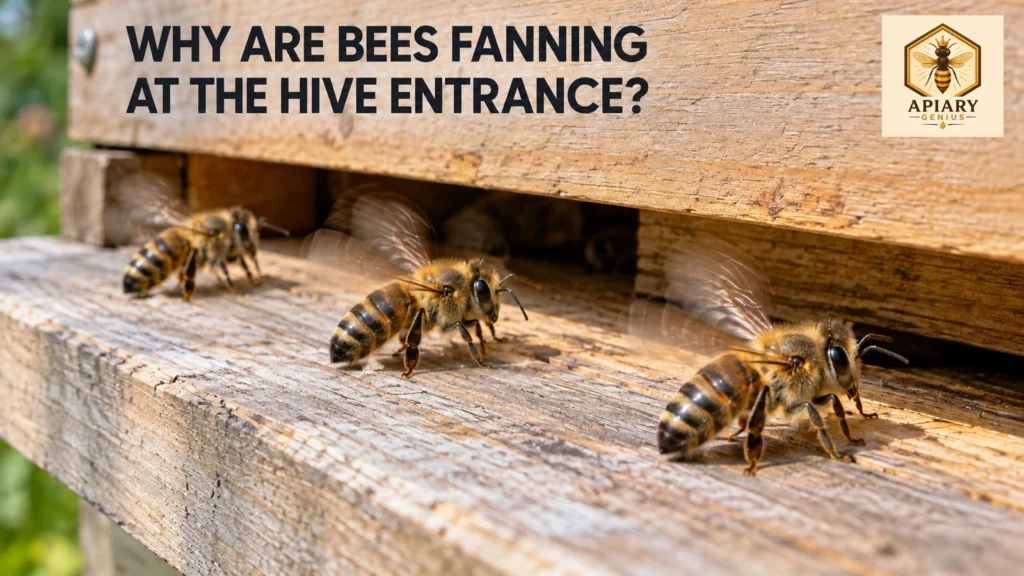
Bees fanning at hive entrance are usually doing normal colony work. Workers standing on the landing board with their wings moving rapidly may be helping ventilate the nest or spreading an orientation scent. The movement alone does not tell you which job they are doing.
Before changing the entrance or adding ventilation, look at their abdomen posture, the weather, nectar activity, and what happened recently. A calm colony processing nectar after sunset presents a different situation from newly installed bees gathering at an unfamiliar entrance.
Quick Answer
Bees fanning at the hive entrance move air while standing still. That airflow can help regulate the nest environment, support nectar drying, or disperse Nasonov pheromone so nestmates can locate the entrance or regroup.
Fanning alone does not mean the hive is overheating or needs more ventilation. Raised abdomens with a visibly exposed Nasonov gland support a scenting interpretation, but distant observation may remain inconclusive. If activity otherwise looks normal, observation is often enough. Research on wing fanning distinguishes ventilation from scent dispersal.
Table of Contents
What Does It Mean When Bees Fan Their Wings at the Hive Entrance?
Usually, it is normal colony work. Bees fanning their wings at the hive entrance remain on a surface instead of taking flight.
Possible functions include ventilation, temperature regulation, humidity regulation, respiratory-gas regulation, nectar drying, and Nasonov pheromone dispersal. Several colony needs may occur together, so the entrance scene need not have one exclusive explanation.
Treat bees fanning at the hive entrance as a behavior to interpret, rather than a problem to fix. Ask what else is happening before deciding that intervention is needed.
How Honey Bees Use Fanning to Ventilate the Hive
Stationary workers can generate airflow through the nest with their wings. Honey bees fanning near the entrance work collectively to exchange internal air with outside air, moving warm or stale air out and allowing fresher air to enter. Outside air may also be cooler, depending on conditions.
This is a collective process. In a study of collective nest ventilation, colonies with broad entrances formed groups associated with separate areas of incoming and outgoing air. Research on social control of ventilation has also documented alternating outward and inward flow through small entrances.
These findings explain why one bee is not a complete ventilation system—and why every hive need not use the same airflow pattern. Body direction alone cannot reliably tell a beekeeper the purpose of fanning or the airflow throughout the nest.
Does Fanning Mean the Hive Is Too Hot?
Not necessarily. Heat can trigger or increase fanning, but it is not the only possible reason. Cooling can also involve water evaporation, so ventilation is only part of the colony’s temperature-control response.
Consider the whole setting:
- Outside temperature and direct sun exposure.
- Time of day and whether the hive has recently been strongly heated.
- Colony size and activity.
- Incoming nectar and processing demands.
- Humidity and recent hive manipulation.
These are clues to investigate, not an overheating test. Ambient temperature alone does not describe conditions inside the colony, and there is no universal outdoor temperature at which entrance fanning becomes abnormal.
If recurring heat-related concerns point to the site’s exposure, review how to choose the best location for a beehive. Site assessment should respond to the broader conditions, not fanning alone.
How Fanning Helps Control Humidity and Carbon Dioxide
Bees produce carbon dioxide through respiration, and colony metabolism contributes moisture. Nectar processing adds another source of water vapor. Air exchange helps regulate these internal conditions.
Controlled research on humidity preference and brood care found that increasing humidity could trigger fanning. This supports a role in humidity regulation; it does not establish one humidity threshold for every field colony.
CO₂ can also stimulate ventilation. Research on atmospheric carbon dioxide regulation examined this response in honey bee colonies.
For the beekeeper, the practical limit is straightforward: wing movement does not reveal the hive’s humidity or CO₂ concentration. You cannot diagnose either condition simply by counting entrance fanners.
Why Bees Fan During a Nectar Flow
Incoming nectar contains substantial water. To become ripe honey, it must lose much of that moisture.
Bees manipulate nectar directly, and airflow can support evaporation within the nest. Research on nectar dehydration describes honey processing as a combination of active evaporation, ventilation-related evaporation, and enzymatic action.
Consequently, strong fanning during a nectar flow may be consistent with ongoing nectar drying. Work can continue after foragers stop bringing nectar home.
However, not all fanning during a flow is solely for drying nectar. Temperature, humidity, gas exchange, and other colony needs may overlap. Nor does entrance fanning tell you that honey is ready to harvest.
Why Bees May Fan in the Evening or at Night
Night fanning can be completely normal. Sunset does not end the colony’s internal work.
Possible reasons include continued nectar processing, moisture removal, residual heat, and other airflow needs. Researchers studying collective ventilation also documented active entrance fanning at night.
Judge the surrounding behavior rather than the hour. Bees fanning calmly while the entrance remains accessible are different from bees showing unusual mortality or sustained distress. Evening fanning does not, by itself, prove overheating.
What Is Nasonov Scenting?
Nasonov scenting is the dispersal of a worker-produced orientation pheromone. It helps other bees locate or gather at a useful place, such as a nest entrance or swarm gathering point.
Workers have a Nasonov gland near the tip of the abdomen. During scenting, they typically raise the abdomen and flex its tip downward to expose the Nasonov gland area while fanning their wings. Airflow carries the scent away from the bee. This posture and mechanism are described in research on honey bee chemical communication.
Relevant situations include locating an entrance, regrouping after disturbance, swarm orientation, and reorientation at a new home. Nasonov is an orientation and recruitment signal, not an alarm pheromone.
Ventilation Fanning vs. Nasonov Scenting
Both behaviors involve wing movement, but their immediate functions differ.
| Clue | Ventilation Fanning | Nasonov Scenting |
|---|---|---|
| Wing fanning | Yes | Yes |
| Raised abdomen | Not required | Characteristic |
| Nasonov gland exposed | No—not part of ventilation itself | Yes |
| Main function | Move air and regulate the nest environment | Disperse orientation pheromone |
| Common contexts | Heat, humidity, CO₂, nectar processing | Orientation, regrouping, entrance-location signaling |
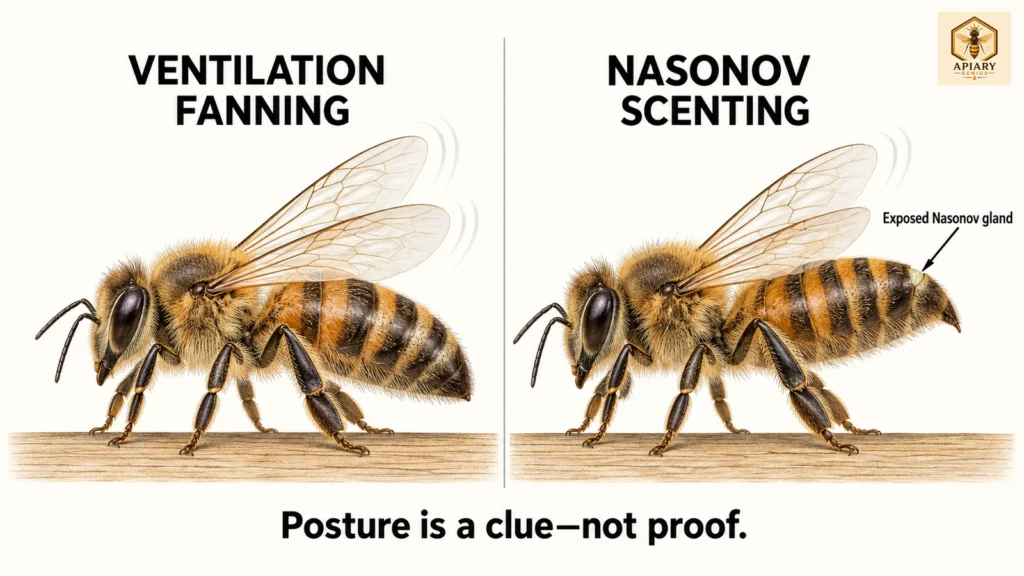
Field observation is not always definitive. The table compares the behaviors; it is not a guaranteed identification tool for every bee seen from a distance.
A raised abdomen is a useful clue, but it does not prove that the gland is exposed. A clear view of the gland area provides stronger support than posture alone. Wing movement or inward-facing versus outward-facing body direction cannot establish the purpose by itself.
Why Do Bees Fan After an Inspection?
Post-inspection fanning may reflect environmental regulation or orientation-related behavior. Research on honey bee chemical communication describes Nasonov release as especially evident after colony disturbance. This makes scenting a plausible explanation in some cases, not a diagnosis of every post-inspection fanner.
Possible interpretations include restoring nest conditions, reestablishing airflow, and scenting to guide nestmates. Timing alone cannot distinguish these possibilities.
Once you have finished, close the hive correctly and observe from outside. If the colony settles and normal activity resumes, further investigation may be unnecessary. Reopening it repeatedly can create more disturbance without answering the original question.
Why Bees Fan After Installing a Package or Swarm
Nasonov scenting can be especially relevant when bees are gathering at a new entrance. Workers that locate the entrance may expose the gland and fan, helping other bees find the same place.
Experimental research on scent-mediated aggregation shows how worker scenting can help bees collectively locate and gather near their queen. This supports the orientation role of scenting, without making every post-installation fanning event identical.
Use How to Install Package Bees or a Nuc for the installation procedure. Fanning is one observation within that process, not proof that the queen has been accepted or the colony is fully established.
After relocation, scenting may also be relevant to regrouping or finding the entrance. Assess return flights and bees gathering at the previous location separately, using How to Move a Beehive.
Is Fanning the Same as Bearding?
No. Fanning describes workers remaining relatively stationary while rapidly beating their wings. Bearding describes large numbers of bees clustering or hanging outside the hive.
The two can occur together. A cluster on the hive front may contain some fanning workers, but that does not make the entire cluster a fanning group.
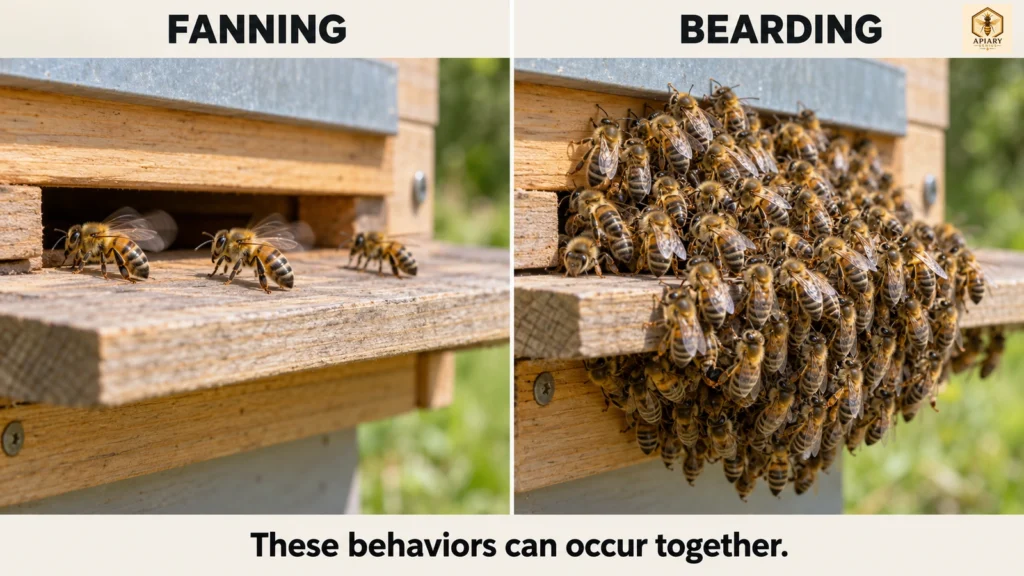
If the main thing you see is a large outside cluster, use Why Are Bees Bearding Outside the Hive? to assess that behavior. Here, the key question is what stationary wing-fanning workers may be doing.
Is Fanning a Sign the Hive Needs More Ventilation?
Not automatically. Bees normally ventilate their own nest. Seeing that work in progress does not establish that the equipment is defective.
Before modifying anything, consider weather, colony strength, nectar flow, water access, entrance condition, simultaneous bearding, and any treatment currently in use. Look for an actual problem, such as a physically blocked entrance, rather than assuming one from wing movement.
If a registered hive pesticide or Varroa treatment is in use, follow its label instructions. Requirements may concern entrances, ventilation, temperature, or hive configuration. EPA’s registered Varroa-product resources provide links to product records; use the label applicable to your product. For the broader monitoring and treatment workflow, see How to Control Varroa Mites.
Should You Open the Entrance More When Bees Are Fanning?
Not as an automatic response. First distinguish a deliberate entrance restriction from a physical obstruction or unusually restricted traffic.
Consider colony strength, robbing risk, pest pressure, weather, and treatment-label requirements. A reducer may be serving a legitimate purpose, particularly where entrance defense matters.
If debris is obstructing the intended opening, address that obstruction with minimal disturbance. If bees can use the opening normally and no other problem is evident, fanning alone does not justify removing the reducer. Any size adjustment should have a specific management reason.
Should You Add Extra Vents or Drill Holes?
Not based on fanning alone. Permanent equipment changes should respond to a demonstrated management problem.
Before drilling holes, adding an upper entrance, or installing extra vents, identify what is wrong and why that change would address it. Account for local conditions and current treatment instructions.
There is no single ventilation configuration that is correct for every colony and climate. Normal fanning is also not, by itself, a reason to add a super or open the hive.
When Fanning May Deserve a Closer Look
Fanning deserves closer attention when it accompanies another concerning condition:
- Extreme heat, especially with inadequate water access.
- Prolonged unusual agitation or widespread distress.
- A blocked entrance.
- Severe simultaneous bearding accompanied by other concerning changes.
- Unusual numbers of dead or dying bees.
- Possible treatment-related problems.
- A sudden departure from the colony’s usual behavior.
Investigate the accompanying problem. For example, check an obstruction directly, verify water availability, or review the current product label. If unusual mortality or distress persists and the cause is unclear, seek help from a local Extension specialist, apiary inspector, or experienced beekeeper.
Fanning alone is not the diagnosis. Neither the number of fanners nor the outdoor temperature supplies a universal intervention threshold.
What to Check Before You Change Anything
- Check weather and temperature. Include direct sun exposure and current heat conditions.
- Note the time of day. Evening and nighttime activity need context, not automatic concern.
- Observe how many bees are fanning. Note whether activity is localized or spread along the entrance.
- Watch abdomen posture. Raised abdomens may support a scenting interpretation.
- Look for a clearly exposed Nasonov gland if safe. Use a zoomed view rather than crowding or handling bees; an unclear view remains inconclusive.
- Consider whether a nectar flow is occurring. Use your recent observations of incoming nectar and colony activity.
- Review recent events. Was the hive inspected, moved, or newly installed?
- Check for physical entrance blockage. Observe the intended opening and passage of bees.
- Look for bearding. Distinguish a few stationary fanners from a large outside cluster.
- Check water availability during hot weather. Confirm that bees have an accessible source with safe landing places.
- Review current treatment-label instructions. Do this before changing entrances or ventilation.
- Observe overall colony behavior. Decide whether there is evidence of a problem beyond fanning.
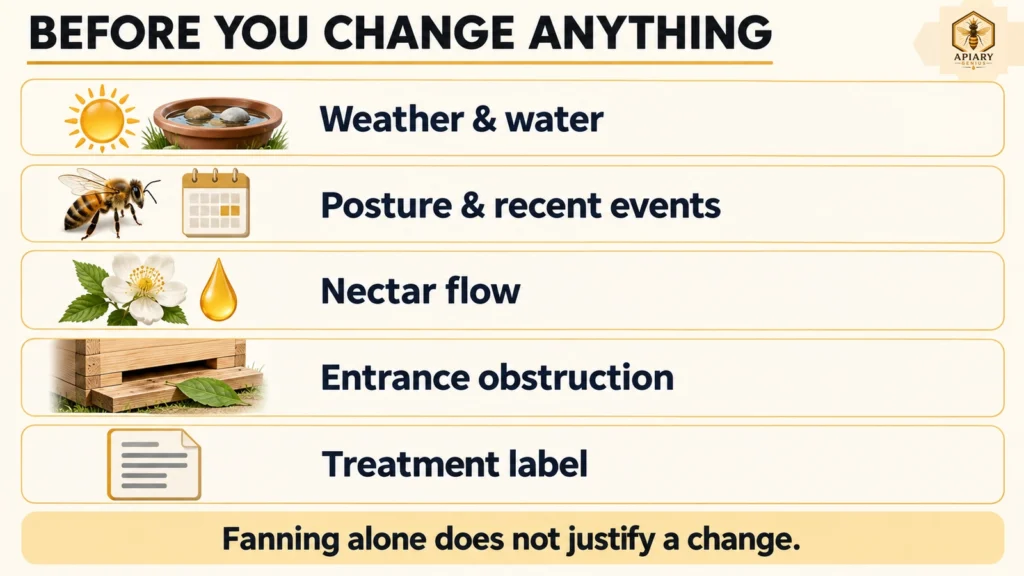
If these checks show an accessible entrance and otherwise normal activity, continued observation may be the appropriate decision.
What Not to Do
- Do not assume fanning means overheating.
- Do not assume fanning proves poor ventilation.
- Do not confuse fanning with bearding.
- Do not assume every fanning bee is releasing Nasonov pheromone.
- Do not diagnose Nasonov scenting from wing movement alone.
- Do not remove entrance reducers automatically.
- Do not drill ventilation holes because of fanning alone.
- Do not modify entrances or ventilation in conflict with treatment labels.
- Do not repeatedly open the hive just to investigate normal fanning.
- Do not treat nighttime fanning as automatically abnormal.
- Do not diagnose swarming from fanning alone.
- Do not assume one hive configuration suits every climate.
Bee-Fanning Troubleshooting Checklist
After completing the checks above, choose your next step from the overall picture:
- Accessible entrance and otherwise normal activity: continue observing.
- A specific problem such as blockage or inadequate water access: address that problem, following any current treatment-label requirements.
- Persistent unexplained distress or unusual mortality: seek local Extension or apiary-inspection help.
No single observation establishes the cause of fanning. Use the signs together rather than treating wing movement itself as a diagnosis.
FAQ
Why are bees fanning at the hive entrance?
Bees fanning at the hive entrance may be moving air for nest regulation or nectar drying, or spreading Nasonov orientation scent. Posture and recent events help interpret the behavior.
Why are bees fanning at night?
Nectar processing and internal environmental regulation can continue after sunset. Night fanning is not automatically abnormal.
How can I tell Nasonov scenting from ventilation fanning?
Look for the characteristic abdomen posture and a clearly exposed gland, then consider the context. Wing movement and body direction alone are insufficient.
Should I remove an entrance reducer if bees are fanning?
Not automatically. Check obstruction, traffic, colony strength, defense needs, weather, and current treatment instructions first.
When should bee fanning worry me?
Look more closely when it accompanies unusual mortality, persistent distress, blockage, extreme heat with poor water access, or treatment concerns. Investigate those signs rather than treating fanning itself as the problem.
Sources
- Peters, Gravish, and Combes (2017). Wings as impellers: honey bees co-opt flight system to induce nest ventilation and disperse pheromones. Journal of Experimental Biology.
- Peters, Peleg, and Mahadevan (2019). Collective ventilation in honeybee nests. Journal of the Royal Society Interface.
- Southwick and Moritz (1987). Social control of air ventilation in colonies of honey bees, Apis mellifera. Journal of Insect Physiology.
- Ellis, Nicolson, Crewe, and Dietemann (2008). Hygropreference and brood care in the honeybee (Apis mellifera). Journal of Insect Physiology.
- Seeley (1974). Atmospheric carbon dioxide regulation in honey-bee (Apis mellifera) colonies. Journal of Insect Physiology.
- Nicolson, Human, and Pirk (2022). Honey bees save energy in honey processing by dehydrating nectar before returning to the nest. Scientific Reports.
- Chemical Communication in the Honey Bee Society. Academic chapter in Neurobiology of Chemical Communication, available through NCBI Bookshelf.
- Nguyen and colleagues (2021). Flow-mediated olfactory communication in honeybee swarms. Proceedings of the National Academy of Sciences.
- U.S. Environmental Protection Agency. EPA-registered pesticide products approved for use against Varroa mites in bee hives.