
Moving a beehive is not just a lifting problem. It is also an orientation problem.
Experienced foragers have already learned where their colony is in relation to nearby landmarks and the surrounding landscape. If an established hive is moved while the old location remains within familiar surroundings, some bees may return to the original spot instead of finding the hive in its new position.
That is why learning how to move a beehive safely starts with two questions: How far is the hive moving, and will experienced foragers still recognize the area around the old location?
A hive that needs to move only a few feet can often be shifted gradually. A move across the yard may be handled gradually or with a direct move plus deliberate reorientation cues. A hive going to a distinctly different apiary can usually be moved directly, provided the colony is securely contained, adequately ventilated, kept upright, and protected from overheating during transport.
The familiar “3 feet or 3 miles” saying can be useful as a management shortcut, but it should not be treated as an absolute biological law.
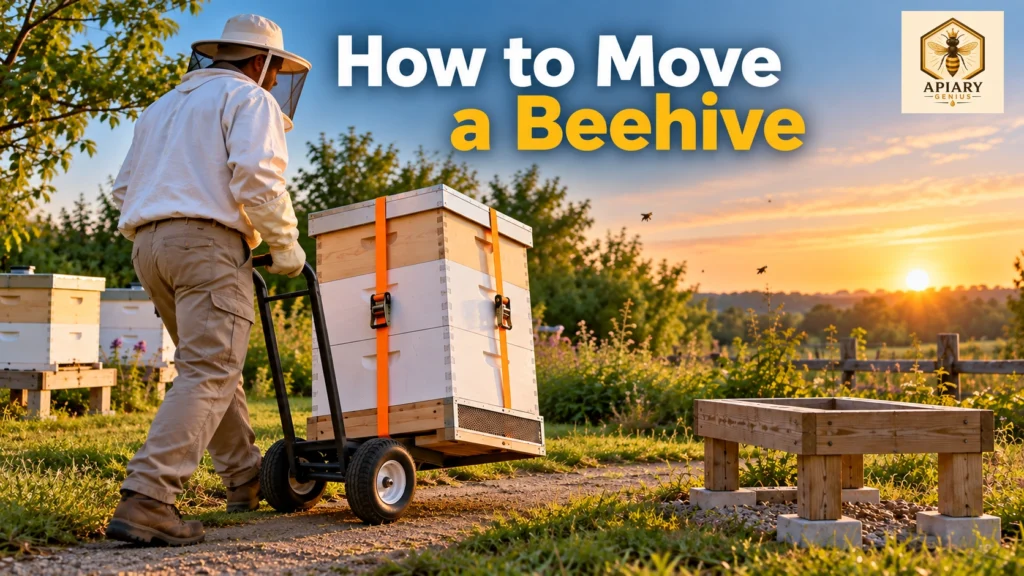
Quick Answer
If you are deciding how to move a beehive, match the relocation method to the distance and the foragers’ familiarity with the old location.
For a move of only a few feet, gradual relocation can allow returning bees to keep adjusting to the entrance’s changing position.
For a move across the yard or elsewhere within familiar surroundings, you can either move the hive gradually or move it directly and use strong visual reorientation cues, such as leafy branches or vegetation immediately in front of the entrance. Some experienced foragers may still return to the old site.
For a longer move to a distinctly different location, choose a time when most foragers are inside, control the entrance without sealing the hive airtight, secure the hive components, maintain ventilation, keep the colony upright, avoid overheating, and reopen the entrance after the hive is safely positioned.
There is no universal distance or confinement period that guarantees successful reorientation. Honey bees navigate using learned spatial information and landmarks, and published Extension guidance uses different relocation methods for different situations.
Table of Contents
Why Moving a Beehive Can Confuse Foragers
Honey bee foragers do not simply leave the hive and recognize it by chance when they return.
They learn spatial information around the colony and can use visual landmarks, landscape features, compass information, and other navigational cues to return home. During orientation flights, bees learn the immediate hive area, while experienced foragers can later use broader landscape information during navigation.
A scientific review of honey bee navigation describes the important role of landmarks and learned landscape information in helping bees locate important places, including the nest. See The Role of Landscapes and Landmarks in Bee Navigation: A Review.
That creates a problem when an established hive is moved within territory the bees already know.
The beekeeper sees a colony that has moved 20, 50, or 100 feet. An experienced forager may instead recognize the familiar surroundings and navigate toward the location she previously learned.
Not every worker is equally tied to that old location.
Younger workers that have not yet completed normal orientation and foraging flights have less location-specific experience than active foragers. Penn State Extension makes practical use of this difference in its colony-division guidance: experienced foragers return to the position they know, while younger bees that have not yet oriented are less strongly tied to that site. See Colony Division: An Easy Method to Split a Colony.
The key point is simple:
Moving an occupied hive is partly a spatial-memory problem, not merely a transportation problem.
Is the “3 Feet or 3 Miles” Rule Really a Rule?
No—not as an absolute biological rule.
“Move a hive less than 3 feet or more than 3 miles” is a traditional beekeeping shortcut. Its practical value is that it warns beekeepers about an awkward middle ground: moving the colony far enough that returning bees may miss the entrance, but not far enough to place them in obviously unfamiliar surroundings.
The numbers themselves should not be treated as hard biological thresholds.
Published Extension guidance illustrates why. Different programs describe different combinations of gradual movement, direct relocation with entrance obstructions, and temporary distant relocation. Oregon State University Extension, for example, describes several possible strategies rather than a single mandatory distance. See Moving Bee Hives — Ask Extension.
A more useful question is:
Will the old hive location still be inside surroundings that experienced foragers recognize?
Depending on the answer, reasonable strategies can include:
- gradual movement;
- a direct short-distance move with reorientation cues;
- temporary relocation to a distinctly different location before moving to the final site; or
- direct relocation to another apiary or other distant destination.
Choose the method according to the actual relocation problem—not according to a magic number.
First Decide How Far the Hive Needs to Move
Before closing the entrance or lifting the colony, place the move into a practical category.
Very short move: a few feet
If the hive only needs to shift slightly to correct stand placement, make room, or reposition it within the same apiary, gradual movement is often practical.
Short or property move
This includes moving the hive across the yard, to another side of the property, or tens or hundreds of feet while still remaining within surroundings the bees may know.
This can be the most complicated category because experienced foragers may continue navigating toward the former hive location.
Long-distance move
A move to another apiary or another distinctly different location gives the colony a new set of surroundings to learn.
Do not reduce “long distance” to one universal mileage figure. Familiar flight territory varies according to the landscape, available forage, landmarks, terrain, and the bees’ previous flight experience.
The central question is whether the new site is meaningfully different from the location experienced foragers already know.
How to Move a Beehive a Few Feet
When you need to move a beehive a short distance, gradual relocation is often the simplest approach.
Move the hive a small amount, allow returning bees to adjust to the changed entrance position, and continue toward the final location in additional steps.
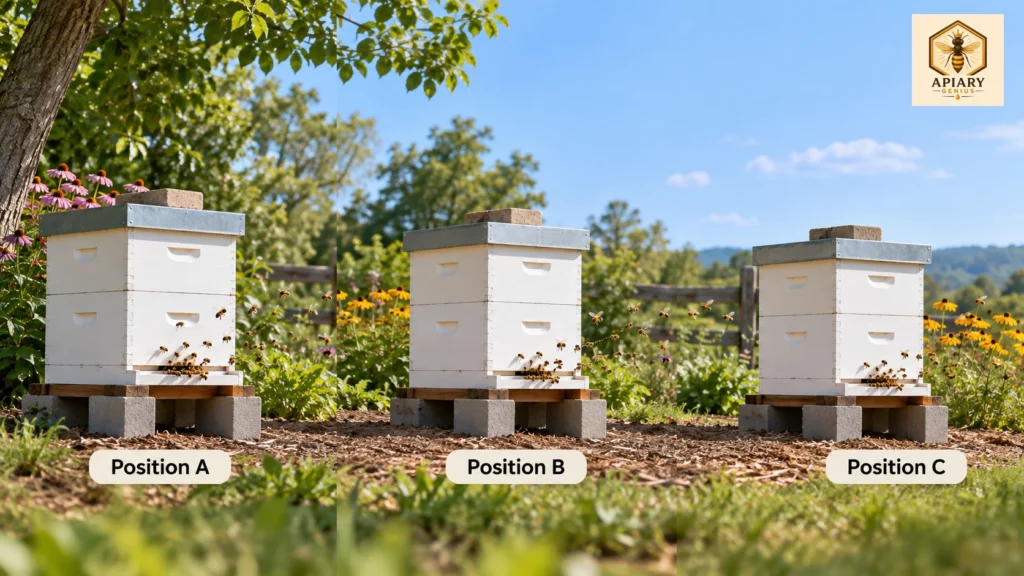
There is no need to make one exact daily distance mandatory. Extension recommendations vary, and practical success depends on the apiary layout and how readily bees are locating the entrance after each adjustment.
Oregon State Extension describes progressive movement over successive days as one workable approach. See Moving Bee Hives.
Watch both the entrance and the previous hive position as you move.
If normal traffic quickly shifts to the new entrance and few bees remain searching at the former position, the relocation is progressing well.
If large numbers repeatedly collect where the entrance used to be, the hive may be moving faster than experienced foragers are adjusting.
Gradual relocation works particularly well when:
- you are not in a hurry;
- the route between the original and final positions is clear;
- the stand can be moved safely;
- the hive does not need to cross awkward obstacles or terrain; and
- there is no urgent reason to remove the colony from its current position.
For a very short gradual move, keeping the entrance generally oriented in the same direction can also avoid introducing an unnecessary additional change.
How to Move a Beehive Across the Yard
Moving a beehive across the yard usually gives you two practical choices.
Option 1: Gradual relocation
The gradual method works the same way as it does for a shorter move: repeatedly shift the colony toward its final location while giving returning bees an opportunity to adjust.
This method takes longer, but each individual change is smaller.
Option 2: Direct relocation with reorientation cues
Sometimes gradual movement is impractical.
You may need the colony off a walkway, away from a property line, out of a work area, or on a new stand immediately.
In that situation, the hive can be moved directly and the entrance environment deliberately changed.
Leafy branches, dense vegetation, or another obvious visual obstruction can be positioned immediately in front of the entrance so exiting bees cannot simply launch into their normal flight path.
The purpose is to make them slow down, maneuver around the obstruction, and reassess the changed surroundings.
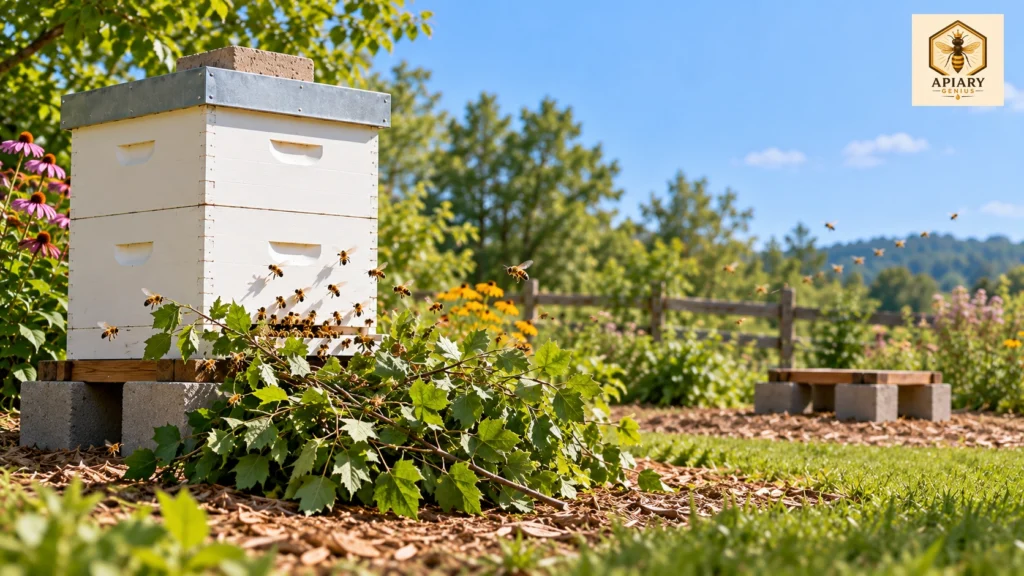
Oregon State Extension describes this type of entrance obstruction as one option for direct moves within a yard. See Moving Bee Hives.
This approach is also consistent with what is known about honey bee orientation: bees use visual information and learning flights when establishing or updating spatial memories.
But an obstruction is an aid, not a guarantee.
Some foragers may reorient quickly. Others may still return to the old location.
Do not block the entrance so heavily that normal airflow is restricted or bees are unable to leave the hive safely.
What If Bees Keep Returning to the Old Hive Location?
Monitor the original stand after any direct move within familiar surroundings.
A small number of bees searching there is not automatically a sign that the relocation has failed.
Returning foragers may circle the old site, land temporarily, or begin searching nearby for the colony.
Some may eventually find the relocated hive.
Others may repeatedly return to the old position.
How much intervention is justified depends on the scale and persistence of the problem.
If only a small number of bees are present and the accumulation is steadily decreasing, monitoring may be enough.
If a substantial cluster repeatedly forms at the former location, a temporary nuc or collection box can sometimes be used to gather returning bees. Those bees may then be reunited with the relocated colony after normal daytime flight activity has ended.
That is a corrective option—not a required step for every relocation.
Persistent large numbers of returning foragers are also useful information. They indicate that the old site remains strongly familiar and that the direct relocation did not cause complete reorientation.
Continue monitoring until significant accumulation at the former site has stopped.
Should You Move the Hive Miles Away First?
Sometimes.
One management option for an awkward short- or medium-distance relocation is a two-stage move:
original location → temporary distant location → final desired location
The biological reasoning is more important than an exact mileage number.
At the temporary site, the colony is placed in surroundings different enough that workers must learn a new location. After operating from that site for a period of time, the hive is moved again to its intended final position, where the bees encounter another changed environment and must orient again.
This method can reduce the tendency of experienced foragers to navigate directly back to the original stand.
However, there is no single scientifically universal distance or waiting period that applies to every colony.
Published Extension recommendations vary in both temporary distance and duration. That variation is one reason the “3 feet or 3 miles” saying should remain a practical heuristic rather than a biological rule.
Do not interpret a specific number from one Extension recommendation as proof that honey bees automatically forget a hive location after exactly that distance or exactly that number of days.
Temporary distant relocation is most useful when a direct move within familiar surroundings is likely to cause substantial returning-forager problems and you have access to an appropriate temporary apiary.
Choose the Time of Day Carefully
The practical goal is to have as many active foragers inside the colony as reasonably possible before the entrance is controlled and the hive is moved.
That generally makes the following periods preferable to peak daytime foraging:
- evening;
- nighttime;
- very early morning; or
- another period when few bees are actively flying.
Michigan State University Extension notes that moving colonies while bees are away foraging can leave those bees behind and reduce colony strength. See the Vegetable Pollinator Stewardship Guide.
Night movement is common, but it is not risk-free.
Honey bees do not normally conduct their usual foraging flights in darkness, but disturbed bees can still crawl, fly short distances, sting, and move toward artificial light.
Mississippi State University Extension specifically warns that bees disturbed at night may be attracted toward nearby lights and can still sting. See Prevention and Treatment of Nuisance Honey Bees Around Your Home.
Wear appropriate protective equipment and plan your lighting before working around a disturbed colony after dark.
The principle is not:
Move at night because the bees cannot sting.
It is:
Move when the greatest practical share of the colony is home, while still working safely.
Secure the Hive Before Lifting It
An occupied hive should not be transported as a loose stack of boxes.
Before lifting the colony, control the main entrance so bees cannot escape during the move while still allowing adequate airflow.
Check for unintended openings between hive components and close escape gaps that could release bees during handling or transport.
Fasten the hive bodies, supers, bottom board, and covers so they cannot separate unexpectedly.
Modern beekeepers commonly use strong ratchet straps when those are appropriate for the equipment being moved.
The entire colony should also be restrained during vehicle transport so that it cannot slide or tip.
University of Georgia Cooperative Extension recommends screening the entrance, sealing escape gaps, fastening hive components, and securing colonies during transport. See Honey Bees and Beekeeping.
The practical principle is straightforward:
The hive should move as one stable, secured unit whenever that can be done safely.
If the assembled hive cannot be lifted safely, separating boxes may be necessary. That increases the complexity of the move because each section must be contained, protected, transported upright, and reassembled correctly.
Do not dismantle the colony unnecessarily merely to make the stack easier to handle.
Ventilation Matters More Than Simply “Closing the Hive”
Controlling the entrance and sealing the hive airtight are not the same thing.
During transport you need to prevent bees from escaping without preventing airflow.
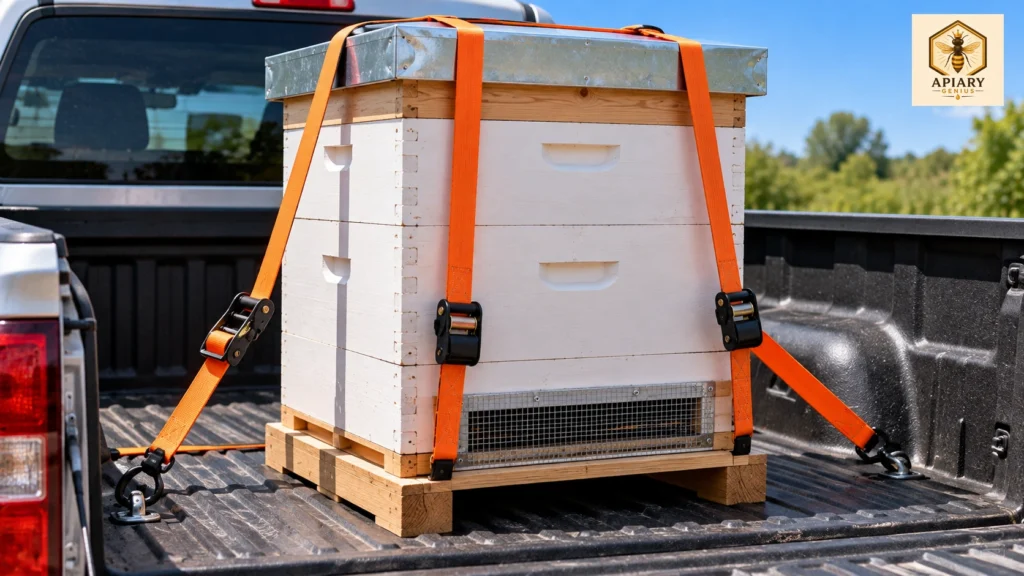
Depending on the equipment and moving method, that may involve:
- a screened entrance;
- a ventilated moving screen;
- a screened cover; or
- another secure closure that keeps bees contained while allowing air exchange.
University of California Agriculture and Natural Resources emphasizes ventilation during hive transportation and warns that colonies can overheat when poorly ventilated. See Bees in the Neighborhood: Best Practices for Urban Beekeepers.
Ventilation becomes especially important when:
- the weather is warm;
- the colony is populous;
- bees will remain confined longer than expected;
- the hive contains substantial brood;
- transportation involves an enclosed vehicle or trailer; or
- delays occur after loading.
A large colony produces and regulates substantial heat. Closing the entrance restricts normal traffic and can interfere with normal ventilation behavior.
Do not leave a closed hive sitting in a hot vehicle or trailer.
Do not assume that a tiny crack automatically provides enough airflow.
And never seal an occupied hive airtight.
Secure ≠ airtight.
Should You Move a Hive With Honey Supers On?
It depends on whether the assembled colony can be lifted and transported safely.
Honey supers can add substantial weight and make the hive taller and less stable.
That increases the difficulty of:
- lifting;
- carrying;
- loading;
- unloading;
- keeping the stack upright; and
- preventing boxes from shifting.
If the complete hive can be moved safely as one secured unit, keeping it together may simplify bee containment and reassembly.
If the colony is too heavy or unstable to move safely, boxes may need to be separated.
That makes the operation more complicated.
The beekeeper must then control escaping bees, keep individual boxes upright, protect frames and comb, secure each section during transport, and reassemble the colony promptly at the destination.
Do not rely on an arbitrary universal hive-weight limit.
Colony configuration, equipment type, honey stores, terrain, lifting equipment, and the people performing the move all affect what can be handled safely.
If lifting the entire colony risks personal injury or dropping the hive, change the lifting plan rather than forcing the move.
Keep the Hive Upright During Transport
Transport the colony on a stable surface.
Secure it so that it cannot slide during acceleration, braking, or turns.
Prevent the stack from tipping, and avoid unnecessary hard impacts.
Frames containing brood, nectar, honey, and wax comb can be damaged by rough handling, particularly if the hive tips or boxes shift unexpectedly.
University of Georgia Cooperative Extension recommends securely restraining moved colonies during transport. See Honey Bees and Beekeeping.
Before driving away, confirm three things:
- The entrance closure is still secure.
- The hive components are still fastened together.
- The entire colony is restrained from sliding or tipping.
A few seconds spent checking the load before transport can prevent a much more difficult situation later.
Set the New Site Up Before the Bees Arrive
Do not close an occupied hive and then begin deciding where the new stand should go.
Prepare the destination first.
The stand should be stable and ready to accept the colony immediately.
Before the move:
- level or stabilize the stand;
- clear the route for carrying or unloading;
- decide where the entrance will face;
- consider the bees’ flight path;
- check drainage;
- evaluate wind exposure;
- consider sun and shade;
- account for nearby people and animals;
- make sure water and normal colony needs can be met; and
- make sure you can safely access the hive for future inspections.
The best permanent entrance direction is not determined solely by the direction the hive faced before relocation.
For a short gradual move, keeping the general entrance orientation similar can reduce unnecessary change.
At a permanent new apiary, however, overall site suitability and a safe flight path take priority.
For a detailed discussion of stand placement, drainage, flight paths, wind, sun, shade, and nearby activity, see How to Choose the Best Location for a Beehive.
The destination should be ready before the colony is closed.
When Should You Open the Entrance?
Open the entrance after the hive reaches its intended position and the equipment is stable.
Before releasing the bees, confirm that:
- the colony is on its final stand;
- the hive is upright;
- the boxes are correctly aligned;
- transport restraints or closures have been checked;
- the area in front of the entrance is safe; and
- any planned reorientation cue is already in place.
There is no universal reason to keep every moved colony closed for a fixed number of days.
In warm conditions, unnecessary confinement can increase overheating risk.
UC Agriculture and Natural Resources recommends opening transported colonies after they have been safely placed at the destination. See Bees in the Neighborhood.
For a short direct move, position any leafy branches or visual obstruction before opening the entrance.
For a long-distance move, the bees can begin learning the new surroundings after the hive has been safely established.
The useful principle is:
Keep the colony contained only as long as the move requires, maintain adequate ventilation during confinement, and reopen the entrance when the hive is safely settled.
How to Encourage Reorientation
Reorientation cues are most useful when a hive has been moved within surroundings experienced foragers may still recognize.
A conspicuous temporary change immediately outside the entrance can encourage exiting bees to reassess the location.
Common examples include:
- leafy branches;
- vegetation;
- a changed entrance landmark; or
- another obvious visual obstruction positioned directly in front of the entrance.
The purpose is not to imprison the bees.
It is to interrupt their normal departure pattern and make the changed entrance environment difficult to ignore.
Honey bees naturally perform orientation and learning flights in which they view the nest and surrounding features. Scientific research shows that landmarks and broader landscape information contribute to later navigation. See The Role of Landscapes and Landmarks in Bee Navigation.
Oregon State Extension also describes vegetation or other entrance obstructions as one possible method when relocating colonies directly within a yard. See Moving Bee Hives.
Do not treat branches as a reset button.
They cannot guarantee that every experienced forager will abandon the old location.
Some bees may still return there temporarily.
Should the Entrance Face the Same Direction?
For a gradual short-distance move, keeping the entrance orientation generally similar can reduce the number of things changing at the same time.
A related principle applies when transferring an established nuc into permanent equipment.
Mississippi State University Extension recommends preserving the nuc’s entrance orientation when transferring bees into their new hive so returning foragers can more easily locate the colony. See Beginning Beekeeping in Mississippi.
That does not mean a relocated production hive must permanently face exactly the same compass direction as before.
At a new permanent site, evaluate the location as a whole.
Safe flight path, stand stability, drainage, wind exposure, sun and shade, beekeeper access, and nearby human activity may be more important than preserving the former entrance direction.
Use similar orientation when it supports a short-move strategy.
Do not make it a permanent requirement that overrides better site selection.
How to Move a Hive to Another Apiary
When deciding how to move a beehive to another apiary, the physical transport becomes more important while the old-site orientation problem usually becomes less important because the colony is entering distinctly different surroundings.
Use this sequence:
- Prepare the destination first.
Have the stand stable, accessible, and ready before closing the hive. - Choose a time when most foragers are home.
Evening, night, early morning, or another low-flight period is generally preferable to peak foraging. - Control the entrance while maintaining ventilation.
Prevent bee escape without sealing the colony airtight. - Fasten the hive components.
Hive bodies, supers, covers, and the bottom board should not be able to separate during handling. - Lift and load safely.
Do not attempt a lift that risks personal injury or dropping the colony. - Keep the hive upright.
Prevent sliding, tipping, and unnecessary impacts. - Avoid overheating and unnecessary delays.
Warm weather and prolonged confinement increase ventilation demands. - Position the colony on the prepared stand.
Confirm that the hive is stable before releasing the bees. - Open the entrance when safe.
Do not leave the colony unnecessarily confined after arrival. - Allow the bees to orient.
Expect orientation activity around the entrance as workers begin learning the new location. - Recheck the colony after the move.
Confirm that entrance activity appears normal and inspect later if colony behavior suggests a problem.
This sequence keeps the relocation focused on four priorities:
retain as many foragers as practical → secure the colony → prevent overheating → allow safe reorientation.
What If You Are Crossing State Lines?
Check current requirements before moving the colony.
Federal and state rules are not identical.
USDA APHIS currently states that it does not regulate interstate movement of honey bees within the continental United States in the same way that it regulates international importation and certain other movements.
That does not mean every interstate move is automatically unrestricted.
Individual states may have their own requirements involving:
- apiary registration;
- health or inspection certificates;
- colony inspection;
- entry documentation;
- pest or disease restrictions; or
- other movement requirements.
Hawaii and some other jurisdictions can have distinct restrictions.
As one example of state-level regulation, the Florida Department of Agriculture and Consumer Services maintains beekeeper registration and movement-related requirements that apply in specific circumstances.
Because state rules can change, do not rely on an old forum post or an outdated checklist.
Before crossing state lines, verify current requirements with:
- USDA APHIS where federal rules are relevant;
- the destination state’s department of agriculture; and
- the state apiary program or apiary inspector.
Check again close to the actual move date.
Is Winter a Better Time to Move a Beehive?
Winter can make some relocations easier, but it is not universally the best time.
Potential advantages can include:
- fewer actively flying foragers; and
- a smaller seasonal colony population in some climates.
University of Georgia Cooperative Extension notes that colonies may be easier to move during winter because populations are generally smaller and hives can be easier to handle. See Honey Bees and Beekeeping.
Cold weather creates a different set of risks.
A winter colony may be tightly clustered to conserve heat, and unnecessary disturbance can disrupt that cluster.
Avoid opening or dismantling the colony more than necessary during cold conditions.
For broader seasonal preparation, see How to Prepare Your Beehive for Winter.
If moving a colony in winter:
- have the destination fully prepared;
- handle the hive gently;
- minimize unnecessary opening;
- avoid prolonged exposure to cold wind; and
- stabilize the colony promptly at the new site.
Winter can reduce the forager-orientation complication, but it introduces cold-weather management considerations.
What About Moving a Hive During Hot Weather?
Hot weather makes ventilation and confinement time especially important.
A populous colony already produces and regulates substantial heat.
When bees are confined for transport, normal entrance traffic and ventilation behavior are restricted.
UC Agriculture and Natural Resources emphasizes the importance of ventilation during transportation and warns about overheating. See Bees in the Neighborhood.
Where possible, avoid moving the colony during the hottest part of the day.
Pay particular attention when:
- the colony is very populous;
- bees were already bearding before the move;
- the entrance will remain closed for an extended period;
- the vehicle or trailer can heat rapidly;
- the hive is exposed to direct sun while waiting; or
- delays occur after loading.
Never leave a closed hive sitting in a hot vehicle while completing unrelated tasks.
There is no useful universal temperature cutoff for every relocation.
Heat risk depends on several factors, including colony size, airflow, sun exposure, equipment, confinement time, and transport conditions.
The practical rule is:
As conditions get hotter, reduce unnecessary confinement and improve ventilation.
What About Moving a Newly Installed Nuc?
A newly installed nuc can have different orientation dynamics from a long-established production colony.
Some workers may already be experienced foragers that learned the nuc’s previous entrance location, while younger workers may have less attachment to it.
When transferring an established nuc into permanent equipment at the same site, preserving the entrance position and general orientation can help returning bees locate the colony.
Mississippi State University Extension specifically recommends orienting the permanent hive entrance in the same direction as the nuc entrance during installation. See Beginning Beekeeping in Mississippi.
If the nuc itself must be moved elsewhere, the same basic relocation questions apply:
- How familiar is the old location?
- How many workers have already oriented there?
- Is the nuc moving a few feet, across the property, or to another apiary?
For complete package and nuc installation procedures, see How to Install Package Bees or a Nuc: A Step-by-Step Guide.
What Not to Do
Avoid these common mistakes when moving a beehive:
- Do not treat “3 feet or 3 miles” as an absolute biological law.
- Do not move a hive during peak foraging by default if retaining as many foragers as practical matters.
- Do not close an occupied hive airtight.
- Do not transport loose or unsecured hive boxes.
- Do not assume branches or vegetation guarantee successful reorientation.
- Do not keep bees confined for a fixed number of days without a specific reason and adequate ventilation.
- Do not leave a closed colony in a hot vehicle or trailer.
- Do not forget to reopen the entrance after arrival.
- Do not ignore large numbers of bees repeatedly returning to the old hive location.
- Do not move a heavy colony in a way that risks personal injury or dropping the hive.
- Do not cross state lines without checking current requirements.
- Do not use this article as a guide for removing bees from walls, trees, roofs, buildings, or other structural cavities.
Structural colony removal, cut-outs, swarm capture, and trap-outs are different reader needs and require different procedures.
Practical Beehive-Moving Checklist
Before relocating an occupied hive, work through these questions in order:
- How far is the hive moving?
- Is the old site still within familiar flight territory?
- Will the relocation be gradual or direct?
- Is the final stand ready?
- Are most active foragers home?
- Is the entrance securely controlled?
- Is ventilation adequate?
- Are the boxes and covers secured together?
- Can the hive remain upright during handling and transport?
- Can the colony be protected from excessive heat?
- Are reorientation cues appropriate for this move?
- Will the old location be monitored afterward?
- If crossing state lines, have current requirements been checked?
- After arrival, has the entrance been reopened and is colony behavior returning to normal?
If the answer to a safety-critical question is no—especially ventilation, load stability, lifting safety, or transport security—correct that problem before moving the hive.
FAQ
How far can you move a beehive at one time?
There is no universal distance that applies to every relocation.
A hive can physically be moved a few feet or transported many miles, but the correct management method depends on whether experienced foragers will still recognize the old surroundings.
Very short moves can often be made gradually. Moves within familiar territory may cause some bees to return to the former stand. A move to a distinctly different location generally requires the colony to learn a new site.
Is the 3 feet or 3 miles rule true?
It is better treated as a traditional rule of thumb than an absolute biological law.
The saying highlights the fact that intermediate moves can confuse experienced foragers, but there is no exact distance at which every honey bee colony automatically forgets its previous location.
Different Extension programs describe different relocation distances and procedures, which is another reason not to treat the numbers as strict biological thresholds.
Can I move a beehive 20 feet?
Yes.
Twenty feet can still be far enough for experienced foragers to return to the old stand while remaining inside surroundings they recognize.
You can move the colony gradually, or move it directly when most foragers are home and use strong reorientation cues such as leafy branches at the new entrance.
Monitor the former location afterward.
Can I move a beehive across my yard?
Yes.
Gradual relocation and direct relocation with deliberate reorientation cues are both practical approaches.
A direct move is faster, but some experienced foragers may still return to the old location.
If many bees repeatedly accumulate there, continue monitoring and use corrective collection only if the number of returning bees justifies it.
Will bees return to the old hive location?
Some may.
Experienced foragers can use learned landmarks and spatial information to navigate toward the location they previously knew.
The risk is greatest when the hive moves within familiar surroundings rather than into a distinctly different landscape.
Younger workers that have not yet oriented are less strongly tied to the former location.
Should I move a beehive at night?
Night is commonly used because most foragers are likely to be inside the hive.
Evening or very early morning can serve the same general purpose.
Night movement does not eliminate sting risk. Disturbed bees can still crawl, sting, and may move toward artificial lights.
Use appropriate protective equipment and plan lighting carefully.
How do I get bees to reorient after moving a hive?
For a short-distance move, place an obvious temporary visual obstruction such as leafy branches or vegetation immediately outside the entrance.
The goal is to make exiting bees slow down and reassess the changed surroundings.
This can encourage orientation behavior, but it does not guarantee that every forager will stop returning to the old site.
Should I block the hive entrance after moving it?
The entrance should be controlled during transport so bees cannot escape, but the colony must still receive adequate airflow.
After the hive is stable at the destination, unnecessary prolonged confinement is generally not the goal.
For short moves, placing leafy branches outside an open entrance is different from sealing the colony inside.
How long should bees stay at a temporary location before moving back?
There is no universal duration that applies to every colony.
Published Extension recommendations vary.
The purpose of the temporary location is to place the colony in sufficiently different surroundings and allow the bees to operate and orient there before the second move.
Do not treat one specific number of days as a biological requirement for every hive.
Can I move a beehive in winter?
Yes.
Winter can reduce the number of actively flying foragers and may involve a smaller colony population in some climates.
However, cold-weather movement can disturb the winter cluster.
Keep the move controlled, avoid unnecessary opening or dismantling, and have the destination prepared in advance.
Can I transport a beehive in a car or truck?
A truck or trailer can be used when the hive is secured upright, prevented from sliding or tipping, adequately ventilated, and contained so bees cannot escape.
An enclosed passenger vehicle creates additional escape and overheating concerns.
Whatever vehicle is used, do not leave a closed colony sitting in a hot vehicle.
Do I need permission to move bees across state lines?
Possibly.
USDA APHIS currently states that it does not regulate interstate movement of honey bees within the continental United States in the same way it regulates international importation, but states can impose their own registration, inspection, health-certificate, entry, pest, or disease requirements.
Hawaii has distinct restrictions.
Before moving bees across state lines, check current USDA APHIS information and the destination state’s agriculture or apiary authority.
Sources
- The Role of Landscapes and Landmarks in Bee Navigation: A Review — Insects / PubMed Central
- Colony Division: An Easy Method to Split a Colony — Penn State Extension
- Moving Bee Hives — Ask Extension / Oregon State University Extension response
- Vegetable Pollinator Stewardship Guide — Michigan State University Extension
- Bees in the Neighborhood: Best Practices for Urban Beekeepers — University of California Agriculture and Natural Resources
- Honey Bees and Beekeeping — University of Georgia Cooperative Extension
- Beginning Beekeeping in Mississippi — Mississippi State University Extension
- Prevention and Treatment of Nuisance Honey Bees Around Your Home — Mississippi State University Extension
- Honey Bees and Other Bees — USDA APHIS
- Beekeeper Registration — Florida Department of Agriculture and Consumer Services